Some days, depression doesn't look dramatic. It looks like staring at the laundry too long, cancelling plans in a place as beautiful as Penticton because you can't gather the energy, or telling yourself you should be able to “push through” while everything feels heavier than it should. If that's where you are, you're not failing. You're dealing with something real, and reaching for help can feel hard precisely because depression so often drains the motivation needed to seek support. For more information, see our Penticton depression counselling.
"Finding depression counselling in Penticton that works for you involves understanding your options, knowing what to look for in a therapist, and taking small, manageable steps to connect with the right support." For more information, see our counselling in Penticton.
A lot of people also wonder whether what they're feeling is “serious enough” to count. Often, that question comes up when someone is still functioning on the outside but struggling internally. If that sounds familiar, it may also help to read about exploring mental health in weight loss, because emotional strain often shows up in parts of life that don't look like “mental health issues” at first glance.
Taking the First Step Toward Feeling Better
Starting therapy rarely begins with certainty. More often, it starts with a quiet thought like, “I can't keep doing this alone,” followed by doubt, guilt, and second-guessing.
That emotional tug-of-war is common. Depression can make even simple decisions feel too big. Looking up counsellors, sending an email, answering a callback, showing up to a first appointment. Each one can feel like a lot when you're already worn down.
When you don't feel sick enough
Many people wait because they think counselling is only for crisis, deep despair, or a complete inability to function. But depression doesn't always arrive in one obvious form. It can show up as irritability, numbness, disconnection, sleeping too much, sleeping too little, losing interest in people you care about, or feeling like your life has gone flat.
You don't need to prove that you're struggling before you deserve support.
You are allowed to ask for help before things get worse.
In Canada, there's also a real gap between needing care and receiving it. Statistics Canada reports that 58.8% of people with a mood disorder felt they needed counselling, while only 43.8% received it, according to Statistics Canada's reporting on access to mental health support. If finding help has felt harder than it should, you're not alone. The system itself can be difficult to access.
What the first step actually looks like
The first step doesn't have to be dramatic. It might be:
- Saving one therapist's webpage so you can come back later
- Writing a draft email without sending it yet
- Telling one trusted person that you've been having a hard time
- Booking a consultation instead of committing to ongoing therapy right away
If your energy is low, aim for movement, not perfection. One small action counts.
Understanding What Works in Depression Counselling
People often ask whether therapy “works,” but that question can feel vague. A more helpful question is this: what does effective depression counselling look like in real life?
It usually feels less like receiving advice and more like having structured support. You talk with someone trained to notice patterns, understand what may be feeding the depression, and help you respond in ways that create change over time.
Different approaches can help in different ways
Not all therapy feels the same. That matters, because “good therapy” isn't one single method.
Here are a few approaches people often encounter:
- Cognitive Behavioural Therapy or CBT helps you notice the link between thoughts, feelings, and actions. If depression tells you, “Nothing matters, so why bother,” CBT works with that loop directly.
- Behavioural activation focuses on action before motivation. This can be especially helpful when depression leaves you waiting to feel better before doing anything, even though small actions often help first.
- Person-centred therapy emphasizes being fully heard without judgment. For some people, that sense of emotional safety is what allows deeper work to begin.
- Trauma-informed care matters when depression overlaps with past trauma, grief, chronic stress, or feeling constantly on guard. It helps therapy move at a pace that feels safe rather than overwhelming.
Progress should be tracked, not guessed
A common fear is spending months in therapy and not knowing whether it's helping. That's a reasonable concern.
A meta-analysis of psychotherapy for adult depression found that about one-third of clients experienced remission, according to this review of psychotherapy outcomes for adult depression. That's encouraging, but it also means not everyone responds to the first approach. Good care pays attention to that.
Practical rule: ask how progress will be measured, not just how sessions are scheduled.
A thoughtful counsellor may use simple check-ins or a validated tool such as the PHQ-9 at the start of therapy and again after several sessions. The point isn't to reduce you to a score. The point is to notice early whether the work is moving in the right direction.
What “working” often feels like
Therapy that's helping doesn't always feel dramatic. Sometimes it looks like:
| Sign | What it may feel like |
|---|---|
| More clarity | You can name what you're feeling instead of just feeling lost in it |
| Less avoidance | Tasks still feel hard, but you're less stuck |
| More self-compassion | Your inner voice gets a little less harsh |
| Better patterns | Sleep, routines, boundaries, or communication begin to improve |
You don't need instant relief to know something useful is happening. Often, the earliest sign is this: you feel a bit more understood, and a bit less alone.
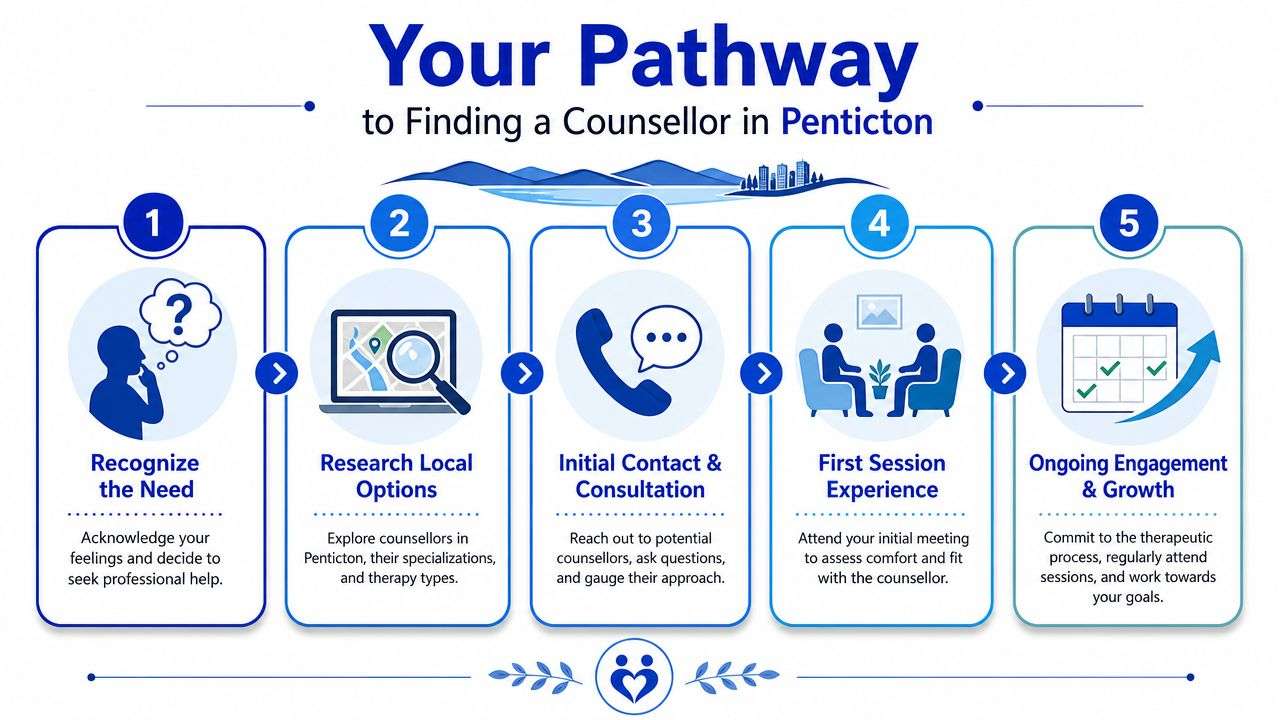
Your Pathway to Finding a Counsellor in Penticton
Searching for a counsellor can stir up a strange mix of hope and dread. Hope that someone might help. Dread that you'll say the wrong thing, choose the wrong person, or get overwhelmed before you even begin.
A step-by-step approach helps because it turns one big emotional task into several smaller practical ones.
Step one is giving yourself permission
Before you search for anyone, pause there. Permission matters.
You do not need to wait until you're falling apart. You do not need a perfect explanation for why you want support. You only need enough honesty to say, “Something isn't working, and I want help.”
Start with regulated, professional directories
If you're not sure where to look, begin with professional bodies and established counselling websites that clearly list credentials, approaches, and contact details. That gives you a safer starting point than random online searching.
As you sort through options, it can help to spend a few minutes learning about counselling services so you can compare what different providers mean when they describe support for depression.
One local option people may come across is Interactive Counselling, which offers in-person, phone, and secure virtual therapy and describes support for depression among its services. The important part is not choosing the first name you see. It's choosing someone whose approach fits your needs.
Make first contact simple
You don't need a polished message. A short email is enough.
You could write:
“Hi, I'm looking for support for depression and low mood. I'm hoping to learn whether you have experience with this and whether your approach might be a fit for me.”
That's plenty.
If calling feels easier, you can keep a few notes beside you:
- What you're seeking such as depression support, grief, trauma, burnout, or post-accident stress
- What format you need such as in-person, phone, or virtual
- What availability matters such as evenings or weekends
- Any practical concerns such as insurance, accessibility, or ICBC-related counselling
Expect some persistence to be part of the process
Unfortunately, finding care is not always quick. As noted earlier, there is a national gap between needing counselling and getting it. That's why not hearing back right away, being placed on a wait-list, or needing to contact more than one provider doesn't mean you're doing anything wrong.
Try this approach instead:
- Choose three names at once rather than waiting on one reply.
- Send the same basic message to each.
- Keep a simple note of who replied and what they offered.
- Book one consultation instead of researching endlessly.
That last point matters. Endless searching can become its own form of avoidance when you're anxious or low.
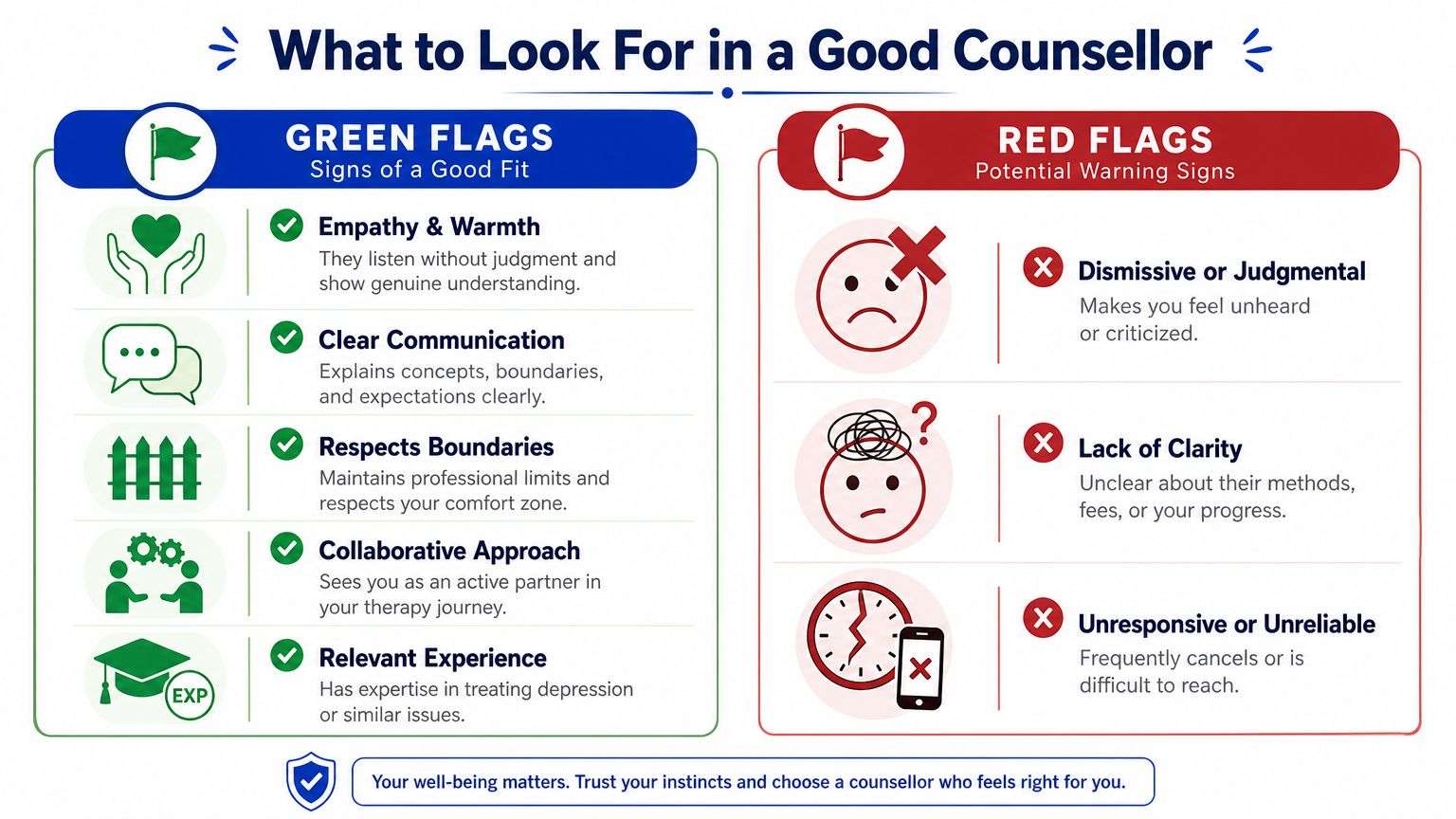
What to Look For in a Good Counsellor
Credentials matter, but fit matters too. A counsellor can be well trained and still not feel right for you. That isn't a failure. It's information.
The best therapeutic relationships usually feel both safe and active. Safe enough that you can be honest. Active enough that therapy doesn't drift.
Green flags that often matter early
In the first few sessions, notice how you feel in the room, on the phone, or on video.
Good signs often include:
- You feel heard instead of rushed, corrected, or analysed too quickly
- They explain their approach clearly so you know what therapy will involve
- They welcome your questions rather than acting like you should already understand the process
- They collaborate with you on goals instead of deciding everything for you
- They respect pacing especially if your depression overlaps with grief, chronic pain, alcohol use, or post-accident stress
That last point matters because depression doesn't always present as classic sadness. It can be tangled up with other experiences, and effective counselling often depends on finding someone who understands that complexity. Research from Canada has also found lower rates of adequate care among men and younger people, as described in this Canadian study on minimally adequate treatment for major depression.
Red flags worth paying attention to
A first session can feel awkward. That alone is not a red flag. But some things are worth noticing.
Be cautious if a counsellor:
- Dismisses your concerns or minimizes what you're describing
- Talks much more than they listen in a way that leaves little room for you
- Uses a one-size-fits-all tone and doesn't adapt to your circumstances
- Stays vague about process so you never understand what you're doing together
- Pushes too hard, too fast when you've said you need a slower pace
If you leave a session feeling unseen, confused, or subtly judged, trust that information.
Fit is not the same as comfort all the time
A good fit doesn't mean therapy always feels easy. Sometimes a strong counsellor asks difficult questions or helps you confront patterns you'd rather avoid. The difference is that you still feel respected while doing hard work.
That's a useful test. You may feel stretched, emotional, or tired after a productive session. You should not feel shamed, handled, or pushed past your limits.
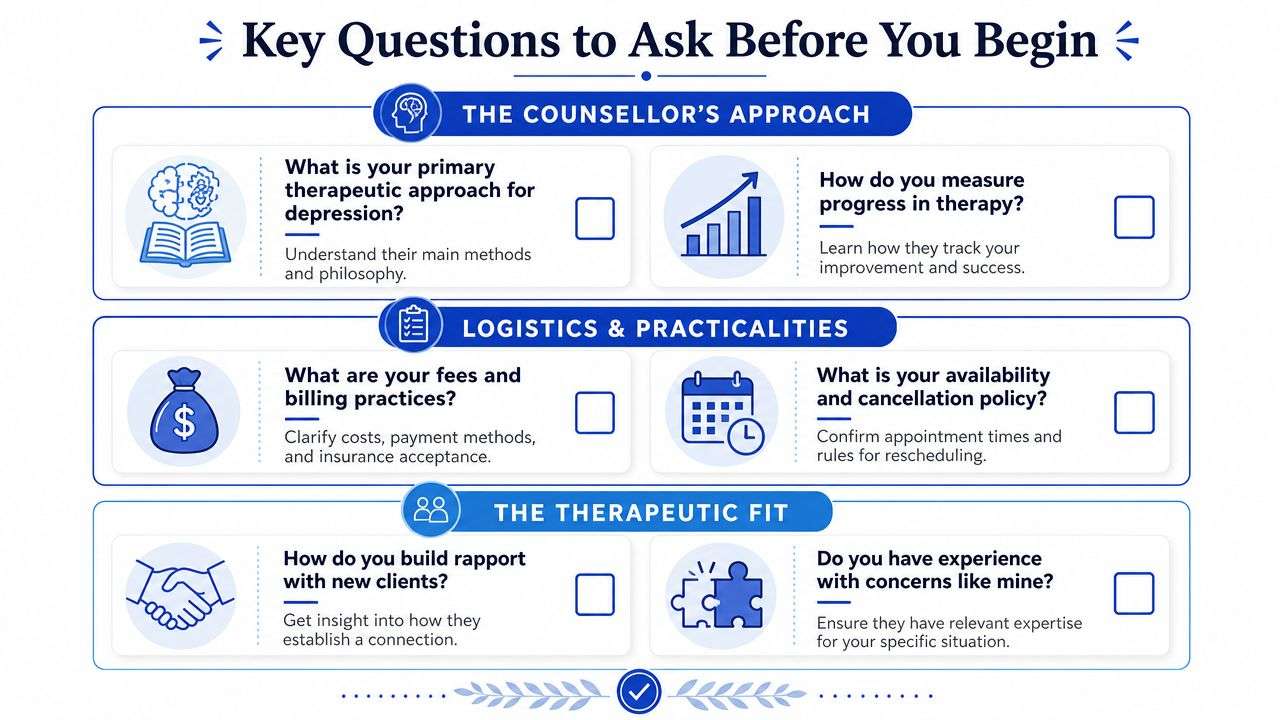
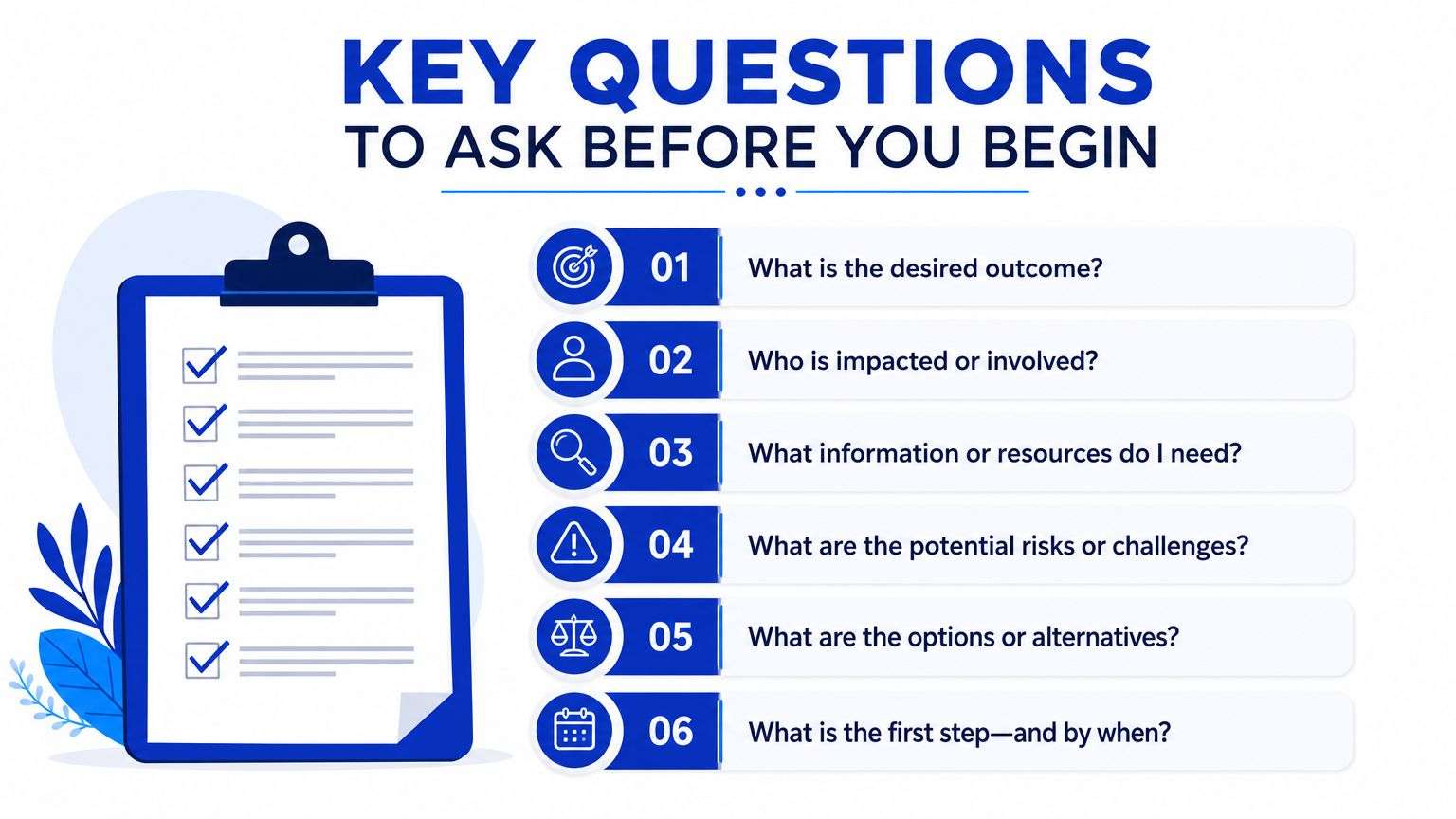
Key Questions to Ask Before You Begin
When you speak with a potential counsellor, you're not interrupting their work by asking questions. You're doing exactly what a thoughtful client should do. This is a professional relationship, and you deserve clear information before you begin.
A short consultation can tell you a lot if you ask the right things.
Questions about their approach
You don't need therapy jargon. Plain language is better.
Ask things like:
- How do you usually work with depression
- What does the first few sessions typically look like
- How do you measure progress in therapy
- What do you do if someone isn't improving
You're listening for clarity here. A good answer should make sense to you. If the explanation feels foggy or overly abstract, that may not be the right fit.
Questions about practical details
Logistics shape whether therapy is sustainable. A great counsellor on paper won't help much if the format or timing doesn't work for your life.
Ask about:
- Session format such as in-person, phone, or secure virtual appointments
- Availability including whether they offer evening or weekend appointments
- Cancellation policies so you know what happens if you're unwell or overwhelmed
- Billing and receipts if you plan to use extended health benefits
- Relevant systems such as ICBC-funded counselling if that applies to you
This matters in Penticton because public mental health access is often structured around standard weekday hours. Interior Health's Penticton Mental Health & Substance Use service lists hours of Monday to Friday, 8 a.m. to 4 p.m., as shown on the Interior Health Penticton service page. If you work, parent, commute, or care for others during those hours, flexible scheduling becomes more than a convenience. It becomes part of access.
Questions about fit and experience
You don't need to interrogate someone. But you do want enough information to know whether they understand what you're dealing with.
Consider asking:
| Question | Why it helps |
|---|---|
| Have you worked with concerns like mine before | Helps you gauge relevant experience |
| How do you build trust with new clients | Gives you a sense of their style |
| How active are you in sessions | Helps you tell whether they're more reflective, structured, or skills-based |
| What if I'm not sure how to talk about what's wrong | Reveals how they support people who feel shut down or overwhelmed |
A note you can use before a consultation
If your mind goes blank under stress, write this down and read it during the call:
“I've been dealing with low mood and I'm looking for support. I'd like to know how you work, what availability you have, and whether you think we might be a good fit.”
That's enough to begin.
If You Need Support Right Now
If you feel at risk of harming yourself, can't stay safe, or feel in immediate danger, seek emergency help now. Call 911 or go to your nearest emergency department.
If you need urgent emotional support, you can contact 988 in Canada for suicide crisis support, available any time by call or text. If you're in British Columbia and need immediate mental health support, you can also call 310-6789 without an area code to connect with crisis line services in the province. If speaking feels hard, ask someone you trust to stay with you while you call.
Common Questions About Starting Therapy
How long does depression counselling usually take
It depends on what's contributing to the depression, how long you've been struggling, and what kind of support you need. Some people benefit from short-term, focused work. Others need a longer process, especially if depression overlaps with trauma, grief, chronic stress, or relationship strain.
A good therapist should be able to talk with you about goals, pace, and how you'll know whether therapy is helping.
What if I don't feel a connection with my counsellor
That happens sometimes, and it's okay. A poor fit doesn't mean therapy won't help. It may only mean that this particular relationship isn't the right one.
If you can, say so directly. You can ask to adjust the approach, or you can choose someone else. You are allowed to be selective.
Is everything I say confidential
Counselling is private, but confidentiality has limits. Therapists should explain those limits clearly at the start. The main exceptions usually involve immediate safety concerns, protection of children, or legal requirements.
If you're unsure, ask directly in the first conversation. A clear answer is a good sign.
How do I know if I'm depressed enough for counselling
If your mood, energy, motivation, sleep, self-worth, or ability to cope has changed in a way that concerns you, that's enough reason to reach out. You do not need to wait until things are unbearable.
Often, the best time to start is when part of you is already wondering whether you should.
If you'd like to keep reading in a calm, practical way, Interactive Counselling offers information about depression support and related counselling options that may help you decide what kind of care fits your situation.
Clinically Reviewed By
Amy Mosset, MCP, RCC-S
Amy Mosset is a Master Practitioner in Clinical Counselling, Clinical Supervisor, and the owner of Interactive Counselling. She provides trauma-informed, evidence-based care and clinical supervision to registered therapists, with a focus on ethical practice, client safety, and high-quality therapeutic outcomes.