When an affair comes to light, most couples don't feel clear or calm. They feel shocked, sick, angry, numb, desperate for answers, and unsure whether one more conversation will help or make everything worse. If that's where you are right now, you're not failing. You're in the early stage of a relational crisis, and the first task isn't to “fix everything.” It's to slow the damage, protect emotional safety, and decide what kind of help you need next. For more information, see our Kelowna couples counselling.
"Rebuilding trust after an affair with couples counselling in Kelowna is possible for many couples, but it works best when therapy creates safety, honesty, accountability, and clarity about whether staying together is truly healthy." For more information, see our counselling in Kelowna.
For many couples, there is real reason for hope. One Canadian-oriented summary notes that about 60% to 80% of couples who enter therapy after infidelity can successfully rebuild trust, and one cited study found 74% recovered after therapy, while only about 15.6% survive without professional help, which is why counselling is often viewed as a high-impact intervention rather than a last resort. For more information, see our couples counselling.
The First Steps in the Aftermath of an Affair
The first days after discovery are often chaotic. One partner may want every detail immediately. The other may feel shame, panic, or a strong urge to defend, explain, or shut down. Neither reaction means healing is impossible, but this is the stage where couples often make the situation worse by trying to force resolution before there is any stability.

Slow the crisis first
In the immediate aftermath, focus on three actions.
Create a pause around major decisions.
If possible, don't decide tonight whether the relationship is over forever, whether someone needs to move out permanently, or whether forgiveness has happened. Temporary space is different from a final decision. People in shock often speak in absolutes they don't yet mean.Set short-term rules for contact and conflict.
That can mean agreeing not to argue in front of children, not to interrogate at midnight, not to use alcohol during discussions, and not to leave threatening messages or texts. If emotions are too high, use time-limited breaks and return to the conversation later.Protect basic functioning.
Sleep, food, hydration, work coverage, childcare, and support from one trusted person all matter. Betrayal often affects the body as much as the mind. If you're barely eating or sleeping, your ability to think clearly will drop fast.
Practical rule: In the first 72 hours, aim for containment, not closure.
What usually makes things worse
Some responses feel understandable but often deepen the injury.
- Demanding endless detail right away can flood both partners and create more trauma than clarity.
- Minimizing the affair with phrases like “it meant nothing” or “can't we just move on?” usually increases pain.
- Premature forgiveness doesn't create trust. It often creates pressure and resentment.
- Using the children as messengers or allies damages the family system and makes later repair much harder.
What helps in these first conversations
Try short, structured exchanges instead of marathon talks.
- Use time limits: Twenty to thirty minutes is often enough at first.
- Stick to one topic: For example, “What do we need tonight so we can both sleep safely?”
- Name what's true: “I'm overwhelmed.” “I need a break.” “I'm not ready to answer that fully yet, but I will in therapy.”
If the affair is still ongoing, or if one partner feels unsafe, the priority shifts. Repair cannot begin while harm is continuing.
Understanding the Three Phases of Therapeutic Repair
Many couples imagine counselling after infidelity as a room where two people repeat painful arguments with a witness. Good therapy is much more structured than that. The process is usually organised around a clear sequence: stabilize the crisis, understand the injury, then build a new pattern of connection.
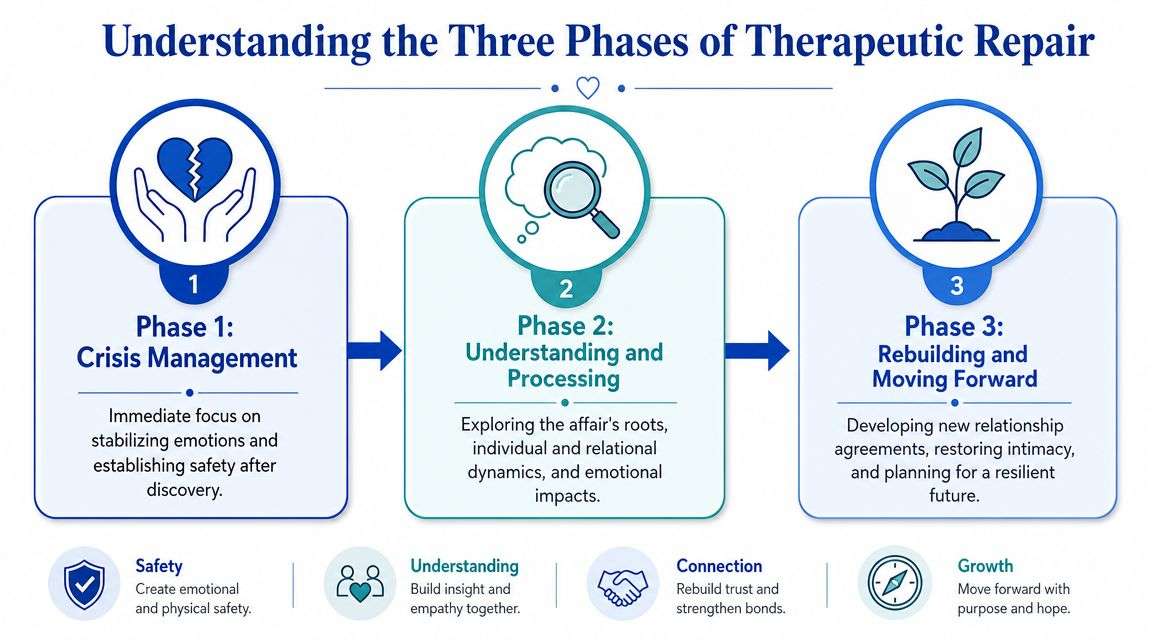
A widely used framework describes three phases of affair recovery in couples counselling: first, stabilizing the crisis and acknowledging the betrayal; second, exploring the meaning of the affair and repairing attachment injury; and third, restoring connection through repeated repair and new interaction patterns. Emotionally Focused Therapy models explicitly use this structure.
Phase one is crisis and safety
At the start, therapy helps slow escalation. The therapist is not trying to push quick forgiveness or force mutual blame. The job is to establish enough steadiness that the couple can talk without causing fresh damage every session.
This phase often includes:
- Acknowledging the betrayal clearly without vague language
- Stopping ongoing harm if the affair or secrecy is still active
- Setting boundaries for communication between sessions
- Helping both partners regulate emotion so conversations become possible
For the betrayed partner, this phase often means having the pain taken seriously. For the involved partner, it means learning that remorse has to be shown in behaviour, not just stated.
Phase two is meaning and deeper understanding
Once the crisis is less explosive, therapy turns toward the questions underneath the event. This is not about excusing the affair. It is about understanding how it happened, what vulnerabilities were present, how the betrayal affected attachment, and what each partner now needs to feel safe and known.
The question is not only “Why did this happen?” It is also “What now has to change so it doesn't happen again?”
This phase may involve grief, shame, anger, and repeated revisiting of the injury. That's normal. Couples often need help tolerating these conversations without either collapsing into blame or fleeing into defensiveness.
Phase three is repair and a different relationship
Trust is not restored by saying “we're moving on.” It returns when the relationship starts to function differently in observable ways.
In this stage, couples work on:
| Focus | What it looks like |
|---|---|
| Repair attempts | One partner notices hurt sooner and responds instead of withdrawing |
| New agreements | Clear boundaries around phones, contact, travel, or disclosure |
| Connection | More honest conversations, less mind-reading, more direct requests |
| Future resilience | A plan for what to do when triggers or setbacks appear |
This final phase isn't about getting back to the old relationship. In healthy recovery, the old relationship is gone. The work is to build one that is safer, more truthful, and more resilient than what existed before.
The Core Work of Rebuilding Honesty and Connection
Between sessions, the work is less dramatic than many couples expect. It is repetitive, observable, and often uncomfortable. Trust starts to return through patterns your nervous systems can recognize as safer.
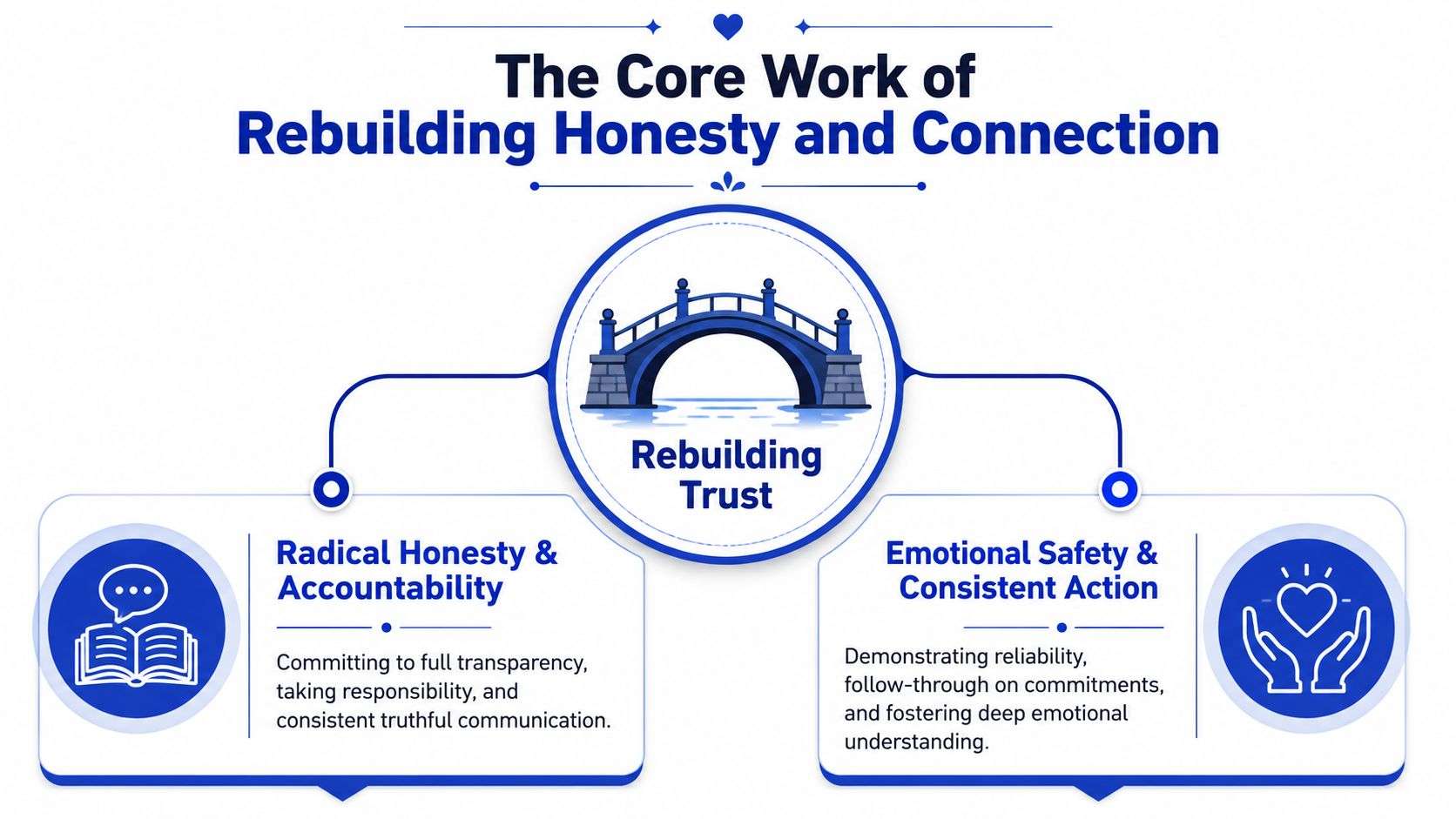
Accountability has to be specific
An apology matters, but it is rarely enough on its own. The injured partner is usually listening for signs that the full reality can be faced without distortion, defensiveness, or pressure to forgive before they are ready.
Specific accountability often includes:
- Naming the betrayal plainly: “I broke trust” lands differently than vague language about a bad period or poor judgment
- Answering agreed questions truthfully: no partial disclosures, strategic omissions, or changing versions of the story
- Making room for the impact: grief, anger, disgust, confusion, and numbness may all show up, sometimes in the same day
- Tolerating a long repair process: rebuilding is often slower than the unfaithful partner hopes and more uneven than either person expects
This part has a real trade-off. The more direct the honesty, the more discomfort there may be in the short term. Yet vague reassurance usually keeps the wound open.
Transparency needs a purpose
Many couples struggle here because transparency can slip into surveillance, and surveillance does not create trust. In early recovery, temporary openness works best when both partners understand why it is being asked for, what it includes, and when it will be reviewed in therapy.
That can look like:
- Sharing schedules in advance
- Explaining changes in plans promptly
- Disclosing any contact or attempted contact with the affair partner
- Following through on agreed boundaries around devices, travel, or social settings
Consistency matters more than grand gestures. A week of openness followed by secrecy or irritation often resets the fear.
It is also important to say this clearly. If one partner uses “transparency” to control, intimidate, or punish, the work shifts. Therapy may need to focus on safety, boundaries, or whether reconciliation is appropriate at all.
Connection is rebuilt in ordinary moments
Couples often expect trust to be repaired in one big conversation. In practice, it is rebuilt in dozens of small exchanges. A clear text when plans change. A calm answer to a hard question. A willingness to stay present when your partner is triggered instead of arguing about whether they should still be upset.
In therapy, I often help couples work on skills at ground level because that is where repair either holds or falls apart.
Helpful patterns include:
- Starting hard conversations without accusation: “I felt a spike of panic when you were late” is easier to hear than “You're doing it again”
- Responding to pain before explaining: understanding the hurt first often prevents the discussion from turning into a debate
- Catching escalation early: taking a pause, lowering your voice, or restating what you heard can stop another injury from forming
- Making direct requests: asking clearly for reassurance, space, or information reduces guesswork and resentment
“Trust grows when words and actions match consistently enough that the relationship starts to feel predictable again.”
Sometimes this work leads to reconciliation. Sometimes it leads to a different kind of clarity. If honesty keeps breaking down, if empathy never develops, or if the relationship becomes less safe rather than more open, therapy should help you face that too. The goal is not to preserve a relationship at any cost. The goal is to build enough truth that you can decide, with clear eyes, what is healthy from here.
What to Expect from Couples Counselling Sessions in Kelowna
For many couples in Kelowna, the hardest part is not the therapy itself. It's making the first contact while everything still feels raw. People worry they'll be judged, pushed to stay together, or made to defend themselves before they're ready.
A typical start is much more grounded than that. You reach out, share a brief description of what's happening, and book an initial session. Depending on the practice, you may be offered in-person, phone, or secure virtual options, which can be useful if one or both of you feel too activated to sit in the same office at first.
The first session often feels like this
The therapist will usually ask what happened, where things stand now, and whether there are any immediate concerns around safety, ongoing contact with the affair partner, extreme conflict, or emotional volatility. The focus is not on deciding who is the “bad one.” It is on understanding the crisis clearly enough to decide what kind of support fits.
You can expect the therapist to watch for a few things:
- Readiness for joint work
- Whether both partners can participate without intimidation or shutdown
- Whether individual support is needed alongside couples work
- Whether the immediate task is repair, stabilisation, or decision-making
In-person and virtual each have advantages
Some couples prefer an office setting because it contains the conversation. They can talk, leave, and not continue the fight in the kitchen five minutes later.
Others do better virtually. It can reduce travel stress, make scheduling easier, and allow each partner to join from a space where they feel more regulated.
A good therapist isn't there to take sides. They're there to keep the process honest, safe, and useful.
Before the first appointment, it helps to write down three things: what happened, what feels most urgent now, and what each of you wants help deciding.
Healing Timelines Milestones and Navigating Setbacks
Three months after disclosure, many couples are shocked by how raw it still feels. One partner is asking, "Why am I still thinking about this every day?" The other is wondering whether anything they do will ever be enough. That stage is common. It does not mean therapy is failing, and it does not automatically mean the relationship can or should be saved.
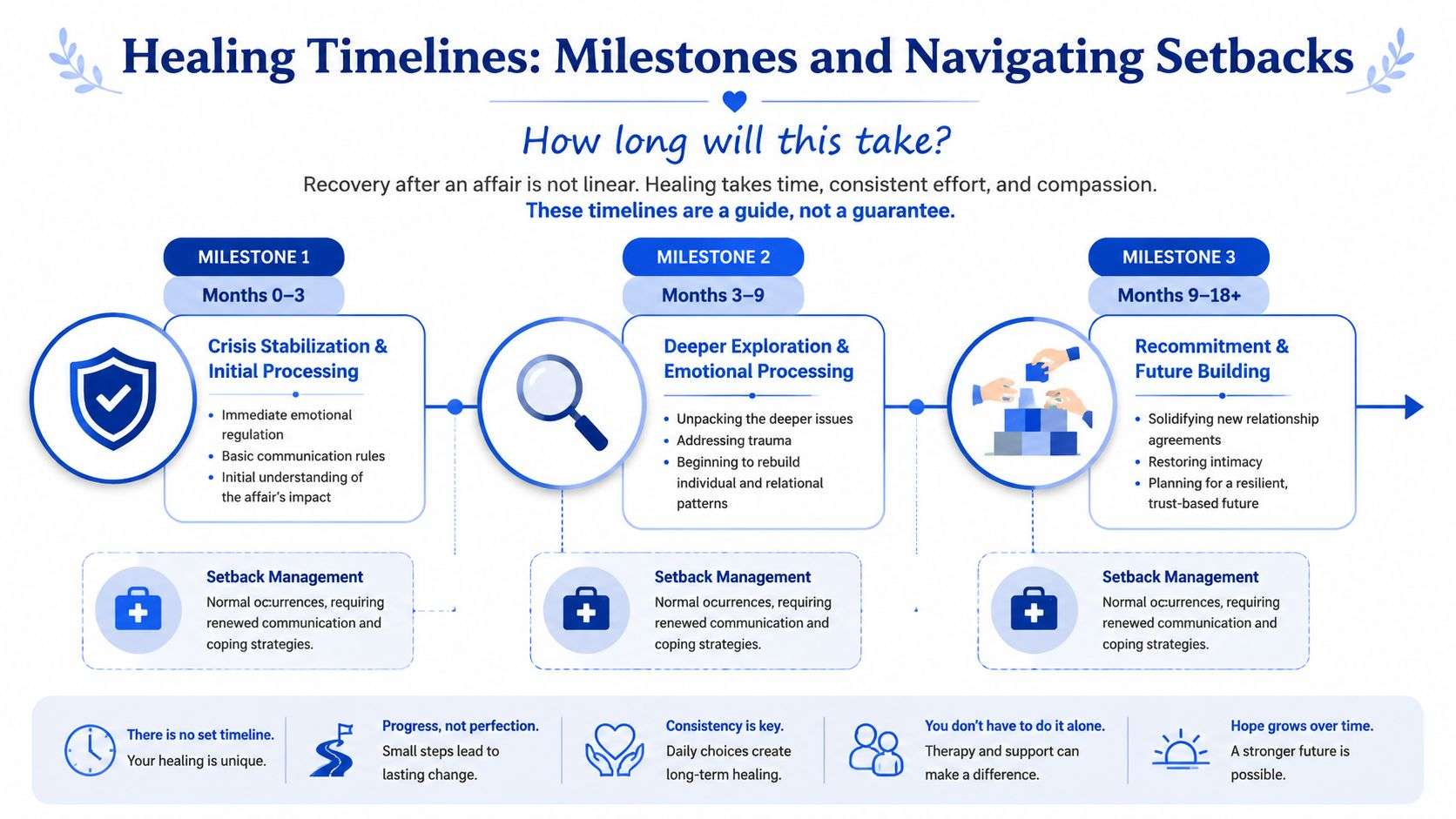
Affair recovery usually takes longer than couples hope. In practice, progress tends to come in uneven waves. There may be a steadier week, then a hard crash after a trigger, anniversary date, business trip, or simple change in tone. As noted earlier, evidence-based couples therapy can help many couples repair after betrayal, but the timeline is usually measured in many months and often longer. That can feel discouraging. It can also be relieving, because it puts the intensity of the aftermath in context.
Speed is not the best measure of healing.
More useful questions are these: Are the lies stopping? Is accountability becoming more consistent? Are arguments ending with more clarity and less damage? Are both people getting clearer about whether repair is healthy, realistic, and wanted?
Milestones that matter more than speed
In the early phase, progress often looks ordinary from the outside. It may be fewer interrogations at midnight. More direct answers. A little more sleep. Less scanning for danger every hour.
Later milestones are quieter but more meaningful.
| Milestone | What it often means |
|---|---|
| Less checking | The betrayed partner feels less compelled to monitor phones, schedules, or tone constantly |
| More initiative | The involved partner offers reassurance, transparency, and updates without being chased |
| Clearer boundaries | Both partners can state what contact, privacy, honesty, and accountability now require |
| Shared future talk | Conversations begin to include plans, values, and practical decisions, not only crisis management |
These shifts matter because they reflect changed behaviour, not just changed intention.
Setbacks need a plan
A setback can happen fast. A late text reply. A changed route home. A restaurant that brings everything back. The betrayed partner may feel panic or rage before there is time to think. The involved partner may feel hopeless, ashamed, or defensive.
The goal is not to prevent every trigger. The goal is to respond to triggers in a way that protects truth and reduces harm.
A useful repair sequence is simple:
- Name what happened. "That dinner reservation brought the affair back for me."
- Stay with the facts. Avoid piling on old accusations or vague character attacks.
- Answer directly. Short, honest answers regulate better than irritated reassurance.
- Return to the agreement. Transparency, check-ins, location sharing, or other boundaries only help if they are followed.
- Notice the pattern. If the same rupture keeps repeating, therapy should address the pattern, not just the latest incident.
I often tell couples that a setback is diagnostic. It shows whether the relationship is becoming safer under strain, or whether the same injury keeps reopening because the foundation is still unstable.
Healing is not always the same as staying together
Some couples reach a milestone that surprises them. The crisis settles enough for both people to think clearly, and they realise they want different outcomes. One partner may be trying sincerely while the other no longer feels able to remain in the marriage. In some cases, the affair exposed older fractures around secrecy, contempt, or chronic disconnection that neither person wants to keep living inside. Broader relationship patterns also matter. Studies and legal analyses of causes of divorce in Florida reflect themes therapists see across regions too, including poor communication, conflict, infidelity, and unresolved resentment.
Clarity counts as progress too.
Healing means the relationship becomes more honest and more workable, or both people become clearer that repair is not the healthiest path. Good counselling supports either outcome with care.
When Rebuilding Trust Is Not the Healthiest Path
Not every relationship should be repaired. That can be hard to hear, especially when one or both partners desperately want things to go back to normal. But good therapy does not assume reconciliation is always the goal.
A major gap in infidelity guidance is the question of whether rebuilding is appropriate at all. Some situations call for caution, distance, individual therapy, or separation before any couples work aimed at reconciliation begins. Red flags include repeated betrayal, coercive control, emotional abuse, or a partner's refusal to end the affair. In those cases, the priority is client safety and clear decision-making, not immediate repair.
Red flags that change the task
Couples counselling for repair may be premature or unsafe when:
- The affair is ongoing
- One partner keeps lying after disclosure
- There is intimidation, coercive control, or emotional abuse
- One partner uses therapy to manipulate, monitor, or pressure the other
- There is no genuine willingness to take responsibility
In these situations, the healthiest question may not be “How do we rebuild trust?” It may be “What protects each person best right now?”
Therapy can support clarity, not pressure
Sometimes the most ethical use of counselling is helping two people face reality without rushing to a decision. That may include naming patterns that have existed for years, sorting out whether remorse is real, or deciding whether a separation is temporary, permanent, or necessary for safety.
For some readers, legal information is part of regaining stability. A practical example is this overview of causes of divorce in Florida, which shows how people often seek clarity about relationship breakdown from several angles at once, including emotional, practical, and legal.
A careful therapist will not push you to stay together to prove the therapy “worked.” The work has value if it helps you make a grounded, informed, self-respecting decision.
Frequently Asked Questions About Affair Recovery
Some questions stay loud in your mind even after you understand the basics. Here are a few that come up often.
| Question | Compassionate Answer |
|---|---|
| Can a relationship really recover after an affair? | Yes, many do. Recovery is possible when there is honesty, accountability, emotional safety, and consistent effort over time. It usually means building a different relationship, not returning to the old one. |
| Do we need to know every detail of the affair? | Not always every detail. Couples usually need enough truth to stop confusion and rebuild reality. A therapist can help decide what information supports healing and what may only deepen trauma. |
| What if one of us wants to stay and the other isn't sure? | That's common. Counselling can still help. The immediate task may be clarity rather than reconciliation. Uncertainty does not mean therapy is pointless. |
| Should we start with couples therapy or individual therapy? | Sometimes both are helpful. If there are concerns about safety, coercion, severe shutdown, or repeated deception, individual support may need to come first or happen alongside joint work. |
| How do we know if therapy is helping? | Look for steadier conversations, clearer accountability, less reactivity, and more capacity to repair after triggers. Progress often appears in the quality of interaction before it appears in feelings of full trust. |
If you're looking for calm, structured support as you sort out what comes next, Interactive Counselling offers information about counselling options for couples, individuals, and families. Reaching out for help doesn't commit you to staying together. It gives you a safer place to understand what happened and decide how you want to move forward.
Clinically Reviewed By
Amy Mosset, MCP, RCC-S
Amy Mosset is a Master Practitioner in Clinical Counselling, Clinical Supervisor, and the owner of Interactive Counselling. She provides trauma-informed, evidence-based care and clinical supervision to registered therapists, with a focus on ethical practice, client safety, and high-quality therapeutic outcomes.