Some days don't look dramatic from the outside, but they still wear you down. You answer emails while thinking about dinner, replay a tense conversation on your commute, snap at someone you love, then feel guilty for the rest of the evening. If that sounds familiar, you're not failing at coping. You're likely running on a stressed nervous system without enough room to pause. For more information, see our couples counselling.
"DBT skills for everyday life aren't just for crisis. They're practical habits that help you handle ordinary stress with more steadiness, clarity, and care."
That matters in Canada, where about 1 in 4 Canadians aged 12 and older reported fair or poor mental health in recent years, and anxiety and mood symptoms are closely tied to difficulty functioning at work, school, and in relationships, as noted in this discussion of DBT tools in everyday life. When stress keeps piling up, small daily skills can make a real difference before things reach a breaking point.
Beyond the Crisis Point
Many people first hear about Dialectical Behaviour Therapy, or DBT, in the context of intense distress. Because of that, it's easy to assume it's only for emergencies, meltdowns, or major mental health crises.
That's a common misunderstanding.
DBT works best when it becomes part of daily life, much like brushing your teeth. You don't wait for a severe toothache before you start. You build a routine that protects you over time. DBT can work the same way for your emotional life.
When daily stress keeps stacking up
A rough morning often starts small. You wake up tired. You skip breakfast. Your phone already has messages waiting. A child refuses to get dressed, or a co-worker changes a deadline, or your mind starts racing before the day has really begun.
None of those moments may qualify as a crisis. But together, they can push your body and mind into reactivity.
DBT pays close attention to those build-up factors. One part of the model, often called PLEASE, looks at vulnerability factors like sleep, eating regularity, substance use, and physical health. When those basics are shaky, emotions tend to get louder and harder to manage.
Practical rule: If your reactions feel “too big” for the moment, check the basics before blaming yourself.
Prevention is the point
A lot of counselling advice focuses on what to do once you're already overwhelmed. DBT also asks a quieter question. What helps you stay more regulated before the overwhelm hits?
That's where micro-practices matter. A slow breath before opening your inbox. A glass of water before your second coffee. A short pause in the car after work so you don't carry the whole day into your home. These aren't dramatic interventions. They're small acts of nervous system support.
DBT is useful here because it treats coping skills as general habits, not emergency-only tricks. It gives you a way to catch stress earlier, respond more intentionally, and recover faster when life feels messy.
Some readers worry that using therapy skills for ordinary stress is somehow “too much.” It isn't. Everyday stress is still stress. You don't need to be in crisis to deserve support, structure, or tools that make daily life more manageable.
What Is Dialectical Behaviour Therapy
You wake up already tense. The sink is full, your phone is buzzing, and you can feel yourself getting sharper with everyone around you. DBT is built for moments like that, before the day fully tips into overwhelm.
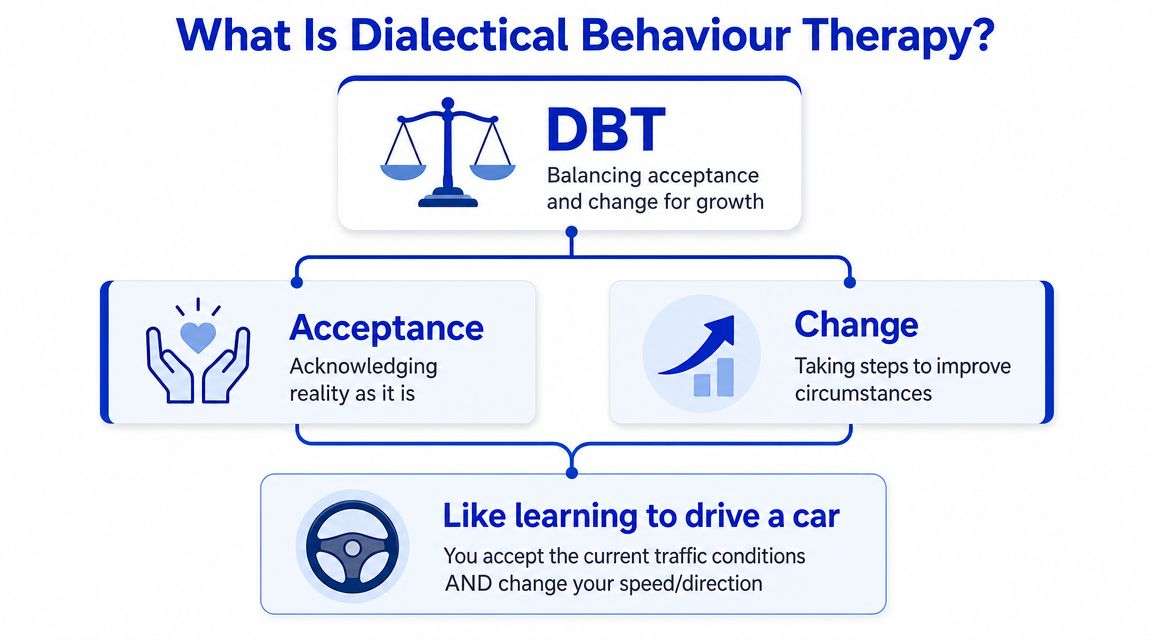
DBT, or Dialectical Behaviour Therapy, is a practical therapy model that teaches skills for everyday life. Central to it are two ideas at the same time. You can accept your current reality, and you can work to change the patterns that are hurting you.
That balance is the word dialectical.
Rain works as a simple example. If it is raining, arguing with the weather does not keep you dry. Accepting the rain helps you choose what works. You take an umbrella, leave earlier, or wear different shoes. DBT applies that same logic to emotions, stress, habits, and relationships. Acceptance helps you see clearly. Change helps you respond usefully.
The four skill areas
DBT is organised into four repeatable skill areas. They are mindfulness, distress tolerance, emotion regulation, and interpersonal effectiveness.
Each one supports a different part of daily functioning:
- Mindfulness helps you notice what is happening, inside you and around you, before you react on autopilot.
- Distress tolerance helps you get through painful moments without adding more harm.
- Emotion regulation helps you understand what you feel and reduce the factors that make emotions harder to manage.
- Interpersonal effectiveness helps you ask for what you need, say no clearly, and protect important relationships.
These skills are meant to be practised in ordinary moments, not saved for breakdowns. You use mindfulness while waiting for the kettle to boil. You use distress tolerance when a rude email lands in your inbox. You use emotion regulation when you notice that poor sleep is making you more reactive. You use interpersonal effectiveness when you need to tell a friend, partner, or coworker something honest without starting a fight.
That is part of what makes DBT so useful. It treats emotional health the way physical therapy treats movement. Small, repeated exercises build strength over time.
Why DBT often feels different
Some therapies focus mainly on understanding why you feel the way you do. DBT also asks a second question. What can you do, in this specific moment, that will help?
That practical focus matters in daily life. If your chest tightens during a meeting, insight alone may not help you answer the next question calmly. A skill might. If you feel a wave of shame after making a mistake, a skill can help you slow the spiral before it turns into a lost afternoon or an argument at home.
DBT is often associated with crisis care, but its real power shows up in repetition. A ten-second pause before replying. A quick body check while brushing your teeth. A more thoughtful tone during a hard conversation. These are small shifts. Repeated often, they change the shape of a day, and over time, the shape of a life.
Mindfulness Finding Your Anchor in the Everyday
Mindfulness gets misunderstood all the time. Many people hear the word and picture sitting cross-legged in silence for a long time, trying not to think.
That's not what DBT means.
In DBT, mindfulness is about paying attention on purpose. It's the skill of noticing what's happening right now, inside you and around you, without instantly reacting to it.

The What skills
DBT breaks mindfulness into three “What” skills.
- Observe. Notice sensations, thoughts, sounds, urges, or feelings.
- Describe. Put words to what you notice.
- Participate. Enter the moment fully instead of hovering outside it.
For example, while making coffee, you might observe the smell, describe “I'm feeling rushed,” and participate by focusing on the pouring, stirring, and first sip instead of scrolling your phone.
That's mindfulness. Simple. Ordinary. Useful.
The How skills
DBT also teaches three “How” skills.
| Skill | What it means in real life |
|---|---|
| Non-judgmentally | Notice without adding labels like “lazy,” “dramatic,” or “stupid.” |
| One-mindfully | Do one thing at a time, even briefly. |
| Effectively | Focus on what helps, not on what proves a point. |
If you're stuck in traffic, a non-judgmental description might sound like, “I'm tense and frustrated.” One-mindfully might mean turning off the podcast and breathing for a minute. Effectively might mean texting that you'll be late instead of rehearsing an argument in your head.
Notice the difference between “I am a mess” and “I am noticing stress.” One creates shame. The other creates space.
Three micro-practices you can try today
You don't need extra time. You need an anchor.
The kettle pause
While waiting for water to boil or toast to pop, feel your feet on the floor and take one slower breath than usual.The doorway reset
Before entering your office, home, or a difficult meeting, stop at the doorway and name one word for your current state. “Tired.” “Anxious.” “Scattered.”The first-three-bites practice
At one meal, notice the taste, texture, and temperature of your first three bites before doing anything else.
These tiny moments train your attention. Over time, they make it easier to catch yourself earlier when stress rises.
Distress Tolerance Navigating Turbulent Moments
Distress tolerance sounds intense, but it's useful for regular life. You don't need a full-blown crisis to need a pause button.
Think about the moment your boss sends a last-minute request, your child starts yelling while you're already overloaded, or someone cuts you off in traffic and you feel heat shoot through your body. That's where distress tolerance comes in.
It helps you survive the moment without adding damage.
The STOP skill in everyday conflict
A simple DBT skill called STOP can help when emotions spike fast.
- Stop what you're about to do.
- Take a step back. Physically or mentally.
- Observe what's happening.
- Proceed mindfully.
Say you receive a text that feels critical. Your urge is to fire back immediately. STOP creates a gap. You put the phone down, notice your pounding heart, realise you're reading the message through the lens of a hard day, and decide to wait before responding.
That's not avoidance. It's wise delay.
TIPP for non-crisis overwhelm
Another DBT set of skills is TIPP. These are often taught for high distress, but they can also help with everyday emotional surges.
Here's how that might look in ordinary situations:
- Temperature
Splash cool water on your face after a tense work call. - Intense exercise
Walk briskly around the block when irritation is building and your mind won't settle. - Paced breathing
Exhale a little longer than you inhale while sitting in your parked car. - Paired muscle relaxation
Tighten and release your shoulders or hands after a stressful interaction.
A parent might use paced breathing in the bathroom for one minute before responding to sibling conflict. A student might do a quick fast walk between classes after getting upsetting feedback. An employee might unclench their hands and jaw before joining a meeting they're dreading.
Hard moments don't always need deep insight first. Sometimes your body needs help settling so your mind can come back online.
A useful question in the heat of the moment
When emotions surge, ask: What action right now will make this easier later?
Not perfect. Not elegant. Just easier later.
That question often shifts people from impulse to choice. Maybe the answer is “drink water.” Maybe it's “don't send the email yet.” Maybe it's “step outside for two minutes.” Distress tolerance helps you hold the wave without becoming the wave.
Emotion Regulation Understanding and Influencing Your Feelings
You wake up already a little tense. The coffee spills. A text goes unanswered. Traffic is slow. By 9:15, your body is acting like the whole day is against you.
That is often how emotion dysregulation works in daily life. It usually builds through small moments, not only big ones. Emotion regulation helps you notice those moments early and make small adjustments before the stress pile gets too high.
A helpful comparison is a car dashboard. Emotions are signals. They tell you something needs attention, but they do not always tell you exactly what is wrong or what to do next. If the fuel light comes on, you do not panic at the light itself. You check what it is pointing to.
Check the facts before your mind fills in the blanks
Emotions are real. The story attached to them may be incomplete.
A friend has not replied. You feel hurt. Your manager says, “Can we talk tomorrow?” and your stomach drops. In both cases, the feeling makes sense. What often causes extra suffering is the fast conclusion your mind adds on top.
Check the Facts slows that process down. You are not trying to argue with yourself. You are trying to give your nervous system better information.
You can ask:
- What do I know for sure?
- What am I guessing?
- Are there other possible explanations?
- What would I say to someone I care about in this same situation?
This works well as a micro-practice. Try it while waiting for the kettle to boil, sitting at a red light, or before opening your email in the morning. Those tiny pauses can stop a small flare of emotion from turning into a full-day spiral.
Opposite action helps when the urge will make things worse
Sometimes the emotion fits the facts, but the impulse that comes with it does not help.
Anxiety says, “Avoid the email.” Shame says, “Cancel on your supportive friend.” Sadness says, “Stay under the covers all day.” The urge promises relief, but often creates more stress later.
Opposite Action means choosing a small helpful behaviour that goes against the unhelpful urge. Small is the key word here. You do not need a dramatic turnaround. You need a doable next step.
- Reply to the email with two sentences.
- Keep the plan, but shorten it to half an hour.
- Open the curtains and stand outside for one minute.
- Make the appointment instead of researching it for three more days.
If you often get stuck between emotion and overthinking, this framework for decisive leadership can offer another way to sort out when to pause, when to trust feeling, and when to act.
PLEASE is emotional maintenance, not a bonus task

DBT also teaches that feelings get louder when your body is running low. That is why PLEASE matters. It points you toward the basics that reduce emotional vulnerability:
- Physical health
- Eating regularly
- Altering substances
- Sleep
- Exercise or movement
These are easy to dismiss because they sound ordinary. Ordinary does not mean unimportant. A skipped lunch, poor sleep, too much caffeine, or a body that has been tense and still for hours can make a minor frustration feel enormous.
Prevention is highly practical. A commuter keeps a protein bar in their bag because they know hunger makes them snappy by 5 p.m. A parent drinks water and eats something before starting the dinner routine. An office worker takes a short walk at midday because sitting under stress all morning leaves them more reactive by afternoon.
Those choices may look small from the outside. Inside the nervous system, they lower the odds that everyday stress turns into a blowup.
Emotion regulation often starts long before a feeling peaks. It starts with the routines that make your inner weather easier to live in.
Interpersonal Effectiveness Strengthening Your Connections
You are standing in the kitchen at 6:10 p.m. A text comes in. Someone needs a favour, a plan has changed again, or your partner says, “Can we talk later?” Nothing dramatic has happened. Still, your chest tightens. You can feel an argument forming before a single hard word is spoken.
That is often how relationship stress starts. Not with a crisis, but with a small moment where you need to say what you mean, hear someone else clearly, and stay steady enough to do both.
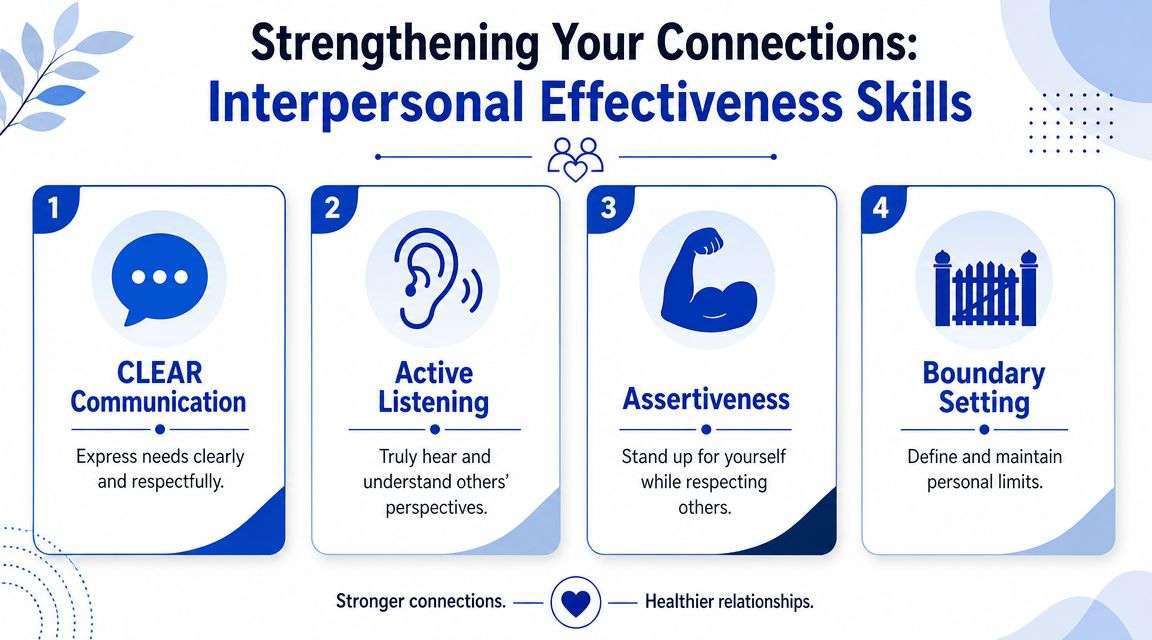
DBT treats communication like any other daily skill. You can practise it in ordinary moments, the same way you might practise balance by standing on one foot while brushing your teeth. Short, repeated reps matter. A clear reply to a coworker. A respectful no to a family member. A pause before answering a loaded text. These small choices strengthen your relationships before resentment piles up.
DEAR MAN for asking clearly
DEAR MAN helps when you want to ask for something, set a limit, or address a problem without spiralling. It gives structure when your mind wants to ramble, shut down, or blurt.
A simple script might look like this:
- Describe: “When meeting times change at the last minute…”
- Express: “…I feel stressed and rushed.”
- Assert: “I'd like us to confirm by noon when possible.”
- Reinforce: “That helps me plan and show up more prepared.”
Then you stay Mindful, Appear confident, and Negotiate if needed.
It can help to treat DEAR MAN like a note card for your brain. Under stress, people often add extra history, defend themselves too much, or speak so indirectly that the main point gets lost. This skill keeps the message simple.
You do not have to wait for a big conflict to use it. Try it in low-stakes situations. Ask a roommate to load the dishwasher by bedtime. Tell a friend you need more notice before making plans. Request quiet for the first ten minutes of your workday. These are practice laps for harder conversations later.
GIVE for protecting the relationship
Sometimes your goal is not only to be heard. You also want to keep the connection warm enough for the conversation to continue. GIVE helps with that.
- Gentle
- Interested
- Validate
- Easy manner
If your partner says, “I feel like you're not listening lately,” GIVE might sound like, “I can see why it feels that way. You matter to me. I want to understand.”
Validation confuses a lot of people at first. It does not mean, “You are right and I am wrong.” It means, “I can see how this makes sense from where you stand.” That small shift lowers defensiveness. It makes problem-solving more possible.
A useful daily micro-practice is to validate one small thing before offering your view. On the commute home, you might decide, “Tonight I will reflect back what I heard before I explain myself.” That is interpersonal effectiveness in preventive form. You are lowering friction before the talk turns into a fight.
Validation means showing that another person's experience makes sense from their point of view.
FAST for self-respect
Some relationships improve when you become kinder. Others improve when you become clearer. FAST is the skill for keeping your self-respect while you speak.
| Skill | Example |
|---|---|
| Fair | Be fair to yourself and the other person. |
| No apologies for existing | Don't apologise for having needs or boundaries. |
| Stick to values | Stay aligned with what matters to you. |
| Truthful | Don't exaggerate or minimise to make the conversation easier. |
A family member asks for something you cannot realistically provide. FAST might sound like: “I care about you, and I can't take that on right now.” Short. Honest. Respectful.
Many people fear that direct communication will damage closeness. In daily life, the opposite is often true. What strains connection is the pattern of saying yes, feeling resentful, then pulling away or snapping later. Clear requests, kind tone, and steady limits build trust because other people learn where they stand with you.
If you are new to these skills, start very small. Practise one clear preference each day. “I'd rather meet at 3.” “I need ten minutes before I talk.” “I can help for an hour, not the whole afternoon.” These are the emotional equivalent of stretching. Small, regular practice makes bigger conversations less overwhelming.
Your Questions About Daily DBT Skills Answered
Do I need a diagnosis to use DBT skills
No. Many people use DBT skills because they want better tools for stress, communication, or emotional overwhelm. You don't need a specific label to benefit from learning how to pause, regulate, and respond more effectively.
What if the skills feel awkward at first
That's normal. Most new skills feel clunky before they feel natural. The first few times you use a breathing practice, a DEAR MAN script, or opposite action, it may feel forced. That doesn't mean it isn't working. It usually means you're learning.
How is DBT different from CBT
They overlap, but DBT places more emphasis on balancing acceptance with change, and it teaches concrete skills for distress, relationships, and emotional vulnerability. Many people find DBT especially helpful when they understand their patterns intellectually but still struggle to shift them in the moment.
What if a skill doesn't work when I'm really upset
That doesn't mean you've failed. It may mean the skill was used too late, or that your nervous system was already too activated. It may also mean you needed a different skill.
DBT skills are not just “calming tools.” They're decision-quality tools, and their effects can be limited if life stays chaotic, sleep-deprived, or substance-affected, as discussed in this article on limits and realities of DBT strategies. Questions like “Will DBT still work if my partner escalates?” or “Is mindfulness enough if I sleep poorly?” are important and valid.
Can DBT solve everything on its own
Not always. DBT is powerful, but it isn't a cure-all. If trauma reminders, chronic pain, grief, unsafe relationships, or severe sleep disruption are driving your distress, DBT may need to be paired with other support. Sometimes the most helpful next step isn't “try harder with the skill.” It's improving safety, rest, boundaries, or the treatment plan itself.
Small daily practices can help a lot. They also work best when your basic needs, environment, and support system aren't constantly pulling the rug out from under you.
If this article brought up familiar patterns in your own life, Interactive Counselling offers compassionate, evidence-informed support for individuals, couples, families, parents, youth, and children. Therapy can help you turn ideas like mindfulness, boundaries, and emotion regulation into practical tools that fit your day-to-day life.
Clinically Reviewed By
Amy Mosset, MCP, RCC-S
Amy Mosset is a Master Practitioner in Clinical Counselling, Clinical Supervisor, and the owner of Interactive Counselling. She provides trauma-informed, evidence-based care and clinical supervision to registered therapists, with a focus on ethical practice, client safety, and high-quality therapeutic outcomes.