Navigating teen isolation in Penticton means looking beyond “typical teen moodiness” and responding to barriers small towns create. It often starts with noticing small-town specific signs, opening gentle conversations, solving practical obstacles like transportation and privacy, and considering a blend of accessible in-person and virtual youth counselling options. For more information, see our Penticton youth counselling.
Penticton youth counselling helps teens manage isolation in smaller towns by combining early recognition, supportive conversations, practical problem-solving, and coordinated access to local and virtual care. For more information, see our counselling in Penticton.
A lot of parents and teens in smaller communities know this feeling well. A young person is home more often, less interested in the activities they used to enjoy, and somehow harder to reach, even when everyone lives close together. In a place like Penticton, that can be confusing because small towns are often assumed to be naturally connected. In practice, they can feel close-knit and lonely at the same time. For more information, see our youth counselling.
That's why generic advice often falls short. “Join a club,” “get out more,” or “just talk to someone” can sound simple, but they ignore the realities of limited anonymity, fewer activity options, transportation gaps, and the pressure of being seen by people you know. If you're searching for practical guidance about Penticton youth counselling and teen isolation, the most useful support is the kind that fits small-town life as it is.
The Quiet Challenge of Growing Up in a Small Town
Your teen says they do not care about going out anymore. Then they stop showing up at the rec centre, skip an activity they used to keep up with, and spend more time in their room with a phone that keeps them busy but does not leave them feeling connected. In Penticton, that shift can happen subtly because shrinking your world does not always look dramatic. Sometimes it starts with one awkward falling-out, one place that no longer feels safe, or one concern about being seen by the wrong person.
Small-town isolation has its own pressure points. Privacy is limited. Options are fewer. Transportation can decide whether support is realistic or out of reach. A teen may want contact and still avoid the very places where contact usually happens because school, sports, work, and family circles overlap.
I see this often in counselling. A young person is not always refusing help. They may be calculating the social cost of getting it.
Why small-town loneliness feels different
In a city, one uncomfortable space can be replaced with another. In a smaller town, leaving one group, one activity, or one friend circle can cut off a large share of a teen's social life. That is a real trade-off parents sometimes miss. Advice like "just try something else" assumes there is something else nearby, affordable, age-appropriate, and reachable without a complicated ride.
The practical barriers matter as much as the emotional ones. If the only counselling office is easy to recognize, if youth programs run at times that depend on a parent leaving work early, or if a teen worries that asking for help will become local conversation, isolation can deepen even when support technically exists.
Small towns can offer belonging. They can also make withdrawal harder to hide and harder to reverse.
Research and practice both point in the same direction. Young people do better when support is easy to reach, coordinated, and low-friction for families. That matches what many counsellors in smaller communities already know. The fewer private logistics a teen has to solve on their own, the better the chance they will accept help and stick with it. For a broader look at how disconnection affects children and teens, see these SEL insights on childhood isolation.
What parents and teens often miss
Isolation in a place like Penticton is rarely only about feelings. It is also about exposure, timing, and access.
A teen may hold back because they are worried about:
- Being recognized walking into a counselling office or youth program
- Depending on a ride and not wanting to explain where they are going
- Seeing classmates or teammates in the one setting that offers support
- Losing a whole social outlet at once when one friendship group changes
- Feeling trapped by reputation in a community where people know each other across school, sports, work, and extended family
That is why the better question is often not, "Why are they pulling away?" A more useful question is, "What is making connection feel risky, visible, or too hard to arrange right now?"
Reading the Signs of Teen Isolation
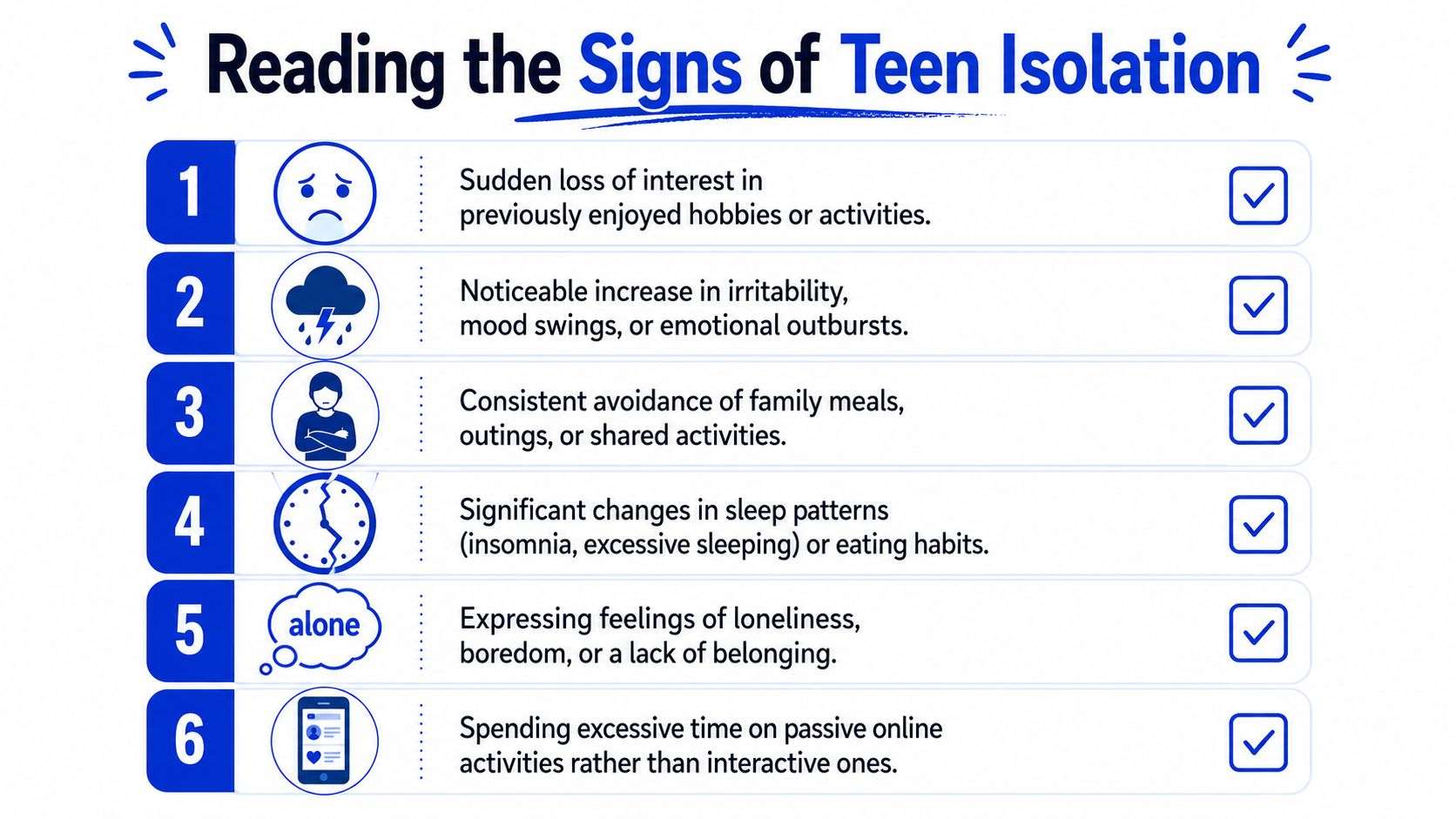
Some isolation signs are easy to spot. Others blend into ordinary adolescence. The goal isn't to overreact to every closed bedroom door. It's to look for patterns, duration, and change.
A teen who wants downtime after school is different from a teen who no longer wants contact with anyone, avoids familiar places, and seems cut off from the routines that used to anchor them.
Signs that deserve a closer look
Pulling back from local routines
If your teen used to go to practices, youth groups, part-time work, community events, or even regular family outings and now avoids all of them, pay attention. In a small town, withdrawing from one or two local spaces can quickly narrow their social world.Shifting from interactive online contact to passive scrolling
Spending time online isn't automatically a problem. The concern is when your teen stops using digital spaces to connect and starts using them mainly to numb out, compare themselves, or pass time alone.Avoiding visible community spaces
Some teens stop going places not because they dislike the activity, but because they don't want to be seen. That can include the gym, school events, coffee shops, the beach, the community centre, or downtown areas where they expect familiar faces.Dropping effort with friendships
They may stop initiating plans, replying to friends, or making any attempt to repair normal friendship tension. Isolation often looks less like conflict and more like quiet disengagement.
Mood and body changes matter too
Behavioural clues rarely appear on their own. Watch for clusters like:
- Irritability that lingers rather than a brief bad mood
- Sleep disruption such as trouble falling asleep or sleeping much more than usual
- Changes in appetite or energy
- Frequent boredom that sounds flat, not restful
- Comments about not fitting in, not belonging, or having “nothing to do”
If you want a broader, parent-friendly resource on how isolation can affect children emotionally and socially, SEL insights on childhood isolation offer useful context without treating every sign as pathology.
What makes this harder in BC smaller communities
BC's 2024 youth mental-health update emphasizes expanding access through Foundry virtual services and integrated supports, reflecting that many youth still face practical access barriers such as geography, wait times, and service coordination outside major urban centres, as noted in this summary of support barriers affecting socially isolated teens.
That's important because sometimes a teen looks resistant when they're discouraged. They may already assume support will be slow, awkward, visible, or complicated to arrange.
Practical rule: Don't wait for a dramatic crisis before taking isolation seriously. Earlier support is often easier for teens to accept.
How to Start a Supportive Conversation
Parents often worry they'll say the wrong thing and make it worse. That fear is understandable, but silence usually creates more distance than an imperfect first attempt. What helps most is a calm, respectful opening that gives your teen room to answer openly or not yet.
The best conversations usually happen side by side, not face to face under pressure. A drive, a walk, folding laundry, or sitting together after dinner can feel easier than a formal “we need to talk.”

What to say first
Open with observation, not accusation.
Try phrases like:
- “I've noticed you seem quieter lately, and I wanted to check in.”
- “You haven't seemed like yourself these past few weeks.”
- “I'm not here to push. I just want to understand what things have felt like for you.”
- “If something feels hard right now, we can figure it out together.”
What usually doesn't help:
- “Why are you always in your room?”
- “You need to make more effort.”
- “Other teens would be happy to have what you have.”
- “You're on your phone too much. That's the problem.”
Those statements can sound like criticism, even if concern is underneath them.
How to keep the conversation open
When your teen does respond, resist the urge to fix everything immediately. Many teens shut down when they sense the conversation has become a problem-solving session before they've even finished talking.
A steadier approach looks like this:
Reflect back what you heard
“It sounds like being around people at school feels exhausting right now.”Validate the feeling without endorsing hopelessness
“That makes sense to me. I can see why that would wear you out.”Ask one next-step question
“Would it help more if I just listened, or if we thought about support options together?”
“You don't need the perfect words. You need a calm tone, patience, and a willingness to stay present.”
When a teen says nothing
Sometimes the first conversation goes nowhere. That doesn't mean it failed.
A quiet teen may still register that you noticed, that you didn't shame them, and that help is available. You can come back gently:
Name the door is still open
“You don't have to talk right now. I'm here when you want to.”Offer choices
“Would texting me be easier than talking?”
“Would you rather speak with another trusted adult?”Reduce intensity
Keep showing up in ordinary ways. Isolation often softens through repeated moments of safety, not one breakthrough discussion.
A teenager who feels trapped or watched may test whether you can stay calm before they trust you with more.
Navigating Small-Town Barriers to Connection
A Penticton teen can want connection and still struggle to find a workable way into it. The club meets across town. A parent is working late. The bus schedule does not line up. The group is small enough that everyone notices who shows up and who stops coming.
That is the part generic advice often misses. In smaller towns, isolation is not always about refusal, low effort, or lack of interest. The problem is often practical access, privacy, and a limited number of good-fit spaces.

The lack of anonymity problem
In a close-knit community, teens often feel visible before they feel supported. They may worry that joining a group, going to an appointment, or even getting dropped off at the same place each week will start questions they do not want to answer.
Parents sometimes underestimate how much that matters. A teen is not being dramatic when they say, “Everyone will know.” In a smaller town, that can feel true.
Useful adjustments are usually simple:
- Choose lower-visibility options such as virtual support, school-based check-ins, or appointment times that do not draw attention
- Keep plans private instead of discussing them with relatives, other parents, or family friends
- Let your teen help decide the format so support feels safer and more workable from the start
Transportation shapes follow-through
I often see families read a missed activity as resistance, when the barrier is logistics. If your teen has to depend on three adults, an awkward ride home, or a long wait after school, even a good activity can become too hard to sustain.
Consistency matters more than ambition here. One realistic plan usually helps more than a packed schedule that falls apart in two weeks.
| Barrier | More useful response |
|---|---|
| No reliable ride | Set a repeating family driving plan or arrange one trusted carpool |
| Distance to activities | Choose one steady activity instead of several hard-to-reach options |
| Limited local options | Try hybrid programs, short-run groups, or nearby events in surrounding communities |
| Cost of getting around | Focus on local routines such as library programs, school supports, walks, or free drop-in spaces |
Limited peer groups can make loneliness sharper
Some teens are isolated because they have not found a good social fit nearby. That is common in smaller towns, especially for youth with niche interests, LGBTQ+ teens, youth recovering from a friend-group breakup, or teens who feel out of step with the local social scene.
Pushing them to “just get out more” rarely helps. A better approach is to match connection to who they are and what is available.
Try options like these:
- Build around one genuine interest such as gaming, art, climbing, music, animals, or fitness
- Look beyond town limits when local choices are thin, including regional sports, arts programs, or volunteer roles
- Use online spaces carefully for shared interests and active participation, not endless scrolling
- Choose lower-pressure settings where conversation can happen beside an activity, not as the main event
For teens involved in sports, participation can drop after one hard season, an injury, or a confidence hit. Some families find it useful to review Vanta Sports guidance for young athletes and then adapt those ideas to the realities of a smaller community.
A helpful question is: what kind of connection can this teen return to next week without it becoming a battle? That is usually the starting point that holds.
Finding the Right Youth Counselling and Support
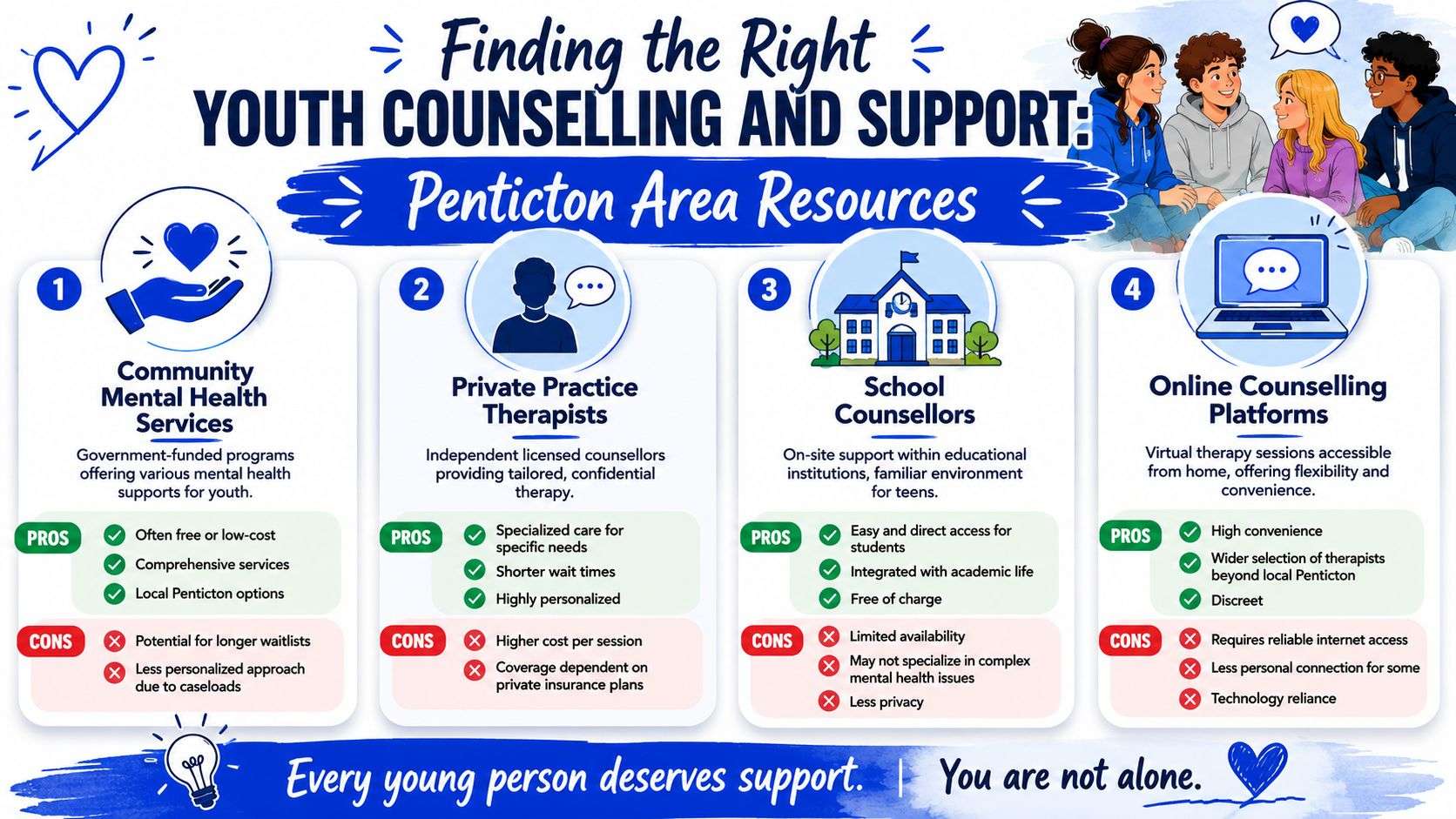
A Penticton parent might be ready to book help, only to hit the small-town realities right away. The local options may be limited, the waitlist may be longer than expected, your teen may worry about being recognized in a waiting room, and getting across town or in from a nearby community may depend on one family vehicle. Choosing support often comes down to what your teen will use consistently, not what looks ideal on paper.
When isolation has been building for a while, family care still matters. Many teens also need support outside the home that is practical, private enough, and easy to return to next week.
In-person and virtual support each solve different problems
For many Okanagan families, the best fit is blended support. That can include school contact, family coordination, local counselling, and virtual care, with each piece covering a different gap.
In British Columbia, Foundry offers virtual counselling and peer support for youth ages 12 to 24 through its app. As described in RBC's coverage of Foundry's small-town youth mental health approach, that kind of service can reduce travel pressure and give teens more privacy in close-knit communities.
Virtual care is useful for some situations. In-person support is still the better choice for other teens, especially if home does not feel private, screens make it harder to focus, or the teen opens up better with someone physically in the room.
| Option | Often works well when | Common limits |
|---|---|---|
| In-person counselling | A teen engages better face to face, needs a separate space, or struggles to talk openly at home | Travel, scheduling, visibility, and transportation can get in the way |
| Virtual counselling | Privacy, convenience, and easier access matter most, especially in a close-knit community | Some teens need help getting started, staying focused, or finding private space |
| School support | The teen already trusts someone in the school and needs support built into the day | Availability and privacy may feel limited |
| Family plus community coordination | Several adults need to reduce stress around school, referrals, routines, and follow-through | It requires communication, planning, and consistency |
What tends to work better than a referral list
A list of names is rarely enough, especially for a teen who already feels shut down. In smaller towns, every extra step can become the point where help stalls. One missed call, one awkward intake form, or one appointment that requires a long drive can stop the process.
What helps more is a warm handoff. That means one adult helps the teen get through the first step instead of handing over a phone number and hoping for the best.
That can look like a school counsellor making the first introduction, a parent sitting nearby for the first virtual session, or a family doctor clearly explaining why this specific referral makes sense. Good follow-up matters too. If the first appointment happens and nobody checks what came next, momentum often drops fast.
If you're exploring local professional support, Interactive Counselling may be one option alongside school and community-based resources.
Building a support web around the teen
Some teens improve with one strong counselling relationship. Others do better with a small, steady support web. In practice, that often means one trusted adult at school, one counselling contact, one parent handling logistics without turning every ride into an interrogation, and one predictable activity that breaks up long stretches alone.
This is especially useful in small towns, where there may not be many social options and changing providers is not always simple. The goal is not to create a perfect plan. The goal is to make support easier to reach than withdrawal.
Families trying to create connection outside the usual school or team routes may also find useful ideas in building confident kids homeschooling, especially the parts focused on intentional social structure instead of waiting for connection to happen on its own.
Counselling works better when the teen does not have to hold the whole support system together by themselves.
Answering Your Questions About Youth Therapy
A parent in Penticton might spend a week working up the courage to suggest counselling, only to hear, “No. I'm not talking to someone everyone knows.” In a smaller town, that reaction is common. Teens are not only weighing whether therapy might help. They are also weighing who might see them walk in, whether they will run into someone they know in the waiting room, and how much control they will have over what gets shared.
What if my teen refuses counselling?
Start with the reason behind the refusal. In my work, teens usually push back because they feel exposed, cornered, or tired of being discussed, not because they have decided support will never help.
A lower-pressure approach often works better than repeated persuasion. Try giving your teen a few concrete choices:
- Format: virtual, in-person, or even a brief phone consult to start
- Pace: one meeting to see how it feels, rather than an open-ended commitment
- Person: a therapist, school counsellor, family doctor, or another trusted adult they already know
- Privacy plan: what they want friends, siblings, or extended family to know, if anything
In a small town, resistance is often tied to practical concerns. The office may be across town. A parent may need to drive. The teen may worry that accepting help will become community gossip. Address those concerns directly. “Would after-school virtual be easier?” is usually more useful than “You need therapy.”
How does confidentiality work for teens?
Ask this early, and ask it plainly.
Parents and teens both need a clear explanation of what stays private, what gets shared, and what changes if there is a safety concern. A good counsellor should be able to explain this in simple language without sounding vague or defensive.
For teens in smaller communities, confidentiality is not an abstract issue. It is often the deciding factor. They may want to know whether a parent sits in on sessions, whether school staff will be updated, or whether they can speak openly about friendships, substance use, sexuality, or family stress without it immediately circulating through adults around them. Those are fair questions.
Clear limits and clear privacy protections help teens settle enough to talk openly.
How will I know if counselling is helping?
Progress usually starts small. For an isolated teen, early change may look less dramatic than parents expect.
You might notice:
- Less shutdown at home
- More tolerance for school or one regular activity
- Fewer fights about leaving the house
- Better sleep or fewer stress complaints before school
- More willingness to text a friend back, attend one event, or make one plan
Watch for patterns, not perfect weeks. In smaller towns, options for social repair are limited, so progress can be slower because every friendship, team, or class connection carries more weight. If a teen has had one bad social rupture, there may not be many other groups to move toward. That does not mean counselling is failing. It may mean the work is focused on trust, coping, and rebuilding confidence before behavior shifts become obvious.
If several sessions pass with no movement at all, revisit the fit. The therapist may be a poor match. The format may be wrong. The goals may be too vague.
What if my teen is isolated but not in crisis?
Support still makes sense.
Teens do not need to hit a breaking point before they deserve care. Isolation often shows up first as irritability, avoidance, endless scrolling, sleep reversal, or a quiet retreat from school, sports, and friends. In a place with fewer activities, fewer transit options, and fewer chances to start over socially, those patterns can harden faster than parents expect.
Early help gives a teen more room to recover before home becomes the only place they go and their phone becomes the only place they socialize.
If your gut says something has changed, take that seriously.
If your family is trying to sort out what support might look like, Interactive Counselling offers information about youth, family, in-person, and virtual counselling options in a Canadian practice setting. Sometimes the next step is learning what kind of help would fit your teen best.
Clinically Reviewed By
Amy Mosset, MCP, RCC-S
Amy Mosset is a Master Practitioner in Clinical Counselling, Clinical Supervisor, and the owner of Interactive Counselling. She provides trauma-informed, evidence-based care and clinical supervision to registered therapists, with a focus on ethical practice, client safety, and high-quality therapeutic outcomes.