When the 2026 Best of Kelowna Awards results came in, our first feeling wasn’t celebration so much as gratitude. These awards are decided by the people of Kelowna — by neighbours, clients, colleagues, and community members who took a moment to vote. That’s a humbling thing to receive, because it isn’t given by a panel or bought with advertising. It’s simply people saying, quietly, “this mattered to me.” We don’t take that lightly, and we wanted to say a proper thank you.
We also want to be honest about how we hold recognition like this. Awards are encouraging, and we’re proud of our team, but they’re not the point of the work. The point is the person sitting across from one of our counsellors on a hard day, finding a little more room to breathe. If these awards mean anything to us, it’s as a reminder of the responsibility that comes with being trusted — not as a trophy to point at.
What the community recognized in 2026
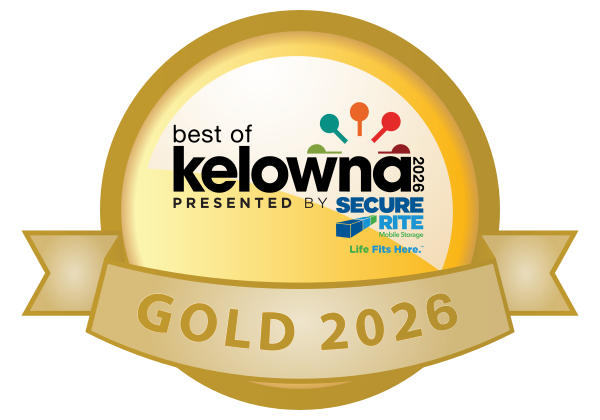
This year, Interactive Counselling as a clinic was recognized with:
- Gold — Best Psychology Clinic (the fourth consecutive year: 2023, 2024, 2025, and 2026)
- Bronze — Best Local Website
- Silver — Best Instagram Account
And our founder, Amy Mosset (MPCC-S, RPC), was recognized individually with:
- Gold — Best Clinical Counsellor
- Gold — Best Therapist
- Gold — Best Life Coach
- Gold — Best Career Coach
- Silver — Best Local Entrepreneur Over 40
We’ve listed these plainly because that feels right. Each one represents people choosing to put our name forward, and we’re thankful for every single vote.
Why community-voted recognition means something to us
There are a lot of “best of” lists in the world, and not all of them mean much. What makes the Best of Kelowna Awards different is that they’re voted on by the community itself. You can’t really campaign your way to them; people either think of you when they’re asked, or they don’t.
For a counselling clinic, that’s a meaningful signal — but not for the reasons you might expect. We don’t measure our work in awards. We measure it in whether someone who walked in anxious leaves with a little more steadiness, whether a couple who’d stopped talking finds a way back to each other, whether a teenager who felt unheard finally feels understood. Those moments are private, and they’ll never show up on a list. When the community recognizes the clinic where that work happens, we take it as a sign the care is reaching people in a way that stays with them.
It also raises the bar for us. Recognition like this is an invitation to keep earning it — to show up with the same warmth and standards on a quiet Tuesday afternoon as on any other day.
A note on Amy’s recognition

Amy would be the first to redirect any praise toward the team and the clients. As the founder of Interactive Counselling and a Master Practitioner in Clinical Counselling (MPCC-S) and Registered Professional Counsellor (RPC), she has spent her career building a clinic where good, evidence-based care is the norm rather than the exception.
Being recognized across several categories in the same year — counselling, therapy, life coaching, and career coaching — reflects the breadth of the work she does and, more importantly, the way she does it: without judgement, grounded in research, and always centred on the person in front of her. You can read more about Amy and the rest of our team here.
What award-winning care actually looks like day to day
It’s easy for a phrase like “award-winning” to sound like marketing, so it’s worth describing what it actually means in practice — because the substance matters far more than the label.
It starts with the relationship. Decades of research are clear that the single biggest predictor of whether therapy helps is the fit between a person and their counsellor — more than any technique or set of letters after a name. So our first job is always to create a space that feels safe, unhurried, and genuinely without judgement. Nothing useful happens until someone feels they can be honest. From there, our counsellors draw on evidence-based approaches matched to the person and the issue:
- CBT for the thought-feeling-behaviour cycles that keep anxiety and low mood stuck.
- EMDR and trauma-informed care for processing trauma and PTSD at the nervous system’s own pace.
- EFT and the Gottman Method for couples working through conflict, disconnection, or affair recovery.
- ACT, IFS, DBT skills, somatic, and mindfulness-based approaches for the wide range of things people bring to counselling.
What ties these together isn’t the acronyms — it’s the principle that you should leave a session with something usable: a reframe, a tool, a small experiment to try, a bit more understanding of yourself. Counselling, as we often say, is a chapter, not a sentence.
The team behind the recognition
None of this is the work of one person, and that’s the part of any award we most want to acknowledge. Our recognition belongs to the whole team — the Registered Clinical Counsellors (RCC/BCACC), Master Practitioners in Clinical Counselling (MPCC), Registered Professional Counsellors (RPC), and Registered Social Workers (RSW) who show up for clients every day.
Every counsellor on our staff is registered with their regulatory body and bound by a professional code of ethics. That means accountability, and it means a shared standard of care — so whoever you see, you’re getting the same evidence-based, judgement-free approach. The awards are, in a real sense, theirs.
Care that reaches across the region — and online
While the Best of Kelowna Awards are Kelowna-specific, the care behind them extends well beyond the city. Interactive Counselling serves clients at our flagship Kelowna clinic as well as in Vernon, Penticton, and Grande Prairie, plus secure online and phone counselling across the province and beyond.
We mention this not to claim more ground, but because access matters. Mental-health support shouldn’t depend on living in the right postal code. Same-week availability, evening and weekend appointments, and the option to meet online are part of how we try to make good care reachable for ordinary, busy lives. No referral is needed to begin.
What awards don’t capture
We’ll end on an honest note. Recognition is lovely, but it doesn’t capture the part of this work that matters most. It doesn’t capture the courage it takes to book a first session, the slow and unglamorous progress of someone learning to manage their anxiety, or the counsellor who stays curious and humble after twenty years because every person is genuinely different. Those things don’t win awards, but they’re the actual substance of good counselling.
So if you read this and feel a flicker of “maybe I should reach out” — let that be the takeaway, far more than any medal. The awards are a kind word from the community, and we’re grateful for it. The real measure of whether we’re doing our job is whether you feel a little more like yourself after sitting with us.
How to choose a counsellor who’s right for you
Because fit matters more than anything, it’s worth taking a moment to choose well rather than booking with the first name you see. Read a few counsellor bios and notice who you feel drawn to — their tone, their areas of focus, the way they describe their work. There’s no wrong instinct here; the goal is simply to start with someone you can imagine being honest with. If the first counsellor isn’t quite the right match, that’s genuinely okay, and switching to another within our clinic is easy and judgement-free. A mismatch isn’t a failure of therapy — it’s just useful information.
It also helps to think about what you’re hoping for. Some people come with a specific issue — panic, a relationship at a crossroads, a loss they can’t move through. Others come with a more general sense that something is off and they’d like space to think. Both are completely valid reasons to start, and you don’t need to have it figured out before you book.
What to expect in a first session
First sessions can feel intimidating, so here’s roughly how they go. Your counsellor will walk through confidentiality and consent, then ask what brought you in. You can share as much or as little as feels comfortable — there’s no “right” way to begin, and you’re always in control of the pace. Together you’ll start to clarify what you’d like to get out of counselling, whether that’s symptom relief, a decision, a relationship to repair, or something harder to put into words. Most people leave the first session feeling a little lighter, with at least one practical takeaway to carry into the week.
You’re never locked in. If a topic feels too tender, you can slow down or change direction. Goals can shift as you go, and the number of sessions is entirely yours to decide. Many people find meaningful change within six to ten sessions; briefer, focused issues often resolve in fewer.
A few common questions about counselling in Kelowna
Do I need a referral? No. You can book directly, and same-week appointments are usually available.
Is counselling covered by MSP? British Columbia’s Medical Services Plan does not cover private counselling. However, many extended-health plans, employee assistance programs (EFAPs), ICBC, Crime Victim Assistance, FNHA, and Veterans Affairs Canada often do. We provide detailed receipts for submission to your insurer, and we direct-bill for ICBC and BC Autism Funding.
Do you offer online sessions? Yes — secure video and phone counselling are available across the province, and many clients use a hybrid of in-person and online to fit their schedule.
What’s the difference between counselling and therapy? In BC the words are used interchangeably. Our team holds registered designations (RCC, MPCC, RPC, RSW) and uses the same evidence-based approaches regardless of which word you prefer.
There’s no “big enough” reason to start
One thing we hear often is some version of “I wasn’t sure my problem was serious enough to come in.” We want to gently put that worry to rest. You don’t need to be in crisis to benefit from counselling, and you don’t need to justify your reasons to anyone. Plenty of the people we work with are managing well on the outside — holding down jobs, raising families, showing up for others — while quietly carrying more than they should have to. Counselling is often most helpful before things reach a breaking point, when there’s still room to build skills and perspective rather than just manage a fire.
Reaching out for support isn’t a sign that something has gone wrong with you. More often it’s a sign of self-awareness and care — the same instinct that leads someone to see a physiotherapist for a sore knee before it becomes an injury. If a part of you has been wondering whether it’s time, that wondering is usually worth listening to. Whatever you’re carrying, you’re likely not the first person we’ve sat with through it, and you won’t be judged for any of it.
If you’ve been thinking about reaching out

There’s never a perfect time to start counselling, and waiting for one usually just means waiting. If something has been weighing on you — anxiety, a relationship that’s struggling, grief, a transition, or simply a sense of being stuck — we’d be glad to help, with no pressure and no judgement. You can explore our counselling services to see what fits, or meet our team and choose a counsellor whose approach resonates. Booking takes about two minutes, and most clients are seen within a week.
To everyone who voted, who referred a friend, who trusted us with something difficult this year: thank you. We’re grateful, and we’re back to work.
The full 2026 results are published at the Best of Kelowna Awards.