If you're reading this after a funeral, after a difficult phone call, or in the middle of a quiet evening that suddenly feels too quiet, you're not alone. In Penticton, grief can feel especially exposed. You may run into someone you know at the grocery store, hear a familiar name at the pharmacy, or feel the weight of being seen when all you want is a few private minutes to get through the day. That can make loss feel both personal and strangely public. For more information, see our Penticton grief counselling.
"Penticton grief counselling can help you cope with loss in a small community by giving you a private, supportive place to process grief while learning how to live with reminders, relationships, and daily life after loss." For more information, see our counselling in Penticton.
Grief doesn't follow neat rules, and it doesn't ask whether you live in a big city or a close-knit town. But the shape of your days matters. In a place where people know each other, where routines overlap, and where memories can live in the same streets you still walk every day, coping with loss often needs both tenderness and practical support. For more information, see our grief counselling.

Navigating Loss and Grief in Penticton
Some people tell me the hardest part isn't only the loss itself. It's trying to carry that loss in public. You may be trying to buy milk and suddenly someone asks, "How are you holding up?" They mean well. Still, the question can land heavily when you're just trying to make it through one ordinary task.
When everyday places feel different
In a small community, grief often changes your relationship with familiar places. A café, a walking path, a church, or a local event can become loaded with memory. You might avoid certain streets. You might also feel guilty for avoiding them.
Both reactions make sense.
Grief often shows up in ordinary moments, not only in dramatic ones.
Many people expect grief to be loud and obvious. Often, it's quieter than that. It can look like standing in line and forgetting why you came in. It can look like staring at the lake and feeling nothing for a few minutes, then everything all at once.
Why this can feel so complicated
Penticton offers something many people value. Community. At the same time, community can feel hard when you're raw. You may appreciate the casseroles, texts, and kind faces one day, then want complete distance the next.
That doesn't mean you're ungrateful. It means you're grieving.
A gentle truth to hold onto is this:
- You don't have to perform your grief for other people
- You don't have to answer every question
- You don't have to heal on anyone else's timeline
- You are allowed to need support and privacy at the same time
If your loss feels tangled, confusing, or lonely, that doesn't mean you're doing grief wrong. It means you're human, and you're carrying something heavy.
Understanding Your Grief Journey
Many people arrive with one quiet fear. They worry they're grieving incorrectly. They may think they should be "further along" by now, or that they should be feeling a certain emotion in a certain order.
Grief doesn't work that way.
Grief isn't a straight road
A better way to think about grief is to imagine a coastline. Some days the water is calm. Other days the tide comes in fast, reshaping everything. The shoreline is still there, but it never looks exactly the same twice.
That's how grief often feels. Not linear. Not tidy. Not predictable.
You might have a steady morning and then break down when you hear a song in the car. You might laugh with a friend and then feel guilty for laughing. You might feel numb when you expected tears, or anger when you expected sadness.
All of those experiences can be part of grief.
Grief can affect more than emotions
People often expect grief to be emotional only. In reality, it can touch many parts of your life at once.
| Area of experience | What it can feel like |
|---|---|
| Emotional | sadness, anger, relief, fear, guilt, longing, numbness |
| Physical | fatigue, heaviness, restlessness, tension, changes in appetite |
| Thinking | brain fog, forgetfulness, trouble focusing, replaying moments |
| Meaning and identity | questioning beliefs, feeling lost, not knowing who you are now |
Seeing this can help many people exhale a little. If you've been tired, distracted, or unlike yourself, that doesn't automatically mean something is wrong with you. It may mean your mind and body are responding to loss.
A helpful reminder: grief is not only something you feel. It's also something your body carries and your mind tries to understand.
What confuses people most
One of the most unsettling parts of grief is how changeable it is. You can feel stable for a week, then suddenly have a very difficult day. Anniversaries can stir things up, but so can tiny things you didn't expect, like seeing their favourite snack in a store.
A few points often help:
- Waves are normal. A hard day doesn't erase the progress you've made.
- Numbness is normal. Some people feel very little at first.
- Relief can be normal too. This is especially true after a long illness or caregiving period.
- Love and pain can sit together. Missing someone and resenting what happened can both be true.
There is no correct personality for grief
Some people cry easily. Others become practical and busy. Some want company. Others need more silence. A person who talks constantly about the loss isn't more loving than the person who can't yet find words.
The shape of your grief will reflect your history, your relationship, your support system, your responsibilities, and your nervous system. That is why comparison almost always hurts.
If you've been asking yourself, "Why am I like this?" try replacing that question with, "What might I need today?"
That small shift can open a gentler path.
The Unique Challenges of Grieving in a Small Town
Grieving in a place like Penticton has its own texture. The same closeness that can feel comforting can also feel overwhelming. People often describe this as living in a fishbowl. They don't mean the town is unkind. They mean it can be hard to disappear for a while.
The fishbowl effect
In a larger city, you may move through the day unnoticed. In a smaller community, that's less likely. People recognise your face, know your family, remember your loss, or ask about someone who has died because they haven't heard the news yet.
That can create several pressures at once:
- Privacy feels limited. You may worry about crying in public or being drawn into conversations you're not ready for.
- Reminders are frequent. Shared community spaces can bring up memory after memory.
- Roles can feel sticky. You may get tired of being known as "the person who lost their spouse" or "the family caring for their parent."
None of this means community is bad. It means grief needs room, and room can be harder to find when lives overlap closely.
The strengths that small communities can offer
There is another side to this. Small communities can respond in tangible, immediate ways. People may check in, drop off meals, offer rides, attend memorials, or remember your loved one by name months later when others have gone quiet.
That kind of remembering matters.
Some people find that the very place that feels exposing also helps hold them up. A neighbour notices when they haven't left the house. A familiar shopkeeper speaks gently. A walking group makes it easier to be with others without needing to explain everything.
You don't have to choose between appreciating support and needing space. Most grieving people need both.
Grief before a death happens
In communities with a significant senior population like Penticton, grief is not limited to after a death. Canadian data shows that 25-30% of family caregivers experience clinical anxiety and depression related to anticipatory grief while caring for a loved one according to local information on grief group support.
Many people do not realize they are already grieving.
If you're helping a parent, partner, or family member through illness, dementia, frailty, or end-of-life changes, you may be carrying loss long before a funeral takes place. You may be mourning the life you had, the conversations you no longer have, or the person as they used to be.
Common signs of anticipatory grief can include:
- Constant worry about what comes next
- Role exhaustion from becoming the organiser, advocate, or decision-maker
- Emotional whiplash between hope, dread, resentment, tenderness, and guilt
- A shrinking sense of self because caregiving has taken over daily life
This kind of grief is easy to overlook because the person is still here. But your pain still counts. Support can be helpful before a death, not only after one.
How Grief Counselling Provides a Safe Harbour
You may be standing in line at the grocery store, trying to keep yourself together, when someone kindly asks how you are doing. In a small community like Penticton, that question can come from a neighbour, a former coworker, your pharmacist, or a friend of the person who died. Their care can be real, and it can still feel like too much. Grief counselling offers a private place where you do not have to manage anyone else's reaction while you are trying to survive your own.
That privacy can feel like taking off a heavy coat you have been wearing everywhere.

What a first session usually feels like
The first appointment does not require a polished story. Many grieving people come in feeling scattered, numb, or unsure what is even wrong. That is a normal place to begin.
A counselling session often works like sitting down in a sheltered cove after being out on rough water. You do not have to explain the whole ocean at once. You can start with the wave that is hitting you today.
You might begin with:
- What happened, if telling the story feels important
- What is hardest right now, such as poor sleep, dread, anger, guilt, loneliness, or tension at home
- What daily life looks like, including work, caregiving, parenting, or being alone in the house
- What you need most, even if all you can say is, "I need this to feel a little less heavy"
A thoughtful grief counsellor will not push you to talk before you are ready. They also will not pressure you to grieve in a neat, cheerful, or socially acceptable way.
What grief counselling can help with
Grief support is often more personalized than people expect. Some counsellors have training in grief, trauma, family systems, or body-based approaches, and some local support groups focus on a specific kind of loss, such as the death of a spouse or parent.
In plain language, that means support can fit your situation more closely.
A counsellor may help you with things like:
- Understanding your reactions so you stop treating your grief like a personal failure
- Settling the body's stress response, especially if you feel restless, frozen, panicked, or easily startled
- Preparing for reminders, such as birthdays, lakefront walks, familiar restaurants, or community events where your loss feels suddenly close
- Handling family tension, when one person wants to talk, another avoids it, and someone else expects you to be "doing better"
- Adjusting to a changed identity, especially if your role in the family or your daily routine has been turned upside down
You do not have to wait until everything is falling apart before asking for help.
Counselling can be useful when you are still getting through the day but doing it at a high emotional cost. The goal is not to erase grief. The goal is to give it a steadier place to land, so it does not spill into every corner of your life without support.
Why counselling can feel different from everyday support
In a close-knit place, support and exposure often arrive together. The same community that brings soup, checks in, and remembers your person can also make it hard to step outside without meeting a reminder or answering questions you were not ready for.
Counselling is different because it is confidential, structured, and centred on you. It is one of the few places where you do not need to protect a parent, avoid upsetting a child, reassure a friend, or soften the truth for people who mean well.
You can say you are angry. You can say you feel relieved after a long illness. You can say you are tired of being strong. You can cry, sit in silence, or show up with no clear words at all.
That kind of space does not replace community care. It balances it. In a small town, that balance can matter a great deal.
Practical Self-Care Strategies for Coping with Loss
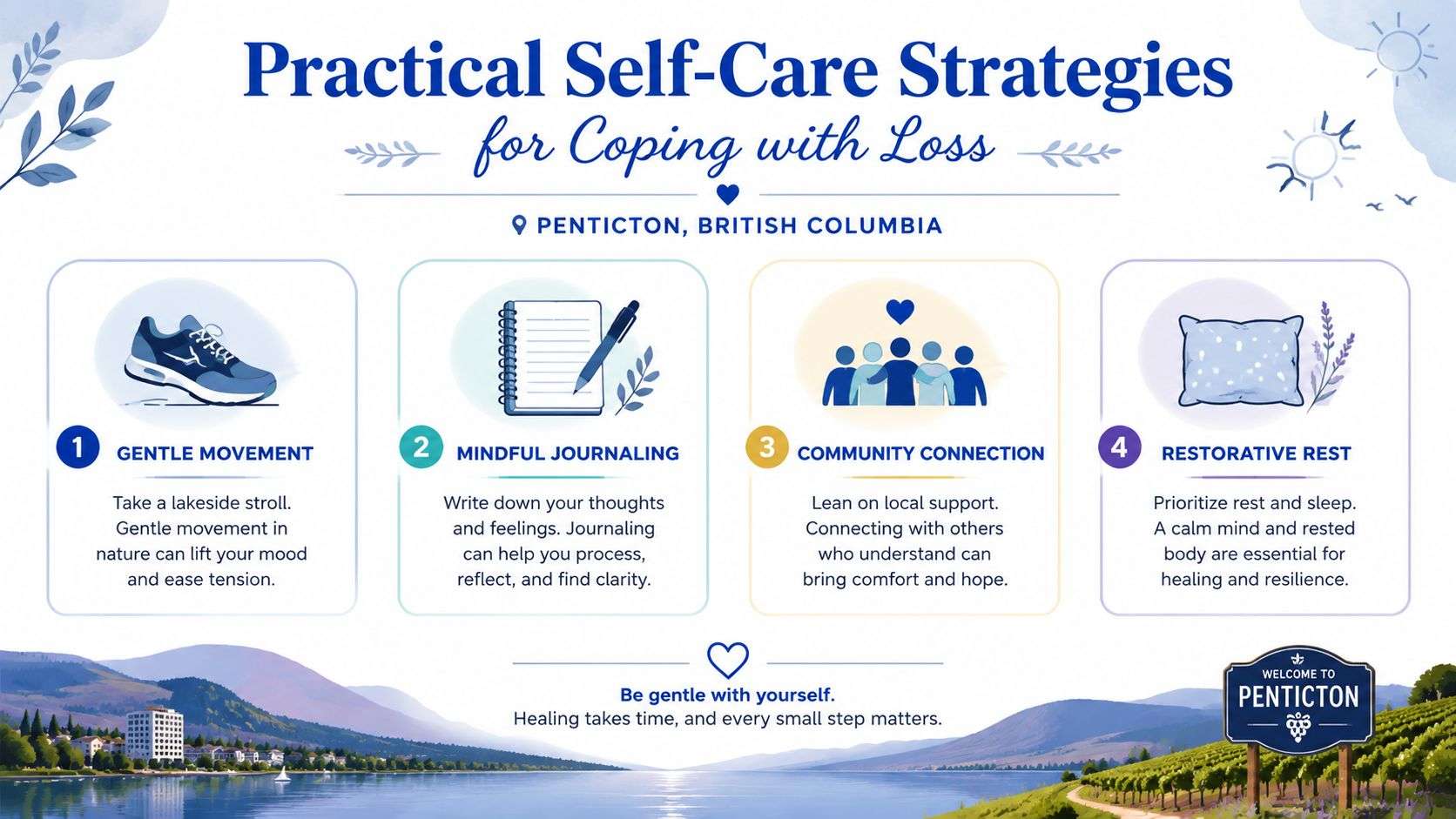
When grief is heavy, self-care can sound like too much work. That's why it helps to think small. Not perfect routines. Not dramatic change. Just gentle actions that make the day a little more livable.
Start with the body you have today
Grief often disrupts basic care. Appetite changes. Sleep becomes uneven. Water, fresh air, and simple meals can fall off the list.
Try "grief-friendly" care instead of ideal care:
- Keep food simple. Toast, soup, fruit, yogurt, crackers, or easy freezer meals count.
- Put water where you'll see it. A glass beside the kettle or on the bedside table helps.
- Lower the bar for rest. If sleep is hard, quiet rest still matters. Lying down with soft music counts.
Use movement as a release valve
You don't need a hard workout. Many grieving people respond better to gentle, rhythmic movement. A short walk along the waterfront, light stretching, or standing outside for a few minutes can help your body come out of survival mode.
Try one of these:
- A ten-minute walk with no pressure to feel better
- Slow stretching before bed
- A familiar route that gives your day some shape
The goal isn't to outrun grief. It's to give it somewhere to move.
Give your thoughts a place to land
Journalling can help when your mind keeps circling. You don't need polished writing. A few honest lines are enough.
Prompts that often help:
- What feels hardest today?
- What do I wish people understood?
- What do I miss right now?
- What helped me get through the last 24 hours?
Write badly if you need to. Honest writing helps more than polished writing.
Protect your energy with kind boundaries
Many people around you will want to help. Some will help well. Some won't know how. You are allowed to guide the contact.
You might say:
- "Thank you for checking in. I don't have much energy for talking today."
- "I'd love practical help more than a visit right now."
- "I'm not ready to discuss details, but I appreciate your care."
Boundaries are not rejection. They are a way of caring for yourself while grieving.
Local Grief Support Resources in Penticton and the South Okanagan
When you're hurting, it helps to know exactly where support exists. Penticton and the South Okanagan have several community-based grief resources that can offer structure, connection, and a sense that you don't have to carry this alone.
South Okanagan Loss Society
The South Okanagan Loss Society serves Penticton and surrounding communities and helps fill an important gap in grief support in the interior of British Columbia. It offers structured grief counselling and weekly facilitated support groups on a donation basis, according to Castanet's coverage of the society's grief support services.
Its two primary groups include:
- Seniors-specific loss group meeting Monday mornings at 10:30 AM at Leir House, 220 Manor Park Avenue, Penticton, BC
- Conversations on Loss and Grief meeting Tuesday evenings from 6:30 to 8:30 PM at Community Futures, #102-3115 Skaha Rd., Penticton
These groups are facilitated by trained counsellors. For many people, that combination of regular schedule, peer presence, and accessible format can make it easier to reach for support.
Regional options across the Okanagan
Grief support in the wider Okanagan has also grown to include different formats. The Central Okanagan Hospice Association lists specialized programming in 2025, including Grief and Yoga, a six-week program running June 4 to July 9 on Wednesdays from 2:00 to 3:00 PM, and a Mixed Loss Grief Group, an eight-week program running July 8 to August 26 on Tuesdays from 10:00 AM to 12:00 PM. The North Okanagan Hospice Society also lists free weekly walking groups on Thursdays from 10:00 to 11:00 AM at Polson Park in Vernon and notes a suggested donation for one-to-one grief counselling, as shown on the Central Okanagan Hospice Association adult grief and bereavement page.
That variety matters. Some people are more comfortable sitting in a room and talking. Others open up more through walking, movement, or quieter group formats.
Support can include community rituals too
For some people, especially those connected to a faith community, grief support also includes shared rituals of remembrance and prayer. If a church is looking for a gentle way to receive private requests from people who are grieving, this guide to building a virtual church prayer box may be useful as a practical community care tool.
If in-person attendance feels difficult, many counselling services also offer phone or secure virtual sessions. That can be especially helpful when privacy, transportation, or emotional energy are barriers.
Answering Your Questions About Grief Counselling
What if I'm worried about seeing my counsellor at the grocery store
That's a very common concern in a small community. It doesn't mean you're overthinking. It means privacy matters to you.
A counsellor understands that. Professional ethics include protecting your confidentiality. Many counsellors won't approach you in public unless you choose to greet them first. If this worries you, bring it up directly in your first session. You're allowed to ask how public encounters are handled.
How do I know if my grief is normal or if I need help
Most grieving people wonder this. In general, grief can involve intense sadness, numbness, anger, fatigue, poor concentration, and changing sleep or appetite. Those experiences can all fall within a normal grief response.
What matters is less whether your grief looks "normal" and more whether you feel supported enough to carry it. If your days feel unmanageable, if you feel stuck and alone, or if you're finding it hard to function in ways that concern you, that's a good reason to seek help. You don't need a perfect threshold.
Do I have to be at rock bottom to start counselling
No. Many people begin counselling long before any crisis point. Some come because they want a place to talk openly. Others come because caregiving, family strain, or constant reminders are wearing them down.
Starting earlier can make grief feel less isolating. It can also help you build steadier ways of coping before anniversaries, legal tasks, or family pressures pile up.
Reaching out early is not overreacting. It's often a wise form of care.
What's the difference between talking to a friend and talking to a counsellor
A caring friend can be a gift. A counsellor offers something different. The space is confidential, focused, and designed to support your process without asking you to take care of the other person's feelings.
A counsellor also brings training. They can notice patterns, help with trauma responses, guide conversations around complicated emotions, and support you through changes in identity, family roles, and meaning after loss.
What if I don't cry in counselling
That's okay. Tears are one way grief shows up, not the only way. Some people speak calmly. Some feel numb. Some laugh unexpectedly. Some need several sessions before emotion arrives in a fuller way.
You don't have to prove your pain. Your grief is real even if it doesn't look dramatic.
If you're looking for a private, steady place to talk through loss, caregiving strain, or life after bereavement, Interactive Counselling offers information about counselling support in Canada, including options that may fit in-person, phone, or secure virtual care.
Clinically Reviewed By
Amy Mosset, MCP, RCC-S
Amy Mosset is a Master Practitioner in Clinical Counselling, Clinical Supervisor, and the owner of Interactive Counselling. She provides trauma-informed, evidence-based care and clinical supervision to registered therapists, with a focus on ethical practice, client safety, and high-quality therapeutic outcomes.