Oilfield burnout symptoms often show up as emotional exhaustion, cynicism, and reduced effectiveness, and the warning signs are common enough that half of oil and gas workers describe their work as exhausting and 39% feel emotionally frustrated. The most helpful response is not to “tough it out,” but to recognise the specific pressures of northern Alberta work, steady your nervous system in the moment, build routines that fit rotation life, and get support before the strain hardens into something more serious. For more information, see our depression counselling.
"Oilfield burnout symptoms include emotional exhaustion, cynicism, and reduced effectiveness, and they're best managed by recognising oil patch stressors early and using a practical plan for coping, routine, and support."
If you're reading this in camp, in your truck before heading home, or late at night after another long shift, you might already know something feels off. You may still be getting the job done, but it takes more out of you than it used to. Small problems hit harder. Sleep doesn't restore much. Time at home feels too short, and time at work feels too long.
That doesn't mean you're weak. It usually means your body and mind have been carrying too much for too long.
Understanding the Signs of Oilfield Burnout
A lot of workers tell themselves they're “just stressed.” Sometimes that's true. Stress tends to rise around a deadline, a shutdown, a conflict, or a hard stretch, then settle once the pressure eases. Burnout feels different. It lingers. It follows you into your days off. It changes how you think, how you sleep, and how much patience you have left for the people you care about.
Burnout rarely starts with one dramatic breakdown. More often, it creeps in through a series of smaller changes. A 2023 survey including Canadian oil and gas workers found that half describe their work as exhausting and 39% feel emotionally frustrated. In Canada more broadly, 69% of all employees report symptoms that can develop into burnout, with fatigue being the number one symptom cited by 40% according to Benefits Canada's reporting on worker burnout survey findings.
Physical signs that look like “just being tired”
In oilfield work, physical fatigue can get normalised fast. People expect long days, changing weather, disrupted sleep, and demanding tasks. That can make burnout harder to spot.
Common physical signs include:
- Sleep that stops feeling restorative. You sleep, but wake up heavy, foggy, or on edge.
- Constant fatigue. Not the kind fixed by one good night off, but the kind that keeps showing up.
- Tension in the body. Tight shoulders, clenched jaw, headaches, stomach issues, or feeling keyed up.
- More errors or slower reaction time. Your mind isn't as sharp, especially near the end of a stretch.
- Using caffeine, nicotine, or scrolling to push through. These can seem harmless at first, but often become signs that your system is overextended.
Burnout often looks ordinary from the outside. The worker still shows up, still performs, still says “I'm fine.” The cost is what happens underneath.
Emotional signs that are easy to dismiss
The emotional side of burnout often gets hidden behind irritability. Many workers don't describe themselves as anxious or overwhelmed. They say they're “short,” “numb,” or “done with people.”
Watch for signs like:
- Emotional exhaustion. You feel drained before the day really starts.
- Cynicism. You care less, trust less, and assume the worst more quickly.
- Frustration that arrives faster. Minor issues feel like major insults.
- Feeling detached from home life. You're physically present, but not really available.
- A low, steady sense of dread before heading back out.
Behavioural signs on site and at home
Burnout changes behaviour. Sometimes your partner notices before you do.
You might see it in patterns such as:
- Pulling away from calls or messages
- Snapping at co-workers or family
- Losing interest in hobbies or downtime
- Going quiet instead of talking
- Feeling ineffective even when you're working hard
One of the hardest parts of oilfield burnout symptoms is that they can clash with how workers see themselves. If you're proud of being dependable, you may keep pushing long after your system has started to protest. That's why self-recognition matters. Naming the pattern early gives you more options, and usually much better ones, than waiting until things fall apart.
Why the Northern Alberta Oilfield is a Pressure Cooker
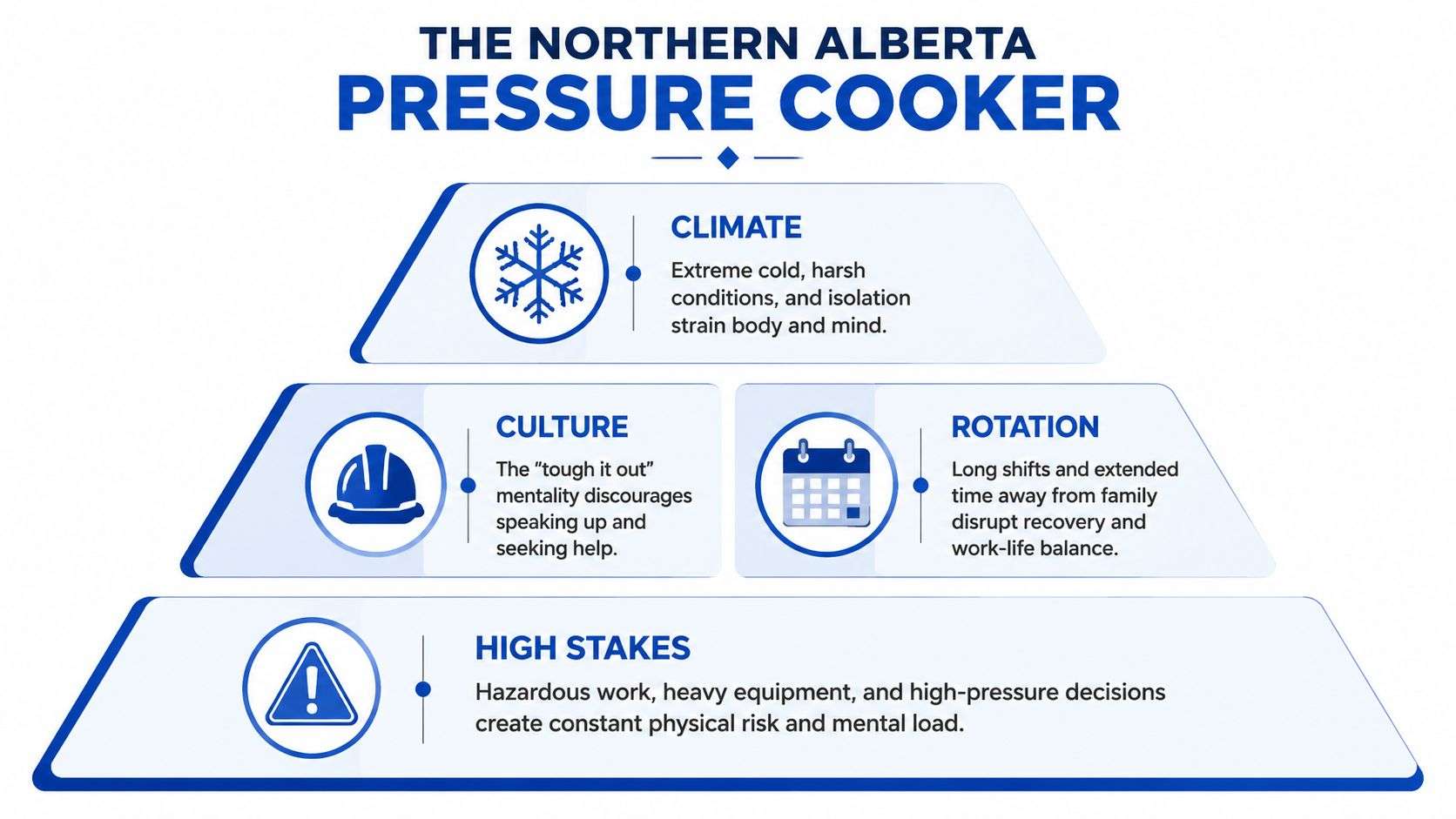
Northern Alberta work isn't stressful only because the job is hard. It's stressful because the demands stack. Long shifts, camp life, distance from family, weather, safety pressure, and a workplace culture that may reward silence all combine into something much heavier than “a busy season.”
Rotation work changes more than your schedule
FIFO and DIDO life can create a repeated cycle of separation, strain, and abrupt adjustment. Some workers feel themselves tighten up near the end of a rotation. Others notice the crash once they get home, when their body finally stops running on output alone.
Research on Canadian Arctic FIFO oil workers found that stressors intensify near the end of a rotation. In that study group, 68% reported problems in relationships with partners, 62% cited financial stress, and 60% felt socially isolated, as described in the study on burnout syndrome among oil workers. Those patterns line up with what many northern Alberta workers and families already know firsthand.
The culture can make people suffer quietly
A lot of oilfield workers are highly capable under pressure. That strength is real. The problem starts when strength gets confused with never speaking up.
In some crews and camps, people still worry that admitting stress means they're unreliable, soft, or not cut out for the work. So instead of saying, “I'm not doing well,” they say nothing. They isolate. They work harder. They drink more on days off. They shut down emotionally at home.
That doesn't solve burnout. It hides it.
High stakes keep the nervous system running hot
This kind of work carries real consequence. Safety matters. Attention matters. Conditions change. Mistakes can hurt people. Even when nothing dramatic happens, your body may stay in a low-grade state of alert for long stretches.
A simple way to picture it is this:
| Pressure source | How it affects you |
|---|---|
| Long rotations | Less recovery time, more emotional wear |
| Distance from family | Loneliness, guilt, relationship strain |
| Camp or remote living | Reduced privacy, less real downtime |
| Tough-it-out culture | Delayed help-seeking, bottled-up stress |
| Hazard and responsibility | Ongoing vigilance, harder mental shutdown |
When people understand the environment, they often stop blaming themselves. That shift matters. Burnout is often a human response to relentless conditions, not a character flaw.
If your stress feels more intense in this setting, that makes sense. The solution isn't pretending the environment doesn't matter. It's responding in a way that respects the environment and your limits inside it.
Immediate Strategies to Reduce On-the-Job Anxiety
When anxiety hits during a shift or in camp, you usually don't need a deep life overhaul in that moment. You need something you can do subtly, quickly, and without drawing attention. The goal is not to erase stress. The goal is to lower the intensity enough that you can think clearly again.

Use your body first
An anxious brain rarely calms down from arguing with itself. Start with the body.
Try one of these:
- Slow your exhale. Breathe in gently through your nose, then make the exhale longer than the inhale. Don't force it. A longer exhale tells your body the threat level has come down.
- Plant your feet. Press both feet into the floor and notice the pressure. This sounds simple because it is. It also helps interrupt the “spinning out” feeling.
- Release one muscle group at a time. Unclench your jaw. Drop your shoulders. Uncurl your hands. Anxiety often stays locked in the body long after the trigger passes.
Narrow your focus when your mind is racing
If your thoughts are spiralling, use a grounding drill. One practical option is the 5-4-3-2-1 method:
- Notice five things you can see
- Notice four things you can feel
- Notice three things you can hear
- Notice two things you can smell
- Notice one thing you can taste
This works because it pulls attention out of the future and back into the present environment.
Practical rule: If your thoughts are moving too fast, don't chase them. Shrink the task. Calm the body. Complete the next safe step.
Take a strategic mental reset
A reset is not the same as checking out. It's a deliberate interruption to stop overload from building.
A useful reset might look like:
- Step outside or into a quieter space for two minutes
- Drink water slowly instead of rushing it
- Write one sentence in your notes app about what's bothering you
- Replace “I need to get through all of this” with “I need to do the next thing well”
For workers who want extra practical ideas on stress, sleep, and routines, the Peak Performance podcast on staying healthy offers general lifestyle tips that fit well alongside counselling strategies.
What usually doesn't work in the moment is pretending you're not activated, hammering more caffeine into an already overstimulated system, or mentally rehearsing every possible worst-case scenario. Anxiety loves speed. Relief usually starts with slowing things down.
Building a Resilient Routine for Life on Rotation
A resilient routine matters most on the days you do not feel resilient.
Rotation work in Northern Alberta puts pressure on the same few fault lines over and over. Sleep gets pushed around by shift timing. Meals get irregular. Home life can start to feel far away even when you are texting every day. Then days off get loaded with chores, family pressure, and the expectation that you should bounce back fast. A routine helps reduce that wear and tear before it turns into shutdown, irritability, or constant dread before the next hitch.
Research on oilfield mental health has linked long hours and poor sleep with higher strain, and practical prevention usually starts with sleep, boundaries, and body-clock habits.

Protect sleep like it's part of the job
In practice, it is.
Workers often try to power through a rough stretch by borrowing from sleep. That can work for a shift or two. After that, concentration drops, small frustrations hit harder, and anxiety gets louder at night because the body is too wound up to settle properly.
A workable sleep routine on rotation often includes:
- Keeping the same wind-down order each night. Shower, snack, dark room, phone away, lights out. The sequence matters more than making it perfect.
- Reducing stimulation before bed. Less scrolling, fewer conflict-heavy conversations, and less checking work messages once you are done.
- Using light on purpose. Bright light helps on wake-up. Lower light helps your body come down.
- Treating catch-up sleep with caution. Extra rest helps, but relying on weekends off to fix chronic sleep debt usually leaves people disappointed and still exhausted.
Build a routine you can keep during a hard hitch
The routine has to survive fatigue, camp life, and long days. If it only works when motivation is high, it is too complicated.
I usually suggest picking a few anchor habits that can travel with you from site to site and from good weeks to bad ones.
| Anchor habit | Why it helps |
|---|---|
| Ten-minute walk or movement break | Lowers physical tension and helps the body come down after high alert |
| Regular meal timing when possible | Prevents energy crashes that can feel like anxiety or anger |
| One intentional check-in with home | Keeps connection steady instead of turning every call into problem-solving |
| A cut-off for work talk after shift | Gives your mind a clear signal that recovery has started |
That last one matters more than people expect. In oilfield culture, there can be pressure to stay switched on all the time, especially if you want to be seen as dependable. The trade-off is that constant mental availability eats into recovery. Reliable workers still need an off switch.
Make days off support recovery, not just catch-up
A lot of rotation workers come home and go straight into another full-time role. Parent. Partner. Fix-it person. Errand runner. That is real life, and most families need help. But if every day off becomes a sprint, the next rotation starts with an empty tank.
Recovery works better when it includes a bit of structure:
- One activity that settles your nervous system. Reading, stretching, prayer, music, a shower, quiet coffee, or time outside.
- One activity that strengthens connection. A meal with your family, a walk with your partner, a consistent bedtime routine with your kids, or a call with someone who gets it.
- One activity that reminds you who you are outside work. A hobby, a gym session, coaching, tinkering in the garage, or anything that is yours.
Small routines are easier to repeat. Repetition is what makes them protective.
If a routine keeps falling apart, that usually does not mean you are lazy or bad at coping. It usually means the plan does not match the reality of FIFO or DIDO life yet. Strip it down. Make it simpler. Keep the parts that help. Routine will not remove camp stress, separation from family, or the pressure to keep performing. It does reduce how much those stressors can run your life.
Communicating Your Needs and Finding Professional Support
A lot of workers wait until things are severe before they talk to anyone. By then, they may be dealing with conflict at home, poor sleep, rising anger, or a level of anxiety that's affecting concentration. Earlier conversations are usually more effective and less painful.
The hard part is knowing how to raise concerns without feeling like you're making trouble. That's where wording matters.
What to say at work
You don't have to disclose everything to ask for support. You also don't need the perfect script.
A grounded approach sounds like this:
- Be specific about impact. “I'm noticing my concentration and recovery are slipping.”
- Name the work condition, not just the emotion. “The current rotation and fatigue are catching up with me.”
- Make a practical request. “I want to talk about what support or adjustments are available.”
- Stay focused on safety and sustainability. Those are often easier for workplaces to hear.
If your company has an employee assistance programme, occupational health contact, or internal mental health resource, use it. If there's a supervisor you trust, start there. Keep notes on what you've been experiencing and what you're asking for. Clear communication helps.
What counselling actually helps with
Therapy is often misunderstood as a place where you just vent and get told to “take care of yourself.” Good counselling is more concrete than that.
It can help you:
- Identify what kind of burnout pattern you're in
- Learn tools for anxiety, sleep disruption, and irritability
- Untangle work stress from relationship stress
- Set boundaries without guilt
- Prepare for hard conversations at work or at home
The trade-off is important to be honest about. Individual support matters, but it can't fully cancel out a punishing environment. That's why effective management usually involves both personal coping and practical use of workplace resources or accommodations. Even where organisations have made efforts to normalise help-seeking, workers still do better when support is paired with changes in the conditions adding pressure.
Getting help is not the opposite of resilience. It's often the moment resilience becomes intentional instead of reactive.
When to stop waiting
Consider reaching out sooner if:
- You dread going back to site every rotation
- Your anger feels harder to control
- You feel disconnected from your partner or kids
- You can't shut your mind off even when you're exhausted
- You're starting to think “this is just who I am now”
Those are not signs that you've failed. They're signs that the current strategy of pushing through isn't giving your system what it needs.
Frequently Asked Questions About Oilfield Burnout
| Question | Answer |
|---|---|
| How do I know if this is burnout and not just a rough stretch? | A rough stretch usually eases when the shutdown ends, the crew changes, or you get a few solid days off. Burnout hangs on longer than the trigger. It often shows up across work and home at the same time. You might notice constant fatigue, a shorter fuse, numbness, dread before heading back to site, or trouble settling into family life even during days off. If the stress keeps following you through the whole rotation cycle, treat it as a sign that something needs attention. |
| Can I recover without quitting the oilfield? | Sometimes, yes. I've seen people improve without leaving the industry, but it usually takes more than just trying harder. Recovery often depends on a mix of better sleep protection, fewer off-shift demands, clear limits with overtime or constant availability, and honest support at home or through counselling. If camp life, travel, or crew pressure keep pushing you past your limit and nothing changes, recovery gets harder. That does not always mean leaving the patch. It may mean changing how you work, recover, and ask for help. |
| How do I talk to my partner about what's going on? | Keep it plain and specific. Try, “I've been more shut down than I thought,” or “Work is sticking with me when I come home.” That gives your partner something real to respond to. Then name what would help: a quiet evening before big conversations, a check-in call during rotation, or support booking counselling. In oilfield families, people often get stuck talking only about schedules and logistics. The harder conversation is about distance, irritability, and feeling like you are no longer fully present. That conversation matters more. |
| Will asking for help hurt my job? | That fear makes sense in a culture where toughness and reliability carry a lot of weight. You do not have to share every personal detail to ask for support. In many cases, it helps to keep the conversation focused on fatigue, concentration, sleep disruption, and staying safe and steady on the job. If your workplace has supports, use them. If you are unsure how to raise the issue without saying too much, a counsellor can help you plan the conversation. |
| What if I'm not in crisis, but I know I'm not doing well? | That is often the best time to get support. You do not need to hit a wall before you take your stress seriously. It's important to be honest about the trade-off. Waiting can feel easier in the short term, especially during a busy run, but early support is often what prevents a deeper crash. It can help you sleep better, lower work anxiety, and reduce conflict at home before those patterns harden. |
If oilfield burnout symptoms are starting to shape your sleep, your mood, or your relationships, it may help to speak with someone who understands how stress shows up in real life, not just in theory. Interactive Counselling offers support for individuals, couples, and families working through anxiety, burnout, relationship strain, and life on demanding schedules.
Clinically Reviewed By
Amy Mosset, MCP, RCC-S
Amy Mosset is a Master Practitioner in Clinical Counselling, Clinical Supervisor, and the owner of Interactive Counselling. She provides trauma-informed, evidence-based care and clinical supervision to registered therapists, with a focus on ethical practice, client safety, and high-quality therapeutic outcomes.