In Canada, 7.6% of people aged 15 and older, about 2.1 million individuals, have experienced PTSD in their lifetime, and PTSD is deeply tied to nervous system dysregulation after trauma. If you feel jumpy, exhausted, numb, panicky, or unlike yourself long after something difficult happened, your body may still be trying to protect you. For more information, see our trauma counselling.
You might be reading this because your sleep is off, your body feels tense for no clear reason, or small things suddenly feel too big. Maybe you're tired all day but wide awake at night. Maybe you cry easily, snap at people you love, or go completely blank when you're stressed. These experiences can feel confusing, especially if part of you thinks, “That was over already. Why am I still reacting?”
"Nervous system dysregulation after trauma is when the body's survival system gets stuck in high-alert or shutdown mode long after a traumatic event has passed."
That stuck feeling is not a character flaw. It isn't weakness, attention-seeking, or proof that you're “broken.” It is often a protective response from a body that learned danger was possible, and then had trouble returning to a steady baseline. For many people, the body keeps sounding the alarm even when life looks safe on the outside.
There can also be relief in knowing you're not alone. In Canada, 7.6% of people aged 15 and older, approximately 2.1 million individuals, have experienced PTSD in their lifetime, according to the Canadian Community Health Survey analysis published by the National Library of Medicine. That number doesn't capture every person living with trauma-related stress, but it does show that trauma-related nervous system disruption is common enough that many families, classrooms, workplaces, and relationships are already affected by it.
Introduction That wired and tired feeling after trauma
A lot of people describe trauma recovery with a frustrating phrase: wired and tired. Your body feels like a car engine revving in park. You want rest, but your system won't settle. Or the opposite happens. You know you need to get something done, but your body feels heavy, distant, and switched off.
Both reactions can come from the same survival system.
When your body is trying to protect you
After trauma, the nervous system often becomes more focused on scanning for danger. That can look obvious, like panic or startle responses. It can also look subtle, like overthinking, digestive upset, irritability, zoning out, or needing constant reassurance.
A person recovering from a frightening event might notice things like:
- Sleep changes that don't make sense, such as feeling exhausted but unable to fall asleep
- Body tension in the jaw, shoulders, stomach, or chest
- Emotional swings between anxiety, anger, numbness, and sadness
- Difficulty concentrating even on simple tasks
- A strong need for control because uncertainty feels unsafe
None of that means your body is overreacting on purpose. It means your system may still be organised around survival.
Your symptoms may be distressing, but they also make sense when you understand what your body has been through.
Why people often feel ashamed
Many trauma survivors know, logically, that the event is over. Their body doesn't always get that message right away. That gap between what you know and what you feel can create shame.
Adults often say things like:
- “I should be over this.”
- “Other people have had it worse.”
- “Why do I freeze over something so small?”
- “Why can't I just calm down?”
Children and teens may not say those words, but they can show the same distress through behaviour. They might cling, shut down, lash out, avoid school, or seem “fine” until one small stress tips everything over.
That is why education matters. When people understand nervous system dysregulation after trauma, they often stop blaming themselves and start responding with more skill and compassion.
Your body's alarm system understanding the science of survival
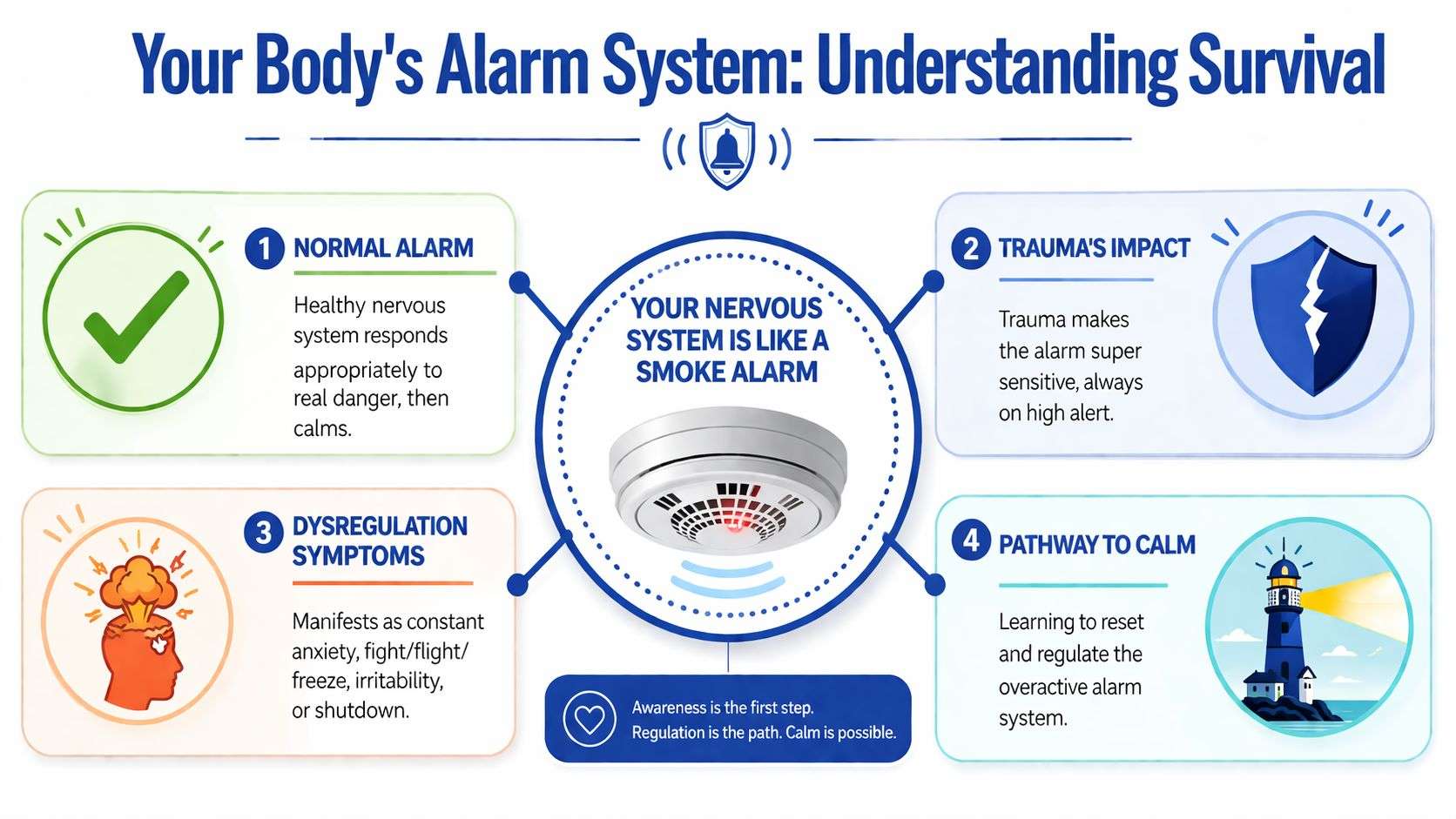
A simple way to think about the nervous system is this: it works like a home's smoke alarm.
A healthy smoke alarm goes off when there's real danger, then quiets down when the danger passes. After trauma, the alarm can become too sensitive. Steam from the shower sets it off. Burnt toast sets it off. A memory, a sound, a smell, or a look on someone's face can set it off.
The accelerator, the brakes, and the shutdown switch
Your autonomic nervous system runs many automatic survival functions. You don't have to consciously tell your heart to beat or your lungs to breathe. This system is always working in the background.
A car analogy can help:
| System | Simple analogy | What it can feel like |
|---|---|---|
| Sympathetic activation | The accelerator | Fast heartbeat, anxiety, restlessness, anger, urgency |
| Parasympathetic settling | The brakes | Calm, digestion, rest, connection, recovery |
| Freeze or shutdown | The system stalls out | Numbness, collapse, disconnection, fog, heaviness |
When trauma happens, the body may move into fight, flight, or freeze to survive. Those are intelligent responses. Problems start when the system can't reliably return to a steadier state after the danger is gone.
The window of tolerance
Therapists often use the phrase window of tolerance. This means the range in which you can feel, think, and respond without becoming overwhelmed or shut down.
Inside your window, you can usually:
- Think clearly
- Notice feelings without drowning in them
- Stay present during stress
- Make choices instead of reacting automatically
- Recover more easily after something upsetting
When trauma narrows that window, ordinary stress can feel huge. A loud noise, conflict with a partner, an unexpected email, school pressure, or traffic can push the body into alarm or shutdown faster than expected.
, trauma survivors can show reduced connectivity between the prefrontal cortex and limbic system by up to 30%, a 40 to 60% constriction of the window of tolerance, and trauma-related HPA axis changes affecting up to 90% of survivors. In plain language, the brain areas involved in emotion, threat, and thoughtful decision-making can have a harder time working together smoothly after trauma.
Why logic alone often doesn't fix it
Many people get confused by this. They think, “I know I'm safe, so why do I still feel unsafe?”
Because trauma is not only a story stored in words. It's also a pattern stored in the body.
When the alarm system fires, the body may react before your thinking brain catches up. That's why you might understand a trigger intellectually and still feel shaky, flooded, frozen, or detached. If you want a practical explanation of that split-second reaction, this article from Interactive Counselling on triggers can help connect the dots.
For people recovering after a crash, this can be especially confusing. The body may react strongly even when injuries seemed minor at first or symptoms appeared later. In those situations, a legal education resource like this guide to delayed car accident injury claims can help explain why trauma responses and physical symptoms don't always show up on a simple timeline.
Practical rule: If your body reacts “too fast,” that doesn't mean you're irrational. It often means your survival system is doing its job a little too well.
What nervous system dysregulation looks and feels like
Many people expect trauma symptoms to look dramatic. Sometimes they do. Just as often, they look ordinary enough that people miss them.
A parent may think, “I'm just impatient lately.”
A teen may think, “I'm just bad at school.”
A partner may think, “We're just fighting more.”
An injured driver may think, “I'm just being weird about traffic now.”
Sometimes the common thread is nervous system dysregulation after trauma.

In adults
In adults, dysregulation can show up physically, emotionally, mentally, and relationally all at once.
A person in a hyper-alert state might:
- Startle easily at sounds, touch, or sudden changes
- Feel restless even when they want to relax
- Become irritable quickly over small frustrations
- Replay conversations and scan for signs of danger or rejection
- Avoid places or people that remind them of what happened
A person leaning more toward shutdown might instead notice:
- Brain fog and trouble finding words
- Emotional numbness or feeling detached from life
- Heavy fatigue that doesn't feel solved by rest
- A sense of disconnection from their own body
- Difficulty caring about things they usually value
Some people swing between both. One day they feel anxious and agitated. The next day they feel flat and exhausted. That back-and-forth can be especially unsettling.
In children and youth
With children, the signs are often easier to misread.
A child rarely says, “My nervous system feels dysregulated.” More often, you see tears, refusal, clinginess, aggression, stomach aches, bedtime struggles, school avoidance, or a meltdown that seems “too big” for the situation.
, in younger clients trauma disrupts the vertical integration between subcortical feeling regions and cortical thinking regions, creating sensory-emotional overwhelm. Because children are still developing the ability to reflect on and verbalise internal experiences, distress often appears as behaviour rather than a clear explanation.
That can change how adults respond.
Instead of asking only, “How do I stop this behaviour?”
it can help to ask, “What is this behaviour communicating about the child's state?”
A younger child may:
- Refuse transitions because their body can't shift gears smoothly
- Become silly or wild when overstimulated
- Cry over small changes because the system is already overloaded
- Need more closeness after feeling unsafe
- Complain of body discomfort when stress is hard to name
An adolescent may look different. They may pull away, sleep oddly, become more reactive, seem perfectionistic, or shut down completely when asked what's wrong.
If you want a deeper overview of how trauma affects the nervous system, that resource can be useful for adults trying to understand their own symptoms or a child's.
A dysregulated child is not giving you a hard time. They are often having a hard time.
In relationships
Trauma doesn't stay neatly inside one person's body. It often spills into connection.
Dysregulation in relationships can look like:
| Relationship pattern | What may be happening underneath |
|---|---|
| Arguments escalate fast | One or both nervous systems move into threat mode |
| Withdrawal after conflict | Shutdown or protective distancing |
| Need for reassurance | The body is scanning for abandonment or danger |
| Trouble with intimacy | Closeness may feel vulnerable or activating |
| Misreading tone or facial expression | A sensitised system assumes threat quickly |
A common cycle looks like this: one person gets activated, the other gets defensive, both feel unsafe, and neither feels understood. The issue on the surface may be dishes, texting, parenting, or money. Underneath, the body may be asking, “Am I safe with you right now?”
Understanding that doesn't erase accountability. It does create room for more skillful repair.
Pathways to regulation evidence-based therapeutic approaches
Healing doesn't mean never feeling stress again. It means your system becomes more flexible. You can move through activation without getting stuck there as easily, and you can return to steadiness more reliably.
A good trauma therapist isn't trying to force you to “calm down.” They are helping your body learn safety, often in small and repeatable ways.
Co-regulation comes first
Before self-regulation grows, many people need co-regulation.
Co-regulation happens when another steady person helps your nervous system feel less alone and less overwhelmed. In therapy, that can mean a calm pace, clear boundaries, predictable sessions, permission to slow down, and a therapist who helps you notice when you're becoming flooded or shutting down.
For children, co-regulation often starts with caregivers. A regulated adult voice, posture, rhythm, and presence can help a child's body settle before words ever do.
How specific therapies help
Different approaches support the nervous system in different ways.
Somatic approaches
Somatic therapy focuses on what is happening in the body, not only what happened in the story. A therapist may help you notice tightness, temperature, breath, posture, movement impulses, or a small shift toward settling.
This can help when trauma feels “stuck” physically. The goal isn't to overwhelm you with sensation. It's to build tolerance gently, so the body can complete protective responses and regain a sense of safety.
EMDR
Eye Movement Desensitisation and Reprocessing helps the brain process traumatic memories that feel frozen in time. With support and structure, the person attends to a memory while using bilateral stimulation, such as eye movements or alternating taps.
For many people, the value of EMDR is that it doesn't require endless retelling. It helps traumatic material become more integrated, so reminders of the event carry less immediate charge. If you're curious about the process, this step-by-step guide to EMDR explains it in clear language.
Sensorimotor and body-based work
Some therapies pay close attention to posture, gestures, muscle tension, and defensive patterns. A person may discover, for example, that their shoulders rise before they even notice fear, or that they hold their breath when they expect criticism.
When that becomes visible, there is room for choice.
Talk therapy still matters
People sometimes hear “body-based” and assume talking doesn't help. That's not quite right.
Trauma-informed forms of CBT, DBT, and other talk therapies can be very useful when they are paced well and matched to the person's state. They can help with:
- Naming triggers
- Building coping plans
- Challenging trauma-related beliefs
- Practising boundaries
- Creating daily structure and support
The key is timing. When a person is far outside their window, insight alone may not land. First the body needs enough safety to receive the insight.
Good trauma therapy doesn't push for disclosure faster than your nervous system can handle.
Practical skills to reclaim your calm in the moment
When you're dysregulated, the best skill is often the simplest one you can use. You don't need a perfect routine. You need something small enough that your body can say yes to it.

Putting on the brakes when you're revved up
If you feel panicky, restless, or overstimulated, try signals of safety and slowing.
- Feel your feet. Press them gently into the floor and notice the support underneath you. This gives the body concrete information about where you are right now.
- Orient to the room. Slowly look around and name a few neutral things you see, such as a lamp, a window, a blue chair, a plant. This helps remind the brain that the present moment is different from the past.
- Lengthen the exhale. Breathe in gently, then let the exhale be a little longer than the inhale. Don't force it. The point is not performance. The point is signalling “we can slow down.”
- Add contact. Place a hand on your chest, cheek, or forearm if that feels okay. Supportive touch can help some people feel more anchored.
A simple script can help: “I'm here. This is a chair. This is the floor. I'm noticing the room.”
Gently pressing the gas when you're shut down
Shutdown needs a different approach. If you feel foggy, numb, collapsed, or far away, strong calming strategies can sometimes make you feel more distant. Instead, try a little more energy.
Consider:
- Small movement such as rolling your shoulders, standing up, or walking to another room
- Temperature change like cool water on your hands
- Sound such as humming softly or listening to steady music
- Visual focus by looking at light, colour, or movement outside a window
The aim is not to jolt yourself. It is to invite a little more presence.
Skills that work better with repetition
These practices tend to become more effective when used often, not only in crisis:
| Skill | Why it can help |
|---|---|
| Grounding | Brings attention to the present environment |
| Breath awareness | Gives the body a rhythm cue for settling |
| Gentle stretching | Releases some protective tension |
| Pleasant sensation tracking | Helps the brain notice safety, not only threat |
| Structured thought tools | Supports perspective when anxiety grows |
If your mind races alongside body stress, practical cognitive tools can help too. These CBT exercises for anxiety can work well alongside body-based regulation skills.
Try to notice what helps by even 5%. Trauma recovery often grows through small shifts, not dramatic moments.
How compassionate counselling supports your healing journey
Healing often becomes easier when you don't have to do it alone.
A trauma-informed counsellor pays attention not only to what happened, but to how your body responds while talking about it. They don't assume that more detail is always better. They help create safety through pacing, collaboration, choice, and respect for your limits.

What support can look like in practice
In counselling, support may include:
- Tracking patterns so you can recognise early signs of activation or shutdown
- Building language for body sensations, emotions, and triggers
- Practising regulation in a safe and structured setting
- Supporting caregivers so children have more co-regulation at home
- Working gradually with traumatic memories instead of forcing exposure too quickly
This matters across age groups. A child may need play, rhythm, and caregiver involvement. A teen may need privacy, body awareness, and help naming internal states. An adult may need support reconnecting with their body after years of overriding it.
After a motor vehicle accident
Motor vehicle accidents can create a very specific kind of nervous system disruption. A person may look physically recovered and still feel intensely activated in traffic, at intersections, during sudden braking, or even as a passenger.
, for clients recovering after an MVA, counselling can address hypervigilance while driving and specific body memory anchors. In BC, ICBC-funded therapy can form part of a structured recovery pathway that connects nervous system healing with the practical demands of returning to daily routines and driving.
For readers who want to explore care options, Interactive Counselling services offers an overview of available support for individuals, children, youth, couples, and families.
Frequently asked questions about nervous system healing
How long does it take to heal my nervous system
There isn't one timeline that fits everyone. Healing depends on many things, including the kind of trauma, how long the stress lasted, current supports, sleep, safety, relationships, and whether the trauma is still ongoing.
What often helps is shifting the goal. Instead of asking, “When will I be completely over this?” it can be more useful to ask, “Am I recovering a little faster, noticing more choices, and getting stuck less often?” Healing is often uneven. A hard week doesn't mean you're back at the beginning.
Can I heal without therapy
Some people make meaningful progress through education, safe relationships, routines, movement, grounding, and self-awareness. Those supports matter.
Therapy becomes especially important when symptoms are intense, daily life is shrinking, your body feels unsafe much of the time, or trauma memories and triggers feel too difficult to manage alone. Professional support can also make healing gentler. You don't have to wait until things are unbearable.
Is it too late to heal from old trauma
No. People can heal from trauma that happened long ago.
Old trauma can still live in present-day reactions, but the nervous system can learn new patterns. Many adults only realise later in life that what they called “just the way I am” was a set of survival adaptations. Once those adaptations are understood with compassion, change becomes more possible.
How do I know if my child needs extra support
Consider reaching out if your child seems persistently more fearful, irritable, aggressive, shut down, clingy, avoidant, or overwhelmed than usual, especially after a frightening or destabilising event. Sleep changes, school difficulties, physical complaints, and strong reactions to separation can also be clues.
You don't need to prove something is “serious enough” before seeking guidance. If your child's behaviour feels confusing, intense, or unlike them, support can help.
When should I reach out for professional help right away
Please consider prompt professional support if you are:
- Having panic, shutdown, or distress that interferes with work, school, parenting, or driving
- Avoiding more and more of life because things no longer feel safe
- Feeling disconnected from your body or reality in ways that scare you
- Stuck in intense trauma memories, nightmares, or constant hypervigilance
- Worried about your safety or the safety of someone else
You deserve support before things get worse, not only after they do.
If this article felt familiar, you don't have to sort through it alone. Interactive Counselling offers trauma-informed, evidence-based care for adults, children, youth, couples, and families, including support for recovery after motor vehicle accidents. Reaching out for more information can be a gentle next step when you're ready.
Clinically Reviewed By
Amy Mosset, MCP, RCC-S
Amy Mosset is a Master Practitioner in Clinical Counselling, Clinical Supervisor, and the owner of Interactive Counselling. She provides trauma-informed, evidence-based care and clinical supervision to registered therapists, with a focus on ethical practice, client safety, and high-quality therapeutic outcomes.