Most couples don’t avoid the money conversation because they’re careless. They avoid it because money touches identity, safety, freedom, family history, and fear. One person worries about being judged for debt. The other worries that asking questions will sound controlling. So they keep planning the wedding, keep talking about the future, and hope finances will sort themselves out later. For more information, see our couples counselling.
"To talk about money before marriage, create a calm space, share your full financial reality with honesty, and treat the conversation as a way to build trust rather than win control."
Starting the Money Conversation with Courage and Care
A couple can be in love and still feel clumsy talking about money. That’s normal. Financial conversations often stir up old messages from childhood, past mistakes, and assumptions about what a “good” partner should already know.
In practice, I see many couples circle around the topic for months. They’ll talk about where to live, whether to have children, and what kind of wedding they want. But income, debt, spending habits, or financial expectations often make the room quiet.
That silence matters. In Canada, money issues rank as the second leading cause of relationship breakdown, affecting approximately 36% of separated or divorced couples who cited finances as a key factor in a 2023 national survey (Northwestern Mutual news release). That doesn’t mean money itself destroys relationships. More often, it’s secrecy, avoidance, resentment, and mismatched expectations that do the damage.
A healthy money talk isn’t a cross-examination. It’s a foundation-setting conversation. You’re learning how each of you thinks, reacts, plans, and copes. You’re finding out whether money represents security, status, generosity, independence, or stress in your shared life.
Some couples also need to talk about legal planning alongside emotional and practical planning. If that’s part of your situation, this guide on how to have a premarital agreement conversation can help you approach it with clarity and respect.
If talking about money already brings tension, support can help you slow the conversation down and make it safer. Some couples begin that work through premarital counselling support, especially when anxiety, conflict avoidance, or past financial hurt is part of the picture.
Setting the Stage for a Successful Money Talk
The setting matters almost as much as the content. If you try to discuss finances when one of you is already exhausted, rushing out the door, or upset about something else, the talk can turn defensive quickly.
Choose the conditions on purpose.

Pick a time that protects the conversation
Don’t start with, “We need to talk about money,” in the middle of dinner cleanup or during a tense car ride.
Try this instead:
- Schedule it ahead of time so neither person feels ambushed.
- Choose a neutral place like the kitchen table, living room, or a quiet café if that feels easier.
- Set a clear time limit so it doesn’t become an endless, draining discussion.
- Pause distractions by putting phones away and turning off the television.
A planned conversation feels less threatening. It gives both people time to gather documents, thoughts, and emotional readiness.
Start with intention, not accusation
The opening few minutes shape everything that follows. If you open with frustration, your partner will likely prepare for defence. If you open with care, you make honesty more possible.
A useful beginning sounds like this:
“I want us to understand each other better around money so we can make decisions as a team.”
That sentence does three important things. It lowers blame, names the purpose, and frames the talk as shared work.
You can also agree on a few ground rules before you get into details.
| Ground rule | Why it helps |
|---|---|
| One person speaks at a time | It prevents interruptions and rushed assumptions |
| No shaming language | It keeps the conversation emotionally safe |
| Ask before advising | It reduces the feeling of being managed |
| Take breaks if needed | It protects connection when emotions rise |
Come prepared with facts and self-awareness
A productive money conversation needs both numbers and reflection. The facts matter. So does the story each person carries about money.
Bring practical information such as:
- Current income
- Regular monthly obligations
- Savings and assets
- Debt balances
- Any major upcoming expenses
Also bring personal insight:
- What money meant in your family growing up
- What you fear most financially
- What financial stability looks like to you
- Whether you’re naturally a saver, spender, avoider, or planner
If you skip the emotional layer, the conversation can become stiff and transactional. If you skip the factual layer, it stays vague and reassuring without being useful. You need both.
Use a team mindset from the first minute
Many couples walk into money discussions without realising they’re preparing for a debate. One wants to prove they’re responsible. The other wants reassurance. Both end up arguing from self-protection.
A better frame is simple. The problem is the problem. Your partner is not the problem.
Practical rule: Replace “Why do you always…” with “How do we want to handle this together?”
That small language shift changes the emotional climate. It moves the conversation from blame to planning.
Know what doesn’t work
Couples usually know they should talk about money. Fewer know what sabotages the talk.
Watch for these patterns:
Scorekeeping
“I earn more, so I should decide.” This creates power imbalance, not partnership.Minimising
“It’s not a big deal.” If it matters to your partner, it is a big deal in the relationship.Interrogating
Rapid-fire questions can feel less like care and more like an audit.Flooding the conversation
Don’t try to solve debt, budgeting, housing, retirement, and family obligations in one sitting.Using shame as motivation
Shame may produce compliance for a moment, but it usually damages trust.
If one of you tends to get overwhelmed, agree on a reset phrase before you begin. Something as simple as “I need a pause, not an exit” can help prevent a short break from feeling like abandonment.
The Core Financial Topics You Must Discuss
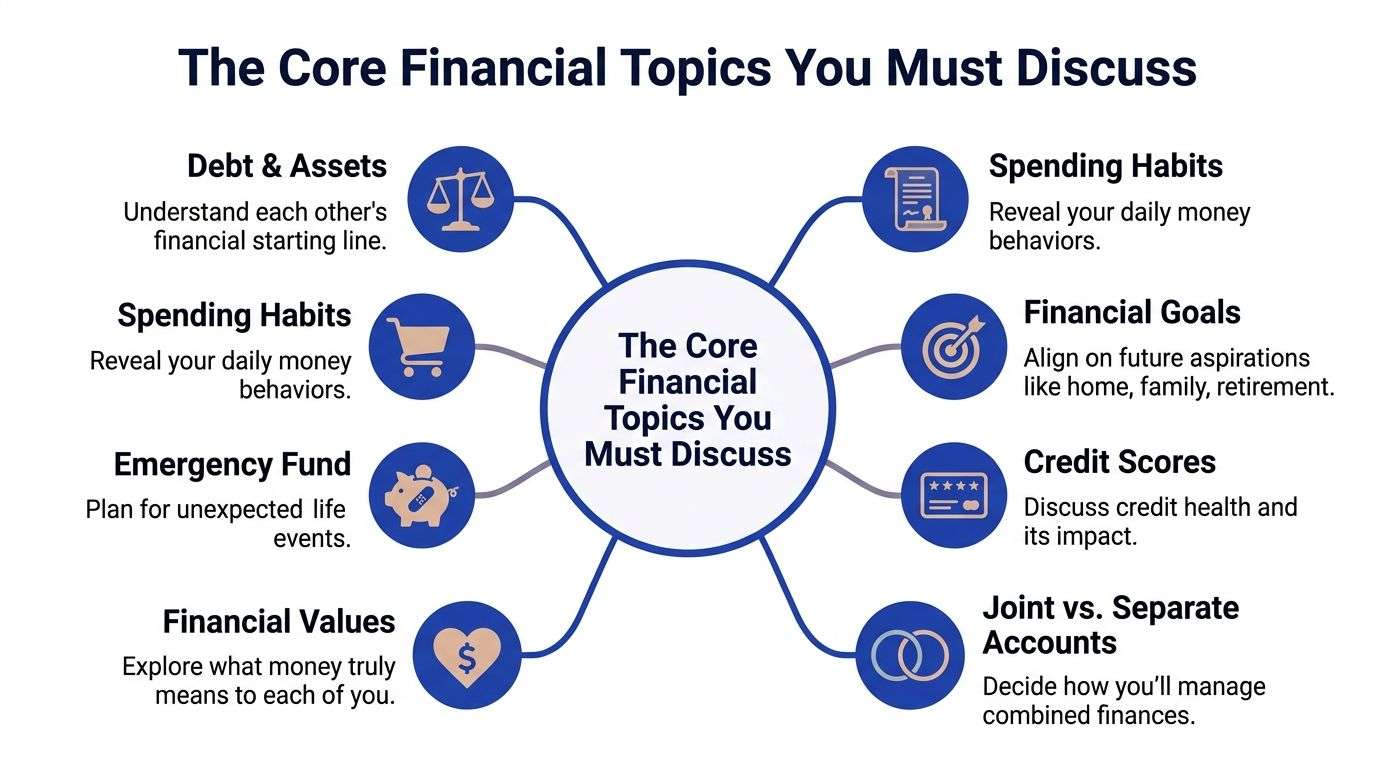
Couples often ask what they need to cover. The answer is more than “How much do you make?” You’re trying to understand the full picture of how each person handles money, what responsibilities they carry, and what kind of financial life they hope to build together.
A 2022 BMO Financial Group survey found that 64% of Canadian couples had money conversations before marriage, while 29% delayed discussing their debts until after the wedding. Debt is one of the most common delayed topics, which is exactly why it needs direct attention.
Here’s the visual overview many couples find helpful.
Your financial starting point
Before you talk about shared plans, disclose your current reality.
That includes:
- Income sources
- Savings
- Investments
- Property or other assets
- Credit cards
- Student loans
- Lines of credit
- Tax obligations or other outstanding balances
This part can feel exposing. That’s why it helps to think of disclosure as information-sharing, not self-defence.
If you’re unsure how marriage interacts with an existing debt load, a practical explainer on if I marry someone with debt, does it become mine can help you separate legal questions from emotional assumptions.
Spending habits and money behaviours
Two people can have similar incomes and still clash constantly if they use money differently. One partner may spend freely on experiences and feel money is meant to be enjoyed. The other may save automatically and feel uneasy without a cushion.
Neither style is automatically wrong. What matters is whether the two of you understand the pattern and can work with it.
Ask each other:
- What kinds of spending feel easy for you?
- What purchases trigger stress?
- Do you track spending or avoid looking?
- Are you spontaneous with money, or do you prefer planning first?
A partner who buys coffee, gifts, clothes, or hobby items without much thought isn’t necessarily reckless. A partner who hesitates over every purchase isn’t necessarily controlling. These habits often come from old experiences, not bad character.
Credit health and financial consequences
Credit can affect shared decisions, especially if you plan to rent, buy property, finance a vehicle, or apply for anything jointly.
You don’t need to turn this into a moral discussion. Keep it concrete:
- Do you know your current credit standing?
- Are there missed payments, collections, or unresolved issues?
- Are there habits that support or strain credit over time?
This topic is sensitive because many people attach shame to it. The more neutral your tone, the more likely your partner will stay open.
Financial honesty isn’t only about confession. It’s about giving your future spouse accurate information so they can make informed decisions with you.
Joint, separate, or hybrid accounts
Couples often assume there’s one “grown-up” answer regarding this. There isn’t. Some couples combine everything. Some keep most things separate. Many use a hybrid system.
A helpful way to compare the options:
| Approach | What it can support | What to watch for |
|---|---|---|
| Joint accounts | Simplicity, visibility, shared responsibility | One partner may feel monitored |
| Separate accounts | Autonomy, privacy, flexibility | Shared costs can become vague or uneven |
| Hybrid approach | Balance between teamwork and independence | Needs clear rules to avoid confusion |
The best system is the one both people understand and agree to. If you want a deeper look at the benefits and drawbacks, this article on joint bank accounts for engaged couples offers a useful starting point.
Financial values and meaning
This topic doesn’t always show up on checklists, but it should. Money arguments are often values arguments in disguise.
For example:
- One person sees family support as an essential duty.
- One sees travel as essential to a meaningful life.
- One values home ownership above all else.
- One prioritises flexibility and lower fixed costs.
Ask:
- What does financial security mean to you?
- What feels worth spending on?
- What would feel like a financial failure to you?
- What role should generosity, family help, or lifestyle comfort play in our decisions?
The answers tell you what money symbolises, not just how it’s used.
Short-term and long-term goals
A strong conversation includes both the next year and the next decade.
Talk about:
- Emergency savings
- Wedding costs
- Housing plans
- Children or fertility-related hopes
- Career changes
- Retirement expectations
- Support for extended family
- Travel or lifestyle priorities
What matters here is not whether your goals are identical. It’s whether they can coexist.
A couple can work with different dreams if they name them early. Trouble begins when one person assumes a timeline or priority the other never agreed to.
Decision-making rules
Many recurring fights come from unclear process, not impossible problems. Couples often haven’t agreed on how decisions get made.
You might decide:
- Purchases above a certain comfort threshold require discussion.
- Bills are reviewed together on a regular schedule.
- One partner handles administration, but both stay informed.
- Big financial changes need both consent.
That kind of structure reduces resentment because expectations are visible.
Protection planning and emergencies
Before marriage, couples should also talk about what happens when life doesn’t go according to plan.
Discuss:
- Insurance coverage
- Emergency contacts
- Access to important account information
- Basic estate planning intentions
- What support would look like during illness, job loss, or crisis
This isn’t about fear. It’s about care. Practical preparation can be an expression of love.
Communication Scripts for Navigating Tough Moments
Knowing what to discuss doesn’t automatically make the discussion easier. Money can trigger shame, fear, defensiveness, and old wounds very quickly.
CMHA data from 2025 says 41% of Canadian premarital couples in therapy cite money anxiety as a depression trigger (Morgan Stanley article referencing CMHA data). That matters because a financially practical conversation can suddenly become an emotionally loaded one.

Use statements that reveal, not attack
When people feel exposed, they often protect themselves with criticism. The problem is that criticism rarely invites honesty.
Try this shift:
| Instead of | Try |
|---|---|
| “You’re careless with money” | “I feel anxious when I don’t know what we’re spending” |
| “Why didn’t you tell me sooner?” | “I’m feeling surprised, and I want to understand the full picture” |
| “You never think ahead” | “Planning helps me feel secure, and I’d like us to build that together” |
“I feel” statements work best when they include a genuine feeling, a concrete concern, and a collaborative request.
Examples:
- “I feel nervous talking about debt because I’m afraid of being judged.”
- “I feel unsettled when we avoid this topic, and I’d like us to set a time to finish it.”
- “I feel more relaxed when we agree on expectations before making big purchases.”
Ask questions that invite truth
A harsh question narrows the conversation. A curious question opens it.
Questions that usually help:
- What did money feel like in your home growing up?
- What financial mistake are you most afraid I’ll judge?
- What does being responsible with money mean to you?
- What kind of support helps you stay engaged in this conversation?
These questions work because they move below the surface. They don’t just ask for facts. They ask for context.
A grounded response sounds like this: “I’m listening. I may need a moment to process, but I want to understand before I react.”
Reflect before responding
Active listening is not silent waiting. It’s showing your partner that you heard the substance and the feeling.
Use simple reflections:
- “What I’m hearing is that debt brings up shame for you.”
- “It sounds like you’re not against budgeting. You’re worried budgeting will feel restrictive.”
- “You want transparency, but you don’t want every purchase monitored.”
That kind of reflection slows escalation. It also reduces the chance that your partner has to repeat themselves louder and sharper.
Have a plan for emotional flooding
Some couples don’t need more information. They need better ways to regulate during difficult discussions.
A pause is useful when:
- voices rise
- one partner shuts down
- the conversation becomes repetitive
- either person feels panicky, numb, or cornered
Try a reset process like this:
Name the state
“I’m getting overwhelmed.”Reassure the bond
“I’m not leaving the conversation. I need a short break.”Set a return time
“Let’s come back in twenty minutes.”Do something regulating
Water, a short walk, slow breathing, or sitting without screens.Restart with one issue only
Don’t resume by reopening every unresolved complaint from the past year.
One useful tool is a shared pause phrase. Some couples choose something simple like, “Let’s slow it down.” The phrase should mean stop, settle, and return. Not stop forever.
Scripts for the hardest parts
Here are a few practical scripts couples can adapt.
When disclosing debt
“I need to share something that feels vulnerable. I’ve been carrying debt, and I’m afraid you’ll see me differently. I want to be fully honest so we can decide together what comes next.”
When there’s an income gap
“I don’t want our different incomes to become a power issue. I’d like us to talk about fairness in a way that respects both contribution and dignity.”
When one person avoids money talks
“I notice this topic gets hard for us. I’m not trying to pressure you. I want us to find a way to talk about it that feels manageable for both of us.”
When one person feels controlled
“I want transparency, but I don’t want to feel parented. Can we build a system that gives us clarity without taking away autonomy?”
When trust has been shaken
“I’m less upset about the number itself than about learning it late. I want to understand what made it hard to tell me.”
Navigating Disagreements and Building Financial Intimacy
Disagreement doesn’t mean you’re incompatible. It usually means you’re two separate people with different histories trying to build one shared life.
That’s not a flaw in the relationship. It’s the work of the relationship.

Some differences are practical. Some are symbolic.
A disagreement about saving versus spending may not really be about the purchase. It may be about safety, control, freedom, or whether each person feels respected.
If one partner wants a larger cushion and the other wants more room for enjoyment, the solution usually isn’t to decide who’s “better” with money. The solution is to build a structure that honours both values.
Many couples do well with a “yours, mine, and ours” model. Shared obligations go into one system. Personal spending remains partly individual. That can reduce micromanaging while preserving teamwork.
Not every issue needs complete agreement
Some topics are solvable. Others are ongoing differences that need management rather than final resolution.
A solvable issue might be:
- how to split rent
- who pays which bills
- when to review the budget
A recurring value difference might be:
- how much is enough in savings
- how generous to be with extended family
- how cautious to be with financial risk
Mature couples learn the difference. If you treat every value difference like a problem to eliminate, you’ll create gridlock. If you treat every practical issue like “just who we are,” you’ll stay stuck.
Financial intimacy grows when both people can say, “I know how you think, I know what matters to you, and I trust that we can keep talking.”
Compromise should feel respectful, not resentful
Good compromise doesn’t mean one person gives up more and calls it love. It means both people can live with the arrangement without building hidden anger.
Healthy compromise often includes:
- Clear boundaries around personal and shared spending
- Visible agreements so neither person relies on memory alone
- Regular review because what works now may not work after marriage, children, illness, or career change
If your disagreements keep circling the same issue, it can help to get structured support. Couples looking for guidance on recurring money tension may find financial conflict in marriage resolution strategies useful as they work toward steadier conversations.
From Talk to Action Your Financial Go-Forward Plan
A good conversation is a beginning. What protects a marriage is what happens after the conversation.
Canadian couples who follow structured financial talks before marriage report 35% lower conflict regarding money in the first few years, according to data cited from the Vanier Institute. Structure helps because it turns good intentions into repeatable habits.
Build your first shared system
After your conversation, write down what you decided. Don’t trust memory, especially if the topic was emotional.
Create a practical first draft that covers:
- How shared expenses will be handled
- Whether accounts will be joint, separate, or hybrid
- Who pays which bills
- How large purchases will be discussed
- What savings goals matter first
Keep it simple enough to use. An elegant plan that no one follows is less helpful than a basic one both people understand.
Schedule regular money dates
Money talks shouldn’t happen only when something goes wrong.
Choose a recurring check-in. During that time, review:
- current expenses
- upcoming costs
- any stress points
- progress on shared goals
- changes in work, health, or family responsibilities
A short, regular meeting is usually easier than one huge, emotionally loaded discussion every few months.
Know when to bring in support
Some couples need a financial professional for planning details. Others need a counsellor because the numbers aren’t the only issue.
Support is worth considering if:
- the same argument keeps repeating
- one partner shuts down whenever money comes up
- debt or secrecy has damaged trust
- financial conversations trigger panic, shame, or hopelessness
If you’re ready to move from scattered talks to a more grounded system, this resource on how to create a financial plan as a couple for a strong future can help you organise the next steps.
Frequently Asked Questions About Premarital Finances
What if one of us earns much more than the other
Don’t assume equal means fair. For some couples, equal contributions feel right. For others, proportional contributions make more sense. The healthier question is whether the arrangement feels respectful, transparent, and sustainable for both people.
What if my partner doesn’t want to talk about money
Resistance usually means something is happening underneath the surface. Your partner may feel shame, fear conflict, worry about being controlled, or lack confidence. Start smaller. Ask what makes the conversation hard, rather than forcing a full disclosure in one sitting.
How often should we have money dates after marriage
Often enough that money doesn’t become a crisis-only topic. Some couples prefer a brief regular check-in and a longer review less often. The exact schedule matters less than consistency.
Should we combine all our finances once we’re married
Not necessarily. Some couples thrive with full sharing. Others do better with a hybrid model that protects both teamwork and personal autonomy. The right choice is the one you both understand and revisit openly over time.
When should we seek premarital counselling around finances
Support can help before things feel severe. It’s especially useful if money talks turn into repeated arguments, one of you avoids the topic completely, or trust has already been strained by secrecy. Couples who want help navigating both legal and emotional planning may also benefit from learning more about premarital counselling and prenups for Canadian couples.
Talking about money before marriage can feel vulnerable, but it’s one of the clearest ways to practise honesty, teamwork, and care. If you’d like support having these conversations in a calm, structured way, Interactive Counselling offers compassionate, evidence-informed counselling for couples who want to strengthen trust before marriage and beyond.
Clinically Reviewed By
Amy Mosset, MCP, RCC-S
Amy Mosset is a Master Practitioner in Clinical Counselling, Clinical Supervisor, and the owner of Interactive Counselling. She provides trauma-informed, evidence-based care and clinical supervision to registered therapists, with a focus on ethical practice, client safety, and high-quality therapeutic outcomes.
Money talks are easier with a neutral third party in the room — our premarital counselling in Kelowna makes space for exactly these conversations.