A couple sits down to sort out a small issue. One asks about a late pickup, an unanswered text, or who is handling dinner. Ten minutes later, the initial topic has vanished. Now they are arguing about tone, effort, respect, and whether either person feels safe enough to be honest. For more information, see our couples counselling.
I see this pattern constantly in practice. The good news is that repeated conflict usually follows a recognizable sequence, and recognizable sequences can be changed with the right tools.
"The best communication exercises for couples are structured, evidence-based techniques that teach partners to replace destructive patterns like blame and criticism with skills like active listening, emotional validation, and collaborative problem-solving."
The exercises in this guide go further than generic advice to "communicate better" or rely only on "I feel" statements. They draw from established models couples therapists use every day, including Gottman, EFT, and Nonviolent Communication. You will find scripts, common mistakes, and variations that fit different stages of a relationship, from early dating to long-term partnership and co-parenting after separation.
Good communication exercises are concrete, repeatable, and usable in the moment, especially when emotions run high.
Some exercises help you slow the conversation down. Others help you name the cycle underneath the argument, clarify needs without blame, or stay engaged without flooding or shutting down. The point is not to speak perfectly. The point is to make your next hard conversation more honest, more workable, and less damaging.
1. The Gottman Method Four Horsemen Awareness and Antidotes
Some couples fight loudly. Others go quiet, get icy, or start explaining themselves like they’re in court. Different styles, same problem. The interaction stops being about understanding and starts being about self-protection.
The Gottman framework gives couples a useful shortcut. Notice the pattern first. Change the move second.
Spot the pattern before you fix the topic
The “Four Horsemen” are criticism, contempt, defensiveness, and stonewalling. You don’t need to memorize terms to use the exercise. You just need to catch your usual move in real time.
A few examples:
- Criticism: “You never listen.”
- Contempt: Eye-rolling, mocking, sarcasm, or speaking from superiority.
- Defensiveness: “That’s not fair. I only did that because you…”
- Stonewalling: Shutting down, leaving emotionally, or going blank.
When couples try to solve the content of the argument before naming the pattern, they usually go in circles.
Practical rule: If the conversation feels harsher than the issue deserves, stop tracking the topic and start tracking the pattern.
A better replacement looks like this:
- Instead of criticism: “I felt alone when I handled bedtime by myself.”
- Instead of contempt: “I’m angry, but I want to say this respectfully.”
- Instead of defensiveness: “I can see my part in this.”
- Instead of stonewalling: “I’m getting flooded. I need a break, and I will come back.”
Try a softened startup
Pick one recurring conflict. Keep it small at first. Household load, lateness, phone use, interruptions, not your most explosive issue.
Use this script:
- Start with one specific situation.
- Name your feeling.
- State your need.
- Make one clear request.
For example: “When we were both in the kitchen and I kept talking while you looked at your phone, I felt brushed off. I need more presence when we’re reconnecting. Could we put phones away for the first few minutes after dinner?”
If one of you tends to shut down, agree on a pause plan before the next conflict. The break only works if the person who pauses also returns.
If these patterns show up often, Gottman method therapy can help couples practise antidotes with more support and less blame.
2. Nonviolent Communication The Four-Step Model
A lot of fights escalate because couples mix observation with accusation. “You ignored me” may feel true, but it’s still an interpretation. The other person usually hears a charge, not a vulnerable truth.
Nonviolent Communication, often called NVC, slows that down. It asks you to separate what happened from what you made it mean.
Use the four-part sentence
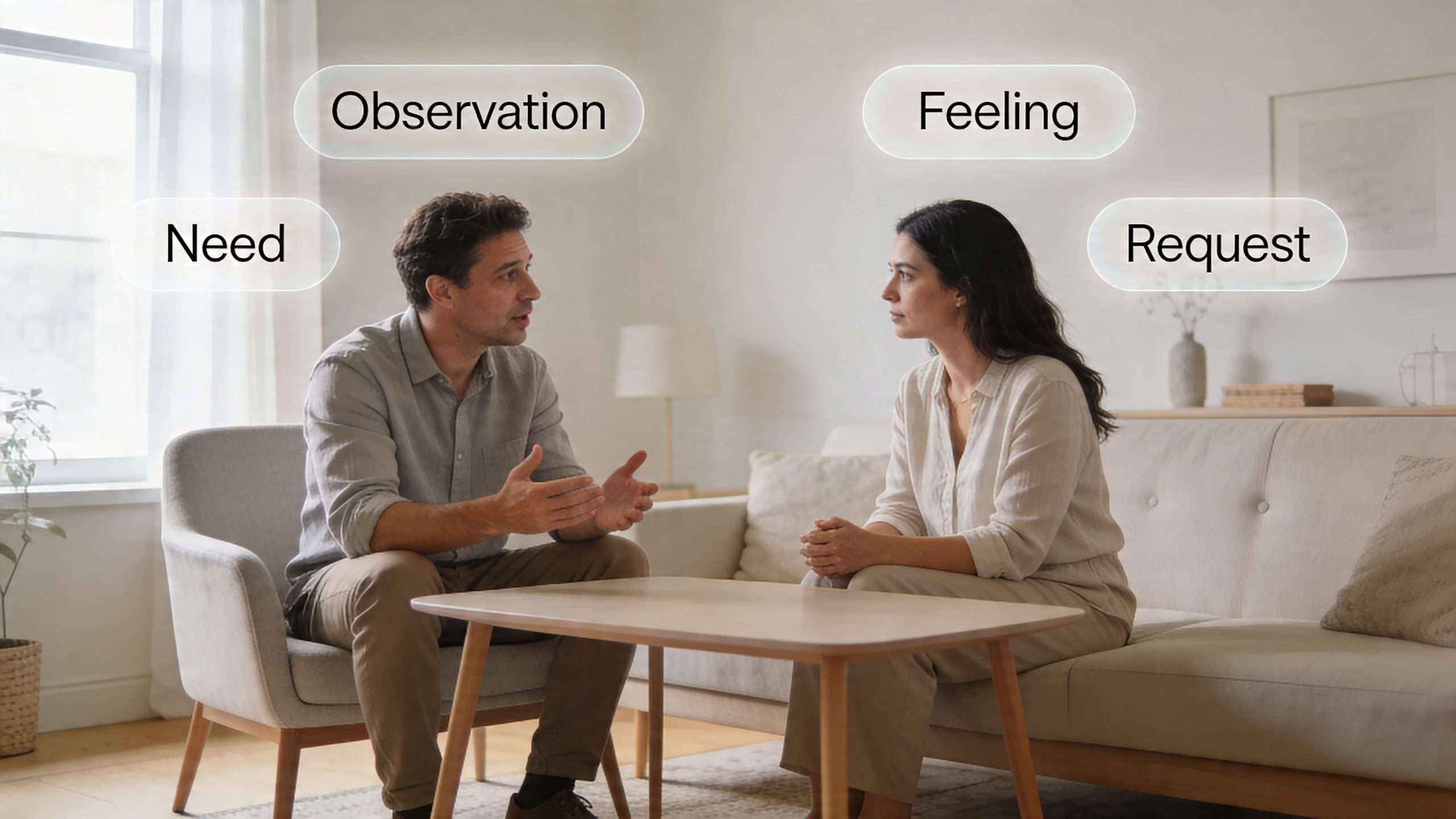
The structure is simple:
- Observation
- Feeling
- Need
- Request
That gives you a sentence like this:
When I see you on your phone during dinner, I feel disconnected because I need time where we’re present with each other. Would you be willing to put it away until we’re done eating?
Notice what’s missing. No mind-reading. No “always.” No “you care more about your phone than me.”
Here’s another example for co-parents:
“When pickup changes at the last minute, I feel stressed because I need predictability for the kids and for my own planning. Could we confirm schedule changes earlier whenever possible?”
This format often feels awkward at first. That’s normal. It’s more deliberate than everyday speech, and that’s part of why it works.
What helps and what backfires
NVC works when the request is specific and doable. It fails when the sentence is technically gentle but emotionally loaded.
Helpful shifts:
- Observation, not verdict: “You came in after we started eating,” not “You made family dinner unimportant.”
- Real feelings: “I felt lonely,” not “I felt abandoned” unless that accurately captures the experience.
- Need, not demand: “I need reassurance,” not “I need you to stop being selfish.”
- Clear request: “Can we choose one evening this week just for us?” not “Can you be better?”
A good request gives your partner something they can respond to. A vague complaint leaves both of you frustrated.
Empathy matters just as much on the receiving side. If your partner uses this structure, try not to debate their feelings before you understand them. The Role of Empathy in Couples Conflict Resolution is a helpful next step if you want to strengthen that part of the process.
3. The Pursuer Distancer Pattern Recognition and Reversal
Many couples think one person is “the communicator” and the other is “emotionally unavailable.” That story is usually too simple. More often, one partner moves toward connection when anxious, and the other moves away when overwhelmed.
Once this cycle starts, each person accidentally confirms the other’s fear.
Name the dance, not the villain
A pursuer might say, “Why won’t you talk to me?” more and more intensely. A distancer might go quiet, leave the room, or answer with as few words as possible.
Inside, the experience is often softer than the behaviour suggests.
- The pursuer may be feeling panic, abandonment, or urgency.
- The distancer may be feeling pressure, failure, or fear of making things worse.
That’s why this exercise starts with mapping the pattern, not judging it.
Try this conversation during a calm moment:
- Partner A: “When I don’t feel connected, I usually…”
- Partner B: “When I feel pressure or conflict, I usually…”
- Then each adds: “What I’m hoping for in that moment is…”
A common example sounds like this: “When you get quiet, I push harder because I’m scared this doesn’t matter to you.” The other replies, “When you push harder, I shut down because I feel like I can’t get it right.”
That is useful information. It turns a fight into a pattern you can interrupt.
Reverse one move at a time
Don’t try to become a different person overnight. Practise one small reversal.
For example:
- If you pursue: Pause before sending the fourth text. Ask for a time to talk instead of forcing it now.
- If you distance: Initiate one short check-in before your partner has to chase you.
This is especially important in stressed relationships. A PMC study on videoconference Couples Communication Skills Training found significant pre-post improvements in communication efficacy for high-conflict couples, which supports structured practice when reactivity is high.
If this dynamic feels familiar, the Pursuer-Withdrawer Pattern can be understood and softened with intentional work. The key is not getting rid of difference. It’s stopping the cycle from turning difference into threat.
4. Active and Reflective Listening Exercises
A familiar scene in my office looks like this. One partner gives a careful explanation of why they felt hurt. The other interrupts to correct a date, a word choice, or the tone. Within two minutes, both people feel more alone than when they started.
That is the problem reflective listening solves. It slows the conversation enough for each partner to feel accurately heard before the discussion shifts to fixing, defending, or debating.

The basic format
Set a timer for two minutes. One person speaks about one specific moment. The listener’s job is to understand the meaning and emotion, not to prepare a rebuttal. When the speaker finishes, the listener reflects back the core message in their own words and checks for accuracy.
Use a reflection like this:
“What I’m hearing is that when I corrected you in front of our child, you felt dismissed and unsupported. You wanted us to stay united in that moment, then talk privately later. Is that right?”
Then pause.
If the speaker says, “Mostly, but the worst part was feeling alone,” the listener tries again. That second pass is often where the conversation softens. In EFT and Gottman-informed work, this kind of accurate reflection helps lower threat and keeps couples from arguing about side details before the main issue is clear.
What good listening sounds like
Reflective listening is not word-for-word repetition. It is accurate emotional translation.
Helpful responses include:
- “You were already overwhelmed, and my comment felt like one more hit.”
- “You wanted reassurance first. Problem-solving could have come later.”
- “I think the bigger issue was feeling unimportant, not just the late text. Did I get that?”
This skill asks for restraint. That is the trade-off. The listener may feel temporarily misunderstood, especially if they are eager to explain intent. Waiting usually works better than correcting too soon.
Common mistakes
Reflective listening fails when the reflection sneaks in blame, self-protection, or cross-examination.
These responses usually escalate tension:
- “What I hear you saying is that I never do anything right.”
- “You felt hurt because you took it the wrong way.”
- “I hear you, but you do the same thing to me.”
A better standard is simple. After your reflection, your partner should look calmer, not more activated.
Listening well does not require agreement on every detail. It requires enough accuracy that your partner no longer has to fight for the floor.
Start with low-stakes conversations before using this in a long-running conflict. Try weekend logistics, bedtime routines, or stress from work. Couples in early dating can use it to learn each other’s emotional shorthand. Co-parents and separated partners can use it to reduce defensiveness and keep discussions focused on the child instead of old injuries. If you want more practical guidance on building this habit, How to Communicate Better in Relationships offers a useful starting point.
5. The Speaker-Listener Technique Talking Token
One partner is halfway through a sentence. The other jumps in to correct a detail. Within two minutes, neither person feels heard, and the original issue gets buried under tone, defensiveness, and old grievances. This is when a talking token helps.
It gives the conversation a clear container. That matters for couples who interrupt each other, for pairs where one person goes quiet under pressure, and for co-parents who need to discuss logistics without sliding into the larger history.

How to run it
Use any visible object. A pen, a coaster, a small card. The person holding it is the only one who speaks.
Keep the structure tight:
- Speaker: stays with one topic, speaks from personal experience, and keeps each turn brief
- Listener: listens without interrupting, then reflects the message back before responding
- Both partners: switch roles only after the speaker feels understood
A short time limit helps. In practice, I usually suggest one to two minutes per turn at first. Longer turns often turn into speeches. Shorter turns are easier to hear, reflect, and answer without flooding.
A useful script looks like this:
Speaker: “When plans changed and I found out late, I felt unimportant.”
Listener: “The late change hurt, but the bigger part was feeling low on the priority list. Is that right?”
Speaker: “Yes. And I felt embarrassed because I had already arranged my day around it.”
That final sentence is often the core issue. The token slows the pace enough for it to surface.
How this differs from basic reflective listening
Reflective listening can still fall apart if both people start talking at once or one partner keeps grabbing the floor. The talking token adds behavioural structure, which is why it shows up in several evidence-based approaches to conflict regulation. It is simple, but not easy. The trade-off is that the conversation feels less natural at first.
That is usually a fair price for a discussion that stays respectful.
Best uses for this technique
This exercise works well in a few specific situations:
- Fast-escalating conflict. Turn-taking reduces overlap and lowers the chance of reactive comments.
- Uneven power in conversation. A quieter partner gets protected space to finish a thought.
- Repair after repeated misfires. The structure helps couples who say, “We keep having the same fight.”
- Co-parenting after separation. It keeps the focus on the immediate decision instead of reopening the entire relationship.
It works less well if a partner uses the format mechanically. A polished reflection with no real curiosity still feels cold. If that happens, pause and ask one direct question before switching roles: “What feels hardest about this for you?”
For early dating, keep the topics lighter at first. Expectations, communication habits, conflict style. For long-term couples, use it for recurring friction points where interruptions have become part of the pattern. For separated parents, choose one agenda item and end the exercise once that item is resolved. Too much material in one sitting usually pulls the conversation off track.
6. The Five Wishes Exercise Needs Clarification
Surface arguments are often terrible translators of deeper needs. “You never help” may mean “I want partnership.” “We never do anything together” may mean “I miss feeling chosen.”
This exercise helps couples move from complaint to longing.
Write the wishes before you discuss them
Each partner writes five wishes for the relationship. They should be honest, specific, and framed positively.
Examples:
- “I wish we had one predictable time each week to reconnect.”
- “I wish we handled parenting disagreements privately.”
- “I wish I felt more warmth from you when I come home.”
- “I wish we could talk about money without either of us shutting down.”
- “I wish we felt like a team during stressful seasons.”
Then read them to each other one at a time.
The listener’s job is not to explain why the wish is unrealistic. It’s to get curious.
Useful questions include:
- “What feels important about that?”
- “When do you miss that most?”
- “What would that give you emotionally?”
- “Is there a smaller version of that we could start with?”
Find the need underneath the wish
A wish often points to a core value or attachment need. Security. Respect. Rest. Partnership. Belonging. Freedom. Predictability.
For multicultural couples, this exercise can be especially valuable because the same wish may carry different meanings depending on family background, language, and cultural norms. In Canada, 22.3% of the population belongs to a visible minority and immigrants make up 23% of the total population, which means many couples are navigating more than personality differences. They’re also navigating different communication scripts.
One partner may hear directness as honesty. The other may hear it as disrespect. One may expect quick repair after conflict. The other may have learned that space is respectful and restraint is love.
The Five Wishes exercise slows those assumptions down. Instead of arguing about who is “right,” you learn what the wish means in that person’s emotional world.
This is one of the gentlest communication exercises for couples because it invites hope, not just damage control.
7. Emotion Coaching and Feelings Vocabulary Building
One partner says, “Why are you making such a big deal out of this?” The other goes quiet, then snaps. On the surface, it looks like anger and overreaction. Underneath, it is often something more tender. Hurt. Shame. Fear. Loneliness. Feeling dismissed.
That distinction matters in the room with real couples. If partners only name the protective emotion, they keep arguing about tone, timing, and wording. Once they can name the softer emotion underneath, the conversation often changes within minutes.
Go beyond broad labels
“Fine,” “stressed,” and “annoyed” do not give a partner much to work with. Precision helps. It lowers defensiveness and increases the chance of a useful response.
Try replacing broad labels with more accurate ones:
- “I’m embarrassed and getting defensive.”
- “I’m overwhelmed, and I can feel myself shutting down.”
- “I’m hurt, and it is coming out as irritation.”
- “I’m anxious that I don’t matter to you right now.”
A good prompt is: “What am I feeling underneath my first reaction?”
This approach draws from emotion coaching and EFT. In practice, I often see criticism covering fear, withdrawal covering hopelessness, and anger covering hurt.
A simple exercise for home
Use a recent conflict, but choose one that is warm, not explosive. Sit side by side if that helps reduce tension. Then each partner completes these three lines:
- “What I showed on the outside was…”
- “What I was feeling underneath was…”
- “What I needed in that moment was…”
For example: “What I showed was annoyance. Underneath, I felt rejected. What I needed was reassurance before we tried to solve it.”
Keep the pace slow. The listener’s job is to reflect back the emotion and need, not debate whether it was reasonable. A simple response works well: “You looked irritated, but underneath you felt rejected and needed reassurance. Did I get that right?”
Common pitfalls
Couples often rush this exercise and slip back into explanation. That weakens the whole point.
Watch for these patterns:
- Turning feelings into judgments: “I feel ignored” is usually a perception, not a pure feeling.
- Skipping the body signal: tight chest, heavy stomach, shaky hands, numbness.
- Arguing with the emotion: “You shouldn’t feel that way.”
- Problem-solving too early.
If identifying feelings is hard in the moment, build the skill outside conflict first. A brief daily check-in helps. Name one feeling, where you notice it in your body, and what it seems to need. That kind of Emotional Awareness makes every other communication tool easier to use, whether you are early in dating, parenting under stress, or trying to co-parent respectfully after separation.
8. The State of the Union Relationship Check-In
The healthiest conversations in a relationship usually don’t happen in crisis. They happen before resentment has had time to harden.
A regular check-in gives couples a place to discuss the relationship on purpose instead of only discussing it when something has already gone wrong.
What to include in the check-in
Set aside time on a regular basis. Keep the structure simple enough that you’ll use it.
You might cover:
- Connection: Have we felt close lately?
- Stress: What external pressures are affecting us?
- Household and parenting: What’s working and what feels uneven?
- Intimacy: Have we felt emotionally and physically connected?
- Repairs needed: Is anything unresolved?
- Support for the next stretch: What do we each need this week or month?
A strong check-in starts with appreciation. Not forced praise. Real noticing.
For example: “I appreciated how calm you stayed during that school issue,” or “Thank you for checking in when I had that hard day.”
Then move to one or two concerns. Not ten.
Why consistency matters
When couples only talk seriously after a blowup, communication starts to feel dangerous. A scheduled check-in changes that association.
This is especially useful in high-stress seasons. The material in your life may vary. Parenting, separation, grief, trauma recovery, work pressure, financial strain. The principle stays the same. Predictable conversations reduce avoidable damage.
For couples navigating trauma-related communication barriers after motor vehicle accidents, generic communication advice may not be enough. One overview notes that British Columbia saw more than 120,000 motor vehicle accidents in an ICBC annual report for 2025, with 60% of survivors reporting relational strain and communication breakdowns and PTSD symptoms affecting 30% of cases. In those situations, a check-in may need a softer start, grounding first, and shorter conversations with more reassurance.
A “State of the Union” check-in isn’t about turning your relationship into a meeting. It’s about making sure important issues have somewhere to go before they erupt.
Comparison of Couples Communication Exercises
No single exercise fits every couple, every conflict, or every stage of a relationship. A couple in early dating usually needs light structure and clearer self-expression. Co-parents after separation often need tighter boundaries and stronger turn-taking. That is why the best tool is the one you can use under stress, not the one that sounds best on paper.
Use this comparison to match the exercise to the problem in front of you.
| Exercise | Implementation complexity | Resource requirements | Expected outcomes | Ideal use cases | Key advantages |
|---|---|---|---|---|---|
| The Gottman Method: Four Horsemen Awareness and Antidotes | Medium. Partners need to spot patterns and practise replacement responses in real time | Low to medium. Self-study can work, though some couples benefit from therapist support and repeated practice | Less criticism and contempt, fewer escalations, stronger repair during conflict | Couples stuck in recurring fights, defensiveness, sarcasm, or shutdown | Clear framework, strong research base, practical antidotes couples can remember in the moment |
| Nonviolent Communication (NVC): The Four-Step Model | High. The structure is simple on paper but harder to use naturally during conflict | Low to medium. Practice helps. Workshops, coaching, or guided sessions can improve follow-through | More clarity about feelings and needs, less blame, more empathic responses | High-conflict couples, co-parents, partners who slip quickly into accusation and counterattack | Gives couples a script for shifting from judgment to observation, feeling, need, and request |
| The Pursuer-Distancer Pattern: Recognition and Reversal | Medium to high. Requires self-awareness, vulnerability, and a willingness to interrupt the usual cycle | Medium. Guided support often helps because each partner tends to see only the other person’s part | Less chasing and withdrawing, more balanced contact, greater emotional safety | Couples with attachment anxiety, avoidance, or repeated one-partner-pushes and one-partner-retreats dynamics | Reduces blame by naming the pattern, not just the person |
| Active and Reflective Listening Exercises | Low. Easy to learn, harder to sustain without repetition | Low. A timer and a few minutes of focused attention are usually enough | Better understanding, fewer assumptions, more felt sense of being heard | Nearly all couples, especially those who interrupt, misread tone, or miss each other’s meaning | Foundational skill that supports every other exercise in this list |
| The Speaker-Listener Technique (Talking Token) | Low to medium. The rules are straightforward, though some couples find the format stiff at first | Low. A small object, time limits, and willingness to follow the structure | Fewer interruptions, safer turn-taking, clearer communication boundaries | High-conflict couples, separated co-parents, blended families, or conversations that go off track fast | Creates containment. That matters when discussions become chaotic or one partner dominates |
| The Five Wishes Exercise: Needs Clarification | Low. Usually written first, then shared aloud | Low. Time, privacy, and enough trust to answer honestly | Better understanding of longings, priorities, and values beneath surface complaints | Couples seeking reconnection, facing life transitions, or trying to move from gridlock to collaboration | Brings hidden needs into the room before they harden into resentment |
| Emotion Coaching and Feelings Vocabulary Building | Medium. Partners need practice identifying emotion accurately before they can respond well to it | Low to medium. Feeling lists, prompts, and sometimes therapist support can help | More emotional awareness, better regulation, greater empathy, less reactive arguing | Couples affected by emotional avoidance, trauma history, or parenting stress | Builds the language many couples were never taught at home |
| The "State of the Union" Relationship Check-In | Medium. Works best with regular scheduling, a clear agenda, and limits on how much gets covered at once | Medium. Dedicated time, notes, and consistency matter more than special materials | Less resentment, better coordination, earlier problem-solving, more follow-through | Couples maintaining a stable bond, co-parents, partners in transition, and couples rebuilding trust | A routine-based check-in that gives difficult topics a predictable place to go |
A useful rule in practice: use highly structured tools for high-reactivity moments, and use insight-based tools when both partners have enough steadiness to reflect. That trade-off matters. Too much structure can feel rigid. Too little structure can leave a vulnerable conversation exposed to the same old pattern.
Your Next Conversation Starts Here
It is 9:30 p.m. The dishes are done. One of you says, "Could we address what happened earlier?" Within three minutes, one person is defending, the other is protesting, and the original issue is already buried under tone, old hurt, and assumptions. That is the moment these exercises are built for.
The goal is not perfect communication. The goal is a conversation both people can stay in long enough to understand what is happening and repair what went wrong. Across the approaches in this guide, the same principle holds. Good tools slow reactivity, make room for emotion, and give each partner a clearer way to speak and listen.
Each method solves a different problem. Gottman-based tools help when criticism, contempt, defensiveness, or shutdown keep taking over. NVC gives couples a clear script when blame is crowding out needs. EFT-informed work on the pursuer-distancer pattern helps when one partner presses harder and the other pulls farther away. Reflective listening and the Speaker-Listener format are useful when interruption and escalation happen fast. Emotion coaching and the Five Wishes exercise are better suited to conversations that look calm on the surface but stay emotionally thin or stuck. A regular State of the Union check-in helps couples catch strain early, before every hard topic becomes an emergency.
Fit matters as much as effort.
Highly structured exercises often work best when a couple gets flooded quickly. The trade-off is that they can feel stiff at first, especially for partners who value spontaneous conversation. Emotion-focused exercises can create closeness faster, but they ask for enough trust that vulnerable feelings will not be mocked, dismissed, or stored for later use in an argument. Check-ins can steady a relationship, but they lose value when they turn into an hour of criticism with no repair and no follow-through.
Start smaller than your instincts tell you to. Do not begin with the most painful topic in the relationship. Pick a recurring issue with a lower emotional charge, such as scheduling, household responsibilities, or how you reconnect after work. Use one structure. Keep the conversation brief. End before either person is depleted. That is how couples build confidence and get evidence that a different pattern is possible.
Progress usually looks ordinary before it looks impressive. A softer startup. One less interruption. A pause before the counterattack. A cleaner repair after a misunderstanding. In my work with couples, those small shifts are often the first signs that the relationship is becoming safer.
Patience matters because communication patterns are rarely just habits. They are often tied to family history, attachment injuries, burnout, grief, betrayal, trauma, cultural expectations, or the pressure of parenting and logistics. If your conversations keep collapsing in the same place, that does not mean the relationship is doomed. It usually means goodwill is not enough on its own. You need repetition, structure, and honest reflection.
When to seek professional support
Some couples practise solid tools at home and still hit the same wall. One partner becomes flooded and disappears emotionally. The other agrees to the exercise but uses it to build a case. Old injuries keep hijacking the present conversation. Co-parenting talks become impossible to contain. After separation, even simple decisions trigger the full relationship history.
That is usually the point where specific support helps. A skilled couples counsellor does more than explain techniques. They track the pattern in real time, slow the pace, interrupt escalation, and choose an approach that fits the stage of the relationship. That matters whether the task is rebuilding after infidelity, handling trauma triggers, working through a major life transition, or learning how to communicate well enough to co-parent after the romantic relationship has ended.
Frequently Asked Questions
1. How often should we practise communication exercises?
Regular practice beats occasional marathon talks. For many couples, two or three short conversations a week works better than waiting until frustration is high. Ten to fifteen minutes is often enough when you are building a new skill.
2. What if one of us is much more willing than the other?
Start with the exercise that feels least exposing. Reflective listening or a short weekly check-in is usually easier to accept than a deep conversation about attachment fears. It also helps to present the exercise as a way to reduce tension and confusion, not as proof that something is badly wrong.
3. Can communication exercises make conflict worse?
Yes. They can backfire when they are used to corner, diagnose, control, or win. A script does not create safety by itself. Timing, tone, pacing, and consent still matter. If either partner regularly feels more activated after trying these tools, stop using that format and get outside help.
4. Which exercise should we start with first?
Match the tool to the pattern. Start with the Speaker-Listener Technique if interruption and escalation are the main problem. Use reflective listening if one or both partners keep saying, "That is not what I meant." Try the pursuer-distancer exercise if one partner chases and the other withdraws. Use emotion coaching or the Five Wishes exercise if the relationship feels functional but emotionally undernourished.
A final thought on connection
Couples rarely need flawless phrasing. They need better conditions for honesty. They need a way to say the hard thing without turning it into an accusation, and a way to hear a painful truth without treating it as an attack.
That is what this toolkit is for. It goes beyond "I feel" statements and gives you tested methods from Gottman work, EFT, and NVC, along with scripts, cautions, and ways to adapt them for early dating, long-term partnership, parenting, or separation. These exercises will not erase difference. They can help you carry difference with more clarity, less fear, and a stronger chance of repair.
Clinically Reviewed By
Amy Mosset, MCP, RCC-S
Amy Mosset is a Master Practitioner in Clinical Counselling, Clinical Supervisor, and the owner of Interactive Counselling. She provides trauma-informed, evidence-based care and clinical supervision to registered therapists, with a focus on ethical practice, client safety, and high-quality therapeutic outcomes.
If you’re looking for thoughtful, evidence-informed support for communication, conflict, co-parenting, trauma, or relationship repair, Interactive Counselling offers compassionate counselling suited to real life and the unique needs of couples and families.