TL;DR:
- SUDS is a subjective, quick tool for clients to rate current emotional distress during therapy.
- Honest and reflective use of SUDS enhances awareness and tracks progress effectively.
- While useful, SUDS has limitations and is best combined with other validated assessment tools.
When a therapist asks you to rate your distress from 0 to 10, it might feel oddly simple—almost too simple. You might wonder whether there’s a right answer, or worry that picking the wrong number could affect your treatment. That moment of uncertainty is more common than you’d think, and it points to a genuine gap in how what SUDS means is communicated to clients. The SUDS scale is one of the most widely used tools in anxiety therapy, and understanding it fully can change how you show up in sessions and how quickly you start to feel better.
Table of Contents
- What is the SUDS scale? Origins and purpose
- How the SUDS scale works in therapy sessions
- Strengths and limitations: What SUDS measures—and what it doesn’t
- Getting the most from the SUDS scale: Best practices for therapy clients
- Why SUDS still matters—even when it’s imperfect
- Explore expert support for managing anxiety
- Frequently asked questions
Key Takeaways
| Point | Details |
|---|---|
| SUDS simplifies distress tracking | The SUDS scale gives you and your therapist an easy way to rate anxiety moment-to-moment. |
| Subjectivity is both a benefit and a flaw | Because SUDS is self-reported, it’s flexible but can be imprecise—especially for children or those with trouble naming emotions. |
| Combine SUDS with honest reflection | You’ll get the most out of SUDS by using honest, specific reflection and pairing it with your therapist’s guidance. |
| SUDS is a therapy tool, not a diagnosis | Use SUDS to guide discussions and track progress, not as a formal diagnosis or scientific test. |
What is the SUDS scale? Origins and purpose
Let’s start with the name. SUDS stands for Subjective Units of Distress Scale. The word “subjective” is the most important one here—it tells you straight away that this tool is entirely about your personal experience, not a universal benchmark.
The scale was developed by Joseph Wolpe in 1969 as a practical way to measure a client’s current emotional intensity during desensitisation therapies. Wolpe was a pioneering figure in behavioural therapy, and he designed SUDS specifically to help therapists and clients communicate about distress without requiring lengthy descriptions. Rather than asking someone to explain how anxious they feel in full sentences, the scale offers a quick numerical shorthand.
Think of SUDS as your emotional thermometer. Just as a thermometer doesn’t judge your temperature as good or bad, the SUDS scale simply reflects where you are right now. A reading of 0 means no distress at all—complete calm. A 10 means the most intense distress you can imagine. Everything in between is your own felt sense of the moment.
Today, SUDS is routinely used across a broad range of therapeutic settings in Canada and worldwide. Its appeal comes down to a few key features:
- Quick to use: Takes only seconds to complete during a session.
- Flexible: Applicable to anxiety, grief, trauma, phobias, and relationship stress.
- Client-driven: You set the scale based on your own history, not population averages.
- Accessible: Requires no literacy, no forms, and no prior training to use.
- Conversational: Opens dialogue between client and therapist about what’s actually happening.
Therapists working in cognitive behavioural therapy (CBT), exposure and response prevention, EMDR, and emotionally focused therapy all rely on SUDS to stay attuned to their clients’ moment-to-moment experience. It may seem like a small part of a session, but it carries meaningful weight.
How the SUDS scale works in therapy sessions
Knowing the history is helpful, but understanding how SUDS actually operates during a real session makes it far more useful to you as a client.
The process usually follows a predictable structure, which helps normalise the experience. Here’s how a typical SUDS-informed session might unfold:
- Brief explanation: Your therapist introduces the scale or provides a quick reminder of how it works.
- Baseline rating: You rate your current distress before any activity or exercise begins.
- Therapeutic activity: You engage in an exposure task, relaxation exercise, or conversation about a difficult topic.
- Post-rating: You rate your distress again after the activity.
- Adjustment: Your therapist uses the before-and-after comparison to guide the next step in your session.
Consider a practical example. Say you’re working through public speaking anxiety. Before a practice exercise, you rate yourself a 7 out of 10. After completing a simulated presentation with your therapist, you rate yourself a 4. That three-point drop is meaningful data. It tells both of you that the activity was manageable and produced noticeable relief.

Research supports this approach. SUDS reductions in EFT have been statistically significant in controlled studies (p<0.001, dropping from 7.40 to 2.85 on average), and consistent SUDS use in exposure therapy has been linked to significant reductions in OCD symptoms. These aren’t just numbers on paper—they reflect real shifts in how clients experience their distress over time.
Using CBT and SUDS together creates a feedback loop. Your rating informs the therapist, who adjusts the pace and intensity of interventions based on what you report. This makes therapy genuinely responsive to you.
Pro Tip: Give your honest rating, not the one you think your therapist wants to hear. Underreporting distress can slow your progress, while overreporting can create unnecessary detours in your care.
Strengths and limitations: What SUDS measures—and what it doesn’t
The SUDS scale is genuinely useful, but it’s not perfect. A balanced view helps you use it well.
On the strength side, SUDS is fast, accessible, and completely centred on your experience. It respects the fact that distress is personal. A 7 for you might feel nothing like a 7 for someone else—and that’s entirely valid. The scale doesn’t ask you to compare yourself to anyone.
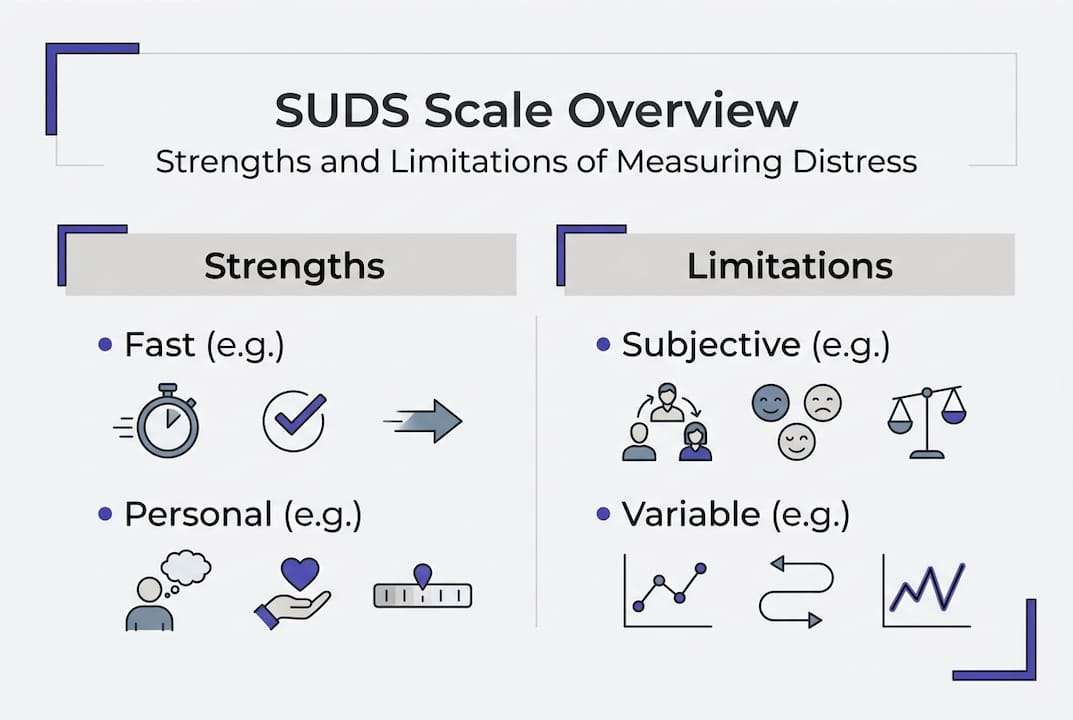
However, that same subjectivity creates limitations. Inter-individual variability means scores can drift over time or be influenced by mood, context, or a desire to appear as though therapy is working. This isn’t a character flaw—it’s a normal human tendency, but it’s worth being aware of.
Here’s a quick comparison to put SUDS in context:
| Feature | SUDS scale | Validated anxiety scales |
|---|---|---|
| Time to complete | Seconds | 5 to 20 minutes |
| Scientific validation | Limited psychometric rigour | Strong empirical grounding |
| Flexibility | Very high | Low to moderate |
| Client involvement | Central | Peripheral |
| Diagnostic use | Not appropriate | Appropriate |
| Session utility | High | Moderate |
Experts have raised legitimate concerns here:
“Recent reviews question SUDS’ psychometric validity, citing construct underrepresentation and a lack of structural validation. Despite this, clinical utility remains strong when SUDS is used alongside validated measures rather than as a standalone diagnostic tool.”
There are also special circumstances to consider. For children, the 0 to 10 numerical format can be abstract and difficult to interpret without additional context. Kids often benefit from visual aids or emotion scales with faces and colours. For individuals with alexithymia (difficulty identifying and describing feelings), the scale may feel opaque. In these cases, a therapist may suggest helping kids manage distress using narrative or body-based approaches alongside SUDS.
Pairing SUDS with standardised tools like the GAD-7 or PHQ-9 gives your therapist a more complete picture and makes your progress tracking more robust.
Getting the most from the SUDS scale: Best practices for therapy clients
You now understand what SUDS is and where its edges are. Here’s how to use it in a way that actually supports your healing.
The first step is to pause before you answer. When your therapist asks for your rating, resist the urge to blurt out a number reflexively. Take a breath. Scan your body—notice where you feel tension, heaviness, or agitation. Ask yourself: “What’s happening in me right now, not an hour ago and not what I’m dreading tomorrow?” That small moment of reflection can shift your rating from a guess to a genuine read.
Breaking feelings down also helps. If you’re feeling several things at once—nervous and sad and ashamed—try identifying the dominant sensation and rating that specifically. This gives your therapist cleaner information to work with.
Here’s a quick reference for making the most of SUDS:
Do:
- Be honest, even if the number feels embarrassingly high or low.
- Use specific memories or sensations to anchor your rating.
- Track your scores across sessions to notice patterns.
- Ask your therapist what a particular score means for your treatment plan.
- Think of SUDS as your emotional thermometer for healing, not a test to pass.
Don’t:
- Compare your numbers to what others might say.
- Rate based on what you think you “should” feel.
- Dismiss low scores as meaningless—even subtle improvements count.
- Assume a high score means you’re not making progress.
Tracking progress in therapy over time is one of SUDS’ greatest strengths in practice, even where empirical validation is limited. Bringing your awareness of scores into conversations with your therapist can deepen your sessions significantly.
Pro Tip: If numbers feel abstract or disconnected from your experience, try describing physical sensations or thoughts instead. For example, “my chest feels tight and I keep catastrophising” gives your therapist just as much to work with as a number—and sometimes more.
Building your emotional regulation skills alongside SUDS use creates a solid foundation for lasting change.
Why SUDS still matters—even when it’s imperfect
Here’s something that often goes unsaid: the most powerful moments in therapy rarely come from a perfectly validated instrument. They come from the conversation a tool sparks.
When a client pauses, thinks genuinely, and says “I’m at a 6 today, but last month this would have been a 9”, something profound is happening. They’re noticing themselves. They’re building self-awareness, tracking their own growth, and engaging as an active participant in their care.
We’ve seen clinicians work with highly complex cases where formal scales felt cold and distant. In those moments, SUDS became a bridge. It gave people permission to name their inner world in a way that felt manageable rather than overwhelming.
The imperfection of SUDS isn’t a flaw to work around. It’s actually a feature. It forces a collaborative dialogue between therapist and client that rigid, standardised tools can’t always achieve. A number invites a follow-up question. That question opens a door.
Tools don’t need to be perfect to be profoundly helpful. They need to be honest, and they need to be used with care.
Explore expert support for managing anxiety
Understanding the SUDS scale is a meaningful first step, but applying it within a supportive therapeutic relationship is where real change happens. At Interactive Counselling, our licensed therapists are experienced in using tools like SUDS within personalised, compassionate care plans that meet you where you are.
Whether you’re exploring understanding therapy options for the first time or looking for a better fit, we offer in-person and online sessions across Canada. You can browse our available counselling services or connect directly through Interactive Counselling to find the right support for your unique experience. Your journey is yours—we’re just here to walk alongside you.
Frequently asked questions
Can I use the SUDS scale at home without a therapist?
Yes, SUDS is self-reported and useful outside formal therapy for tracking emotional intensity and recognising triggers. Sharing your observations with a therapist, though, adds context and makes the tool significantly more effective.
Is SUDS more reliable than other anxiety rating tools?
SUDS is fast and flexible, but standardised anxiety scales are considered more scientifically reliable for diagnosis and research purposes. SUDS works best as a session tool rather than a standalone measure.
Why do some people find it hard to rate their distress?
Emotional awareness varies considerably from person to person. Those with alexithymia or children may struggle to give accurate ratings due to difficulty identifying or labelling their feelings.
What does a changing SUDS score mean over my therapy journey?
A decrease in scores typically signals reduced distress and genuine progress, while an increase may point to new triggers or deeper material emerging that deserves attention in session.
Recommended
- Understanding the Suds Scale: Your Emotional Thermometer for Healing – Interactive Counselling
- Understanding the Suds Scale for Kids: a Parent’s Guide to Measuring Emotional Intensity – Interactive Counselling
- How Anxiety Shows Up Differently in Adults vs Teens: A Guide
- Child anxiety: how it shows up differently than adult anxiety – Interactive Counselling