TL;DR: For more information, see our couples counselling.
- Many Canadian couples experience increased emotional distance after children leave home.
- Proactive efforts like establishing rituals and seeking therapy can rebuild intimacy.
- The empty nest offers a rare opportunity for couples to redefine and strengthen their relationship.
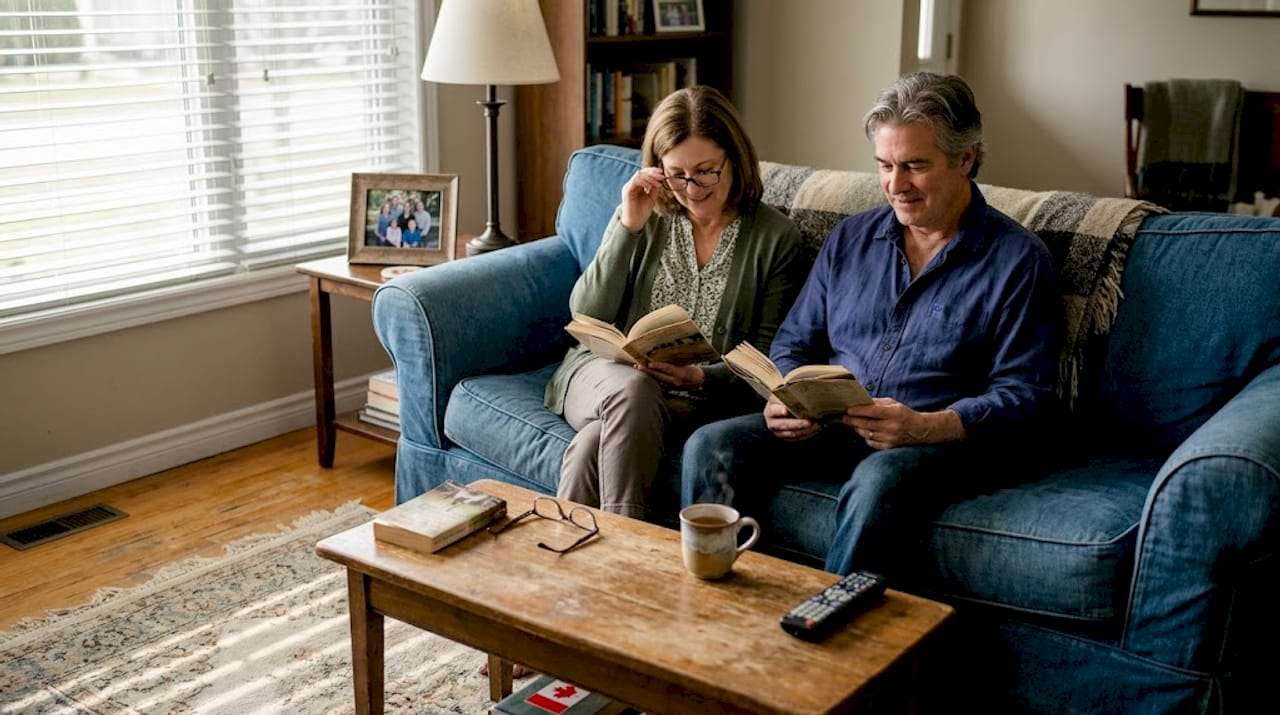
When the last child moves out, many Canadian couples expect to feel relieved, even excited. What catches them off guard is the silence, and what it reveals. Grey divorce rates are rising sharply in Canada, with separation among those 65 and older up 78% since 1991. That statistic is not just a number. It reflects thousands of couples who spent decades raising children, only to find themselves strangers once the parenting role faded. If you are feeling that distance right now, you are not alone, and more importantly, this is not the end. This guide walks you through why disconnection happens, what is at stake, and exactly how to rebuild something real.
Table of Contents
- Why empty nest marriages feel distant
- Understanding the risks: Empty nest divorce and dissatisfaction
- Core strategies to rebuild intimacy and connection
- Who struggles most: Common pitfalls and edge cases
- Why the empty nest is your second chance, not a dead end
- Support for your empty nest journey
- Frequently asked questions
Key Takeaways
| Point | Details |
|---|---|
| Disconnection is common | Many couples feel distant when the structure of parenting is gone. |
| Risks are real but avoidable | Addressing distance early reduces the chances of separation or divorce. |
| Intentional action works | 90-day plans and therapy methods like the Gottman Method can rekindle intimacy. |
| Growth is possible together | With openness and support, the empty nest can become a fulfilling new chapter for both partners. |
Why empty nest marriages feel distant
For most couples, parenting is the great organiser of daily life. School runs, sports schedules, homework, meal planning. These routines create a rhythm that keeps two people moving in the same direction, even when they are not truly connecting. When those routines disappear, the structure goes with them, and what is left can feel unfamiliar.
Research on parental reactions to children leaving home shows a wide range of emotional responses, from grief and loss to relief and renewed freedom. The problem is that couples rarely process these feelings together. One partner may feel liberated while the other mourns. That emotional mismatch can quietly widen a gap that was always there but never noticed.
According to therapists working with empty nest relationship reconnection, Canadian couples entering this phase face increased risk of disconnection because the logistical and parenting-based “glue” that held daily life together simply dissolves. Without it, couples must find a new reason to engage, and many do not know where to start.
Here is what that disconnection often looks like in practice:
- Conversations that revolve entirely around logistics, bills, or updates about the kids
- Evenings spent in separate rooms, absorbed in separate screens
- A sense of living with a familiar stranger rather than a partner
- Irritability or tension without an obvious cause
- Feeling emotionally lonely even while physically together
This kind of quiet drift is not dramatic. It does not announce itself. It creeps in gradually, which is exactly what makes it so easy to miss. You may have been managing grief and new purpose without realising it, channelling all your energy into the children and leaving your partnership on autopilot.
“The empty nest does not create distance. It simply makes visible the distance that was always there.”
Understanding why the empty nest feels harder than expected is the first step. It is not a character flaw. It is a predictable consequence of years spent prioritising parenting over partnership.
Understanding the risks: Empty nest divorce and dissatisfaction
Understanding why disconnection arises sets the scene for what is at stake if it continues. The data is sobering. Grey divorce rates have risen 78% for Canadians aged 65 and older since 1991, and the average Canadian marriage ends at 15.3 years, a timeline that coincides almost exactly with when children typically leave home.
Separately, 25% of marriages experience significant strain during the empty nest transition. That is one in four couples. And couples are 40% more likely to divorce after their children leave home than at other life stages. These are not abstract risks. They reflect real patterns in real relationships.
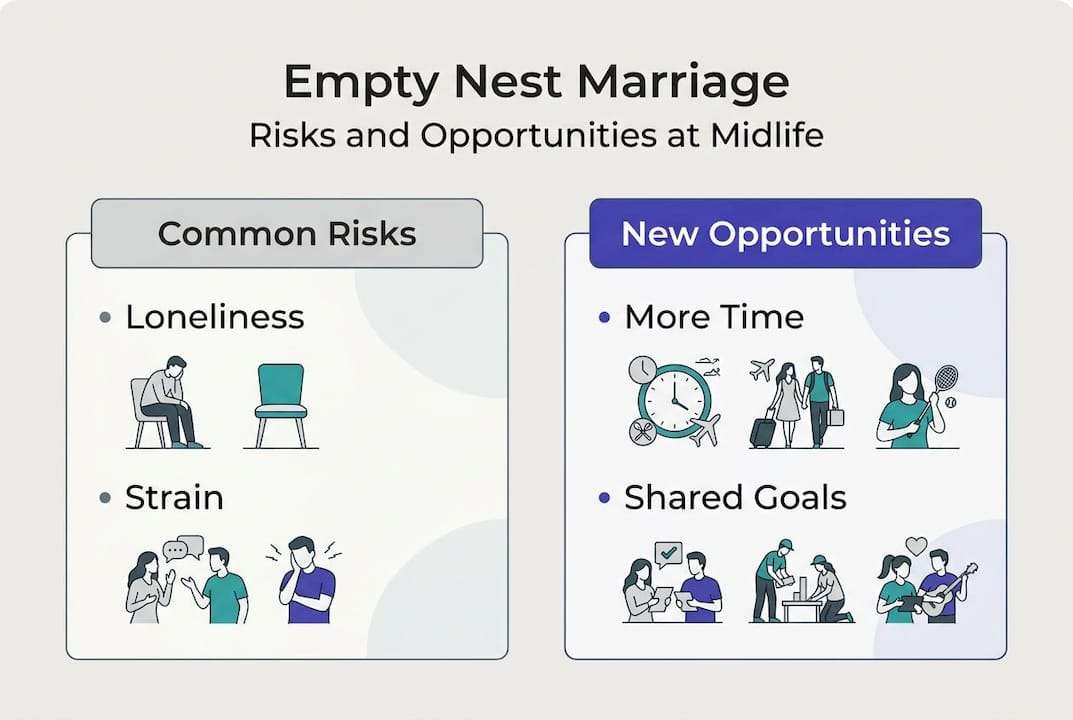
The following table outlines how the empty nest transition compares to earlier relationship stages:
| Relationship stage | Primary focus | Emotional risk | Common outcome |
|---|---|---|---|
| Early marriage | Building life together | Low to moderate | Bonding and shared vision |
| Parenting years | Child-centred logistics | Moderate, often masked | Gradual emotional drift |
| Empty nest transition | Redefinition of purpose | High | Reconnection or separation |
| Post-adjustment | Renewed partnership | Low if addressed | Deeper intimacy or regret |
Women tend to initiate change more often during this period, largely because emotional awareness often surfaces first for them. They may recognise the distance, name it, and seek support before their partner has even registered that something is wrong. That gap in awareness can itself become a source of conflict.
Here are the key warning signs that the transition has moved from uncomfortable to genuinely risky:
- You have not had a meaningful personal conversation in weeks
- Physical affection has decreased or disappeared entirely
- One partner is consistently withdrawing or becoming defensive
- Arguments feel circular and never reach resolution
- You feel more like housemates than partners
“Avoiding the conversation does not protect the relationship. It accelerates the distance.”
If you are wondering whether your relationship has reached a crossroads, a clear divorce guide for Canadians can help you think through where you stand. For those still in the middle of the struggle, navigating relationship struggles in your 30s, 40s, and 50s is a deeply explored topic with practical guidance available.
The key insight here is this: couples who avoid addressing the transition are at far greater risk than those who name it, even imperfectly. Acknowledgement is not weakness. It is the beginning of repair.
Core strategies to rebuild intimacy and connection
With an understanding of the risks, it is time to focus on practical, research-driven ways you can rebuild and strengthen your relationship. The most important thing to know is that reconnection is deliberate. It does not happen by accident, and it does not happen by simply waiting for things to improve.
Therapists working with relationship rebuilding methods recommend a structured 90-day framework that couples can begin immediately. It involves four core pillars:
- Establish new rituals. Create daily or weekly moments that belong only to the two of you. A morning coffee together without phones, a weekly walk, a shared meal with no distractions. Small, consistent rituals rebuild the sense of “us.”
- Renegotiate roles. Who are you to each other now that you are not co-parents in the active sense? This conversation is uncomfortable but necessary. You are not just partners in parenting anymore. You are partners in life.
- Rediscover shared activities. Think back to what you enjoyed before children. Travel, cooking, music, sport. Revisiting old interests or discovering new ones together creates shared meaning.
- Seek professional support. Therapy is not a last resort. It is a tool for growth, and the empty nest is an ideal time to use it.
When it comes to professional approaches, the Gottman Method is one of the most thoroughly researched frameworks for couples in midlife transitions. It focuses on building friendship, managing conflict, and creating shared meaning, all of which are directly relevant to the empty nest experience. Emotionally Focused Therapy (EFT) is another highly effective approach, helping couples identify and shift the negative cycles that keep them stuck.

| Approach | Core focus | Best suited for |
|---|---|---|
| Gottman Method | Friendship, conflict, shared meaning | Couples rebuilding day-to-day connection |
| EFT | Emotional bonding cycles | Couples with deep emotional distance |
| Narrative therapy | Rewriting the relationship story | Couples redefining identity post-parenting |
Pro Tip: Do not wait for a crisis to seek support. Couples who engage with therapy during the transition, rather than after it breaks down, report significantly better outcomes.
If you are also working through your own sense of identity during this time, rediscovering yourself after the kids move out is a valuable companion process. Addressing loneliness after children leave individually can also reduce the pressure you place on your partner to fill every emotional gap. And when you are ready to take a structured step, couples counselling in Canada is more accessible than ever, with both in-person and online options available.
Who struggles most: Common pitfalls and edge cases
As you consider proactive approaches, it is important to know which couples are more vulnerable and what stumbling blocks can appear. Not all couples enter the empty nest on equal footing.
When both partners have built their identities around professional success and parenting, the empty nest strips away two of their three major roles simultaneously. What remains can feel alarmingly thin. One partner, often the one who was more emotionally invested in the parenting role, notices the distance first and may spend months trying to signal it before the other partner registers the concern.
Here are the most common pitfalls couples encounter during this transition:
- Assuming time will fix it. Many couples believe that the discomfort is temporary and will resolve on its own. It rarely does without intentional effort.
- Filling the void with busyness. Picking up extra work, travel, or social commitments can mask the disconnection without addressing it.
- Waiting for the other person to make the first move. Both partners often feel it is the other person’s responsibility to initiate reconnection.
- Avoiding conflict to keep the peace. Suppressing tension does not eliminate it. It accumulates.
- Dismissing professional support as unnecessary. Many couples delay seeking help because they believe therapy is only for couples in crisis.
Additional support from couples and family counselling services can be particularly helpful when one partner is more resistant to change. A skilled counsellor can create a safe space for both perspectives without taking sides.
Pro Tip: If you have been trying to reconnect for several months without progress, that is not a sign of failure. It is a sign that you need a different kind of support. Knowing when to separate vs when to work on it is a question worth exploring with a professional rather than alone.
Early intervention matters enormously. Couples who seek guidance within the first year of the empty nest transition have a much higher chance of building a genuinely satisfying relationship in the years that follow.
Why the empty nest is your second chance, not a dead end
Here is something most articles about the empty nest will not tell you directly: this transition, as uncomfortable as it feels, is one of the rarest opportunities a long-term couple will ever have.
For the first time in perhaps two decades, you have time. You have space. You have the freedom to decide, together, what your relationship is actually for. That is not a loss. That is an extraordinary gift, if you choose to treat it that way.
We have seen couples who arrived in therapy feeling like strangers leave with a depth of connection they had never experienced, even in the early years of their relationship. The parenting years, for all their joy, often compress intimacy into the margins. The empty nest blows those margins wide open.
Thinking about finding purpose after the empty nest is not just an individual exercise. It is a couples exercise. What do you want your next chapter to look like, together? Therapy is not just for crisis management. It is a platform for designing the relationship you actually want.
The couples who thrive in this stage are not the ones who had the easiest transition. They are the ones who chose to face it honestly.
Support for your empty nest journey
If this article has resonated with you, the next step is not complicated. It is simply reaching out. At Interactive Counselling, we work with couples across Canada, in Kelowna, Vernon, Grande Prairie, Penticton, and online, who are navigating exactly this kind of transition. Our licensed therapists offer in-person, phone, and online sessions, so support fits around your life rather than the other way around.
Not sure which approach is right for you? A relationship counselling comparison can help you understand your options clearly. You can also explore the full range of types of counselling services we offer to find the right fit. Reaching out is not a sign that your relationship is broken. It is a sign that you value it enough to invest in it.
Frequently asked questions
What if only one partner feels disconnected after the kids leave?
It is very common for one partner to notice emotional distance first. Communicating openly and suggesting professional support can help both partners understand and begin addressing the issue together.
How long does it take to rebuild connection after the nest is empty?
Many couples see real improvements within three months using intentional strategies, particularly with a 90-day reconnection framework. Lasting, deep change may take closer to a year of consistent effort.
Are professional therapies like EFT or Gottman Method effective for empty nest couples?
Yes. Both Emotionally Focused Therapy and the Gottman Method have strong evidence supporting their effectiveness for couples navigating midlife transitions, including rebuilding trust and intimacy after the children leave.
Is divorce inevitable if we feel distant after our children leave?
Not at all. While 25% of marriages experience significant strain during this transition, many couples report higher satisfaction after working through the adjustment, especially with professional guidance and a genuine commitment to reconnection.
Recommended
- Rediscovering yourself after the kids move out: empty nesters
- Overcome emotional neglect in marriage: reconnect in 2026
- Why the empty nest feels harder and how to cope
- Empty nest syndrome: grief, identity & new purpose
Our Kelowna marriage counselling team helps empty-nest couples rediscover the relationship underneath the parenting years.