The house is quiet in a way that feels wrong. You may be sleeping badly, crying at odd times, snapping at people you love, or moving through the day as if everything is happening behind glass. Then a frightening thought shows up: Is this grief, or is it depression? Many people ask that after a death, especially when the pain does not look like what they expected. For more information, see our grief counselling.
"After a loss, grief and depression can look similar, but grief usually comes in waves tied to the person who died, while depression is more constant, more self-critical, and more likely to drain meaning and pleasure from all of life."
Your Feelings After a Loss Are Valid and Complex
A lot of people feel unsettled not only by the loss itself, but by their own reactions to it. One person feels deep sorrow but can still laugh at a memory over coffee. Another feels numb, detached, and ashamed that they are not crying more. Someone else can keep working, answering emails, making dinner, and still feel as though their inner world has fallen apart.
All of those responses can happen in grief.
One of the hardest parts of bereavement is that grief does not always look how movies, books, or even family expectations tell us it should look. Some people cry openly. Some become very practical. Some feel anger before sadness. Some feel relief mixed with heartbreak, especially after a long illness or a painful relationship. Mixed feelings do not mean you loved the person less.
Why the question feels so urgent
The reason people ask whether it is grief or depression is simple. The overlap is genuine.
Both can affect sleep, appetite, energy, motivation, concentration, and your sense of connection with other people. Both can make it hard to imagine the future. Both can make ordinary tasks feel heavy.
What matters is not judging yourself for having these reactions. What matters is noticing the texture of what you are living through.
What often gets missed
In counselling, one of the most useful conversations is not “How sad are you?” but “What kind of sadness is this?”
Is the pain pulling you toward memories of the person who died? Do moments of comfort still break through? Does your sense of self still feel mostly intact, even while your heart hurts? That points more toward grief.
Or has your suffering become broader and harsher? Do you feel empty, hopeless, worthless, or unable to enjoy anything at all? That can point toward depression, and it deserves attention.
If you are struggling to name what you feel, that does not mean you are failing at grief. It means you are having a human response to a major loss.
The Natural Course of Grief
Grief is not a tidy sequence. It does not move in clean stages, and it does not reward people for being “strong.” Most often, grief behaves more like waves. A reminder, a date, a song, a scent, an empty chair, a routine you used to share. Any of these can bring a sudden swell of emotion.

That wave-like quality matters because it helps explain why grief can feel intense and still be within the range of a natural response. If you want a fuller discussion of that non-linear process, this piece on healing that is not linear can help put words to the uneven rhythm many people experience.
What grief can feel like emotionally
Grief is often associated with sadness, but sadness is only one part of it. Many grieving people also feel:
- Longing: Missing the person in a way that feels physical.
- Anger: At the death, at the medical system, at family conflict, at life continuing.
- Guilt: About what was said, not said, done, or left undone.
- Disbelief: A sense that your mind understands the death, but your body does not.
- Relief: Especially after caregiving strain or prolonged suffering, followed by guilt about that relief.
These responses can coexist. Love and anger can sit beside each other. Relief and sorrow can show up in the same hour.
What grief can feel like in the body
Loss is emotional, but it is also physical. People often describe:
- Fatigue: Even after resting.
- Changes in appetite: Eating much less or eating for comfort.
- Restlessness or heaviness: Feeling unable to settle, or unable to get moving.
- Tightness in the chest or throat: A body-based sense of distress.
- Sleep disruption: Trouble falling asleep, waking early, or vivid dreams.
These symptoms can be alarming. They do not automatically mean you are depressed. They do mean your nervous system is carrying a lot.
How grief changes relationships
Grief can alter your social world in ways people do not always expect.
You may want company, but not small talk. You may need help, but feel unable to ask. Some friends may disappear because they do not know what to say. Others may become unexpectedly steady and kind. Family members may grieve in completely different styles, which can create conflict on top of pain.
This is one reason grief can feel so lonely even when people care about you.
What often helps and what often does not
Some responses tend to support healthy grieving better than others.
| Helpful in grief | Often unhelpful in grief |
|---|---|
| Naming the loss directly | Pretending you are fine |
| Letting feelings rise and fall | Forcing yourself to “move on” |
| Gentle routines | Expecting full productivity quickly |
| Supportive company | Isolating for long stretches |
| Personal rituals and remembrance | Avoiding every reminder forever |
Grief is not a problem to solve. It is an adjustment your mind, body, and relationships have to live through.
How Grief and Depression Overlap and Diverge
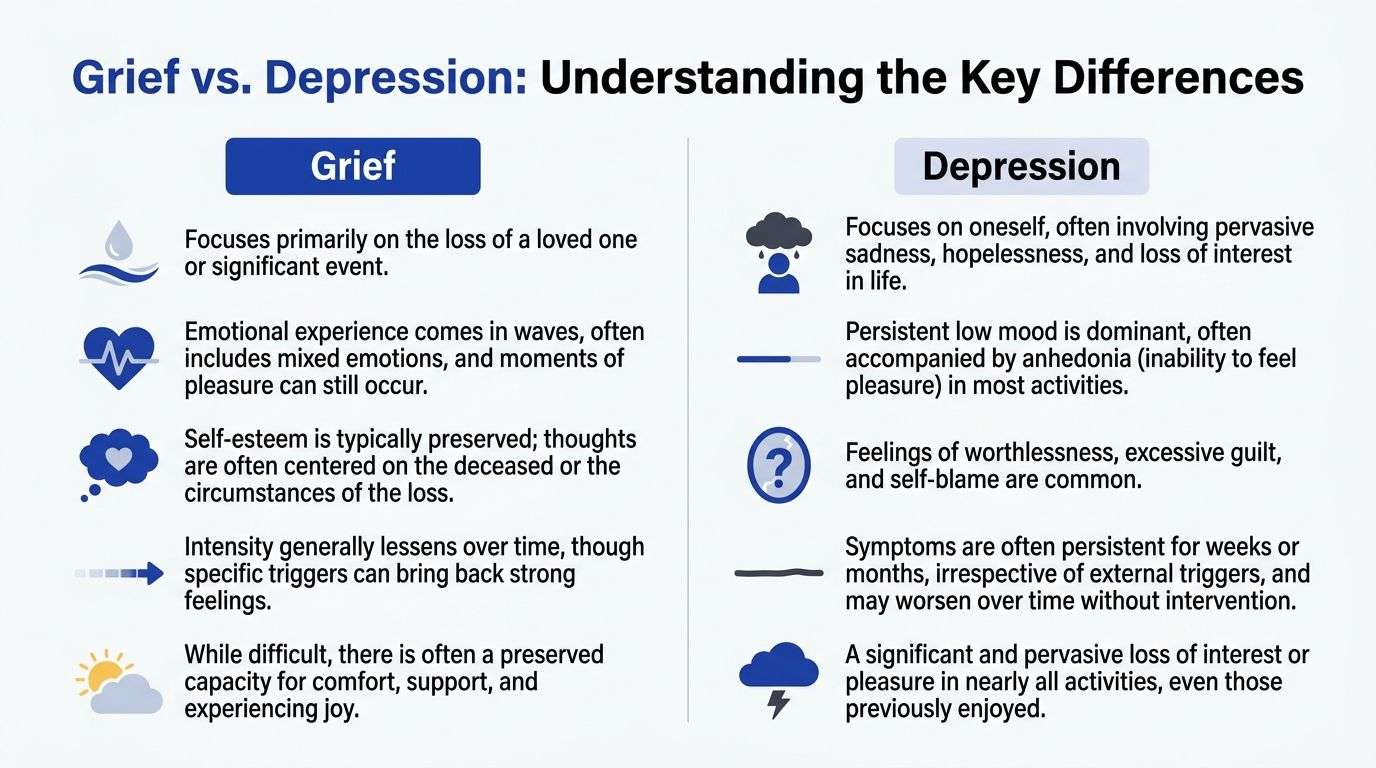
The clearest way to understand is it grief or depression? understanding the difference after a loss is to compare them side by side. The overlap can be strong, but the underlying pattern is often different.
A quick comparison
| Experience | Grief | Depression |
|---|---|---|
| Pattern of pain | Comes in waves, often linked to reminders | More constant and harder to interrupt |
| Main focus | The person who died and the loss itself | The self, life as a whole, and hopelessness |
| Self-esteem | Often preserved | Often eroded by worthlessness or self-blame |
| Pleasure | Moments of comfort or joy can still appear | Pleasure tends to feel absent or very muted |
| Connection | Support may feel hard to reach for, but often still helps | Withdrawal often deepens and support may feel pointless |
| Course over time | Usually shifts gradually, even if unevenly | May stay flat or worsen without treatment |
A helpful Canadian data point supports that distinction. Normal grief shows fluctuating low mood and preserved self-esteem, while depression involves pervasive anhedonia and feelings of worthlessness. Up to 30% of grieving individuals may develop complications, and post-loss depression rates can reach 18% in provinces like Ontario according to the summary at APIBHS on grief versus depression.
The focus of the pain matters
In grief, the pain usually points outward toward the loss.
You may think, “I miss her so much.” “I cannot believe he is gone.” “I keep reaching for my phone to text them.” Even guilt in grief is often tied to the relationship or the circumstances of the death.
In depression, the pain often turns inward.
You may think, “I am a burden.” “Nothing matters.” “I am broken.” “I ruin everything.” The loss may have triggered the depression, but the suffering spreads far beyond the person who died.
A core difference is this. Grief says “I miss them.” Depression often says “I am nothing.”
The role of self-worth
This is one of the most clinically useful distinctions.
A grieving person may be devastated and still know, somewhere inside, “I am still me.” Their world has changed. Their heart hurts. But their basic sense of worth is not always destroyed.
A depressed person often loses that anchor. They may feel ashamed, defective, useless, or intensely self-critical. They may struggle to believe they matter to anyone.
That difference can be subtle from the outside. It is not subtle on the inside.
Can you still feel anything good
Many grieving people feel guilty when they laugh, rest, enjoy a meal, or have a decent day. They worry that these moments mean they are forgetting the person.
They do not.
The ability to feel brief warmth, gratitude, connection, or even humour usually fits with grief. Depression tends to flatten those experiences. It is not only sadness. It is often a reduced capacity to feel pleasure, relief, or meaning.
Timing alone does not tell the whole story
People often ask, “How long is too long?”
That is understandable, but it is not the best first question. Time matters less than pattern, intensity, and functioning.
Some people have intense grief early on and remain connected to life. Others begin to slide into a darker, more global despair. In Canada, bereavement-related depression is a significant concern, with about 15 to 20% of bereaved individuals developing a major depressive episode, and the DSM-5 removed the bereavement exclusion in 2013 so clinicians can diagnose depression sooner after a loss when needed according to ISTSS on grief and depression.
What self-checking can and cannot do
Self-reflection can be useful, especially if you notice persistent hopelessness, worthlessness, or a broad loss of interest in living. Some people find it helpful to begin with structured self-checks such as these free depression screening tools before speaking with a professional.
A screening tool is not a diagnosis. It is a prompt to take your experience seriously.
If you are someone who appears functional on the outside but feels hollow inside, this discussion of high-functioning depression may also feel familiar.
Understanding Prolonged Grief Disorder
Some people do not fit neatly into “typical grief” or “depression.” Their grief remains intense, consuming, and stuck in a way that does not soften into a more integrated form over time. In Canada, that pattern is increasingly recognised as Prolonged Grief Disorder, often shortened to PGD.

What makes PGD different
PGD is not merely “grieving too long.” That phrase is inaccurate and unkind.
The central issue is not the calendar alone. It is the feeling that acute grief has not shifted. The person may still feel consumed by yearning, intense preoccupation with the deceased, and a sense that life cannot reorganise around the reality of the loss.
A Canadian-relevant source notes that PGD affects around 10% of bereaved adults in Canada, and a 2020 study in the Canadian Journal of Psychiatry found 9.5% of a Quebec cohort met PGD criteria 12 months after the loss. It also highlights that grief in PGD remains intensely focused on the lost loved one, while depression tends to involve a more generalized low mood and loss of self-worth, as described by the U.S. Department of Veterans Affairs overview of grief reactions.
How it feels in lived experience
People with PGD often say things like:
- “It still feels unreal.”
- “I cannot build a life around this.”
- “Everything meaningful ended when they died.”
- “I avoid reminders, or I cannot stop seeking them.”
That last point matters. Some people become intensely pulled toward reminders of the person. Others avoid them because the pain feels unbearable. Both can happen when grief becomes stuck.
Why the Canadian context matters
Canada’s use of modern diagnostic frameworks has helped clinicians describe this experience more clearly. That matters because people living with PGD are often told one of two unhelpful things: either “this is just grief” or “this is just depression.”
Neither response captures the full picture.
If your loss still feels acutely present long after others expect you to be “back to normal,” it may help to read more about complicated grief when the pain does not ease over time. Sometimes people feel relief just from seeing their experience named accurately.
PGD does not mean you loved too much or grieved incorrectly. It means your grief may need more focused support than time alone can provide.
Real Stories Differentiating Grief from Depression
Clinical definitions help, but many people recognise themselves more easily in stories than in checklists. These examples are fictional and anonymised, built from patterns counsellors commonly see.
Jasmine’s grief still has movement
Jasmine lost her partner eight months ago. Mornings are the hardest. She reaches for the other side of the bed and feels the shock all over again. Grocery shopping makes her cry because she still catches herself picking up his favourite food.
But when her sister comes by, Jasmine can talk about him. She cries, then laughs at a story about his terrible dancing. She still enjoys sitting in the sun with tea. Some days she takes a walk and feels a little more grounded afterward.
Jasmine is suffering, but her pain is clearly tied to her partner and the life they shared. Her sense of self is shaken, not erased. She can still receive comfort.
This sounds more like grief.
David’s pain has turned inward
David’s mother died earlier this year. At first, family members expected him to be devastated, and he was. But as the months passed, his sadness became less about his mother and more about himself.
He began saying things like, “Everyone would be better off without me,” and “I am useless.” He stopped caring about meals, messages, music, and work. Friends tried to bring him out, but he said nothing felt worthwhile. Even when he talked about his mother, the conversation quickly shifted into hopelessness about his whole life.
David is bereaved, but his distress is no longer only grief-shaped. The tone is broader, flatter, and more self-attacking.
This sounds more like depression after a loss.
Alina feels stuck in the moment of loss
Alina’s brother died more than a year ago. She still feels as if the death happened yesterday. She spends hours replaying the circumstances of what happened and cannot bear family gatherings because his absence feels intolerable. She has not been able to reconnect with friends, routines, or future plans.
She does not mainly describe worthlessness. She describes yearning, disbelief, and a life frozen around the loss.
That pattern may fit prolonged grief more than depression.
Why stories help
People often expect a perfect match between their experience and a diagnosis. Real life is messier than that.
You may relate partly to Jasmine and partly to David. You may be grieving and depressed at the same time. You may feel okay one day and frightened by your own thoughts the next. That does not make your experience invalid. It means careful assessment matters.
Navigating Your Path Forward with Practical Coping Strategies
When someone is overwhelmed after a loss, broad advice like “take care of yourself” is rarely enough. What helps is smaller, more concrete action. The right strategy also depends on whether you are primarily moving through grief, struggling with depressive symptoms, or both.

Honouring grief without fighting it
Some approaches support grief because they make room for the loss rather than trying to erase it.
- Create a ritual. Light a candle, visit a meaningful place, cook their recipe, or write them a letter. Ritual gives shape to feelings that otherwise feel chaotic.
- Keep a memory practice. A notebook, voice memo, or photo album can help hold memories gently instead of fearing they will disappear.
- Let the wave pass through. If a song, anniversary, or object brings tears, try not to treat the feeling as a failure. Name it. Breathe. Stay with it if you can.
- Use specific support requests. “Can you call me tonight?” is easier than “I need support.”
If anger is part of your grief, that is also a common and often misunderstood reaction. Some readers may find this piece on coping with grief and anger useful as a companion to the emotional work of mourning.
Managing depressive symptoms with structure
Depression responds less to waiting and more to gentle, repeated activation.
- Shrink the day. Do not ask, “How do I survive this month?” Ask, “What is my next task?”
- Pick one daily anchor. Showering, opening the curtains, walking to the mailbox, or eating breakfast at a set time can create a foothold.
- Use low-pressure movement. A short walk, stretching, or standing outside for a few minutes can help interrupt the shut-down cycle.
- Reduce all-or-nothing thinking. If you cannot do everything, do one thing. One thing counts.
When depression is present, motivation often follows action rather than preceding it. Waiting to feel ready can keep you stuck.
Support systems are not optional
The role of support is one of the most important differences between grief and depression. Grieving individuals who feel isolated are at much higher risk of developing clinical depression. People with depression often actively withdraw from support, while grieving people usually want connection but may struggle to ask for it according to Harvard Health’s discussion of grief morphing into depression.
That means practical support planning matters.
Try identifying:
- One family member who can handle updates or check-ins
- One friend who can sit with emotion without fixing it
- One workplace contact who knows you may need flexibility
- One professional to contact if things worsen
If you need more ideas for day-to-day support, this article on how to deal with grief offers practical starting points.
When to Seek Professional Support and What to Expect
There is no prize for pushing through alone. If your suffering is growing, staying flat, or becoming harder to manage, professional support can help clarify what is happening and what kind of care fits best.
Signs it is time to reach out
Consider speaking with a counsellor, psychologist, physician, or other qualified professional if you notice any of the following:
- Persistent worthlessness or hopelessness
- Thoughts of death, suicide, or feeling that others would be better off without you
- Inability to function in daily life
- Heavy reliance on alcohol or substances to get through the day
- Intense grief that remains stuck and disabling over time
In Canada, about 15 to 20% of bereaved individuals may develop a major depressive episode, and because the DSM-5 removed the old bereavement exclusion in 2013, clinicians no longer need to delay diagnosis when depressive symptoms clearly meet criteria after a loss. That shift reflects the need for earlier assessment and care, as noted in the earlier cited ISTSS source.
What grief counselling and depression treatment look like
Many people hesitate to get help because they imagine therapy will be cold, overly clinical, or focused on making them “get over it.” Good therapy should do the opposite.
Grief-focused counselling often helps you:
- process the reality of the loss
- express emotion safely; manage anniversaries, rituals, and family dynamics
- rebuild life around the absence without abandoning the bond
Depression treatment often includes approaches such as cognitive behavioural therapy, which looks at patterns of thought, behaviour, and withdrawal that keep depression going. A physician may also discuss medication when depressive symptoms are significant.
These are not competing paths. Sometimes a person needs support for grief and depression at the same time.
What a first session often feels like
A first appointment is usually less dramatic than people fear. The clinician will likely ask about:
- the loss itself
- your current symptoms
- sleep, appetite, concentration, and functioning
- your support system
- any safety concerns, including suicidal thinking
The aim is not to label you quickly. The aim is to understand you accurately.
If you are considering learning more about professional support, it can help to remember that reaching out is not an admission that you are coping badly. It is a way of giving yourself proper care during a very hard season.
The right support does not take your grief away. It helps you carry it without losing yourself.
Frequently Asked Questions about Grief and Depression
Can I experience grief and depression at the same time
Yes. A person can be grieving a real loss and also develop depression. This is one reason self-diagnosis can feel confusing. If your pain is about the person who died but is also accompanied by persistent worthlessness, hopelessness, or a broad loss of pleasure in life, both may be present.
My loss was sudden and traumatic. Does that change anything
It can make the experience more complex. Sudden loss often leaves people with shock, intrusive images, guilt, unanswered questions, and a stronger sense of instability. That does not guarantee depression, but it can increase the need for careful assessment and trauma-informed support.
I can still go to work. Does that mean it is not depression
Not necessarily. Some people remain very functional on the outside while feeling profoundly unwell inside. Functioning is important, but it is not the only measure. If your inner world feels flat, hopeless, or relentlessly self-critical, it is worth taking seriously even if others think you are doing fine.
How can I support a child or teen after a death
Keep language clear and honest. Children often grieve in bursts, moving in and out of play, tears, questions, and routine. That does not mean they are unaffected. Offer consistency, answer questions at their developmental level, and watch for lasting changes in sleep, school functioning, withdrawal, or behaviour. If a child seems stuck or overwhelmed, professional support can help.
Is it normal to feel guilty when I have a good day
Yes. Many grieving people feel this. Relief, laughter, rest, and enjoyment do not mean you are leaving the person behind. They usually mean your nervous system is doing what it is meant to do, which is move between pain and restoration.
If you are moving through loss and want thoughtful, evidence-informed support, Interactive Counselling offers care for grief, depression, trauma, family stress, and life transitions in a compassionate, practical way.
Clinically Reviewed By
Amy Mosset, MCP, RCC-S
Amy Mosset is a Master Practitioner in Clinical Counselling, Clinical Supervisor, and the owner of Interactive Counselling. She provides trauma-informed, evidence-based care and clinical supervision to registered therapists, with a focus on ethical practice, client safety, and high-quality therapeutic outcomes.