
Some days, emotions feel powerful and heavy, even when nothing obvious has gone wrong. For many young adults across Ontario, this sense of emotional overload can cause confusion and self-doubt. Emotional overwhelm can arise from complex internal and external factors, not just clear events or triggers, which means feeling deeply isn’t a flaw. Understanding how your brain and experiences shape your emotional world can make these moments less isolating and guide you towards real, compassionate support.
Table of Contents
- Understanding Emotional Overwhelm And Misconceptions
- Common Misconceptions About Emotional Overwhelm
- Why Unexplained Overwhelm Happens
- Brain Science Behind Intense Feelings
- How Your Brain’s Alarm System Works
- The Thinking Brain’s Role
- Why You Can’t Always Explain Your Feelings
- Stress, Triggers, And Everyday Emotional Factors
- How Stress Accumulates Invisibly
- The Role Of Pre-existing Vulnerabilities
- Daily Triggers You Might Overlook
- How Upbringing And Society Influence Emotions
- The Messages You Absorbed Growing Up
- Environmental Impact On Your Nervous System
- Societal Pressure And Modern Expectations
- Practical Approaches To Emotional Regulation
- Build Awareness Before You React
- Ground Yourself In The Present Moment
- Use Your Breath As An Anchor
- Name It To Tame It
Key Takeaways
| Point | Details |
|---|---|
| Understanding Emotional Overwhelm | Emotions can arise without clear triggers, influenced by internal and external factors. This challenges misconceptions that feelings must be logically justified. |
| Accumulated Stress | Emotional overwhelm often results from multiple stressors accumulating over time, rather than a single event. Recognising this can help in managing emotional responses. |
| Physiological Response to Emotions | The brain’s emotional centres function continuously and lead to feelings that may not be immediately understandable. Awareness of this can reduce self-blame for feeling overwhelmed. |
| Practical Emotional Regulation Techniques | Developing awareness and employing grounding techniques, such as deliberate breathing, can help manage overwhelming emotions effectively. Consistent practice improves emotional resilience. |
Understanding Emotional Overwhelm and Misconceptions
You might assume that overwhelming emotions always have an obvious trigger. Your boss said something harsh, a relationship ended, or you faced a major setback. But this isn’t always how emotions work.
Research shows that emotional overwhelm can arise without clear causes, stemming instead from complex internal and external factors that aren’t immediately obvious. Emotions influenced by cognitive appraisals and personal self-concept can feel intense even when no specific event triggered them.
This reality contradicts a common misconception: that emotions are purely reactive. Many people believe their feelings should always make logical sense. When they don’t, they blame themselves for being “too sensitive” or “irrational.”
Here’s what actually happens:
- Your brain continuously processes information below your conscious awareness
- Past experiences shape how you interpret present situations
- Physical factors like sleep, nutrition, and stress hormones influence emotional intensity
- Your sense of self and perceived value of tasks shapes your emotional responses
Emotions aren’t faulty signals that need to be justified—they’re complex responses shaped by biology, psychology, and circumstance.
Common Misconceptions About Emotional Overwhelm
Many young adults believe emotions should always have identifiable causes. When they don’t, self-blame follows. You might think: “I shouldn’t feel this anxious. Nothing bad happened.”
This misunderstanding isolates you from support. If you can’t explain the feeling, you might avoid talking about it altogether.
Another misconception is that emotional overwhelm means something is wrong with you. It doesn’t. Emotional awareness and understanding how emotions function is the foundation for moving through these experiences more effectively.
The truth is simpler: emotions are data. They tell you something matters to you, even if the exact reason isn’t clear yet.
Why Unexplained Overwhelm Happens
Your nervous system responds to perceived threats, not just real ones. Stress accumulation from multiple sources creates a pressure that eventually feels unbearable, even if one triggering event never occurs.

Accumulated pressure builds like water behind a dam. Eventually, small things trigger flooding—not because they’re significant, but because your system is already full.
Other factors include:
- Unprocessed emotions from past situations
- Perfectionism or unrealistic self-expectations
- Uncertainty about your future or identity
- Physical exhaustion masquerading as emotional distress
- Social isolation reducing your emotional resilience
Understanding these layers helps you respond with compassion instead of judgment.
Pro tip: _When emotions feel overwhelming without clear cause, pause and ask yourself: “What has been accumulating?” rather than “What triggered this?” This shifts focus from finding blame to recognizing your emotional capacity has reached its limit.
Brain Science Behind Intense Feelings
Your emotions aren’t arbitrary. They’re produced by precise biological systems that operate largely outside your conscious control. Understanding how your brain generates feelings helps you stop blaming yourself for being “too emotional.”
The limbic system regulates emotion generation and processing, including key structures like the amygdala, hypothalamus, thalamus, and hippocampus. Your amygdala acts as your brain’s alarm system, detecting emotional threats and triggering responses before you’re even consciously aware of them.
This explains why intense feelings can hit suddenly. Your amygdala doesn’t wait for permission from your thinking brain—it reacts instantly.
Here is a comparison of key brain regions involved in processing intense emotions and their main roles:
| Brain Region | Main Function | Key Emotional Impact |
|---|---|---|
| Amygdala | Detects threat, triggers alarm | Instantly produces fear or anxiety |
| Hypothalamus | Releases stress hormones | Heightens arousal and alertness |
| Hippocampus | Stores emotional memories | Provides emotional context |
| Prefrontal Cortex | Analyses and regulates feelings | Calms or explains emotions |
Understanding these functions can help you connect physical sensations to emotional reactions.
How Your Brain’s Alarm System Works
Imagine your amygdala as an overeager security guard. It spots something that might be threatening and sounds the alarm immediately, flooding your body with stress hormones.
Sometimes this alarm fires even when there’s no real danger. Past trauma, chronic stress, or accumulated worry can make your amygdala hypersensitive.
When this happens, you feel overwhelming fear or anxiety without knowing exactly why.
Key players in emotional processing:
- Amygdala detects emotional threats instantly
- Hypothalamus releases stress hormones like cortisol and adrenaline
- Hippocampus stores emotional memories and context
- Thalamus relays sensory information to emotional centres
The Thinking Brain’s Role
Your prefrontal cortex (PFC) is your brain’s rational decision-maker. It assigns meaning to emotions and helps regulate their intensity. However, the prefrontal cortex processes external sensations, memories, bodily states, and self-related information simultaneously, creating complexity.
This neural sophistication means your feelings result from intricate processing you can’t fully observe. Multiple brain regions are working together, sometimes sending conflicting signals.
When you’re stressed or tired, your prefrontal cortex functions less effectively. Your amygdala’s alarm system becomes louder and harder to quiet.
Your brain’s emotional centres operate 24/7, processing information you’ll never consciously notice—which is why feelings can feel overwhelming without a clear cause.
Why You Can’t Always Explain Your Feelings
Your brain processes roughly 11 million bits of information per second. You’re consciously aware of maybe 40 bits. Everything else? Handled beneath awareness.
This means emotional responses are shaped by unconscious perceptions, past experiences, and body sensations you haven’t registered yet. The feeling arrives before the conscious understanding follows.
Your body registers fatigue, hunger, or tension before your mind catches up. These physical states influence your emotional resilience significantly.
Pro tip: _Check your physical state before assuming your emotions need psychological explanation: Have you slept enough? Eaten today? Moved your body? Often, addressing basic needs naturally quiets emotional overwhelm faster than analysing its source.
Stress, Triggers, and Everyday Emotional Factors
Emotional overwhelm rarely happens in isolation. It’s typically the result of multiple stressors layering on top of each other, creating a cumulative effect that feels disproportionate to any single event.
Research shows that mental health fluctuations are influenced by stressful life experiences and ongoing daily stressors. Emotional well-being doesn’t exist in a vacuum—it fluctuates based on what’s happening in your life, your environment, and your underlying vulnerabilities.
You might feel fine on Monday, then emotionally shattered by Wednesday. The difference isn’t your character—it’s accumulated stress.
How Stress Accumulates Invisibly
Stress doesn’t announce itself clearly. You wake up worried about an assignment, your roommate makes a critical comment, you skip lunch because you’re busy, and your sleep suffers.
None of these alone feels catastrophic. But together, they create a pressure that builds throughout your week.
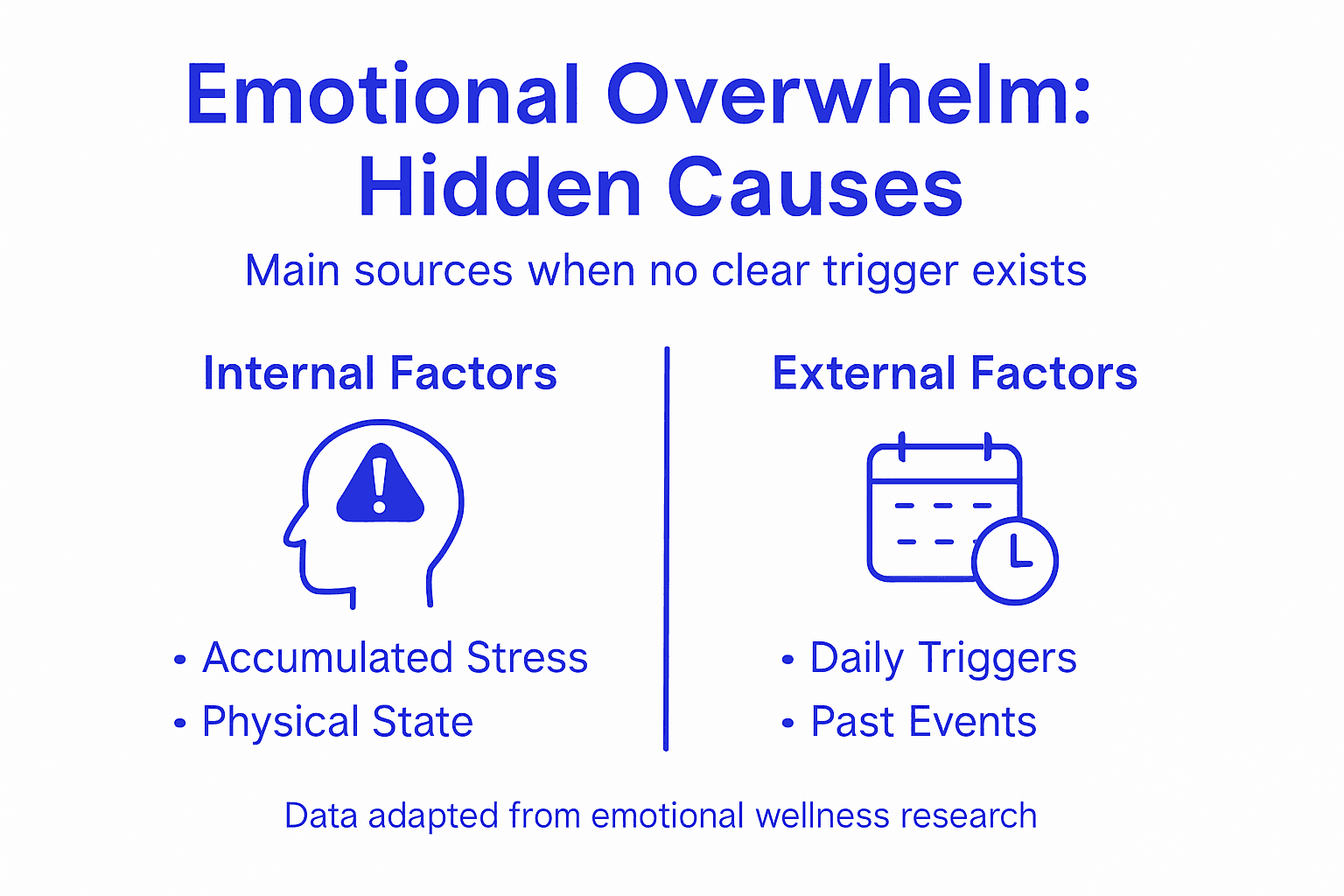
By Friday, you’re overwhelmed. Your friends ask what’s wrong, and you can’t pinpoint a single cause.
Common stress layers that pile up:
- Academic or work pressure extending over weeks
- Relationship tension or uncertainty
- Financial worry and instability
- Sleep deprivation reducing emotional resilience
- Physical neglect (skipped meals, no movement)
- Social isolation or disconnection
- Uncertainty about your future or identity
Stress compounds like interest. Small amounts accumulate silently until suddenly, you’re overwhelmed by what feels like nothing specific.
The Role of Pre-existing Vulnerabilities
You don’t experience stress equally. Someone with a history of anxiety, past trauma, or low self-worth will feel emotional overwhelm more intensely than someone without these vulnerabilities.
This isn’t weakness. It’s biology. Your nervous system has been shaped by experience, making certain stressors hit harder.
If you experienced instability in childhood, for example, even minor uncertainty about the future can trigger disproportionate anxiety. Your system is primed to perceive threat.
Understanding your vulnerabilities helps you anticipate when you’ll be more fragile and plan support accordingly.
Daily Triggers You Might Overlook
Triggers aren’t always obvious trauma responses. They’re the small things that nudge your nervous system toward overwhelm.
A critical comment from someone you care about. A deadline you forgot. A text message from someone who hurt you. Overstimulation in a crowded environment. Lack of control over a situation.
These daily triggers accumulate throughout your day, each one adding to your emotional load. Your capacity decreases gradually until minor things feel devastating.
Managing triggers means recognising them early and creating intentional recovery moments throughout your day.
Pro tip: Track your emotional intensity for one week alongside daily stressors, sleep, and eating patterns—you’ll likely notice clear connections between what feels overwhelming and the multiple factors preceding it, not a single “cause.”
How Upbringing and Society Influence Emotions
Your emotions aren’t purely individual experiences. They’re shaped profoundly by your upbringing, culture, and the environment where you grew up. What feels overwhelming to you might feel manageable to someone from a different background.
Cultural ideas and practices shape how people experience and express emotions, determining emotional patterns and intensity. Your family taught you unspoken rules about which emotions were acceptable, when to express them, and how intensely.
These learned patterns run so deep you often don’t notice them operating. They become your emotional baseline.
The Messages You Absorbed Growing Up
Your family had implicit rules about emotions. Maybe sadness was shameful, anger was dangerous, or vulnerability was weakness. Perhaps emotions simply weren’t discussed.
These messages become internalised. Now, when you experience emotions that violated those old rules, you feel conflicted. Your body wants to feel the emotion, but your mind resists it as “wrong.”
This internal conflict creates overwhelm. You’re not just feeling the emotion—you’re fighting it simultaneously.
Common emotional rules from upbringing:
- Keep emotions private; never burden others
- Sadness is self-indulgent; stay busy instead
- Anger is dangerous and must be suppressed
- Happiness means you’re not taking things seriously enough
- Vulnerability reveals weakness
- Emotional needs are inconvenient
Environmental Impact on Your Nervous System
Where you grew up affects how your brain processes stress. Research shows that urban upbringing and city living affect neural mechanisms related to social stress processing, increasing vulnerability to emotional overwhelm.
If you grew up in chaotic, unpredictable environments, your nervous system learned hypervigilance. Now, even minor social uncertainties trigger threat responses.
If you grew up in fast-paced, high-stimulation environments, slower situations might feel anxiety-inducing. Your brain expects constant stimulation.
These aren’t character flaws. They’re adaptive responses to your early environment.
Your upbringing wrote your emotional rulebook. Sometimes those rules no longer serve you—and that’s when overwhelm happens.
Societal Pressure and Modern Expectations
Beyond your family, society sends constant messages about acceptable emotions. You should be happy, grateful, productive, and positive. Negative emotions indicate failure.
This creates pressure to suppress authentic feelings. When you feel overwhelmed, you’re not just managing the emotion—you’re managing shame about having it.
Social media intensifies this. You see curated versions of others’ lives, making your emotional struggles feel abnormal and isolating.
Pro tip: Identify one emotional rule from your upbringing that no longer serves you (such as “emotions should be hidden”), then consciously practice the opposite in small, safe settings—like expressing a feeling to a trusted friend—to gradually rewire your nervous system’s response.
Practical Approaches to Emotional Regulation
Understanding why you feel overwhelmed is only half the battle. You also need tools to manage those feelings when they arrive. Emotional regulation isn’t about eliminating emotions—it’s about responding to them skillfully.
These aren’t complicated techniques requiring special training. They’re practical, evidence-based strategies you can start using today to reduce overwhelm and build resilience.
Research shows that trauma-informed strategies like mindfulness and breathing techniques help individuals manage and regulate emotions effectively. Regular practice improves your ability to stay grounded when emotions intensify.
Build Awareness Before You React
The first step is noticing emotions early, before they overwhelm you completely. Most people only recognise they’re struggling when they’ve already spiralled.
Start checking in with yourself throughout your day. How’s your body feeling right now? Tense shoulders? Tight chest? Racing thoughts? These physical signals arrive before the emotional flood.
Early awareness gives you a chance to intervene. You catch the wave before it crashes.
Practical awareness techniques:
- Pause three times daily to scan your body for tension
- Notice your breathing patterns—shallow breathing signals stress
- Track your mood and what preceded it (sleep, food, social interaction)
- Recognise your personal overwhelm signals (irritability, fatigue, numbness)
Ground Yourself in the Present Moment
When emotions feel overwhelming, your mind often races to worst-case scenarios. Grounding techniques anchor you back to the present, where you’re actually safe.
These work by engaging your senses. You notice five things you see, four you can touch, three you hear, two you smell, one you taste.
Other grounding methods include holding ice, walking barefoot on grass, or pressing your feet firmly into the ground. Physical sensations interrupt the overwhelm cycle.
Grounding doesn’t eliminate the emotion—it gives your nervous system a chance to remember that you’re safe right now.
Use Your Breath as an Anchor
Your breath is always accessible. When panic or overwhelm arrives, slow, intentional breathing signals your nervous system to calm down.
Try box breathing: breathe in for four counts, hold for four, exhale for four, hold for four. Repeat five times. The rhythm interrupts stress responses.
Or simply extend your exhale longer than your inhale—exhale for six counts instead of four. This activates your parasympathetic nervous system, your body’s “rest and recover” mode.
Name It to Tame It
There’s power in putting feelings into words. When you name an emotion, you activate your prefrontal cortex, your brain’s rational centre. This naturally reduces amygdala activation.
Instead of “I’m falling apart,” try: “I’m feeling anxious because I accumulated stress this week. That’s a normal response.” This tiny shift moves you from overwhelm into understanding.
Practising emotional regulation skills like self-reflection and cognitive restructuring supports your ability to respond rather than react.
Pro tip: Choose one regulation technique and practice it when you’re calm, not during crisis—your nervous system learns better when not activated, so you’ll actually remember to use it when you need it most.
Here is a summary of practical emotional regulation strategies and how they help:
| Technique | How It Works | When to Use |
|---|---|---|
| Body Scan | Increases awareness of tension | Start and end of day |
| Grounding Exercises | Focuses on senses to calm body | During overwhelm |
| Box Breathing | Slows heart rate, reduces stress | When anxious |
| Labelling Emotions | Activates rational thinking | Early in escalation |
Applying these consistently can improve resilience and recovery from emotional overwhelm.
Find Relief from Emotional Overwhelm with Compassionate Support
Feeling overwhelmed by emotions that seem to come without a clear cause can be confusing and isolating. As highlighted in the article, these powerful feelings arise not just from external events but from complex internal processes and accumulated stress. If you recognize the struggle of intense emotions, persistent anxiety, or a flood of feelings that are hard to explain, you are not alone. Key pain points include difficulty understanding why emotions are so intense, managing the body’s stress responses, and overcoming old emotional rules that no longer serve you.
At Interactive Counselling, we offer personalized therapy solutions designed to help you build awareness, regulation skills, and compassionate self-understanding. Our licensed therapists provide flexible options including in-person sessions in Kelowna, Vernon, Grande Prairie, and Penticton, as well as online therapy nationwide. By connecting with professionals who understand the biology of emotions and the impact of upbringing and stress, you can start to regain control and calm. Take the first step today by visiting Interactive Counselling to explore how our supportive environment can guide you through emotional overwhelm with proven strategies. When emotions feel too much, do not wait. Reach out now and begin transforming your emotional experience.
Frequently Asked Questions
What causes emotional overwhelm without an obvious trigger?
Emotional overwhelm can arise from accumulated stressors, unprocessed emotions, physical exhaustion, or past experiences. It often feels disproportionate due to layers of everyday pressures and underlying vulnerabilities.
How does the brain contribute to feelings of emotional overwhelm?
The limbic system, particularly the amygdala, processes emotions and triggers responses rapidly. When overwhelmed, your brain’s alarm systems can activate even without clear threats, leading to intense feelings of anxiety or fear.
What are some effective strategies to manage emotional overwhelm?
Effective strategies include practicing mindfulness, grounding techniques, box breathing, and labeling your emotions. These methods help increase awareness, calm your nervous system, and provide a sense of control over your feelings.
How can upbringing impact my emotional responses?
Your upbringing shapes your emotional patterns through implicit family rules about acceptable emotions and societal expectations. This background can influence how you interpret and respond to stress, potentially leading to feelings of overwhelm when those emotional rules are challenged.
Recommended
- Big Emotions in Childhood – How They Shape Development
- Helping children cope with big emotions (anger, fear, sadness) – Interactive Counselling
- Emotional Awareness: First Step to Well-Being
- How Emotional Patterns Shape Canadian Wellbeing