Healing from trauma isn't about trying to erase the past. It’s about building a present where you feel safe, in control, and able to look toward the future with a sense of hope. This journey is deeply personal, and it often begins with small, gentle steps focused on one thing above all else: establishing safety and stability. This is the foundation everything else is built upon. For more information, see our trauma counselling.
This guide focuses on early-stage trauma recovery skills and nervous-system stabilization, rather than in-depth trauma processing or specific therapy modalities
Your First Steps Toward Safety and Stability
When you’re just starting to heal from a traumatic experience, the process can feel overwhelming. Your world might seem unpredictable, and even your own body may not feel like a safe place to be. This is an entirely normal response. Before any deep emotional work can begin, the first priority is creating a sense of safety—both in your surroundings and within yourself.

This initial phase isn’t about processing memories or digging into what happened. It’s simply about learning how to calm your nervous system and reassure your brain that the immediate danger is over. Think of it like setting up a secure base camp before you consider starting a challenging climb.
Understanding Your Window of Tolerance
A helpful concept in trauma recovery is the 'window of tolerance'. This is the zone where you can manage your emotions and handle daily life without feeling completely overwhelmed or shutting down. When you’re inside this window, you feel relatively calm, connected, and capable of responding to life’s demands.
Trauma has a way of shrinking this window, making it far too easy to be pushed into states of:
Hyperarousal: Feeling anxious, on-edge, irritable, or panicky (the "fight or flight" response).
Hypoarousal: Feeling numb, disconnected, exhausted, or empty (the "freeze" response).
The goal isn't to never feel these things again, but to gently widen your window of tolerance over time. This happens by noticing when you’re starting to leave your window and using simple skills to guide yourself back to a place of balance. To explore this more, you can learn about the importance of psychological safety in healing.
Identifying Triggers and Creating a Safe Space
A trigger is anything—a sight, sound, smell, person, or even an internal feeling—that reminds your nervous system of the past trauma. It can pull you out of the present moment and back into a state of high alert. Identifying your triggers isn’t about avoiding life forever; it's about understanding what makes you feel unsafe so you can prepare and cope.
Start by gently noticing what shifts your mood or energy. Keep a simple, judgment-free log, either mentally or on paper. Perhaps it’s crowded places, a certain tone of voice, or a specific time of day. Once you have some awareness, you can begin to intentionally create more safety for yourself.
This might look like:
Adjusting Your Environment: Adding soft lighting, cozy blankets, or calming scents to your home.
Setting Gentle Boundaries: Politely declining invitations or ending conversations that start to feel overwhelming.
Creating Soothing Routines: Starting or ending your day with a predictable, calming activity, like sipping tea or listening to quiet music.
The experience of trauma is unfortunately common. Research shows that over three-quarters of Canadians have been exposed to at least one traumatic event. However, its impact varies greatly from person to person, which is why a personalized, supportive healing path is so important. You can learn more from these Canadian trauma statistics from a recent study.
Simple Grounding Exercises to Reconnect with the Present
When you feel overwhelmed or disconnected, grounding techniques are your anchor. They pull your attention away from distressing thoughts and memories, bringing you back to the safety of the here and now by engaging your senses.
Here are a few gentle exercises you can try:
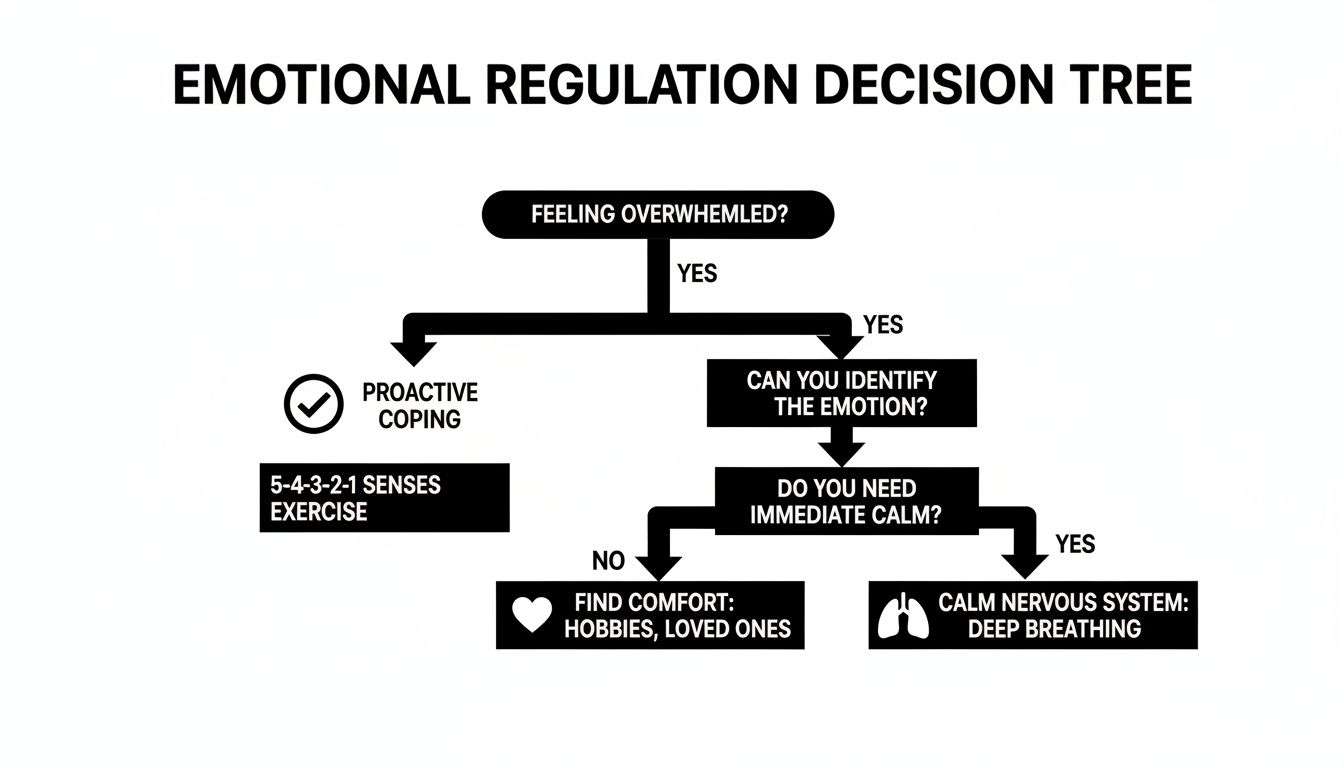
The 5-4-3-2-1 Method: Silently name five things you can see, four things you can physically feel (like the chair beneath you), three things you can hear, two things you can smell, and one thing you can taste.
Temperature Change: Hold a cool glass of water or splash a little cool water on your face. The sudden change in temperature can be a powerful sensory reset.
Mindful Touch: Pick up an object near you and focus completely on how it feels—its texture, weight, and shape. A smooth stone or a soft blanket works well.
These first steps are about restoring a fundamental sense of security. By focusing on your immediate safety and learning to ground yourself, you are building the essential foundation you need to heal from trauma at a pace that feels right for you.
Building Your Emotional Regulation Toolkit
Once you’ve started to feel a bit safer, the next step in healing is learning to manage the powerful emotions that will inevitably surface. It's completely normal for intense feelings like anxiety, anger, sadness, or numbness to arise. They can feel like unpredictable waves that threaten to pull you under. The goal here isn't to stop the waves—it's to learn how to navigate them.
Emotional regulation is the skill of riding those emotional waves instead of being swept away. This is about creating a personal toolkit of strategies that work for you. It’s not about suppressing feelings, but about giving yourself practical ways to navigate them without becoming completely overwhelmed.
Introducing Mindfulness and Gentle Awareness
A cornerstone skill for regulating emotions is mindfulness: paying attention to the present moment, on purpose, without judgment. When a big emotion like panic or rage hits, our instinct is often to fight it or run from it, which usually makes it stronger.
Mindfulness offers a different path. Instead of reacting, you learn to simply notice the feeling. You might say to yourself, "Anxiety is here," or "I'm noticing a lot of heat in my chest." This creates a small but powerful gap, gently reminding you that you are not your feelings—you are the person experiencing them.
This practice isn't about emptying your mind, but observing what's there with gentle curiosity. Over time, this helps your brain's alarm system dial down because you're teaching it that you can handle these internal storms. You can learn more about building these emotional regulation and resilience skills to create a stronger foundation.
Calming Your Nervous System with Your Breath
One of the most immediate and effective tools you have is your breath. When distressed, your breathing naturally becomes shallow and quick, which signals danger to your nervous system. By consciously slowing your breath, you send a powerful message back to your brain that you are safe.
A simple technique is box breathing:
Breathe in slowly through your nose for a count of four.
Hold your breath gently for a count of four.
Breathe out slowly through your mouth for a count of four.
Hold at the bottom of the exhale for a count of four.
Repeat this cycle for a few minutes. The predictable rhythm is incredibly soothing and helps reset your nervous system, pulling you out of that frantic "fight or flight" state.
Using Your Senses to Stay Anchored
When your mind is spinning, grounding techniques that engage your five senses are a lifeline. They pull your focus out of the internal chaos and anchor you firmly in the present moment. Creating a personal 'calm kit' can be an incredibly helpful way to have sensory tools ready when you need them most.
This might be a small bag or box containing items that are comforting to your senses:
Touch: A smooth worry stone or a small piece of soft fabric.
Smell: A small vial of calming essential oil like lavender.
Taste: A mint, a piece of sour candy, or a small square of dark chocolate.
Sight: A photograph of a loved one or a peaceful place.
Sound: A playlist of calming music or nature sounds on your phone.
Having these resources ready means you don't have to think when you feel overwhelmed; you can simply reach for your kit and find immediate, tangible support. Building this toolkit is a compassionate act of self-care and a vital part of learning how to heal from trauma.
Finding the Right Professional Support
While building your own emotional regulation toolkit is a huge step forward, sometimes the journey requires a guide. Reaching out for professional support isn't a sign of weakness; it’s an act of courage and a powerful acknowledgment that you deserve specialized care. A good therapist can provide a safe, structured space where you can explore difficult feelings and memories without getting overwhelmed.
Taking that first step can feel intimidating, especially when you're already feeling vulnerable. The goal here is to demystify some of the most effective, evidence-based approaches so you can feel more informed about finding the right fit.
What is Trauma-Informed Care?
You’ll likely hear the term trauma-informed care, and for good reason. It’s not a specific type of therapy but a foundational approach. It means a therapist understands the widespread impact of trauma and recognizes that your symptoms are often your system's adaptive attempts to keep you safe.
A trauma-informed therapist prioritizes:
Safety First: Creating a space where you feel physically and emotionally secure is the top priority.
Trust and Transparency: Building a collaborative, respectful relationship where you have a voice in your healing process.
Empowerment: Helping you recognize your own strengths and build skills, rather than seeing you as someone who is "broken."
This approach shifts the question from "What's wrong with you?" to the more compassionate question, "What happened to you?"
Common Therapeutic Approaches for Trauma
There is no single "best" therapy for trauma. The most effective one is the one that resonates with you and your unique needs. Below are a few highly-regarded methods.
Cognitive Behavioural Therapy (CBT)
Cognitive Behavioural Therapy (CBT) is one of the most well-researched therapies. It operates on the principle that our thoughts, feelings, and behaviours are interconnected. Trauma can create powerful, negative thought patterns (like "The world is unsafe" or "It was my fault") that keep you stuck.
In trauma-focused CBT, a therapist helps you identify these unhelpful thought patterns and gently challenge them. You’ll learn practical skills to reframe your thinking and change behaviours that reinforce anxiety. It’s a structured, goal-oriented approach that can help you feel more in control.
Eye Movement Desensitization and Reprocessing (EMDR)
EMDR is a unique therapy designed to help people heal from the symptoms of traumatic memories. When a traumatic event happens, the memory can get "stuck" in the brain's processing system. EMDR helps the brain properly process these memories so they can be filed away.
During an EMDR session, you focus on the traumatic memory while simultaneously experiencing bilateral stimulation, like guided eye movements. This process seems to help the brain's processing system resume its natural healing course, allowing the memory to be stored in a way that is no longer distressing. The memory doesn't disappear, but its intense emotional charge fades.
Somatic Therapies
Somatic therapies are built on the understanding that trauma is held in the body. These approaches focus on releasing the physical tension and stress trapped within the nervous system. Instead of just talking about what happened, a somatic therapist guides you to pay close attention to your physical sensations—like a tight chest or clenched jaw. Through gentle movement and breathwork, you learn to release these stored survival responses.
While approximately 8% of Canadian adults meet the criteria for probable PTSD, over half sought professional help. This data from Statistics Canada underscores the importance of finding accessible, effective support.
Finding the right person is just as important as finding the right method. A strong therapeutic relationship built on trust and empathy is often the most significant factor in successful healing. For more guidance, you might find it helpful to read our guide on how to find the right therapist.
Reconnecting with Yourself and Your Life
Healing from trauma isn't just about processing the hard stuff; it’s about gently and intentionally stepping back into your own life. When you’ve been stuck in survival mode, your world can shrink, and your sense of who you are can get lost. This part of the journey is about rediscovering yourself beyond what happened and reclaiming a life that feels meaningful and yours.

It’s the slow, compassionate shift from surviving to truly living. It starts with small, predictable steps that rebuild your sense of comfort and control.
Rebuilding Comfort Through Simple Routines
After trauma, life can feel chaotic. Simple, gentle routines become a powerful tool. They send a quiet, consistent message to your brain: "You are safe now." Predictability creates calm. When your mind and body know what to expect, they can start to relax.
This doesn't mean you need a rigid schedule. Think of it as creating small, comforting anchors of predictability.
You could try weaving a few of these into your week:
A Morning Anchor: Before looking at your phone, start each day with the same quiet activity, like five minutes of stretching or sipping a warm drink by the window.
Mindful Movement: Try a short walk around the same time each afternoon. Pay attention to the feeling of your feet on the pavement and the sounds of your neighbourhood.
An Evening Wind-Down: Create a small ritual to signal the day is ending, like reading a chapter of a book or listening to a calming podcast.
These small, repeated actions build a foundation of safety from the ground up.
Nurturing Supportive Connections
Trauma can make you feel profoundly alone and make it difficult to trust others. Reconnecting with safe, supportive people is a vital part of healing, but it must be done at your own pace. The key here is quality, not quantity. One or two trusted relationships can make all the difference.
When you feel ready, start with low-pressure interactions, like a quick text to a friend or a short phone call with a family member who understands. The goal is to experience connection without feeling overwhelmed. As you reconnect, setting boundaries becomes essential. A boundary isn’t a wall; it’s a compassionate way to protect your energy.
It might sound like:
"I'd love to see you, but I only have the energy for about an hour today."
"I really appreciate you asking, but I'm not ready to talk about that right now."
"I need to take some quiet time for myself this evening."
Setting a boundary is an act of kindness to yourself and reinforces that your needs matter.
Rediscovering Your Passions and Values
Trauma can overshadow your identity, making you forget the things that once brought you joy. A beautiful part of healing is rediscovering—or even discovering for the first time—what makes you feel alive.
This is a time for gentle exploration, not pressure. Be curious. What did you love to do before the trauma? What were you into as a kid?
Make a simple, no-pressure list of possibilities:
Creative outlets like drawing, writing, or playing an instrument.
Getting out in nature by hiking or gardening.
Learning a new skill, like a language or a new recipe.
Volunteering for a cause that means something to you.
Start small. Try one thing for just 15 minutes. The point isn’t to become a master painter or expert chef. It's to re-engage with the parts of yourself that have been lying dormant. This process helps you build a life that is rich, meaningful, and defined by you—not by what happened to you.
Navigating Setbacks on Your Healing Path
The path to healing from trauma is rarely a straight line. It’s more like a spiral—some days you’ll feel strong and steady, and other days you might stumble. Having a difficult day or week doesn't mean you've failed or that your progress has been erased. Setbacks are a normal part of the process.
Think of them not as failures, but as feedback. Every challenge is a chance to practice your coping skills, learn more about what you need, and deepen your resilience. The goal isn’t to avoid stumbles, but to learn how to meet yourself with kindness when they happen.
Understanding What Can Trigger a Setback
A setback often occurs when you encounter a trigger that overwhelms your nervous system. Sometimes these are obvious, but other times they are subtle. Recognizing what might lead to a difficult period can help you prepare.
Common triggers include:
Anniversaries: Dates connected to the traumatic event can stir up intense emotions.
New Life Stressors: Major life changes like a job loss or relationship conflict can drain your emotional resources.
Sensory Reminders: An unexpected sight, sound, or smell tied to the past can set off your body’s internal alarm.
Physical Exhaustion: When you're run down or sleep-deprived, your capacity to handle stress naturally shrinks.
Awareness empowers you to approach these situations with more self-compassion, knowing that a strong reaction is a normal response, not a sign of moving backward.
Creating a Proactive Plan for Tough Moments
When you feel yourself starting to slide, it can be hard to think clearly. That’s why creating a simple, personalized plan before you need it is one of the kindest things you can do for yourself.
1. Identify Your Early Warning Signs
How does your body tell you it’s getting overwhelmed? These signals are unique to you. Maybe you clench your jaw, feel tightness in your chest, or become irritable. Get to know your personal red flags.
2. List Your Go-To Coping Skills
What are your top 3-5 grounding or soothing strategies? You want your most reliable tools, like:
Doing a 5-4-3-2-1 grounding exercise.
Holding a piece of ice to reset your senses.
Putting on a specific calming playlist.
Calling a friend who knows how to listen.
3. Know Who to Contact for Support
List the names and phone numbers of people in your support system. This could be a trusted friend, family member, or your therapist. Having this information ready removes barriers when you're already distressed.
A setback is not a sign that healing is impossible. Natural recovery is common. The lifetime prevalence of PTSD in Canada is 9.2%, yet only 6.1% have a current diagnosis, suggesting many people find their way through it over time. You can explore more about the prevalence and recovery rates of PTSD in Canada.
When you view setbacks as feedback instead of failure, your perspective shifts. Each difficult moment teaches you something valuable. Every day you continue on this path is an act of incredible strength.
Frequently Asked Questions About Healing from Trauma
As you walk this path, questions will naturally arise. Feeling uncertain at times is part of the process. Below are answers to some common questions, offered with the hope of bringing clarity and reassurance.
How long does it take to heal from trauma?
There is no set timeline for healing. It’s a gradual, non-linear process that depends on many factors, including the nature of the trauma, your personal history, and your support system. The kindest thing you can do is let go of any pressure to meet a deadline. Instead, focus on celebrating small, steady steps forward and honour your own pace.
Can I heal from trauma without therapy?
It is absolutely possible to develop coping skills and find healing on your own. People are incredibly resilient. That said, professional therapy offers unique support. A trained, trauma-informed therapist brings specialized knowledge and proven tools (like EMDR or somatic approaches) specifically designed to help your brain and body process what happened in a safe, contained way. While self-healing is powerful, therapy can often make the process feel safer and more direct.
What is the difference between a bad memory and trauma?
While any bad memory can be painful, a traumatic memory often feels fundamentally different. A typical bad memory is something you remember happening in the past. A traumatic memory, on the other hand, can get ‘stuck’. When triggered, it doesn't feel like a memory at all—it can feel like the event is happening right now, setting off intense physical and emotional reactions. Trauma is less about the event itself and more about the body's and mind's ongoing response to it.
Why do I feel so disconnected from everyone?
Feeling numb, detached, or cut off from others is a very common response to trauma. This experience, often called dissociation, is a protective strategy your brain uses to shield you from emotions that feel too overwhelming. It’s your system's way of creating distance from pain to help you survive. As you build safety and learn grounding skills, these feelings of connection can gradually return. Be patient with yourself; this is your system trying its best to keep you safe.
Healing is a journey of reclaiming your sense of self and safety in the world. It requires patience, courage, and a great deal of self-compassion. Remember that every step you take, no matter how small, is a testament to your strength and resilience. If you feel you need support along the way, learning more about counselling and how it can support you can be a helpful next step.
Clinically Reviewed By
Amy Mosset, MCP, RCC-S
Amy Mosset is a Master Practitioner in Clinical Counselling, Clinical Supervisor, and the owner of Interactive Counselling. She provides trauma-informed, evidence-based care and clinical supervision to registered therapists, with a focus on ethical practice, client safety, and high-quality therapeutic outcomes.