We’ve all got it—that quiet, constant broadcast in the back of our minds. It’s the voice that points out every mistake, questions every decision, and whispers that we’re not quite good enough. This internal monologue, what we often call the inner critic, is a universal part of being human. Sometimes, it can keep us safe or even motivate us. But it becomes a real problem when the volume gets stuck on high, turning from a quiet whisper into a relentless narrator of self-doubt. For more information, see our Kelowna couples counselling.
"Negative self-talk affects daily life when this inner voice starts to dictate your feelings, limit your choices, and damage your relationships, essentially becoming the loudest, most convincing voice in your head." For more information, see our counselling in Kelowna.
Understanding Your Inner Critic
Imagine your mind is like a radio. We all have a station that plays the “not good enough” hits on a loop. For many of us here in Kelowna, this station is just background noise. The trouble starts when that's the only station you can tune into, and its signal is so strong it drowns out everything else. For more information, see our couples counselling.

This constant stream of criticism isn't a character flaw or some sign of weakness. It’s actually a learned pattern of thought. Often, it develops over years as a way to protect ourselves from failure or what we fear others might think. The problem is, what once felt like a shield can quickly become a cage, holding you back from the life you truly want.
How The Inner Critic Gains Power
Your inner critic thrives in the quiet moments. It gets stronger when we're feeling stressed, tired, or vulnerable. It doesn't just comment on what you do; it actively shapes your perception of reality until its persistent messaging starts to feel like undeniable truth.
Think about it. A single mistake at work isn’t just a mistake—it becomes "proof" that you're incompetent. A disagreement with your partner isn't just a conflict—it's twisted into "evidence" that you're unlovable. Living with that pattern is completely exhausting and leads to very real consequences.
This internal narrative is so powerful because it’s incredibly personal. It knows all your past mistakes and deepest insecurities, and it isn’t shy about using them against you. When this voice becomes the dominant force in your thinking, the impact on your well-being is tangible.
The Connection To Broader Mental Health
It's crucial to see that a persistent, harsh inner critic is often tangled up with broader mental health challenges. It can be both a significant contributing factor to, and a symptom of, conditions like anxiety and depression.
- For anxiety, the inner critic is like fuel on the fire. It churns out "what if" scenarios and catastrophic predictions, keeping your nervous system on constant high alert.
- For depression, it reinforces feelings of hopelessness and worthlessness. It makes it incredibly difficult to find motivation or even see a path forward.
Understanding this connection is the first real step toward changing the channel. You are not your thoughts, and that critical voice does not have to run the show.
Recognizing its presence and seeing its impact is a powerful move toward regaining control. The good news is that just as these thought patterns are learned, they can be unlearned. It is absolutely possible to challenge this voice and nurture a kinder, more supportive one with the right tools and support.
How Negative Self-Talk Shows Up In Your Daily Life
That voice in your head—the one that whispers you're not good enough, that you're going to fail, that you're a burden—isn't just a fleeting thought. It’s an active force that quietly steers your decisions, actions, and how you experience the world. It’s the subtle but powerful current pulling you away from what matters most.
At first, you might not even notice its influence. But over time, that inner critic can start calling the shots, shaping everything from your career path and personal relationships to the way you parent your kids. The first step to reclaiming control is learning to recognize when that voice is speaking. Once you see the direct line between a critical thought and a self-sabotaging behaviour, you can start treating it for what it is: a predictable, manageable pattern, not the truth.
At Work and In Your Career
Professionally, the inner critic is a master of disguise. It often poses as "being realistic" or "humble," but its real mission is to keep you small and safe. It's the voice that blows every potential risk out of proportion while shrinking your accomplishments and skills down to nothing. It effectively locks you in your comfort zone, where real growth can't happen.
Think about a thought like, "There's no way I'm qualified for that promotion." That doesn't just stay in your head. It translates directly into action—or, more often, inaction.
- You put things off. Why pour your heart into a big project when you're convinced the outcome will be mediocre anyway? Procrastination becomes a form of self-protection.
- You avoid opportunities. You see a posting for a new role or a chance to lead a challenging assignment and immediately talk yourself out of it. You're certain of rejection, so you don't even try.
- You feel like a fraud. When you do succeed, you brush it off as a fluke or pure luck. This is classic imposter syndrome—a constant fear that you'll be "found out" and exposed as incompetent.
This cycle of self-doubt is a recipe for career stagnation. It leads to burnout from the sheer exhaustion of constant self-scrutiny and leaves you feeling deeply dissatisfied, even if you’re objectively doing well.
In Your Personal Relationships
Negative self-talk is toxic to connection. When your internal monologue is relentlessly critical, it becomes almost impossible to believe that anyone else could genuinely love or appreciate you. This deep-seated insecurity acts like a wedge, creating friction and distance where you crave closeness.
Consider the thought, "I'm so boring. Why would they want to spend time with me?" This single belief can ripple outward in destructive ways:
- You constantly seek reassurance. You might find yourself repeatedly asking your partner, "Are you mad at me?" or asking friends if they had a good time, needing their validation to quiet your own internal fears.
- You withdraw from social life. To avoid the sting of potential rejection, you start turning down invitations or skipping social events. It just feels easier to be alone.
- You jump to negative conclusions. A friend doesn't text back right away, and your mind doesn't go to "they must be busy." It goes straight to "I've done something to upset them."
Over time, these behaviours can wear down even the strongest relationships. You end up creating a self-fulfilling prophecy where your fear of being alone actually pushes people away, leaving you feeling isolated.
When It Comes To Parenting
For parents, especially here in Kelowna, the pressure to get everything right can feel immense. The inner critic thrives in this environment, taking the normal, everyday struggles of raising children and twisting them into evidence of personal failure. This fuels a powerful cycle of guilt and anxiety.
A simple moment of frustration—"I lost my patience with the kids today, I'm a terrible parent"—can echo for hours. This kind of thought can cause you to overcompensate out of guilt, become emotionally distant out of shame, or swing the other way and become overly permissive because you no longer trust your own judgment.
This relentless self-criticism makes one of the world's most demanding jobs feel utterly impossible. It robs you of the chance to find joy in the messy, imperfect, beautiful moments of family life. If this sounds familiar, know that exploring new counselling approaches can help you find a kinder, more effective way to navigate these feelings.
To help you start spotting these patterns in your own life, let’s look at how you can consciously shift from a critical mindset to a more compassionate one.
From Self-Criticism To Self-Compassion
This table contrasts common negative thought patterns with constructive, compassionate alternatives to help you identify and challenge your inner critic.
| Common Negative Thought Pattern | The Impact on Daily Life | A Healthier, Balanced Alternative |
|---|---|---|
| "I completely failed that presentation. Everyone thinks I'm incompetent." | This leads to avoiding future public speaking opportunities, feeling anxious around colleagues, and dwelling on the perceived failure for days. | "That presentation didn't go as well as I'd hoped, and I feel disappointed. What's one thing I learned that I can apply next time?" |
| "I can't believe I ate that cake. I have no self-control." | This triggers feelings of shame and guilt, often leading to more restrictive dieting or "giving up" and overeating. | "I enjoyed that piece of cake. One treat doesn't define my health. I'll get back to my usual routine with my next meal." |
| "I'm a bad parent because I yelled at my kids." | This can cause you to withdraw emotionally from your children out of shame or to overcompensate by abandoning all boundaries. | "I'm human, and I lost my temper. I can apologize to my kids, and we can all work on better ways to handle big feelings." |
Shifting your internal dialogue isn't about ignoring your mistakes; it's about trading harsh, unproductive judgment for curiosity and kindness. This small change in perspective can make a world of difference in how you handle life's challenges.
The Deeper Impact on Your Mental and Emotional Health
The daily frustrations of a harsh inner critic are draining, no doubt. But its influence runs much deeper than a bad day at work or a fleeting moment of parenting guilt. Think of it like a slow, steady current that, over time, can pull you toward more serious challenges like chronic low self-esteem, anxiety, and even depression.
Tackling negative self-talk isn't just about feeling a bit better in the moment—it's about protecting your long-term mental and emotional health. Understanding this connection is the first step, because it explains why simply trying to "think positive" often falls flat. The roots of this pattern go deeper than most of us realize.
The Self-Reinforcing Cycle of Negative Thoughts
Negative self-talk rarely shows up alone. It’s the engine of a powerful, often invisible cycle that can be incredibly hard to break on your own. It's a tangled loop where your thoughts, feelings, and actions get stuck feeding off each other.
This is how that inner critic’s voice can poison the most important areas of your life.
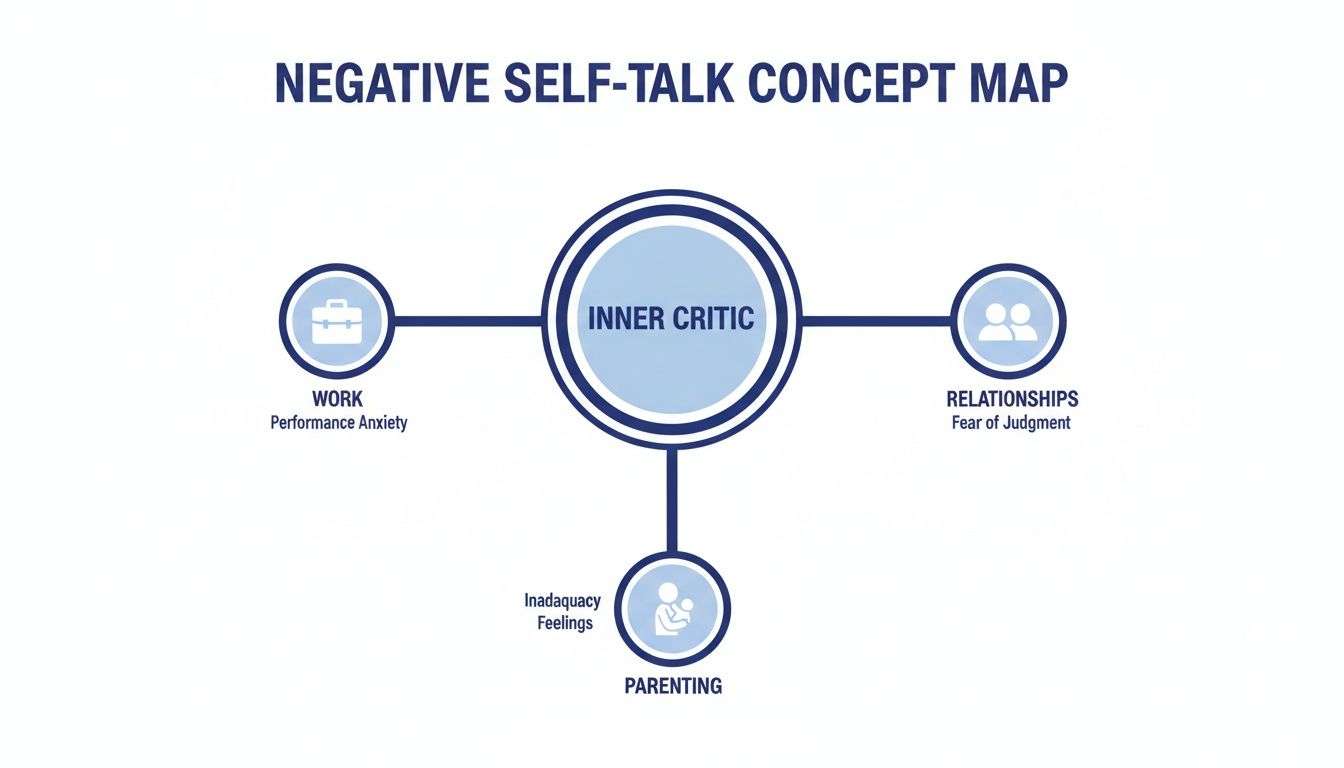
As you can see, a single source of self-criticism doesn't stay in one lane; it spreads, impacting your professional, personal, and family life all at once.
Here’s a breakdown of how that cycle typically plays out:
- It starts with a negative thought: "I'm definitely going to mess this up." This isn't just a casual thought; it lands with the weight of absolute truth.
- This thought sparks painful emotions: You're hit with a wave of anxiety, shame, or hopelessness. You might even feel it in your body—a tight chest, a knot in your stomach.
- Those emotions drive your behaviour: To escape that awful feeling, you might put off the task, call in sick, or just pull back from everyone involved.
- The behaviour reinforces the original thought: By avoiding the situation, you never give yourself the chance to prove that inner critic wrong. The avoidance becomes "proof" in your mind: "See? I knew I couldn't handle it."
This loop can become so automatic you don't even notice it's running. All you know is that you feel stuck, and that critical voice sounds like it's just telling it like it is.
From Self-Doubt to Clinical Concerns
When this cycle repeats day after day, it can pave the way for diagnosable mental health conditions, or make existing ones worse. A relentless inner critic is a major player in the development of both anxiety disorders and depression.
In essence, negative self-talk convinces your brain that you are under constant threat. The catch? The threat isn't coming from outside; it's coming from you. This sustained state of high alert is utterly exhausting.
The constant stress of self-criticism keeps your nervous system on overdrive, which can make you much more vulnerable to anxiety. At the same time, it eats away at your sense of self-worth and hope, creating the perfect conditions for depression to take hold. While reframing your inner dialogue is key, learning practical workplace stress management techniques can also offer real relief from the daily pressures that feed that negative voice in the first place.
Recognizing these deeper connections is a vital step toward getting the right kind of support.
Actionable Strategies to Reframe Your Inner Voice
Recognizing the patterns of your negative self-talk is a huge first step. The next, and even more powerful one, is learning how to respond differently when that inner critic pipes up. Changing this relationship isn’t about going to war with your own thoughts; it’s about learning to see them for what they are—just old, habitual stories that are often flat-out wrong—and choosing not to let them run the show.

This is where evidence-based therapy comes in. It offers some surprisingly gentle yet incredibly effective tools to help you do just that. You can start practicing these strategies in small ways today, building a foundation for a kinder, more balanced inner world. Think of them not as quick fixes, but as new skills you're developing over time with a bit of patience and practice.
Become a Thought Detective with CBT
Cognitive Behavioural Therapy, or CBT, is one of the heavy hitters when it comes to tackling negative self-talk. The whole approach is built on a simple but profound idea: our thoughts, feelings, and behaviours are all tangled up together. If you can change a distorted thought, you can change how you feel and what you do.
CBT basically invites you to become a detective for your own thoughts. So when that inner critic makes a harsh accusation—like "I'm a total failure"—your job isn't to argue back or just accept it as fact. Instead, you gently investigate it.
You can start this process by asking yourself a few key questions:
- "Okay, but what's the evidence?" Look for cold, hard facts that either support or contradict the negative thought. You'll often find the evidence against it is much, much stronger.
- "Is there another way to look at this?" Try to find a more balanced, fair, or even compassionate perspective on what happened.
- "What would I tell a friend if they were saying this?" We are almost always kinder and more reasonable with our friends. This question helps you tap into that natural compassion for yourself.
This process isn't about slapping on a layer of fake positivity. It’s about getting to the truth. By consistently questioning those automatic negative thoughts, you slowly strip them of their power and make room for more realistic and helpful ways of thinking.
Observe Your Thoughts with ACT
Acceptance and Commitment Therapy, or ACT, comes at it from a slightly different angle. Instead of directly challenging your thoughts, ACT teaches you how to just notice them without getting all tangled up in their drama. The goal is to "unhook" from your inner critic so it no longer dictates your actions.
Imagine your thoughts are like clouds drifting across the sky. Some are dark and stormy, others are light and fluffy. With ACT, you learn to be the sky—vast and unchanging—and just watch the clouds pass by. They come and go, but they aren't you.
A core practice in ACT is something we call defusion. It's all about creating a little bit of space between you and your thoughts, so you can see them as just words, not absolute truths or commands you have to obey.
Here are a few gentle defusion techniques you can try right now:
- Label your thinking: When a critical thought shows up, just say to yourself, "I'm having the thought that I'm not good enough." This small change in phrasing immediately separates you from the thought.
- Thank your mind: Honestly, your brain is just trying to protect you, even if it's going about it in a clumsy, unhelpful way. You can say, "Thanks, mind, for that input," acknowledging the thought without buying what it's selling.
- Sing the thought: This one sounds silly, but it works. Try singing your negative thought ("I'm such a loser…") to the tune of "Happy Birthday." It's almost impossible to take a thought seriously when it sounds that ridiculous.
ACT helps you stop wasting energy fighting your own mind and instead pour that energy into taking actions that truly matter to you. Exploring the difference between a scarcity or abundant mindset is another powerful way to reframe that inner voice and focus on what you want to build in your life.
Cultivate Self-Compassion as an Antidote
Maybe the most direct antidote to a harsh inner critic is simple self-compassion. It means treating yourself with the same kindness and understanding you'd offer a good friend who is having a tough time. This isn’t about making excuses or letting yourself off the hook; it’s about recognizing that being imperfect and making mistakes is just part of being human. Our guide on how to quiet your inner critic also dives into more therapist-backed strategies that actually work.
Self-compassion has three key ingredients:
- Mindfulness: Simply noticing that you're in pain, without judging yourself for it or getting swept away by the drama.
- Common Humanity: Remembering that everyone struggles. You aren't alone in this. Pain and failure are shared human experiences.
- Self-Kindness: Instead of attacking yourself, you actively try to be warm and understanding. You soothe and comfort yourself.
The next time that inner critic goes on the attack, try this: place a hand over your heart, feel the warmth, and say something kind to yourself. It could be as simple as, "This is really hard right now. It's okay. I'm here for you." This small gesture can begin to rewire your brain for kindness instead of criticism.
When To Seek Professional Support For Your Mental Health
The strategies we've covered are fantastic tools for managing that inner critic, and most people can make a real difference just by putting them into practice. Self-help is a powerful first step. But what happens when that negative voice is so ingrained, so persistent, that it feels like these tools just aren't enough?
Deciding to talk to a therapist isn't a sign of failure. Far from it. It's a courageous act of self-care. It’s an admission that you value your well-being enough to ask for a guide who knows the terrain and has a map. It’s about choosing a structured, supportive path toward healing.
Recognizing The Signs It Is Time To Reach Out
It can be tough to know when to shift from self-help to professional support. There’s no magic signal, but there are definitely some common threads that suggest your inner critic's impact has grown beyond what you can handle on your own.
Think of it like this: if that nagging voice has morphed into a constant, heavy presence that drains the colour from your world, it’s a good time to think about getting help.
Here are a few clear signs that it might be time to reach out:
- Your daily life is significantly impaired. Maybe your performance at work is slipping, you’re avoiding friends and family, or you just can't find joy in the things you used to love.
- The thoughts feel uncontrollable. You’ve tried to reframe them, you’ve tried mindfulness, but the negativity is relentless and just keeps spiralling.
- You're dealing with persistent anxiety or depression. This can show up as constant worry, a feeling of hopelessness, big changes in your sleep or appetite, or just a deep, lingering sadness you can't shake.
- Your coping strategies are becoming unhealthy. You might notice you’re turning to emotional eating, drinking more than usual, or using other behaviours to numb that inner voice.
Overcoming The Hesitation To Seek Help
Even when we know we need it, taking that first step can feel monumental. Stigma, fear, or just a stubborn belief that we "should" be able to fix this ourselves can be massive roadblocks. This hesitation is incredibly common, and we see it right here in British Columbia.
Unfortunately, many who need support never get it. The Mental Health Research Council of Canada found that while 1 in 5 Canadians experience mental illness each year, many face significant barriers to getting help. If you're interested, you can explore key facts on mental health in Canada to learn more.
Seeking therapy is not admitting defeat. It's an act of empowerment—a decision to stop letting your inner critic write your story and to start writing a new chapter for yourself.
A therapist offers a safe, non-judgmental space to dig into the roots of your negative self-talk without fear. They provide proven, evidence-based strategies designed for you, helping you build lasting skills for a kinder, quieter mind.
For those in the Kelowna area who feel ready to take that step, learning about counselling options is a gentle, proactive way to start your journey.
A Few Common Questions About Negative Self-Talk
As you start to tune into that critical voice in your head and think about how to respond, it's natural for questions to pop up. Honestly, that’s a great sign—it means you’re becoming more aware of your own inner world.
Here are a few answers to the questions we hear most often in our Kelowna practice. We hope they offer some clarity and a bit of reassurance as you get started.
Can I Get Rid of Negative Self-Talk Completely?
The goal isn't actually to silence that inner critic for good—that would be an exhausting and pretty much impossible task. A better way to think about it is learning to change your relationship with it.
Imagine you're the calm, wise adult in a room where a scared or angry child is yelling. You wouldn't just try to shout over them. Instead, you'd learn to listen without getting swept up in their panic, and you definitely wouldn't automatically believe everything they say.
Therapy helps you do just that: notice the thoughts without letting them grab the steering wheel. It’s about turning down their volume so you can hear a stronger, more compassionate inner voice. The aim isn't to achieve some state of non-stop positivity, but to make sure your wise, kind self is the one holding the microphone.
Why Is My Inner Critic So Loud?
If your inner critic feels especially harsh or is constantly chattering away, it's often because of past experiences. Our brains are hardwired to remember threats to keep us safe, and that includes emotional ones.
These critical thought patterns are often learned behaviours that may have been formed in response to things like:
- Childhood experiences: Growing up with highly critical parents, teachers, or other caregivers can lead us to internalize that voice as our own.
- Bullying or social rejection: Painful moments of exclusion can leave behind a deep-seated belief that there's something fundamentally wrong with us.
- High-pressure environments: Constant demands to perform—whether at school, work, or in sports—can foster a relentless perfectionism and a paralyzing fear of failure.
- Past mistakes: Sometimes, we just can't let ourselves off the hook. We replay our mistakes and punish ourselves long after everyone else has moved on.
Figuring out the origins isn't about blaming anyone (including yourself). It’s about building some compassion for how these patterns developed in the first place. They were probably trying to protect you in some way. Understanding that is the first real step toward creating new, healthier thoughts that actually serve you today.
How Is This Different from Being Realistic?
This is a fantastic and really important question. There’s a world of difference between constructive self-assessment and a destructive inner critic. It all comes down to the intention and the impact.
Realistic self-assessment is specific, objective, and aimed at growth. Negative self-talk is often broad, personal, and aimed at punishment.
Let’s say you made a mistake on a report at work.
A realistic thought might sound like: "I missed a key detail in that report. I should create a checklist to double-check my work next time." See how that leads to a productive action?
In contrast, negative self-talk sounds more like: "I can't believe I missed that. I'm so careless and incompetent. Everyone must think I'm a total fraud." This thought doesn't lead to a solution; it just leads to shame, anxiety, and feeling stuck. One is a tool for improvement, the other is a weapon for self-attack.
Can I Overcome This on My Own?
Absolutely. Many people find huge success using self-help tools and strategies on their own. They can be incredibly powerful for building a solid foundation of self-awareness and resilience.
A few things that often help get you started are:
- Journaling: Simply writing down your negative thoughts can help you see them more objectively and start to question them.
- Mindfulness apps: Guided meditations can be a great way to learn how to observe your thoughts without getting tangled up in them.
- Self-help books: There are tons of excellent books based on CBT, ACT, and self-compassion that offer structured exercises and new perspectives.
However, if that inner critic feels completely overwhelming, is deeply rooted, or is tangled up with bigger issues like trauma, persistent anxiety, or depression, working with a therapist can make a world of difference. A professional offers expert guidance and personalized strategies to help you navigate the root causes safely. It's not a sign of failure to ask for help; it's about choosing to bring a skilled guide with you on a challenging journey.
We hope this article has given you a clearer picture of your inner critic and some gentle, effective ways to start shifting that relationship. Remember, this journey is all about progress, not perfection. Every small step you take toward a kinder inner world is a huge win for your well-being. If you feel that speaking with a professional could support you further, we invite you to learn more.
Clinically Reviewed By
Amy Mosset, MCP, RCC-S
Amy Mosset is a Master Practitioner in Clinical Counselling, Clinical Supervisor, and the owner of Interactive Counselling. She provides trauma-informed, evidence-based care and clinical supervision to registered therapists, with a focus on ethical practice, client safety, and high-quality therapeutic outcomes.