If you're reading this, you probably know that voice all too well—the one in your head that loves to second-guess, judge, and criticize your every move. It can feel relentless. But it's important to know this: you aren't alone, and that voice isn't some deep, personal flaw. It's a learned narrator, an internal script written by your life experiences. For more information, see our trauma counselling.
"The inner critic is not a personal flaw; it is a survival strategy learned in environments where our authentic self did not feel safe, loved, or good enough."
Think of it as a misguided protector. It learned its harsh tactics as a way to keep you safe from judgment, rejection, or repeating old hurts. It’s a complex echo of parents, teachers, societal pressures, and difficult things you've been through. Understanding where this voice comes from is the first, most compassionate step you can take toward changing your relationship with it. Let's gently explore its roots together.
Quick Answer: Where the Inner Critic Comes From
That persistent voice didn't just appear out of thin air. It was carefully constructed over time, piece by piece, from the messages you received and the experiences you navigated. While every story is unique, the critic's development generally traces back to three interconnected areas of your life.
| Primary Source | How It Shapes the Critic |
|---|---|
| Childhood & Attachment | The critic often adopts the tone, expectations, and unspoken rules of our earliest caregivers, forming a blueprint for our self-worth. |
| Trauma & Self-Protection | Overwhelming events can create a hyper-vigilant critic that tries to prevent future pain through constant self-monitoring and blame. |
| Learned Beliefs & Socialization | We absorb messages about success, failure, and belonging from our culture, which gives the critic a script to follow. |
Seeing these sources laid out can help demystify the critic. It’s not just you being "hard on yourself"—it’s a patterned response with a history.
The 3 Roots of Your Inner Critic
To really get to know this internal voice, it helps to see how different influences work together to create it. Think of it less as a single entity and more as a composite sketch drawn from your past.
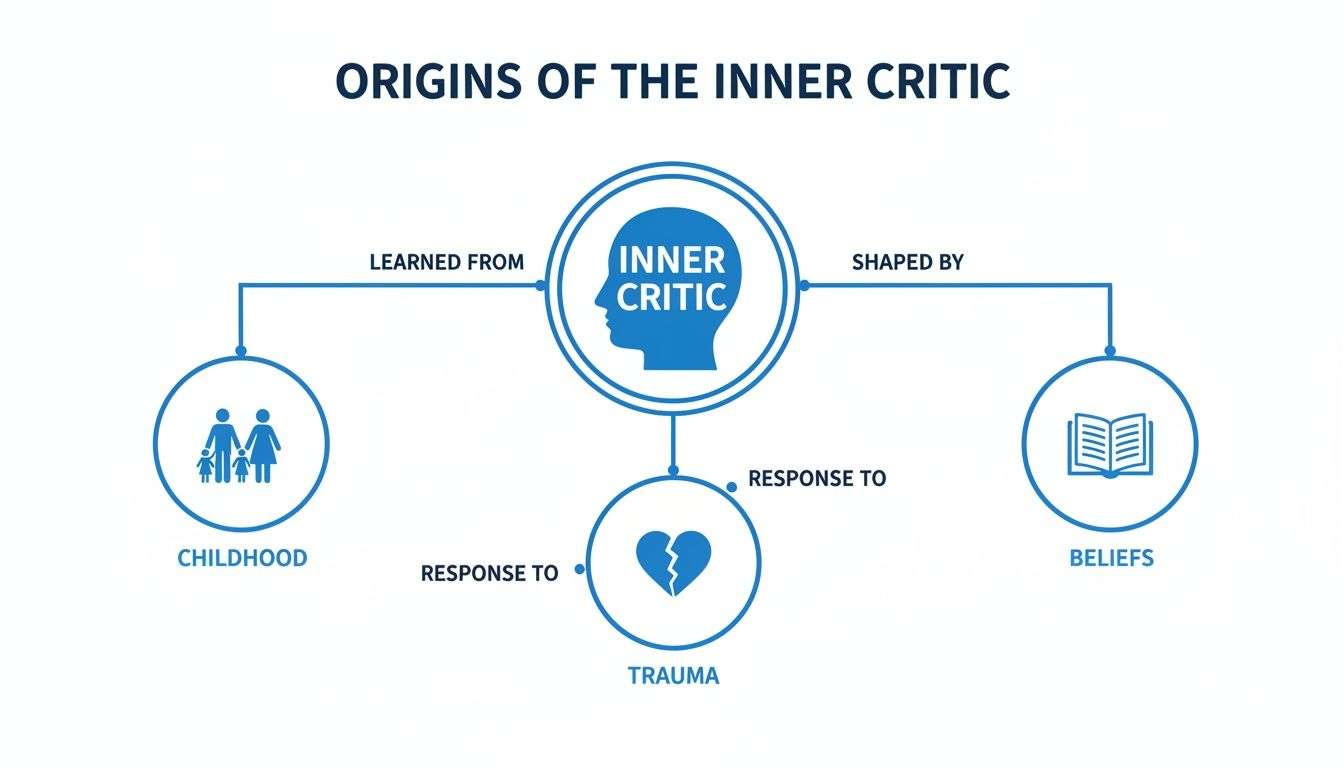
As the visual shows, these three core sources are deeply intertwined.
- Childhood and Attachment: Our very first relationships literally shape how we see ourselves. If we felt we had to be "perfect" to earn love or avoid criticism, our inner critic learned to enforce those rules from the inside.
- Trauma and Self-Protection: When we go through something deeply painful or overwhelming, the brain does whatever it can to prevent it from happening again. Sometimes, that means creating an inner critic that polices our every action, believing that if we can just be "good enough," we'll be safe.
- Learned Beliefs and Socialization: From a young age, we’re bombarded with messages about who we should be. These cultural "rules" about success, appearance, and productivity become the measuring stick our inner critic uses against us.
Understanding these origins is a key part of the work in counselling. It’s not about blaming the past; it's about connecting the dots with compassion so you can finally write a new, kinder script for your inner world.
How Childhood Experiences Shape Your Inner Voice
Our earliest relationships are the architects of our inner world. Long before we have words for it, the foundation for our inner critic is laid. A child’s mind is a sponge, soaking up every word, expectation, and emotional current in their environment to figure out how to stay safe, feel loved, and belong.
It’s in these formative years that the first drafts of our internal scripts are written. More often than not, the voices of our caregivers become the very voice we hear inside our heads for the rest of our lives.
The Internalization of Caregiver Voices
Think about it this way: as children, our survival depends entirely on our connection with our caregivers. To keep that bond secure, we become hyper-aware of what earns a smile and what brings a scolding. We quickly learn which behaviours lead to praise and which ones lead to punishment, criticism, or the cold shoulder.
If a child constantly hears they're "too loud," "too sensitive," or "not trying hard enough," they don't just hear the words—they absorb them as fundamental truths about who they are. The same thing happens with unspoken rules. When a child senses that love is conditional on good grades or perfect behaviour, they internalize that message as a core belief: "I must be perfect to be loved."
This isn't about blaming parents, who were often doing the best they could with what they knew. It’s simply about understanding a powerful, almost automatic process: the external voices of our childhood become the internal voice of our adult critic.
The inner critic often speaks with the authority of our earliest attachments. It adopts the tone, language, and emotional weight of the very people we once relied on for our sense of safety and self-worth.
Core Beliefs Forged in Childhood
This process of soaking up external messages forms deep-seated core beliefs about ourselves and the world. These beliefs act like a filter, colouring how we see every experience. They're also the fuel that keeps the inner critic running.
Some common critical core beliefs that start in childhood include:
- "I am not good enough." This often grows from feeling like you could never quite meet your parents' expectations.
- "I am a burden." A child might internalize this if their needs were treated as an inconvenience.
- "I am unlovable." This can take root if affection felt inconsistent or could be withdrawn at any moment.
- "I must not make mistakes." This belief is common in homes where mistakes were met with harsh criticism or significant consequences.
These beliefs don’t just feel like thoughts; they feel like facts. The inner critic’s job, in its own misguided way, is to police our behaviour to make sure we never break these "rules," believing it's protecting us from the rejection or pain we once felt.
When Childhood Hurts Shape the Critic
Painful childhood experiences are a major source of a harsh inner critic. Emotional neglect—where a child's emotional needs are consistently ignored—is especially potent in creating a powerful critic. It teaches a child that their feelings don't matter or are wrong. This can lead to an adult who berates themselves for having perfectly normal human emotions. Getting a handle on how childhood emotional neglect shapes adult attachment can shed more light on these patterns.
Ultimately, the critic that forms in childhood is a survival strategy. It’s a young mind's attempt to control the uncontrollable, to earn love, and to avoid being left behind. Understanding this origin story is also a reminder of why building resilience in children is so crucial for fostering a healthier internal world for the next generation. The first step toward healing is to reframe the critic—not as an enemy, but as a misguided protector that we learned we needed a long, long time ago.
The Link Between Trauma and a Powerful Inner Critic
When you go through something truly overwhelming, your entire sense of safety gets rewired. Trauma, whether it's a single shocking event or an ongoing painful situation, fundamentally changes how your nervous system sees the world. In the aftermath, the inner critic often steps up—not out of cruelty, but as a fierce, albeit misguided, protector.

Traumatic experiences can give the critic its intense volume and unwavering power. For a nervous system now wired for danger, a new internal rulebook is written, one designed to prevent that kind of pain from ever happening again, at all costs.
How Trauma Gives the Critic Its Power
After a traumatic event, the world can feel unpredictable and profoundly unsafe. To regain some semblance of control over the uncontrollable, the mind often turns inward. The inner critic seizes this opportunity, appointing itself as a powerful internal risk manager. It operates on the belief that if it can just police your behaviour perfectly, it can keep you safe.
This is why self-blame is so incredibly common after trauma. A thought like, "If I had just been smarter, it wouldn't have happened," is agonizing, yet it offers a sliver of perceived control. It’s a painful illusion that suggests you can prevent future harm by simply being better next time. The critic’s harshness becomes a strategy to enforce this impossible standard.
When trauma shatters your sense of safety, the inner critic steps in to create a new set of rules. It operates on the flawed but desperate belief that if you can be perfect, you can be safe.
Perfectionism as a Survival Response
For many trauma survivors, the critic’s main tool is relentless perfectionism. This isn’t about simply having high standards; it’s a full-body survival response. The nervous system learns to equate mistakes—no matter how small—with mortal danger.
This internal dynamic is often rooted in adverse childhood experiences. In Canada, data from public health agencies shows a powerful connection between childhood adversity and long-term mental health challenges, suggesting that experiencing multiple types of hardship significantly increases the odds of developing mental health conditions later in life. In this context, the inner critic acts as an internalized survival mechanism, using harsh self-judgment to maintain control and prevent more harm. You can learn more about these findings in this report on the well-being of Canada's children.
This drive for perfectionism can show up in many ways:
- Over-preparing for every situation: The critic believes that if you can anticipate every possible outcome, you can avoid being blindsided again.
- Replaying conversations endlessly: It scans for any mistakes you might have made, hoping to "correct" them for the future.
- Procrastinating on important tasks: The fear of not doing something perfectly feels so threatening that it becomes paralyzing, leading to total avoidance.
Each of these behaviours is driven by the critic’s desperate attempt to create a world where you are no longer vulnerable.
Decoding the Critic's Messages After Trauma
It's helpful to learn how to translate what the critic is saying. While its words are harsh, its underlying job is to protect you from re-experiencing the helplessness of trauma. The table below helps reframe its messages by revealing the protective (though misguided) intention behind them.
| Critic's Message | What You Hear | The Protective Intention |
|---|---|---|
| "Don't trust anyone." | You're going to get hurt again. | To prevent betrayal or harm by keeping you isolated and self-reliant. |
| "You have to be perfect." | You're not good enough as you are. | To avoid criticism or failure, which feel as dangerous as the original trauma. |
| "It was your fault." | You are fundamentally flawed. | To create a sense of control; if it was your fault, you can prevent it next time. |
| "Don't even try. You'll fail." | You are incapable and weak. | To protect you from the shame and pain of not succeeding. |
Seeing the critic’s hidden agenda doesn't silence it overnight, but it does shift your relationship with it. You can start to see it not as an enemy, but as a terrified part of you that needs compassion, not a fight. This understanding is a crucial first step toward softening its voice and finding a gentler way to feel safe in the world.
Cultural Messages and Learned Beliefs That Fuel the Critic
Your inner critic doesn't operate in a vacuum. While family and personal history play a huge role, that harsh inner voice is also a keen observer of the world around it. It soaks up the unspoken rules and expectations of our culture, learning what it supposedly means to be successful, attractive, or just plain good enough.

Think of these outside pressures as a script, handed directly to your critic. Suddenly, it has a massive library of "shoulds" and "should nots" to throw at you. Realizing this is a huge step, because it shows us that this voice isn't just a personal flaw—it's often a collective echo we’ve mistakenly claimed as our own.
The Influence of Societal Standards
From a young age, we're surrounded by messages that paint a very specific picture of a "good life." We see it in movies and on social media, we hear it in advertisements, and it even slips into well-meaning conversations. These all create a powerful, though often invisible, set of benchmarks that our inner critic loves to measure us against.
Some of these pervasive learned beliefs include:
- The Myth of Constant Productivity: Modern "hustle culture" can teach us to see rest as laziness. Your critic internalizes this message, whispering that you're falling behind if you dare to take a break.
- Unrealistic Beauty and Body Standards: The media bombards us with an incredibly narrow, often digitally perfected, vision of the "ideal" body. This gives the critic endless ammunition to attack your appearance.
- The Equation of Worth and Achievement: Especially in competitive schools or workplaces, we learn to fuse our identity with our accomplishments. A failed project isn't just a setback; your inner critic twists it into proof that you are a failure.
When we understand that our inner critic is just reciting a cultural script, we can start to question the author. We can see that these aren't our original thoughts—they're just lines we were taught to memorize.
This shift in perspective can be incredibly liberating. It moves the focus from, "What's wrong with me?" to a much more empowering question: "What messages have I been taught to believe about myself?" Pinpointing the source of these learned beliefs is the first step toward writing your own definition of a worthy life.
Internalizing the "Never Enough" Mindset
Perhaps the most damaging message our critic latches onto is the "never enough" mindset. It's a cruel, moving target. No matter what you achieve, the goalposts are constantly shifting. You get the promotion, and your critic immediately starts nagging you about the next one. You hit a fitness goal, and it instantly finds a new flaw to obsess over.
This mindset keeps you on a hamster wheel of striving, driven by a deep-seated fear that if you ever stop, you'll be worthless. It's an exhausting way to live, creating a constant hum of anxiety and self-doubt. The critic thrives in this kind of environment because it was built to spot flaws and push for more, even when "more" comes at the expense of your peace.
When you recognize that this "never enough" voice is a reflection of a society obsessed with endless growth, you can give yourself permission to step off the wheel. It helps you see the critic not as a source of truth, but as a mouthpiece for a cultural story that isn't serving you. From there, you can begin to challenge its authority and decide what "enough" means on your own terms.
Practical Strategies to Soften the Inner Critic
Knowing where your inner critic comes from is a massive breakthrough. It helps you see that voice not as a personal failing, but as a story of survival. Now, we can shift our focus to the gentle, practical work of changing your relationship with it.
The goal isn't to declare war on this part of you. That's a battle you can't win. Instead, we learn to listen with curiosity and respond with compassion. Fighting back often gives the critic more power. The real work is in learning to notice its arrival without getting swept away, slowly creating a kinder, more encouraging space inside your own head.
Begin with Mindful Awareness
You can't change a pattern you don't notice. Mindfulness is the practice of paying attention to the present moment without judging it. It’s a powerful tool for catching your inner critic in the act.
Instead of instantly believing the critic’s harsh narrative, you can learn to step back and observe the thought. Think of it like watching clouds drift across the sky. You can see the thought—"I'm not good enough for this"—without having to climb onto the cloud.
Here are a few ways to start:
- Name It: When you hear that familiar critical tone, just gently say to yourself, "Ah, there's the critic again." This simple act creates a tiny but crucial bit of space between you and the thought.
- Notice Body Sensations: Where does the critic show up in your body? Is it a tightness in your chest? A knot in your stomach? Tuning into these physical cues helps you catch it before you’re lost in a spiral of negative thinking.
- Return to Your Breath: Your breath is always with you, a steady anchor to the present moment. When the critic gets loud, take one slow, deep breath. It helps calm your nervous system and reminds you that you are here, now, and fundamentally okay.
Shift from Criticism to Self-Compassion
Self-compassion is the perfect antidote to the critic’s poison. It’s about treating yourself with the same kindness you’d offer a dear friend who was struggling. This isn’t about making excuses; it’s about offering support instead of judgment when you need it most.
A simple yet profound exercise is to consciously reframe the critic’s statements. When you catch a harsh thought, practice shifting it to a more supportive one. As you get better at this, you'll find it helps you build a strong sense of self, creating a solid foundation that stands apart from the critic's voice.
Self-compassion doesn’t ask, "How can I fix this?" It gently asks, "What do I need right now?" It is a practice of offering warmth to the parts of you that are hurting the most.
This table offers a practical guide to help you transform common critical thoughts into gentler, more supportive internal messages.
Shifting from Self-Criticism to Self-Compassion
| Common Critical Thought | A Gentle Reframe | Why This Helps |
|---|---|---|
| "I can't believe I made that mistake. I'm so stupid." | "Making mistakes is part of being human. What can I learn from this?" | This moves you from shame to curiosity and growth. |
| "Everyone else is so much more successful than I am." | "I am on my own unique path. I can focus on my own progress." | This counters comparison and brings the focus back to your personal journey. |
| "I shouldn't feel this sad. I need to just get over it." | "It's okay to feel this way. My feelings are valid." | This provides validation for your emotional experience, which calms the nervous system. |
Taking a moment to reframe your thoughts in this way isn't about ignoring reality—it's about choosing a more constructive and caring way to relate to yourself through it.
Connect with Your Body
The inner critic doesn't just live in your mind; its effects ripple through your entire nervous system. Those harsh words can trigger a very real threat response. This is why body-based (or somatic) approaches are so important. They help soothe your nervous system directly.
Here are a few simple somatic practices you can try anywhere:
- Place a Hand on Your Heart: This simple gesture can release oxytocin, a hormone associated with safety and connection. Just feel the warmth of your hand and the rhythm of your own breath.
- Grounding: When your mind is racing with criticism, bring your attention to your feet on the floor. Feel the solid support beneath you. This can pull you out of anxious thoughts and back into the present moment.
- Gentle Movement: A slow walk or some gentle stretching can help release the tense energy that the critic often creates in your body.
Changing your relationship with your inner critic is a journey of patience and practice. Every time you choose a compassionate response over a critical one, you are rewiring your brain and nurturing a kinder, more supportive home within yourself.
Knowing When to Seek Professional Support
While these strategies can be incredibly powerful, there are times when the critic’s voice is just too loud, persistent, and deeply rooted to manage on your own. This is often the case when it's tangled up with past trauma, anxiety, or depression.
Recognizing you need more support isn’t a sign of weakness. In fact, it’s a courageous act of self-compassion—a brave step toward lasting healing.

If your inner critic is consistently sabotaging your daily life, your relationships, or your sense of well-being, it might be time to talk to someone.
Signs It May Be Time for Support
How do you know when it's time? It might be worth reaching out if you're regularly experiencing:
- Intense Emotional Distress: The self-critical thoughts leave you feeling overwhelmed, hopeless, or caught in a spiral of shame.
- Impact on Daily Functioning: The relentless inner voice makes it hard to concentrate, connect with loved ones, or take care of your basic needs.
- Perfectionism and Avoidance: You're putting off important tasks or backing away from opportunities because you’re terrified of not being perfect.
- Feeling Stuck: You've tried self-help strategies, but that critical voice feels just as strong as ever.
Therapy offers a safe, non-judgmental space to explore your inner critic’s origins and learn personalized strategies to heal. It’s a dedicated partnership focused on untangling the roots of this voice so you can find lasting peace.
Working with a counsellor gives you a supportive ally who can help you uncover the unique story behind your critic. For anyone who suspects their harsh inner voice is tied to overwhelming past events, exploring trauma-informed counselling can be particularly effective. A therapist can guide you through specialized, evidence-based approaches that help calm your nervous system and change your relationship with this internal voice.
Your journey toward a kinder inner world is your own, but you don’t have to walk it alone. Reaching out is an act of profound self-care, affirming that you are worthy of support, compassion, and a life where your own voice is the kindest one you hear.
Frequently Asked Questions
As you start to notice that critical voice, a lot of questions naturally come up. It's a confusing and often painful experience. Here are some of the most common questions, answered with clarity and support.
Can I get rid of my inner critic completely?
This is a completely understandable goal. However, trying to eliminate your inner critic often feels like a war against yourself. A more compassionate approach is to change your relationship with it. Think of it less like an enemy and more like a misguided part of you that’s trying to protect you in a harsh way. With practice, you can learn to hear its voice without being swept away by it. Its volume can lower, and its words won't have the same power. You can learn to recognize it, understand where it's coming from, and choose to respond with kindness.
Is my inner critic from childhood or trauma?
It's often tough to pull these two apart, especially since difficult childhoods and trauma can be intertwined. That said, there can be subtle differences. A critic that stems mostly from childhood messages might sound eerily like a parent or teacher. The themes often revolve around not being good enough or lovable enough. In contrast, a trauma-based critic tends to be more intense and frantic. It has a survivalist edge, using harsh self-blame ("If I were better, this wouldn't have happened") or rigid perfectionism to prevent danger from happening again. A therapist can help you explore these connections in a safe, supportive way.
Can the inner critic be helpful sometimes?
Many of us believe our inner critic is what keeps us motivated. We worry that without it, we'd become lazy. But this kind of motivation is almost always fuelled by fear—the fear of failing, of being judged, or of being found unworthy. It might get you to finish a project, but it comes at a steep price, leading to chronic anxiety, stress, and burnout. True, lasting motivation doesn't come from fear. It grows from self-compassion, connecting with what you truly value, and having a genuine desire to learn and grow. Learning to encourage yourself with kindness is a more effective and sustainable way to build resilience.
Taking these first steps to understand your inner critic is a powerful act of self-awareness and courage. If you feel ready to explore this further, learning more about supportive therapeutic approaches can be a gentle next step on your path to a kinder inner world.
Clinically Reviewed By
Amy Mosset, MCP, RCC-S
Amy Mosset is a Master Practitioner in Clinical Counselling, Clinical Supervisor, and the owner of Interactive Counselling. She provides trauma-informed, evidence-based care and clinical supervision to registered therapists, with a focus on ethical practice, client safety, and high-quality therapeutic outcomes.