Avoiding uncomfortable emotions or situations can offer quick relief, but for many people in Kelowna and Vernon, this pattern quietly deepens anxiety and depression. Understanding the difference between adaptive and maladaptive avoidance is crucial for those striving to reclaim their quality of life. This overview helps explain why avoidance feels so powerful, how it impacts daily life, and what steps you can take to break free for better mental health in British Columbia. For more information, see our Kelowna anxiety counselling.
Table of Contents
- Defining Avoidance Behaviours And Misconceptions
- Types Of Avoidance: Social, Cognitive, Behavioural
- Why We Avoid Emotions And Situations
- Short-Term Relief Versus Long-Term Harm
- Risks Of Chronic Avoidance In Daily Life
- Evidence-Based Approaches To Overcoming Avoidance
Key Takeaways
| Point | Details |
|---|---|
| Understanding Avoidance | Avoidance behaviours are actions taken to escape discomfort, but excessive avoidance can worsen anxiety over time. |
| Types of Avoidance | Recognise the three types of avoidance—social, cognitive, and behavioural—to address patterns that may hinder your life. |
| Risks of Chronic Avoidance | Chronic avoidance can lead to social isolation, strained relationships, and hindered career advancements. |
| Effective Strategies | Evidence-based approaches like exposure therapy and cognitive-behavioural techniques can effectively reduce avoidance behaviours. |
Defining Avoidance Behaviours and Misconceptions
Avoidance behaviours sound straightforward, but most people misunderstand what they actually are. At their core, avoidance behaviours are actions (or inactions) we take to escape uncomfortable situations, feelings, or thoughts. When you skip a social gathering because you’re anxious, postpone a difficult conversation, or distract yourself with your phone to avoid worrying—these are all avoidance behaviours. For more information, see our counselling in Kelowna.
The first major misconception is that all avoidance is bad. In reality, adaptive avoidance from genuine threats serves an important survival function. If you avoid touching a hot stove, that’s healthy avoidance protecting you. The problem emerges when avoidance becomes excessive and persistent without actual danger present. For more information, see our anxiety counselling.
Many people confuse temporary relief with long-term benefit. When you avoid something anxiety-provoking, your nervous system calms down immediately. This creates a powerful illusion that avoidance “works.” What actually happens is that avoidance reinforces the anxiety cycle. Each time you escape discomfort through avoidance, you teach your brain that the feared situation is genuinely dangerous. Over time, this pattern strengthens anxiety rather than resolving it.
Another critical misconception is viewing avoidance as simple laziness or weakness. In truth, avoidance is a sophisticated survival mechanism your brain uses when it perceives threat. For people in British Columbia managing anxiety disorders, understanding this distinction matters tremendously. The issue isn’t that avoidance is a character flaw—it’s that maladaptive avoidance patterns that persist without real threat interfere with your ability to live a full life and ultimately feed the anxiety you’re trying to escape.
Avoidance also creates a subtle trap. As avoidance expands to more situations, your comfort zone shrinks. What started as avoiding one triggering situation can evolve into avoiding entire categories of activities, relationships, or responsibilities. This generalisation of avoidance is what transforms it from adaptive protection into a disorder that limits your potential.
Pro tip: Notice where you’re avoiding in your daily life without judgment—write down three situations you typically escape from, and observe whether any real danger exists or whether your brain is simply predicting discomfort.
Types of Avoidance: Social, Cognitive, Behavioural
Avoidance doesn’t come in just one flavour. Understanding the different types helps you recognise patterns in your own life and why certain strategies seem to backfire. Avoidance operates across three distinct domains: social, cognitive, and behavioural. Each type shows up differently, but they all serve the same purpose—protecting you from discomfort in the short term while fuelling anxiety in the long term.
Social Avoidance
Social avoidance means steering clear of people and situations that trigger anxiety. You might skip community events, cancel plans with friends, or avoid making phone calls. For residents of Kelowna and Vernon, this might mean avoiding local gatherings or group activities you’d normally enjoy. The catch is that every time you dodge a social situation, your anxiety about socialising grows stronger. Your brain learns that these situations are unsafe, even when they’re not. Over time, your world gets smaller as more social situations feel off-limits.
Cognitive Avoidance
Cognitive avoidance involves mental strategies like thought suppression and distraction to escape uncomfortable thoughts. You might push away worries, refuse to think about a problem, or lose yourself in endless scrolling to avoid confronting difficult feelings. The irony is that trying not to think about something often makes it louder in your mind. Suppression creates a mental battle that exhausts you and keeps anxiety alive. Your brain becomes preoccupied with the very thoughts you’re trying to escape.

Behavioural Avoidance
Behavioural avoidance includes physical actions to sidestep feared situations. You might avoid driving after a minor accident, skip work because you’re anxious about a meeting, or postpone important tasks. These actions feel protective, but they reinforce the belief that the situation is genuinely dangerous. The more you avoid, the more your anxiety strengthens around that specific situation.
All three types intertwine. You might use cognitive avoidance (distraction) to fuel social avoidance (skipping an event) through behavioural avoidance (staying home). Recognising which types dominate your life is the first step toward breaking the cycle. When you work with a therapist at Interactive Counselling, identifying these patterns becomes the foundation for developing coping strategies that actually address anxiety rather than reinforcing it.
Here’s a summary of how different avoidance types appear and their impact:
| Avoidance Type | Typical Example | Short-Term Effect | Long-Term Impact |
|---|---|---|---|
| Social | Skipping parties | Anxiety relief | Isolation, limited relationships |
| Cognitive | Thought suppression | Mental peace | Increased stress, recurrent thoughts |
| Behavioural | Avoiding tasks | Reduced discomfort | Poor performance, missed opportunities |
Pro tip: This week, pick one avoidance pattern you notice and track it for three days—note whether it’s social, cognitive, or behavioural, what triggered it, and how you felt afterward.
Why We Avoid Emotions and Situations
At its core, avoidance exists because your brain wants relief. When you feel overwhelmed by anxiety, anger, sadness, or shame, your nervous system screams for escape. Avoidance delivers exactly that—immediate, tangible relief. You avoid and the discomfort drops. Your body relaxes. The problem is that this relief comes with a steep price.
The primary reason we avoid is simple: emotions feel unbearable. When anxiety floods your system or sadness feels crushing, doing nothing seems safer than facing it head-on. Your mind tells you that if you just don’t think about it, don’t go there, don’t feel it, maybe it will disappear. This logic makes sense in the moment. But emotions don’t work that way.
Vulnerability fuels avoidance too. Facing difficult emotions means acknowledging you’re struggling. It means admitting uncertainty or fear. For many people in British Columbia dealing with anxiety, vulnerability feels dangerous. If you admit the problem exists, you might have to do something about it. Avoidance keeps you in a comfortable state of denial, even though that comfort is actually a cage.
When you avoid emotions consistently, avoidance can result in increased physical and mental health issues like depression and worsening anxiety. Your body holds onto the stress. Your nervous system stays activated. The emotion you’re trying to escape doesn’t vanish—it intensifies. What started as manageable sadness becomes clinical depression. What was situational anxiety becomes generalised anxiety disorder.
Another critical reason we avoid is that managing emotions requires recognising them first. This feels harder than distraction. Scrolling your phone feels easier than sitting with loneliness. Working late feels more productive than processing anger. Yet these quick fixes cost you in the long run. Each avoidance episode teaches your brain that the emotion is genuinely dangerous, worth fleeing from at all costs.
Understanding this pattern is where change begins. You’re not weak or broken. Your brain is doing exactly what it evolved to do—protect you from perceived threats. The issue is that your threat detection system is miscalibrated. With support from a therapist at Interactive Counselling, you can recalibrate how you relate to difficult emotions and situations.
Pro tip: The next time you feel the urge to avoid, pause and name the specific emotion you’re running from—say it aloud or write it down—before deciding whether to avoid or face it.
Short-Term Relief Versus Long-Term Harm
This is the central paradox of avoidance: it works brilliantly in the moment and destroys you over time. When you avoid something that triggers anxiety, your nervous system calms down within minutes. That relief is real. Your heart rate drops. Your muscles relax. Your mind quiets. This immediate payoff is why avoidance is so seductive and so hard to break.
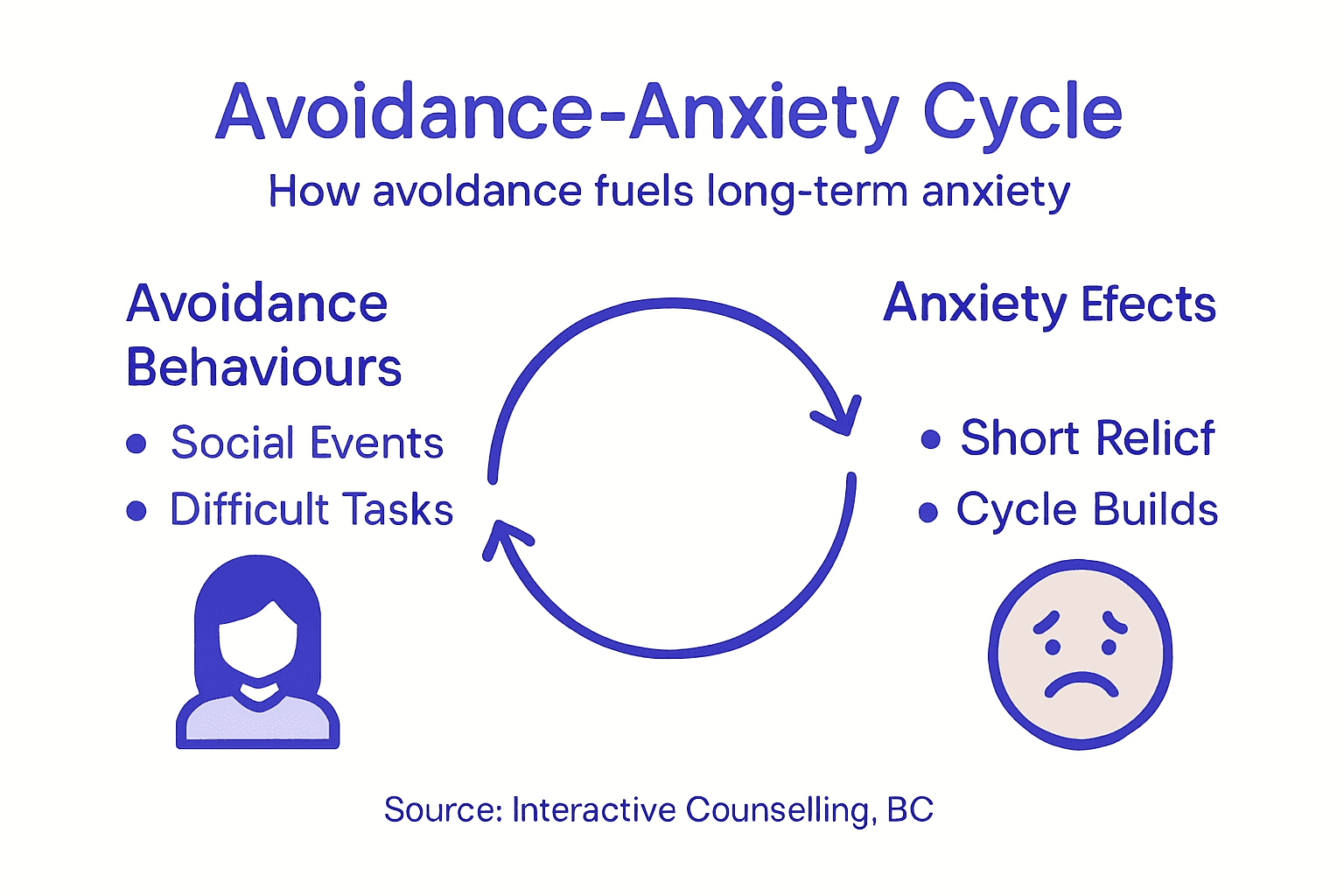
But here’s what happens beneath the surface. When you avoid a feared situation, your brain never learns that the situation is actually safe. You don’t gather the corrective information you need. Instead, avoidance prevents exposure to corrective information and perpetuates fear responses. Your fear stays frozen in place, waiting for the next trigger. The anxiety gets locked in.
Think of it like a physical wound. If you never expose a cut to air or clean it, it doesn’t heal properly. It festers. Avoidance works the same way with anxiety. The emotion needs exposure and processing to resolve. Every time you dodge, you’re keeping the wound closed.
The Reinforcement Trap
Each avoidance episode trains your brain to see that situation as genuinely dangerous. You avoid public speaking once, and your brain registers public speaking as a threat. You avoid it again, and the threat perception strengthens. After months or years of avoidance, your brain has catalogued dozens of “dangerous” situations. Your world shrinks. Your functioning deteriorates.
Maladaptive avoidance creates what researchers call a vicious cycle. The temporary relief reinforces the avoidance behaviour, so you do it again next time. Long-term harm includes increased anxiety, disrupted functioning, and reinforcement of fear. What started as manageable anxiety has now become a disorder that limits your career, relationships, and quality of life.
Breaking the Pattern
The solution isn’t to white-knuckle through discomfort alone. It’s to gradually expose yourself to avoided situations in a structured, supported way. A therapist at Interactive Counselling can help you build tolerance incrementally, allowing your nervous system to learn that these situations are survivable. This is where short-term discomfort creates long-term freedom.
Pro tip: Identify one small avoided situation you could face this week—nothing massive, just something slightly uncomfortable—and commit to doing it while tracking how your anxiety actually changes over time.
Risks of Chronic Avoidance in Daily Life
When avoidance becomes a habit, it stops being a coping strategy and starts being a disability. Chronic avoidance—the kind that persists month after month, year after year—quietly dismantles your life in ways you might not immediately notice. The costs accumulate silently until one day you realise how much smaller your world has become.
The most visible cost is social isolation. When you avoid social situations, you stop showing up. Friendships fade because relationships require presence. You decline invitations. You cancel plans. Over time, people stop inviting you. What started as anxiety-driven avoidance becomes actual loneliness. For people in Kelowna and Vernon, this might mean avoiding community events, local gatherings, or even coffee with friends. The isolation feeds the anxiety, creating a downward spiral.
Relationships suffer profoundly too. If you avoid difficult conversations with your partner, resentment builds. If you avoid discussing problems, they fester. Intimate relationships require vulnerability and honest communication. Avoidance kills both. Partners become frustrated when you consistently dodge important discussions or back away from emotional intimacy. Many people find their most meaningful relationships deteriorate simply because avoidance made closeness impossible.
Career and Education Impact
Avoidance directly interferes with professional and educational advancement. You might avoid speaking up in meetings, which means your ideas never get heard. You avoid challenging projects, so you don’t develop new skills. You avoid networking because it feels uncomfortable. Meanwhile, colleagues who push through discomfort get promoted. They build stronger professional networks. They gain experience and confidence. Chronic avoidance can result in social isolation, impaired relationships, and hindered career or educational advancement, creating real limitations on your earning potential and professional fulfillment.
Physical and Mental Health Consequences
Your body pays a price too. Chronic stress from untreated anxiety causes physical symptoms: tension headaches, digestive issues, muscle pain, and sleep disturbances. Your nervous system stays in a state of high alert. Meanwhile, maladaptive avoidance can exacerbate anxiety disorders and co-morbid mental health conditions like depression. What began as anxiety alone becomes anxiety plus depression, plus possible panic disorder. The mental health landscape becomes increasingly complex and harder to navigate.
The good news is that early intervention changes everything. Working with a therapist at Interactive Counselling helps you break the avoidance cycle before it causes more damage. The sooner you address this pattern, the faster you reclaim your life.
Pro tip: List three areas of your life that avoidance has impacted—relationships, work, health, or activities—and pick the smallest one to address first with professional support.
Evidence-Based Approaches to Overcoming Avoidance
Breaking free from avoidance requires more than willpower. It requires a deliberate strategy grounded in how your nervous system actually works. The good news is that decades of research have identified approaches that genuinely work. These aren’t quick fixes or motivational platitudes. They’re evidence-based methods that rewire how your brain responds to anxiety.
The most powerful approach is exposure therapy. This involves gradually facing the situations, thoughts, or feelings you’ve been avoiding. The key word is gradually. You don’t jump into the deep end. Instead, you create a hierarchy of feared situations, starting with mildly uncomfortable ones and working up. Structured and incremental exposure to feared stimuli reduces avoidance and fear by allowing your brain to gather corrective information. Each time you face a feared situation and discover it’s survivable, your nervous system updates its threat assessment. The fear shrinks.
Cognitive-Behavioural Techniques
Cognitive-behavioural techniques gradually introduce exposure to stressors, changing attitudes and behaviours toward fearful situations. This means addressing both what you think and what you do. If you think “I can’t handle a social gathering,” you examine that thought while simultaneously attending small social events. Your behaviours shift your thoughts. Over time, the two reinforce each other in a positive direction.
Acceptance and Mindfulness Approaches
Some situations can’t be avoided entirely. When that’s true, acceptance-based and mindfulness approaches help. Rather than fighting the anxiety or trying to eliminate it completely, you learn to acknowledge it, sit with it, and take action anyway. You notice the anxious thought without believing it. You feel the nervous sensation without letting it stop you. This fundamentally changes your relationship with discomfort.
Below is a comparison of evidence-based approaches for overcoming avoidance:
| Approach | Main Strategy | Suitable For | Unique Benefit |
|---|---|---|---|
| Exposure Therapy | Gradual confrontation | Anxiety, phobia, avoidance | Builds resilience, reduces fear |
| Cognitive-Behavioural Techniques | Changing thoughts/behaviours | Unhelpful beliefs and habits | Reconstructs negative thinking |
| Mindfulness and Acceptance | Observing emotions | Chronic discomfort, stuck patterns | Improves emotional tolerance |
Professional Support Matters
Working with a therapist at Interactive Counselling makes all the difference. A trained professional designs an exposure hierarchy tailored to your specific fears. They provide support and guidance as you face increasingly challenging situations. They help you understand what’s happening in your nervous system. They catch you when old patterns try to reassert themselves. Most importantly, they ensure you’re moving at a sustainable pace, building confidence with each small victory.
Pro tip: Start with one small avoidance pattern this week—choose something mildly uncomfortable, not terrifying—and track what happens to your anxiety before, during, and after facing it.
Take Control of Avoidance Behaviours to Reduce Anxiety in British Columbia
Avoidance behaviours can quietly limit your life by reinforcing anxiety and shrinking your comfort zone. If you find yourself skipping social events, suppressing difficult thoughts, or postponing important tasks, you are not alone. These patterns feel protective but often increase anxiety over time. At Interactive Counselling, we understand how overwhelming it can be to face these challenges without support.
Our personalized therapy services across Kelowna, Vernon, Grande Prairie, and Penticton — as well as through flexible online sessions — are designed to help you break free from avoidance cycles. By working with our licensed therapists, you will develop practical coping skills, build resilience through gradual exposure, and learn to face emotions in a supportive environment. Start your journey toward reclaiming connection and confidence today by visiting Interactive Counselling. Discover how our tailored therapy solutions can empower you to move beyond avoidance and live fully on your own terms.
Frequently Asked Questions
What are avoidance behaviours?
Avoidance behaviours are actions or inactions taken to escape uncomfortable situations, feelings, or thoughts, such as skipping social gatherings, delaying difficult conversations, or distracting oneself to avoid worrying.
Are all avoidance behaviours negative?
Not all avoidance is negative. Adaptive avoidance can serve a protective function, such as avoiding genuinely dangerous situations. The issue arises when avoidance becomes excessive and persists without real danger, reinforcing anxiety.
How does avoidance fuel anxiety?
Avoidance temporarily relieves anxiety, leading to the illusion that it works. However, it reinforces the belief that the avoided situation is dangerous, causing anxiety to strengthen over time instead of resolving.
What are some common types of avoidance?
The three main types of avoidance are social avoidance (steering clear of people or situations), cognitive avoidance (using mental strategies to escape difficult thoughts), and behavioural avoidance (taking physical actions to avoid feared situations).
Recommended
- Why Avoidance Fuels Anxiety – Patterns and Solutions
- Coping vs Avoidance: Impact on Emotional Health
- Understanding the Symptoms of an Anxiety Disorder
- How to deal with social anxiety: Practical tips to cope