The term "mother wound" speaks to a specific kind of emotional pain—one that can stem from a primary caregiver who was unable to consistently provide the safety, attunement, and unconditional love we needed as children. This early relationship dynamic often becomes a blueprint for our adult lives, profoundly shaping our sense of emotional safety, self-worth, and how we connect with others, frequently in ways we don't fully see. For more information, see our couples counselling.
What Is a Mother Wound and How Does It Form?

The idea of a "mother wound" can feel heavy, so it’s important to clarify what it is—and what it isn't. This isn't about blaming mothers or labelling them as "bad." Instead, it offers a compassionate lens to understand how our earliest relationship experiences can leave lasting imprints on our emotional world.
Think of yourself as a child, like a house being built. Your primary caregiver—who for many of us is our mother—was the architect of your emotional foundation. When a mother is secure, loving, and emotionally available, she helps build a solid foundation. You learn that you're worthy, you're safe, and your needs are important. You learn that connection is something you can rely on.
But what happens if the architect was struggling? What if she was working from a flawed blueprint handed down from her own childhood, wrestling with unhealed trauma, or trying to manage immense societal pressures without enough support?
The Cracks in the Foundation
A mother wound begins to form when a child's deep-seated needs for emotional connection and safety aren't met consistently. This doesn't always mean overt abuse. In fact, it often happens in subtle, quiet ways, even in homes that look perfectly fine from the outside.
These cracks in our emotional foundation can appear for many reasons:
Emotional Unavailability: A mother might be physically present but emotionally absent due to her own depression, anxiety, or unresolved pain.
Generational Patterns: She may be raising her children the only way she knows how, unintentionally passing down the same patterns of criticism or emotional neglect she experienced.
Enmeshment: Sometimes a mother leans on her child for her own emotional support, which blurs healthy boundaries and teaches the child that their job is to manage everyone else's feelings.
Conditional Love: A mother might only offer praise and affection when her child performs or meets certain expectations, creating a lifelong feeling that love must be earned.
At its heart, the mother wound is a deep longing for a kind of nurturing that you may not have received. It’s the gap between the unconditional love you needed and the conditional connection you may have experienced.
It's About Understanding, Not Blame
Acknowledging a mother wound is an act of self-awareness. It's about finally validating your own experience and giving a name to that quiet ache you may have carried for years.
It’s realizing that the struggles you face today—whether it's chronic people-pleasing, a harsh inner critic, or difficulty trusting others—aren't signs that you're broken. They are adaptations. They are survival strategies you learned to get by in a challenging emotional environment.
Taking this step is a courageous first move toward understanding how your early life continues to shape your emotional safety as an adult. It opens the door to gently repairing that foundation from the inside out, so you can build a future based on genuine self-worth and secure connection. Acknowledging this pain isn't an act of disloyalty to your mother; it's an act of loyalty to yourself.
How Early Caregiving Shapes Your Inner World
Our very first relationships don't just keep us alive; they build the foundation of our inner world. The way our primary caregiver responded to us as infants taught our nervous system what to expect from others and how to handle everything from stress to safety. Those early patterns become the blueprint we often follow for the rest of our lives.
At the heart of it all are two critical ideas: attachment and emotional attunement. Think of it like a dance. When a caregiver is consistently in sync with their child's emotional rhythm—offering comfort when they cry, sharing in their joy—the child develops a secure attachment. They learn a profound lesson: "I can count on others, my feelings make sense, and the world is a generally safe place to be."
But what happens when that dance is out of step? If a caregiver is unpredictable, distant, or overwhelmed, a child might develop an insecure attachment. They learn that their needs are inconvenient or that they have to hide parts of themselves to keep the connection going. This isn't a conscious choice; it's a survival strategy that gets wired in early.
The Voice Inside Your Head
One of the most powerful things we inherit from this early dynamic is our inner voice. A child who is met with empathy and understanding often grows up with a kind, reassuring voice inside their own head. When they face a challenge, that voice is a source of support, much like their parent was.
On the other hand, if a child’s feelings were often dismissed, criticized, or ignored, they may internalize that critical tone. This can become a harsh inner critic that follows them into adulthood, whispering that they're not good enough or that their needs are a problem.
Your inner critic isn't proof of your flaws—it's an echo of the past. It’s a defence mechanism you learned as a child, trying to anticipate criticism to protect yourself from getting hurt.
These relational habits become core beliefs, running on autopilot just below the surface. Some common beliefs that can grow from these early wounds include:
"I am not worthy of love." This often comes from feeling like love was something you had to earn.
"My needs are a burden." This can develop when asking for comfort was met with a sigh, irritation, or silence.
"I am responsible for others' happiness." This is a heavy burden often carried by children who had to emotionally parent their own caregivers.
"It is not safe to be vulnerable." If showing your true self led to rejection, you quickly learn to build walls to stay safe.
How Generational Patterns Take Root
It's crucial to understand that these patterns are rarely passed down on purpose. A mother simply cannot give what she never received herself. If she grew up without emotional support, she may struggle to provide it for her own child, no matter how much she loves them.
A mother’s unhealed trauma can also create a barrier to her being fully present. This isn't about placing blame. It's about seeing the cycle of pain for what it is—a current that flows through generations until someone finds the courage and support to change its course.
Recognizing the Signs of a Mother Wound in Adulthood
The emotional blueprints we create in childhood don't just vanish when we grow up. They become the quiet, automatic scripts that can run our adult lives, shaping our relationships, our self-worth, and how safe we feel in the world. Learning to spot the signs of a mother wound isn't about placing blame; it’s a powerful act of self-awareness and compassion.
Think of these patterns not as character flaws, but as brilliant survival strategies. They are the tools you developed to navigate a tricky emotional environment as a child. Seeing them for what they are is the very first step toward consciously choosing a new way to live and relate.
This map illustrates how our earliest caregiving experiences lay the foundation for our attachment style and, ultimately, the voice of our inner critic.
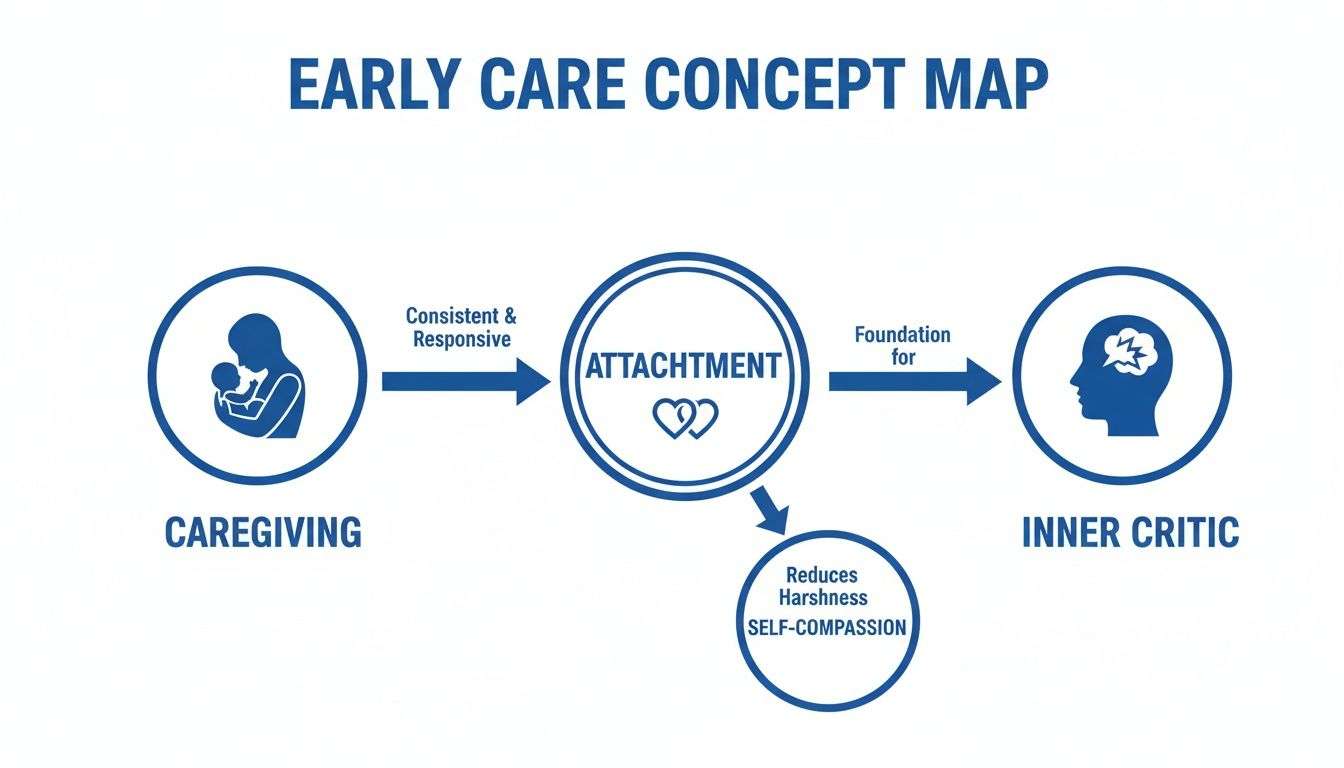
As you can see, a caregiver's responses are directly linked to a child's feelings of security. That sense of security (or lack thereof) is what tunes the frequency of the internal narrative we carry for the rest of our lives.
The table below outlines some of the most common ways these early experiences can show up in adulthood.
Common Manifestations of the Mother Wound in Adult Life
| Adult Pattern or Behaviour | Potential Root in Early Experience | Underlying Fear or Belief |
|---|---|---|
| Chronic People-Pleasing | Needing to manage a parent's moods to feel safe or loved. | "My needs are a burden. I am only valuable when I am useful to others." |
| Harsh Inner Critic | Internalizing a parent's critical voice or high expectations. | "If I am not perfect, I will be rejected or abandoned." |
| Difficulty Setting Boundaries | Being taught that your needs were secondary or that saying "no" was disrespectful. | "Setting a boundary will lead to conflict or the loss of love." |
| Fear of Intimacy | Experiencing emotional neglect or inconsistent affection. | "Getting close to someone will only lead to disappointment or pain." |
| Imposter Syndrome | Receiving love that was conditional on achievement. | "My success is a fluke. I am not truly worthy of my accomplishments." |
| Emotional Numbness | Learning that expressing feelings led to dismissal, punishment, or overwhelm. | "My emotions are dangerous and unacceptable. It's safer not to feel." |
Recognizing yourself in these patterns can be a moment of profound insight. It’s the point where you can begin to untangle the past from the present and reclaim your sense of self.
A Constant Feeling of Not Being Good Enough
This might be the most universal sign of a mother wound: a persistent, nagging sense that you are fundamentally lacking. It’s not just fleeting self-doubt. It’s a core belief that you have to endlessly prove your worth to earn your spot, to be loved, to be accepted.
This feeling often takes root in a childhood where love and approval felt conditional. When affection was a reward for good grades, compliant behaviour, or for keeping a mother happy, the message you internalized was that your authentic self wasn't quite enough.
The Weight of People-Pleasing
Do you find it nearly impossible to say "no" without a wave of guilt? People-pleasing is a classic survival tactic learned by children who felt responsible for their caregiver's emotional well-being. To keep the peace and stay connected, you likely became an expert at sensing your mother’s needs, often pushing your own aside.
In adulthood, this can make setting boundaries or advocating for yourself feel like a monumental task. You might find yourself agreeing to things you don't want to do, swallowing your true feelings to avoid conflict, and feeling utterly drained from carrying the emotional load for everyone around you.
People-pleasing isn't a sign of weakness; it's a sign that you learned early on that your safety depended on making others comfortable. It was a skill that kept you safe then, but it may be limiting your freedom now.
Difficulty with Emotional Regulation
When our early home life lacks consistent emotional safety, our nervous system may not learn how to handle big feelings. If your mother dismissed your emotions ("You're just being dramatic") or was overwhelmed by them herself, you may have inadvertently learned that your feelings were inconvenient, shameful, or even dangerous.
As an adult, you might find yourself struggling to regulate your own emotional world. This can look like:
Feeling easily flooded by emotions like anger, sadness, or anxiety.
Shutting down or numbing out to avoid feeling anything at all.
Having intense emotional reactions that feel out of proportion to the situation.
Learning to regulate your emotions is about building the internal sense of safety you may not have received. It’s about teaching your adult self that your feelings are valid and that you have the capacity to hold them without being swept away.
It’s also important to remember these dynamics aren't just about mothers. Similar patterns can show up in our relationships with fathers. We explore this further in our guide on understanding the father wound. Recognizing how these key early relationships shaped our sense of emotional safety is a crucial piece of the healing puzzle.
In our Kelowna, Vernon, Penticton, and Grande Prairie counselling offices, we often see how mother wounds affect emotional regulation, boundaries, and self-worth well into adulthood.
Beginning Your Gentle Path to Healing
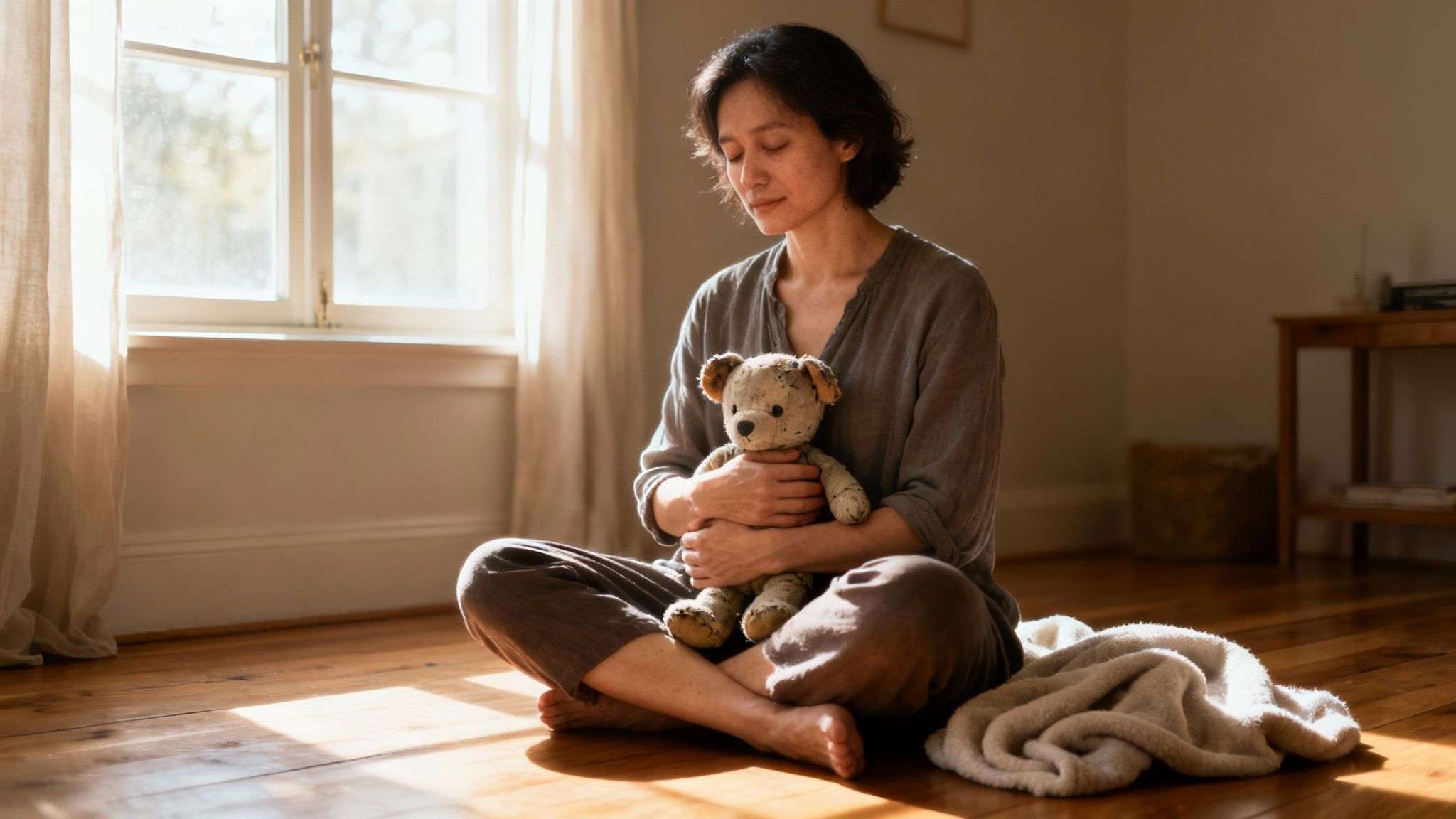
Understanding where a mother wound comes from is a huge step, but it’s just the starting point. The journey toward healing is a gentle, deeply personal process that unfolds from the inside out. It's not about changing the past; it's about fundamentally changing your relationship with yourself in the present. This path is paved with self-respect and profound compassion.
Healing isn’t a straight line. It's more like a practice—a commitment to returning to yourself with kindness, over and over again. The most powerful first step you can take is self-awareness.
Many clients we support in Kelowna, Vernon, Penticton, and Grande Prairie share these exact patterns, often without realizing they began in childhood through subtle emotional dynamics.
Acknowledging Your Experience Without Judgment
The first step is simple yet powerful: acknowledge the truth of your experience. This means letting yourself feel the grief, anger, or sadness for what you needed but didn’t get, without minimizing it. You don’t need anyone else’s permission to know that your feelings are real.
This act of acknowledgment is a game-changer. It’s a quiet declaration that your needs were valid then and they are still valid today. It’s about finally honouring the inner child who just wanted to feel safe and seen.
Healing begins the moment you give your own experience more authority than anyone else's denial of it. It’s about trusting your own story.
Learning to Re-Parent Your Inner Self
The idea of re-parenting is at the heart of healing mother wounds. In essence, it means consciously giving yourself the comfort, reassurance, and unconditional love you might have missed in childhood. This isn't about acting like a child; it's about becoming a wise, compassionate adult for the parts of you that are still hurting.
Re-parenting can look like many small, consistent actions:
Speaking to yourself with kindness, especially when that inner critic gets loud. You might gently say, "It's okay to feel this way. I'm right here with you."
Celebrating your small wins and acknowledging your efforts, instead of only focusing on the outcome.
Creating soothing rituals that help calm your nervous system, like wrapping yourself in a warm blanket or taking five deep breaths.
Honouring your needs for rest, nourishment, and play, without feeling guilt.
Each of these acts helps build a new internal foundation—one of safety, trust, and unwavering self-worth. You are showing up for yourself in all the ways you wished someone had shown up for you.
Setting Boundaries as an Act of Self-Respect
For many people carrying a mother wound, setting boundaries can feel terrifying. It might seem selfish, unkind, or even dangerous if you learned early that your job was to keep others happy. But learning to set gentle yet firm boundaries is one of the most transformative acts of self-love you can do.
A boundary is simply a line you draw to protect your peace and emotional energy. It’s about recognizing your own limits and communicating them respectfully. It’s you saying, "I value myself enough to protect my well-being."
Healing these wounds often involves seeking support. Safe, trusting relationships—whether with friends, partners, or a therapist—can provide a "corrective emotional experience," showing you that connection can be secure and reliable.
Frequently Asked Questions About Mother Wounds
Working through something as personal as a mother wound naturally brings up questions. It's a complex and emotional topic, so it’s completely normal to look for more clarity as you start to unpack what it all means for you. Here are some answers to common questions.
Does healing my mother wound mean I have to blame my mother?
Not at all. The goal isn't to assign blame—it's to gain understanding. Healing is an internal process, focused on acknowledging how your early years have shaped you. Many mothers did the best they could with the emotional tools they had, which were often limited by their own unhealed pain. The focus of this work is on you: grieving what you needed but didn't get, spotting the coping patterns you developed, and learning to give yourself the emotional safety you've always deserved. You can love your mother while also honouring the truth that some of your childhood emotional needs went unmet.
Can I heal if my mother is no longer in my life?
Yes, absolutely. Healing a mother wound is an internal journey centered on the relationship you have with yourself. It doesn’t require your mother to be involved, to understand your perspective, or even to be in your life. The real work is in exploring how your earliest bonds shaped your beliefs, emotional triggers, and relational patterns. By committing to practices like self-compassion, setting firm boundaries in all your relationships, and re-parenting your inner self, you can build a new, secure foundation from the inside out.
What is the first practical step I can take to start healing?
One of the most powerful and immediate steps is to practice mindful self-awareness without judgment. It’s about gently turning your focus inward and simply noticing your internal world. Begin by observing when you feel the pull of people-pleasing, hear your inner critic get loud, or have an emotional reaction that feels bigger than the situation warrants. When it happens, try to meet it with curiosity instead of criticism. You could ask yourself: "What's happening in my body right now?" or "What thought just went through my mind?" This simple act of pausing and acknowledging your inner experience is the first step toward self-attunement. It’s how you begin to offer yourself the steady, compassionate presence you may have always longed for.
If you’re in Kelowna, Vernon, Penticton, or Grande Prairie and you’re ready to explore and heal the impact of a mother wound, our counsellors can offer a safe, compassionate space to support you. We provide in-person and online sessions, meeting you wherever you are in your healing journey.
Untangling the complexities of the past to build a more secure emotional future is a brave and meaningful journey. If you feel ready to explore these patterns with professional, compassionate support, it can be a valuable step. Taking the time to understand your own story is a profound act of self-care.