If you're reading this, chances are that getting behind the wheel feels nothing like it used to. A car accident, even a minor one, can fundamentally change your relationship with driving, turning a once-routine activity into a source of intense anxiety. This is a completely normal and understandable response to a traumatic event. Your body and mind are trying to protect you from future harm, but this protective instinct can create a powerful fear of driving after an accident that keeps you from moving forward. For more information, see our ICBC counselling.
This article explores eight compassionate, trauma-informed strategies designed not just to improve your driving skills, but to rebuild your sense of emotional safety and restore your confidence on the road. We will walk through evidence-based approaches that focus on calming your nervous system, understanding your thought patterns, and gently re-engaging with driving at your own pace. Our goal is to provide supportive, actionable steps you can take to reclaim your independence, one gentle step at a time.
1. Cognitive Behavioral Therapy (CBT) and Cognitive Restructuring for Driving Anxiety
Cognitive Behavioural Therapy (CBT) is a highly effective, evidence-based approach for overcoming the fear of driving after an accident. It operates on the principle that our thoughts, feelings, and behaviours are interconnected. Following a car accident, it's common to develop negative thought patterns—like "I'll crash again" or "That intersection is too dangerous"—that fuel anxiety and lead to avoidance. CBT helps you identify these unhelpful thoughts and systematically challenge them in a gentle, supportive way.
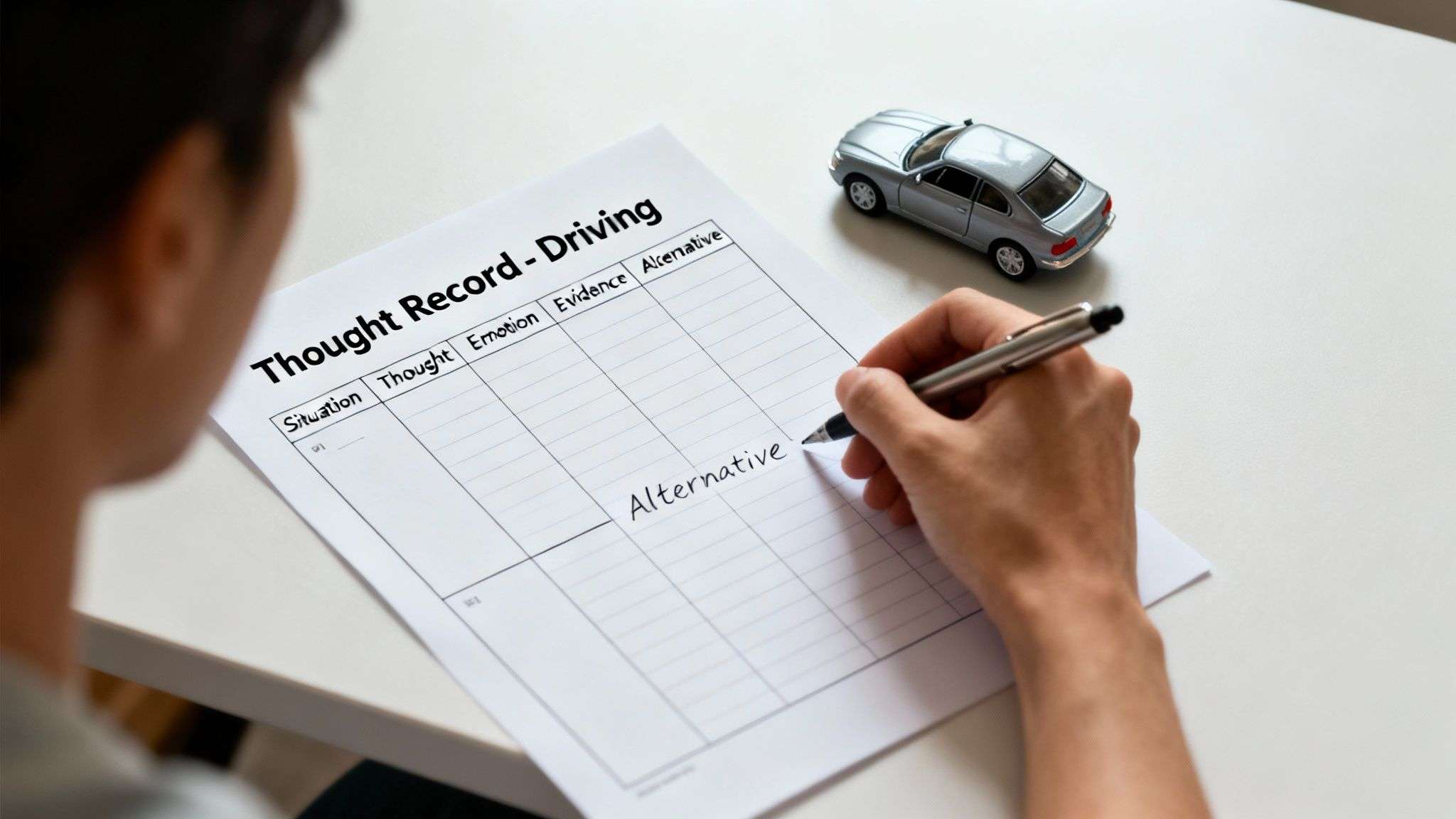
The core technique used is called cognitive restructuring. This process involves examining the evidence for and against your anxious thoughts, helping you develop more balanced and realistic perspectives. For example, the automatic thought, "I will crash if I drive in the rain again," can be restructured to, "Rain requires more caution, but by driving slowly and increasing my following distance, I can navigate the road safely." This shift doesn't ignore the risk; it empowers you with a sense of control.
How to Apply This Technique
To put this into practice, you can start by noticing your automatic thoughts when you feel anxious about driving. A structured way to do this is with a thought record. Here are some actionable tips:
Keep a Thought Record: Use a notebook to track situations that trigger your fear, the automatic thoughts that arise, and the emotions you feel. This builds awareness of your unique patterns. To get started, you can find a helpful template for a cognitive therapy thought record here.
Challenge Your Thoughts: Ask yourself questions like, "What is the evidence that this thought is true? What is the evidence that it isn't true?" and "What is a more balanced way of looking at this situation?"
Create Alternative Beliefs: Instead of just stopping at challenging the thought, actively create a more helpful, balanced one to replace it. For instance, if you approach the accident location and think, "This intersection is dangerous," a balanced alternative is, "Accidents can happen anywhere, but thousands of cars pass through here safely every day."
Work with a Professional: A therapist trained in trauma-informed CBT can guide you through this process with compassion and expertise, ensuring you feel safe as you rebuild your confidence.
2. Gradual Exposure Therapy (In Vivo Exposure)
Gradual exposure therapy is a structured, hands-on method for overcoming the fear of driving after an accident. This technique is based on the principle that facing your fears in a controlled and systematic way helps your brain unlearn the association between driving and danger. Following a traumatic event, your mind creates a powerful link between driving and panic, leading to avoidance. Gradual exposure systematically breaks this link by providing new, safe experiences behind the wheel, allowing your anxiety to naturally decrease over time.
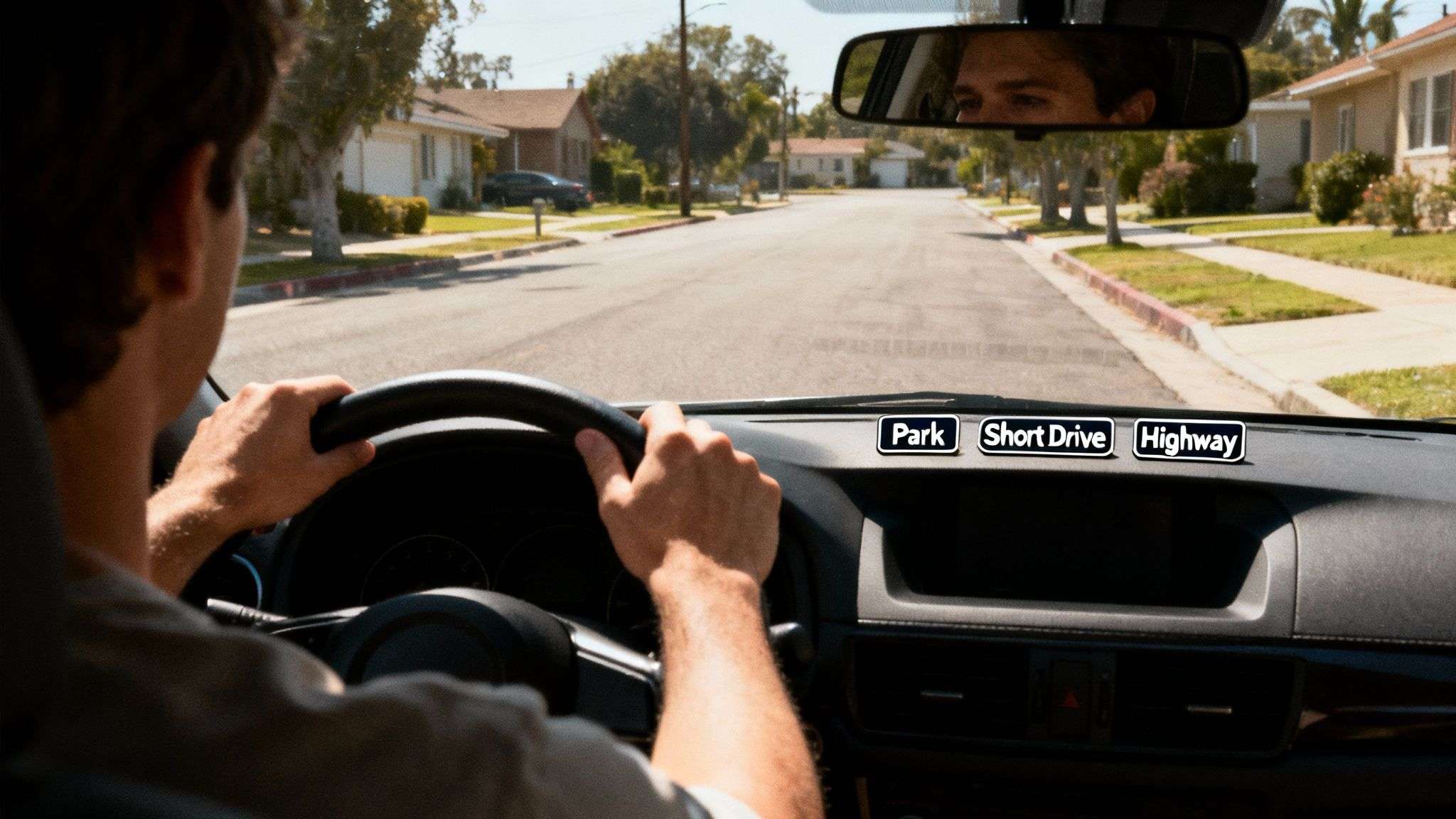
The process, also known as in vivo exposure, involves creating a hierarchy of feared driving situations, from the least scary to the most challenging. You then work your way up this list at your own pace. For instance, you might start just by sitting in the parked car and progress to driving down a quiet street, then eventually to navigating the intersection where the accident occurred. This gradual process builds confidence and teaches your nervous system that you are safe.
How to Apply This Technique
To begin this process, it's crucial to create a personal "fear hierarchy" and approach it with patience. The goal is not to eliminate anxiety instantly but to stay in a situation long enough for the fear to subside on its own.
Create a Fear Ladder: List 10–15 driving-related scenarios that trigger your fear. Rank them from least anxious (e.g., sitting in the car with the engine off) to most anxious (e.g., driving on the highway).
Start Small and Be Consistent: Begin with a task that causes only mild to moderate anxiety. Practice it repeatedly until your fear level significantly decreases before moving to the next step on your ladder.
Don't Rush the Process: Stay in each exposure situation until your anxiety has reduced by about half. Ending the exposure too early can reinforce the fear.
Bring a Support Person: In the initial stages, you might find it helpful to have a trusted friend or family member in the car with you for support.
Seek Professional Guidance: A therapist specializing in trauma can help you design a safe and effective exposure plan, providing crucial support as you navigate this challenging but rewarding journey.
3. Eye Movement Desensitization and Reprocessing (EMDR)
Eye Movement Desensitization and Reprocessing (EMDR) is a specialized psychotherapy approach designed to help people heal from trauma. After a car accident, the brain can get "stuck" on the traumatic memory, causing intrusive thoughts, flashbacks, and intense fear when you think about driving. EMDR uses bilateral stimulation, such as guided eye movements or tapping, to help your brain reprocess these memories, so they lose their painful emotional charge.
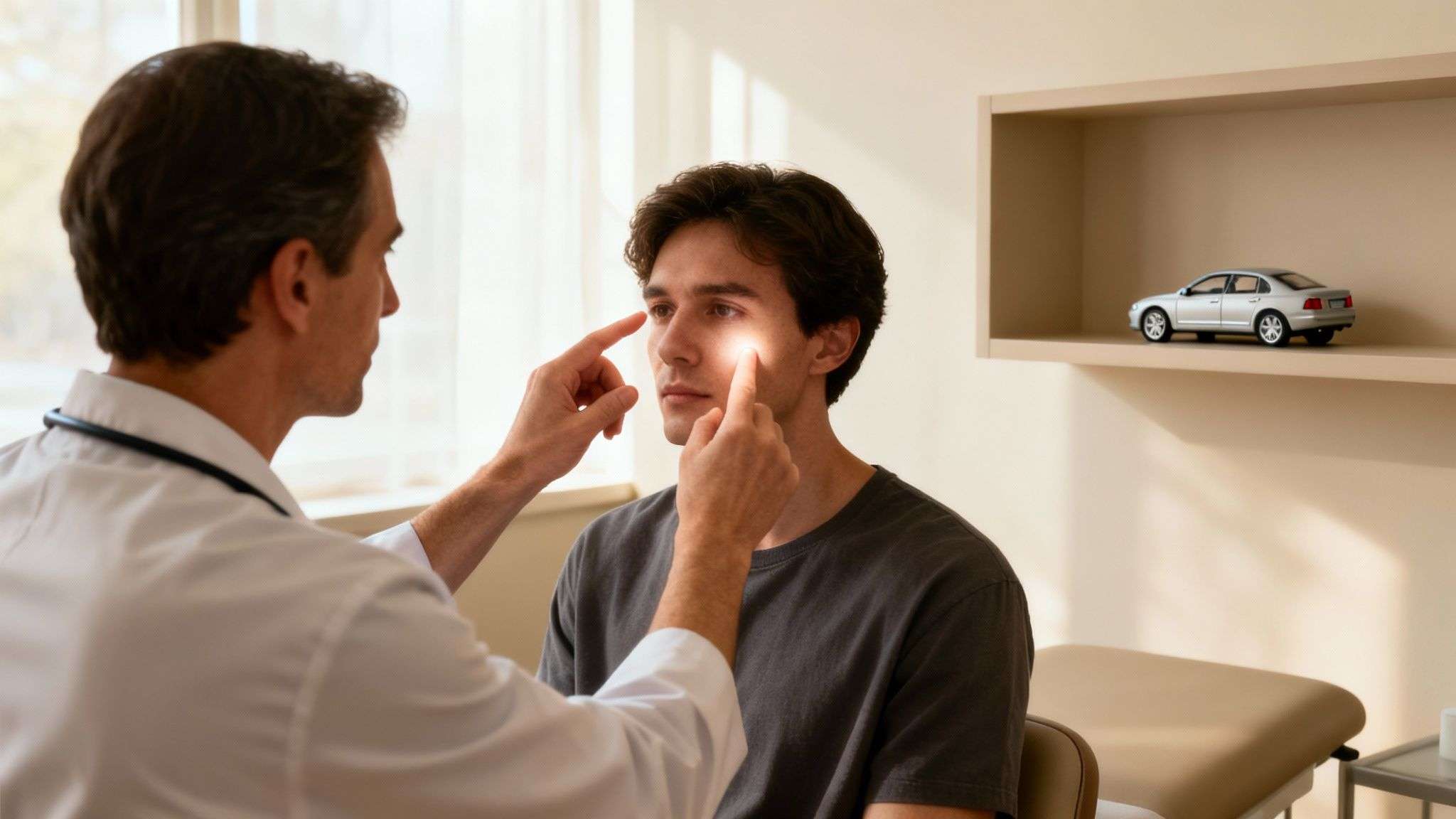
This therapy helps reduce the intensity of trauma-related memories that trigger your fear of driving after an accident. For example, a person who re-experiences the sounds and sensations of the collision might find that after EMDR, they can recall the event without the associated panic. The memory becomes just a memory, rather than something that feels like it is happening all over again.
How to Apply This Technique
EMDR is a structured therapy that must be delivered by a trained professional. It involves a specific, eight-phase protocol to ensure safety and effectiveness. If you are considering this approach, here are some actionable steps:
Find a Certified Therapist: It is crucial to work with a licensed therapist who is specifically trained and certified in EMDR. This ensures they can guide you through the process safely.
Target the Traumatic Memory: Your therapist will help you identify the specific memories, images, or feelings related to the accident that are the source of your distress.
Engage in Bilateral Stimulation: During sessions, you will focus on the traumatic memory while engaging in therapist-guided eye movements, taps, or sounds. This helps the brain resume its natural healing process.
Practice Self-Care: Your therapist will teach you grounding techniques to manage any distress between sessions. Understanding how trauma counselling works can help you prepare for this empowering process.
4. Mindfulness and Present-Moment Awareness
Mindfulness is the practice of directing your attention to the present moment without judgment. After a traumatic car accident, the mind can get stuck in a loop of replaying the event or projecting catastrophic "what-if" scenarios onto the future. This pattern fuels the fear of driving after an accident by keeping your nervous system in a constant state of high alert. Mindfulness counters this by anchoring you in the now. It allows you to notice anxious thoughts and physical sensations, like a racing heart or tense shoulders, without automatically interpreting them as immediate danger.
This practice helps you observe these feelings as temporary and separate from reality, preventing them from escalating into a full-blown panic attack. Instead of being lost in a cycle of fear about what could happen, your focus shifts to the tangible tasks of driving: the feel of the steering wheel, the sound of the engine, and the sight of the road ahead. Over time, this builds emotional regulation and restores a sense of control behind the wheel.
How to Apply This Technique
Integrating mindfulness into your routine can create a calmer baseline, making it easier to manage anxiety when it arises. Here are some practical ways to start:
Practice Daily Meditation: Begin with just 5-10 minutes a day using guided meditation apps or online resources. This trains your brain to return to the present moment, a skill you can call upon when feeling overwhelmed.
Use the 5-4-3-2-1 Grounding Technique: If you feel panic rising while driving, bring your focus back to your senses. Notice five things you can see, four things you can feel (like the seat beneath you), three things you can hear, two you can smell, and one you can taste.
Focus on Mindful Breathing: Before you start the car, spend a few moments on a simple breathing exercise, such as inhaling for four counts and exhaling for six. This activates the body’s relaxation response.
Acknowledge Sensations without Judgment: When you notice anxiety, mentally label it: "This is tension in my shoulders," or "This is a fearful thought." Acknowledging it without criticism allows the feeling to pass more easily. A therapist specializing in trauma and PTSD counselling can also help you integrate these techniques safely.
5. Somatic and Body-Based Therapies
Somatic and body-based therapies offer a powerful approach to healing the fear of driving after an accident by focusing on the body's physical stress response. A traumatic event like a car crash can dysregulate the nervous system, leaving it stuck in a state of high alert. Somatic therapies work directly with these physiological responses, such as muscle tension, shallow breathing, and a racing heart, helping to release stored trauma from the body.
These approaches, including Somatic Experiencing and Sensorimotor Psychotherapy, help you develop body awareness to track these sensations without becoming overwhelmed. For example, a person with post-accident hypervigilance might learn grounding techniques to calm their nervous system, reducing the constant feeling of danger. The goal is to complete the body's interrupted fight-or-flight response in a safe, therapeutic space, restoring a sense of physical and emotional safety.
How to Apply This Technique
Integrating somatic awareness can help you manage anxiety in the moment and gradually retrain your body's response to driving. Here are some actionable tips:
Practice Grounding: Before and during a drive, consciously feel your feet on the floor of the car and your hands on the steering wheel. This simple act anchors you in the present moment and signals safety to your nervous system.
Use Intentional Breathing: When you notice anxiety rising, practice slow, deep belly breaths. Inhaling for a count of four and exhaling for a count of six can activate your parasympathetic nervous system, which promotes a state of rest.
Notice Sensations Mindfully: Try a body scan while sitting in your parked car. Gently notice any areas of tension, like in your shoulders or chest, without judgment. Simply acknowledging the sensation can help it begin to release.
Work with a Professional: A therapist trained in somatic approaches can provide expert guidance. They create a safe environment to help you process the physical memories of the trauma and build your capacity to feel calm behind the wheel.
6. Graded Return-to-Driving Program with Professional Support
A graded return-to-driving program is a structured, personalized plan to help you resume driving after an accident at a pace that feels safe and manageable. Developed collaboratively with a therapist, this approach breaks down the overwhelming goal of "driving normally again" into small, specific, and achievable milestones. It systematically pairs gradual exposure-based practice with professional guidance, monitoring, and crucial emotional support to safely rebuild your skills and confidence behind the wheel.
This method acknowledges that overcoming a fear of driving after an accident isn't about simply forcing yourself back on the road. Instead, it’s about creating a series of small wins that build momentum. For example, a parent who had an accident with their child in the car might start with solo drives on quiet streets, then progress to driving with their partner, then with one child, and eventually, the whole family. This step-by-step process restores a sense of control and predictability.
How to Apply This Technique
Working with a professional is key to creating an effective plan. They can help you set realistic goals and provide support when you encounter anxiety spikes. Here are some actionable tips:
Establish a Baseline: With your therapist, rate your current comfort level on a scale of 0 to 10 for different driving situations (e.g., residential streets, highways, nighttime). This helps identify a safe starting point.
Set SMART Goals: Create goals that are Specific, Measurable, Achievable, Relevant, and Time-bound. An example could be: "I will drive on my quiet residential street for 10 minutes alone, three times this week during the day."
Create a Written Plan: Outline the steps and post the plan somewhere visible, like on your fridge. This serves as a tangible roadmap and a reminder of your progress and commitment.
Celebrate Small Wins: Acknowledge every achievement, no matter how small. Completing a five-minute drive without overwhelming panic is a significant victory and a foundation to build upon.
Build in Flexibility: Your plan should include emotional check-ins and be flexible enough to accommodate days when anxiety is higher. The goal is progress, not perfection.
7. Relaxation Techniques and Autonomic Nervous System Regulation
After a traumatic car accident, your body’s alarm system, the sympathetic nervous system, can become overactive, triggering a “fight or flight” response whenever you think about driving. Relaxation techniques are powerful tools that activate the opposing parasympathetic nervous system, responsible for "rest and digest," which calms your body down. These practices directly counter the physical symptoms of anxiety like a racing heart, shallow breathing, and muscle tension, which are common when dealing with the fear of driving after an accident.
By consciously regulating your body's stress response, you teach your nervous system that you can feel safe and in control, even when faced with a trigger like getting behind the wheel. Techniques like diaphragmatic breathing and progressive muscle relaxation provide immediate, measurable relief. With consistent practice, they also build your baseline resilience, making you less susceptible to being overwhelmed by anxiety when it arises.
How to Apply This Technique
Integrating relaxation into your routine can create a foundation of calm that makes facing driving-related fears more manageable. Here are some actionable tips:
Practice Daily: Dedicate 10 to 15 minutes each day to a relaxation practice, even when you aren't feeling anxious. This builds the skill so it's readily available when you need it most.
Use Grounding Breaths: When you feel a surge of panic, use a simple breathing pattern like 4-7-8 (inhale for 4 seconds, hold for 7, exhale for 8) or box breathing (inhale-4, hold-4, exhale-4, hold-4). This can be done discreetly anytime, anywhere.
Try Progressive Muscle Relaxation (PMR): Systematically tense and then release different muscle groups throughout your body, from your toes to your face. This process highlights the difference between tension and relaxation, helping you consciously release physical stress.
Incorporate Gentle Scents: For those specifically seeking natural remedies, consider using essential oils for anxiety relief with a car diffuser to create a calming sensory environment.
Rehearse in the Car: Practice your chosen techniques while sitting in your parked car. This helps create a new, positive association between the vehicle and a state of calm. You can learn more about different methods for coping with anxiety to find what works best for you.
8. Acceptance and Commitment Therapy (ACT) for Driving Anxiety
Acceptance and Commitment Therapy (ACT) offers a unique approach to managing the fear of driving after an accident. Rather than trying to eliminate anxiety, ACT focuses on accepting those feelings as a normal part of your experience while committing to actions that align with your personal values. This therapy helps you stop struggling against your anxiety and instead allows you to move forward with your life, even with anxiety present.
The goal is not to feel good before you drive, but to live a meaningful life despite the discomfort. For example, instead of waiting for the fear to disappear, a parent might focus on the value of being there for their children. This allows them to drive to school events or family gatherings, even while experiencing anxiety, because the action aligns with their commitment to family. This reduces the secondary anxiety that often comes from feeling anxious about being anxious.
How to Apply This Technique
ACT uses mindfulness and acceptance strategies to help you handle painful thoughts and feelings more effectively. Here are some actionable tips to get started:
Identify Your Core Values: What does driving enable you to do that is important to you? Write down values like independence, family connection, career progression, or spontaneity. Use these as your motivation to get back in the car.
Use the 'Passengers on a Bus' Metaphor: Imagine your anxious thoughts are unruly passengers on a bus. You are the driver. You can acknowledge their presence without letting them grab the steering wheel and dictate your direction.
Practise Mindful Acceptance: When an anxious thought arises, simply notice it without judgment. You can say to yourself, "I'm having the thought that I might crash," and then gently bring your focus back to the physical act of driving safely.
Create Acceptance Statements: Use short, powerful phrases to acknowledge your feelings without giving in to them. Simple statements like, "I notice anxiety is here, and I can still drive to the grocery store," can be incredibly effective.
8-Method Comparison: Treatments for Driving Anxiety After an Accident
| Intervention | Implementation complexity | Resource requirements | Expected outcomes | Ideal use cases | Key advantages |
|---|---|---|---|---|---|
| Cognitive Behavioral Therapy (CBT) & Cognitive Restructuring | Moderate — structured, time-limited protocol (12–20 sessions) | Licensed CBT therapist, worksheets, homework time | Reduced catastrophic thoughts, improved coping, measurable progress over weeks | Clients with anxiety/PTSD-related driving fear who can engage in homework | Strong empirical support; teachable, lasting cognitive tools |
| Gradual Exposure Therapy (In Vivo Exposure) | Moderate–High — requires careful hierarchy and safety planning | Therapist guidance or trained support person, repeated real-world practice time | Habituation to feared driving situations, increased confidence, durable behavior change | Specific phobia or avoidance of driving, ready for in-vivo practice | Builds genuine confidence via real experience; relapse-resistant when practiced |
| Eye Movement Desensitization and Reprocessing (EMDR) | High — specialized eight-phase protocol and trained clinician | EMDR-certified therapist, session monitoring for emotional intensification | Rapid reduction in trauma-related reactivity; reprocessed accident memories | Driving anxiety rooted in unprocessed accident trauma or PTSD | Efficient trauma processing; less need for prolonged verbal retelling |
| Mindfulness & Present-Moment Awareness | Low–Moderate — simple techniques but requires regular practice | Low-cost apps/resources or instructor, daily practice time | Improved emotional regulation, reduced rumination, greater present focus | Drivers needing in-the-moment tools or as adjunct to other therapies | Accessible, usable while driving, supports long-term resilience |
| Somatic & Body-Based Therapies | Moderate–High — body-focused approaches needing specialist training | Trauma-informed somatic therapist, session time for bodywork/movement | Nervous system regulation, reduced physical hyperarousal, bodily sense of safety | Clients with strong physiological symptoms or somatic trauma responses | Directly targets bodily responses; useful before or alongside cognitive work |
| Graded Return-to-Driving Program with Professional Support | Moderate — structured individualized plan with monitoring | Therapist time, possible supervised drives, written milestones | Structured progression to driving, restored skills and confidence, accountability | Clients ready to resume driving who need monitored, stepwise practice | Clear milestones, professional support and real-time coaching |
| Relaxation Techniques & ANS Regulation | Low — easy to learn, immediately applicable | Minimal: self-practice, apps, brief instruction | Immediate symptom relief, lowered heart rate/tension, better momentary control | Acute anxiety episodes, in-car symptom management, adjunct to therapy | Rapid, low-cost relief; can be practiced anywhere with no side effects |
| Acceptance and Commitment Therapy (ACT) | Moderate — experiential and values-based work | ACT-trained therapist, homework focused on valued actions | Increased psychological flexibility, reduced avoidance, improved functioning despite anxiety | Chronic anxiety or avoidance limiting life roles, motivated for values-driven change | Shifts focus to values and committed action; reduces struggle with anxiety |
Your Questions Answered & The Road Ahead
Navigating the road back to confident driving can bring up many questions. Here, we address some common concerns with compassion and clarity, summarizing the key takeaways from our discussion on overcoming a fear of driving after an accident.
Frequently Asked Questions
1. Is it normal to still be scared of driving months after an accident?
Absolutely. There is no set timeline for healing from trauma. A car accident is a significant event, and the fear it creates can linger long after physical injuries have healed. This response is a sign that your nervous system is still trying to protect you. Be patient with yourself; recovery is a process, not a race.
2. Will my fear of driving after an accident ever go away completely?
While the goal is to significantly reduce the fear so it no longer controls your life, it's possible to have occasional moments of anxiety. The aim of therapy isn't to erase the memory but to change your relationship with it. You can learn to manage these feelings effectively, so they become brief, manageable signals rather than overwhelming roadblocks.
3. What's the difference between normal caution and a phobia?
Healthy caution involves being more aware of your surroundings, following traffic laws, and driving defensively. A phobia or severe driving anxiety often involves intrusive thoughts, panic symptoms, and significant avoidance of driving that interferes with your daily life, relationships, or work.
4. Do I have to revisit the accident details in therapy?
Not always in graphic detail. While some therapies like EMDR focus on processing the memory, many effective approaches like somatic therapy and mindfulness focus on regulating your body's response in the present moment. A good therapist will work with you to find a path that feels safe and manageable.
Moving Forward with Support
Recovering from a car accident is about more than just getting back behind the wheel; it's about restoring your sense of safety in the world. The journey requires patience, self-compassion, and the right kind of support. If you find that this fear is impacting your quality of life, know that professional help is available. Exploring options like trauma-informed counselling can provide you with the tools and guidance to navigate this challenging road. You don't have to do this alone. Taking the first step to learn more is a powerful move toward regaining your freedom and peace of mind.
At Interactive Counselling, our therapists specialize in trauma and anxiety, offering a safe, non-judgemental space to process your experience and rebuild your confidence one step at a time. Learn more about how our evidence-based approaches can support your recovery at Interactive Counselling.
If a crash has left you anxious behind the wheel, you may not have to pay out of pocket for support — our ICBC counselling in Kelowna is direct-billed through your active claim, so you can focus on recovery.