Trying to manage your own personal growth while also juggling the dynamics of family life can feel like a lot. If you're feeling stuck or overwhelmed, please know you're not alone. Making the decision to look into life and family counselling is a powerful, positive step towards building stronger relationships and finding clarity for yourself and the people you care about most. For more information, see our family counselling.
"Life and family counselling is a supportive process where a trained professional helps individuals and families navigate challenges, improve communication, and strengthen their relationships in a safe, non-judgmental environment."

What Is Life and Family Counselling, Really?
It’s completely normal to have questions about what counselling actually involves. Simply put, life and family counselling is a collaborative process designed to help you and your loved ones understand each other better and work through challenges together. It’s not about finding fault or placing blame; it's about creating a space where everyone feels heard and respected, so you can find a healthier way forward.
While they often go hand-in-hand, it can be helpful to look at the two sides of this supportive service.
- 'Life' Counselling: This side is focused on your individual journey. It provides a confidential space to work through personal hurdles, whether that’s managing stress, navigating grief, or figuring out your next steps during a major life transition. The goal is to help you understand your own thoughts and feelings, build resilience, and move toward personal growth.
- 'Family' Counselling: This side views the family as an interconnected system. A helpful way to picture it is a hanging mobile—when one piece moves, all the other pieces are affected. Family therapy helps untangle knots in communication, resolve long-standing conflicts, and guide everyone through shifts like a separation or blending families.
It's a Partnership, Not a Lecture
The most important thing to know is that counselling is a partnership. Your counsellor acts as a neutral guide, not a judge. Their role is to facilitate better conversations, offer fresh perspectives, and provide evidence-based tools that you can use long after your sessions have ended.
Everything is built on a foundation of empathy and respect. It’s a chance for everyone to take a breath, step away from the daily conflicts, and see old patterns in a new light, creating an environment where every person feels heard and understood.
Does It Actually Work?
The idea that talking can create real, positive change is supported by significant evidence. People who engage in counselling consistently report measurable improvements in their lives. For example, a recent large-scale survey showed that a remarkable 87% of people experience positive changes from therapy, reporting increases in confidence, overall happiness, and self-esteem.
Furthermore, with 93% of respondents recognizing the deep connection between mental and physical health, it's clear that caring for your emotional well-being is a fundamental part of a healthy life.
Ultimately, starting this process is an investment in a more resilient and connected future. To learn more about how family dynamics are addressed, you can explore the role of family counselling.
Common Reasons Families Seek Support
Every family has its own unique rhythm and its own set of challenges. It's completely normal to hit a point where that rhythm feels off and you feel stuck, no matter what you try. Deciding your family might benefit from outside support isn’t a sign of failure—it’s a sign of strength and a testament to how much you care.
Families are complex ecosystems. When one person is struggling or the group faces a significant change, everyone feels the ripple effects. That’s why seeking counselling can be a powerful, proactive step toward building a more connected and resilient family.
Navigating Communication Breakdowns
Does it ever feel like everyone in your home is speaking a different language? You’re all talking, but nobody seems to be truly hearing each other, leading to a frustrating cycle of misunderstandings and hurt feelings. This is one of the most common reasons families seek support.
What starts as a small miscommunication can build into a wall of silence or escalate into constant arguments. A counsellor can act as a neutral translator, helping everyone understand what’s really being said—and felt—underneath the words. We work to replace patterns of blame and defensiveness with genuine curiosity, creating a space where everyone finally feels heard.
Managing Conflict and High Tension
Disagreements are a natural part of life, but when arguments become the default, it can drain the energy from your entire home. If you're constantly walking on eggshells, dealing with the silent treatment, or bracing for the next fight, you know how exhausting it can be.
Counselling offers a safe, structured environment where you can finally address these conflicts without things escalating. A therapist helps you identify the real root of the arguments and teaches you practical ways to disagree respectfully. You’ll learn how to find resolutions that work for everyone, giving you tools to navigate future challenges more constructively. To explore these dynamics further, you can learn more about family roles in dysfunctional families.
Adjusting to Major Life Transitions
Life is always changing, and some of those changes can shake a family to its core. Even happy transitions require everyone to adapt, and that adjustment period can be challenging. Some of the most common life events that bring families to counselling include:
- Separation or Divorce: Navigating the emotional and logistical realities of a separation is one of the most difficult experiences a family can face.
- Blending Families: Bringing two families together to create a new step-family is a delicate process filled with unique joys and complexities.
- Welcoming a New Child: A new baby changes everything. For new parents, things like understanding postpartum depression warning signs can be crucial, and counselling provides vital support during this overwhelming time.
- Grief and Loss: Losing a family member sends shockwaves through the entire system, and each person grieves in their own way and on their own timeline.
Supporting Children and Teens
Parenting doesn't come with a manual, and there will always be moments when you feel worried or unsure how to best support your child. Perhaps you have a younger child with challenging behaviours, or a teenager who is wrestling with anxiety, peer pressure, or school stress.
Therapy can provide insight into what’s driving your child's behaviour and help you develop parenting strategies that build connection instead of creating more conflict. It also gives your child or teen a confidential space to open up and learn healthy ways to cope with their big feelings. The strain on families is real—studies show that family and relationship issues affect a significant portion of the population, highlighting the need for supportive resources.
What to Expect in Your Counselling Sessions
Deciding to start counselling is a significant step, and it's completely normal to feel a bit apprehensive about what comes next. Let’s walk through what you can expect, so you can feel more comfortable and prepared. Think of it less as a formal procedure and more as the beginning of a supportive conversation focused entirely on your family’s well-being.
Your First Few Sessions
The first meeting is really about getting to know each other. It’s a low-pressure opportunity for you to share what’s going on and for your counsellor to listen with empathy. Our primary goal in the beginning is to understand your family’s unique world from every perspective.
We'll ask questions to get a sense of your family's strengths—because every family has them—as well as the challenges that brought you here. From there, we'll work together to map out some clear, achievable goals. This isn't about us telling you what to do; it’s about co-creating a roadmap that guides our sessions toward the changes your family wants to see.
At its core, the counsellor’s role is to be a neutral guide. We don’t take sides or pass judgement. We’re here to create a safe space where everyone feels heard, helping you understand each other better.
This initial phase is all about building a foundation of trust, which is essential for the meaningful work ahead.
How Sessions Are Structured
Family counselling isn’t a rigid, one-size-fits-all program. Its strength lies in its flexibility. We adapt the structure of our sessions to fit what your family needs at any given moment.
Some sessions might bring the entire family into the room together. Other times, it might be more productive for:
- Parents or co-parents to meet alone to align on parenting strategies.
- Siblings to have their own space to work on their relationship.
- Individuals to have one-on-one check-ins to focus on personal goals that affect the family.
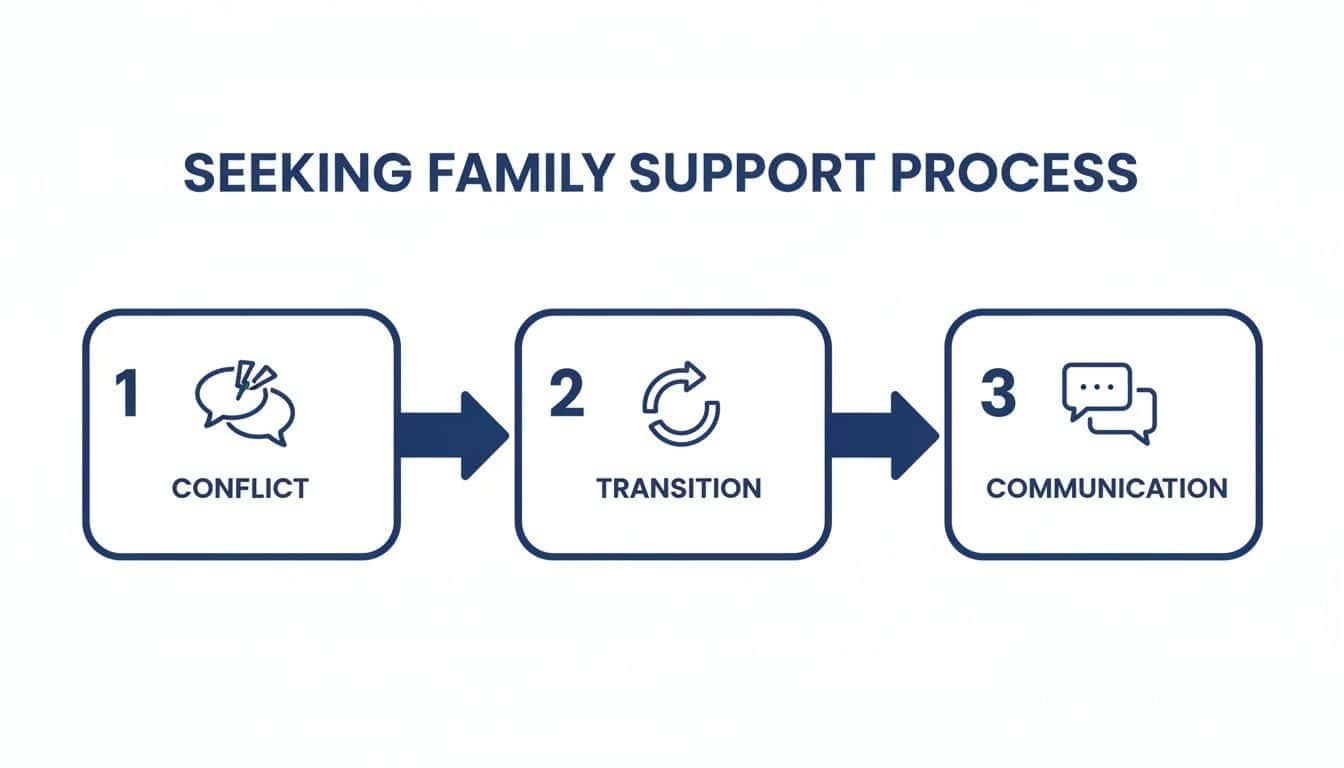
Think of the journey in three stages, as shown above. We often start by navigating the initial Conflict, move through a Transition period where new skills are learned, and work toward healthier Communication. Your counsellor is there to guide you through each phase.
A typical journey through counselling is a progressive process. The table below outlines what you can generally expect at each stage.
A Typical Journey Through Family Counselling
This table outlines the key stages of the family counselling process, from the first contact to achieving your goals, helping you understand what to expect at each step.
| Counselling Stage | What Happens in This Stage | Primary Goal |
|---|---|---|
| Initial Contact & Intake | You reach out and have a first session. We discuss confidentiality, your history, and what brought you here. | To establish a safe environment and understand the core issues. |
| Assessment & Goal Setting | In the first 1-3 sessions, we explore family dynamics and collaboratively set clear, realistic goals. | To create a shared "roadmap" for therapy that everyone agrees on. |
| The "Work" Phase | This is the longest phase. We use different therapeutic approaches to address conflicts, learn new skills, and practice them. | To build practical communication and problem-solving skills. |
| Review & Adjustment | Periodically, we check in on progress toward your goals and adjust our approach if needed. | To ensure therapy remains effective and on track. |
| Transition & Closure | As goals are met, we focus on maintaining progress, preparing for future challenges, and planning for the end of therapy. | To empower the family to confidently use their new skills independently. |
Throughout this entire journey, you are a partner in the process. Your therapist will always explain their reasoning, ensuring you feel informed and involved. The focus is always on building practical skills you can use in your day-to-day life.
If you'd like a more detailed picture of that initial conversation, you can learn more about what to expect from your first session.
Proven Approaches Used in Family Therapy
When you decide to try family counselling, it's natural to wonder what actually happens in a session. It's not just an unstructured chat; a skilled counsellor uses specific, well-researched methods to guide your family toward healthier ways of interacting. These are practical, effective roadmaps grounded in what we know works.
Let's look at a few of the most common and effective approaches, explained in a simple, relatable way.
The Family as an Interconnected System
A core idea in family therapy is Family Systems Theory. The best way to understand this is to imagine a baby's mobile hanging over a crib. If you gently touch one of the hanging animals, all the other pieces move too. They shift and readjust in response. No single part moves in isolation.
This is a perfect metaphor for how families operate. When one person is struggling—whether with a parent’s stress from work, a teenager’s anxiety, or a child’s behaviour—it creates ripples that affect everyone.
A counsellor using this perspective helps your family see these invisible connections. Instead of focusing on one person as "the problem," we look at the whole family dynamic. We work together to understand how your unique patterns of interaction might be contributing to the issue.
The goal isn't to fix one part of the mobile. It’s about adjusting the connections between the parts so the whole system can find a new, healthier balance.
Changing Patterns of Thinking and Behaving
Another powerful tool is Cognitive Behavioural Therapy (CBT), which is adapted specifically for families. At its heart, CBT focuses on the link between our thoughts, feelings, and actions. Think of a thought like a seed. If you plant a seed of worry—“My teenager is so withdrawn, they must be upset with me”—it can grow into feelings of sadness or anxiety. Those feelings might then cause you to act defensively or pull away, unintentionally making the situation worse.
In family counselling, we use CBT to help everyone notice these automatic negative thought patterns. A therapist can guide your family to:
- Identify unhelpful thoughts: Learn to recognize when a thought is an assumption, not a fact. For example, a parent might challenge the belief that a child's bad grade is a direct reflection of their failure as a parent.
- See the thought-to-action link: We map out how a specific thought (like "they never listen to me") leads directly to a particular behaviour (like yelling).
- Develop new skills: Most importantly, you'll learn practical ways to reframe those thoughts and choose more constructive actions, breaking old cycles and creating calmer, more positive interactions.
Tuning Into the Emotional Music
Sometimes, the real issue isn't what you're arguing about—the chores, the curfew, the screen time. The real conflict is driven by the unspoken emotions bubbling just beneath the surface. This is where Emotionally Focused Therapy (EFT) comes in. EFT helps families learn to hear the "emotional music" playing behind the words.
This approach focuses on uncovering deeper, more vulnerable feelings that are often disguised as anger or frustration. For example, a parent's sharp anger over a messy room might actually be covering a deep fear of not being respected. A teenager's defiance might be masking a feeling of loneliness or a desperate need to feel understood.
An EFT-trained counsellor creates a safe space for everyone to share these core emotions. By helping family members express their true needs and fears in a way that can be heard, we de-escalate conflict and begin to rebuild secure, loving bonds. The focus shifts from winning an argument to truly connecting with one another. Our post on collaborative problem solving offers similar concepts.
The Lasting Benefits of Family Counselling
When you choose to begin family counselling, you're doing more than just addressing immediate problems. It’s an investment that can ripple through your family's future, laying a new foundation for how you connect, communicate, and face challenges together for years to come.

Building Stronger Communication Skills
One of the most immediate benefits is a shift in how you talk to each other. Life and family counselling helps you break the frustrating pattern of talking at one another and start truly listening. You’ll learn how to express your needs and feelings without it turning into an accusation or a fight.
Imagine having those tough conversations that lead to understanding, not more hurt feelings. This is one of the most practical skills you’ll gain, helping to reduce daily tension and build a new level of mutual respect. These are real, tangible strategies for strengthening family relationships.
Forging Deeper Emotional Bonds
So often, what looks like anger or stubbornness is really a bid for connection. Underneath family arguments are often deep-seated needs to feel loved, safe, and simply seen. Counselling provides a safe space to finally talk about these things and start repairing connections that have worn thin over time.
The skills learned in therapy help you create a family culture where everyone feels seen and supported. This creates a legacy of emotional security that children can carry with them into their own adult relationships.
This doesn't mean you'll stop disagreeing. But when you do, it will happen on a foundation of trust and connection, which makes finding your way back to each other so much easier.
Developing Healthier Conflict Resolution
Every family has conflict; what matters is how you navigate it. In counselling, you’ll gain a toolbox for handling disagreements in a healthy way. Instead of arguments spiralling out of control or ending in cold silence, you’ll learn to approach problems as a unified team.
This means you'll be able to:
- Identify the root of an issue, not just the symptom that started the fight.
- Practice listening to understand, so everyone feels their perspective has been heard.
- Work together to find solutions that are acceptable to everyone.
- Learn how to "repair" the relationship after a disagreement so resentment doesn't build.
The need for these skills is widely recognized. Across North America, the demand for qualified marriage and family therapists is growing, which shows how much communities value the importance of strong family units. You can read more about these professional trends from the U.S. Bureau of Labor Statistics.
At the end of the day, life and family counselling isn't just about fixing the problems you have now. It’s about building a more resilient, loving, and connected family for the long haul.
Your Questions About Family Counselling Answered
It’s completely natural to have questions when you’re considering something as important as life and family counselling. Taking this step is a big decision, and getting clear, straightforward answers can help you feel more confident and prepared. Let's walk through some of the most common questions we hear from families.
How do I know if my family needs counselling?
There’s no single "right" time to start, and reaching out for support is always a sign of strength. You might consider counselling when you notice persistent patterns that are causing distress or making everyone feel disconnected.
Some common signs include:
- Constant Conflict: It feels like arguments are the new normal, and everyone is walking on eggshells.
- Communication Breakdowns: You talk, but nobody seems to be listening, leading to frequent misunderstandings and hurt feelings.
- Major Life Transitions: Your family is struggling to navigate a big change—like a separation, blending families, or grieving a loss—and the stress feels overwhelming.
- Concerns About a Child: You’re worried about a child's behaviour, their emotional well-being, or struggles at school, and you're not sure how to help.
If you simply feel "stuck" and nothing you've tried seems to be working, counselling can offer a fresh perspective and new tools to move forward in a healthier direction.
What if some family members are hesitant to join?
This is one of the most common challenges. It’s rare for an entire family to be on board with starting therapy from day one. The good news is that counselling can still be incredibly helpful even if only one or two members are ready to participate.
Often, positive change can begin with just a few willing people. As hesitant family members start to see constructive shifts—perhaps the home feels calmer or communication improves—they may become more open to joining later. The most important thing is to start where you can. Your counsellor can also offer guidance on how to talk to reluctant family members in a supportive, non-pressuring way.
How is confidentiality handled in family sessions?
Confidentiality is the bedrock of effective therapy. At the beginning of your first session, your counsellor will clearly explain the principles of privacy and respect. This is a crucial step in creating a safe space where everyone feels they can share openly.
The counselling room is a confidential space designed for honesty and trust. Your therapist will explain the professional and ethical standards for privacy, including any legal limits, ensuring everyone understands and feels secure.
In simple terms, what’s said in the room, stays in the room. The only exceptions relate to safety, such as a risk of harm to oneself or others, particularly a child or vulnerable person. Your counsellor will review these limits with you so everyone is on the same page from the start.
Are online counselling sessions effective?
Yes, they absolutely can be. Secure virtual counselling has proven to be just as effective as in-person meetings for many families. The convenience and accessibility of online sessions can be a game-changer for busy households, making it easier to coordinate schedules and maintain consistency.
Additionally, some people find they can relax and open up more from the comfort of their own home. We use the same evidence-based approaches online as we do in our office, so you can choose the format that works best for your family without compromising the quality of care. It’s reassuring to know there are flexible ways to get help, such as the different formats available for services like counselling.
Can counselling help after a traumatic event?
Yes, counselling can be vital in these situations. A traumatic event, like a serious illness or accident, can send emotional shockwaves through an entire family. It's common for individuals to struggle with anxiety, fear, or post-traumatic stress, and these reactions naturally affect the whole family dynamic.
Trauma-informed counselling offers a safe space to:
- Process the frightening experience, both individually and together.
- Learn to manage the anxiety, stress, and other intense emotions that follow.
- Strengthen family bonds and communication while navigating the recovery process.
Working with a therapist helps ensure that emotional healing occurs alongside any physical recovery, building resilience for the entire family.
We hope these answers have helped bring some clarity. Taking that first step can feel like the hardest part, but being informed makes it much more manageable. Whenever you feel ready, compassionate and professional support is here to help your family build a stronger, more connected future.
Clinically Reviewed By
Amy Mosset, MCP, RCC-S
Amy Mosset is a Master Practitioner in Clinical Counselling, Clinical Supervisor, and the owner of Interactive Counselling. She provides trauma-informed, evidence-based care and clinical supervision to registered therapists, with a focus on ethical practice, client safety, and high-quality therapeutic outcomes.