Deciding you want to save your marriage is a quiet, powerful moment. It's not usually a grand gesture, but a deep, personal choice to look at the space that has grown between you and your partner and decide, together, that you want to close it. For more information, see our couples counselling.
This journey is about re-establishing communication, rebuilding trust, and learning to work as a team again, instead of as opponents. It’s a path back to rediscovering why you chose each other in the first place and building something even stronger on that foundation.
Acknowledging the Disconnect in Your Marriage

Before you can begin to mend your relationship, you both have to gently acknowledge that something feels off. This isn't about pointing fingers or keeping a tally of past wrongs. It’s about bravely admitting that the connection feels weak or broken, even if you can't quite pinpoint why.
Emotional drift is subtle. It happens slowly over time as life gets busy, small arguments go unresolved, and before you know it, you can feel more like roommates than partners. The very first step is simply admitting to yourself, "This isn't working the way it should, and I want to fix it."
Understanding the Shift
To map a path forward, it’s helpful to understand what changed. Try to look back with curiosity, not judgment. These questions are a starting point for your own reflection, not a scorecard of your relationship's failures.
- Emotional Availability: Are you still sharing the small details of your day, your wins, and your worries? Or have conversations shrunk to logistics about bills and schedules?
- Shared Joy: When was the last time you genuinely laughed together? Or worked on a fun project as a team?
- Physical Connection: Has physical touch, from holding hands to intimacy, become rare or feel like an obligation?
- Conflict Resolution: When you argue, does it end with a cold silence that lasts for days? Or are you able to find your way back to each other?
Honest self-reflection isn't meant to make you feel worse; it’s about gaining clarity. It helps you see where the relationship is right now with compassionate, honest eyes. Facing these truths provides a real starting point and can ignite the strength you need to fight for your marriage.
Restarting Meaningful Communication

When a relationship is under strain, meaningful conversation is often the first thing to go. What used to be easy chats can become a minefield of circular arguments, defensive stand-offs, or just a heavy, draining silence.
The goal isn't to win the next debate. It's to rebuild a bridge of understanding so you can truly hear and connect with each other again.
Stop Accusing, Start Expressing
The dynamic of a conversation changes completely when you shift from accusation to expression. One of the most powerful and evidence-based tools for this is the use of "I" statements.
Instead of saying, "You never help around the house," try framing it from your perspective: "I feel overwhelmed and unsupported when the chores pile up." The first is an attack; the second is an invitation for your partner to understand your experience. This small tweak can de-escalate a potential argument before it starts, opening the door for empathy instead of slamming it shut with blame.
Learn to Listen, Not Just Hear
Of course, talking is only half the equation. The other, equally important part is active listening. This is more than just waiting for your turn to speak. It means giving your partner your full attention—putting your phone away, pausing your internal monologue, and genuinely trying to see the world from their perspective, even if you disagree.
You can show you're engaged by:
- Paraphrasing their point: "So, if I'm understanding you right, you felt unappreciated when I didn't mention the work you did in the yard."
- Asking open-ended questions: "Can you tell me more about what that felt like for you?"
- Validating their emotions: "I can see why that would have been really hurtful."
Couples often fall into destructive patterns without realizing it. Shifting your approach can make all the difference.
From Destructive to Constructive Communication
| Common Pitfall | Constructive Alternative |
|---|---|
| Blaming: "You always…" or "You never…" | Using "I" Statements: "I feel…" or "I need…" |
| Mind Reading: "I know what you're thinking." | Asking for Clarity: "What's on your mind right now?" |
| Defensiveness: "It's not my fault, you're the one who…" | Taking Responsibility: "I can see my part in this." |
| Invalidating: "You're overreacting." | Validating Feelings: "I understand why you're upset." |
Making these changes isn't about giving in; it's about shifting the dynamic so you can solve problems together instead of fighting each other. Healthy communication isn’t about proving you’re right. It’s about ensuring both partners feel heard, understood, and respected. For a deeper dive, our guide on how to communicate better in relationships offers even more practical techniques.
The Slow, Hard Work of Rebuilding Trust
Trust is the foundation of a marriage. When it's damaged—either by a significant betrayal or the slow erosion of a thousand small letdowns—the ground beneath you feels unstable. Rebuilding it isn't a quick fix; it's a slow, patient, and often challenging process.
This journey requires absolute consistency from the partner who broke the trust and profound vulnerability from the one who was hurt. It’s a delicate process that requires deep empathy from both of you.
If You're the One Who Broke the Trust
Your actions now carry all the weight. Words and apologies are a start, but true healing begins when you take full, unreserved ownership of what you did. This means no excuses and no justifications. It requires being transparent, answering difficult questions honestly, and proactively demonstrating your commitment to change.
- Be an open book. This might mean offering access to your phone or social media without being asked.
- Keep your word, always. Every single promise, no matter how small, must be kept. Consistency builds credibility.
- Practice patience. Understand that your partner’s healing won't follow a neat timeline. There will be good days and hard days.
If You're the One Who Was Hurt
Your pain, anger, and confusion are completely valid. It's important to allow yourself to feel those emotions without judgment. Your path forward involves processing that hurt and making a conscious choice, day by day, whether you can open your heart to trust again. It's not about forgetting what happened, but about deciding if you can integrate this experience into your shared story and still move forward, together.
It can be helpful to remember that working through this has a real upside. Research suggests that subsequent marriages can face higher rates of dissolution. This implies that putting in the hard work to repair your primary relationship can give you a stronger, more resilient foundation for the future.
How to Handle Major Relationship Crises
Sometimes, the problems in a marriage feel bigger than a breakdown in communication. When you're facing a major crisis—like infidelity, overwhelming financial debt, or a serious health issue—it can feel like your world has been turned upside down.
This is when you must stop thinking like two people in a disagreement and start acting as a unified team. The goal is no longer about winning the fight; it's about navigating the storm together.
The First Step: Create Emotional Safety
You can't begin to tackle a crisis until you both feel safe enough to be vulnerable. This means establishing clear ground rules for how you'll interact. For example, you might agree to immediately pause any discussion that becomes heated, promising to return to it only when you’re both calm.
This isn’t about avoiding the problem. It's about building a container strong enough to hold difficult conversations without shattering your connection. It’s about being able to discuss the real issues with empathy, not fear.
When a marriage is in crisis, the deepest wound often isn't the event itself, but the emotional disconnection that follows. If one partner shuts down or pulls away, it can feel like a second betrayal, compounding the original hurt and making recovery feel impossible. Research and divorce rate statistics often point to this emotional distance as a key factor in separation, highlighting how vital it is for partners to stay connected with compassion, especially when life feels overwhelming.
Knowing When to Ask for Professional Support
It’s easy to feel like you have to fix your marriage on your own. But reaching out for professional support isn’t a sign of failure—it's a sign of profound strength and commitment to making things work.
So, when is it time to bring in a neutral third party? If you feel stuck, having the same argument over and over with no resolution, that’s a clear sign. The same goes for simmering resentment or the feeling that you’ve hit a wall you just can’t get past together.
A trained therapist can offer a safe space where you can finally have the conversations that feel too scary or explosive to start at home. They provide new perspectives and evidence-based tools that you simply may not have. It’s a proactive investment in your future.
This decision tree offers a straightforward way to think about whether professional support is the right next step.
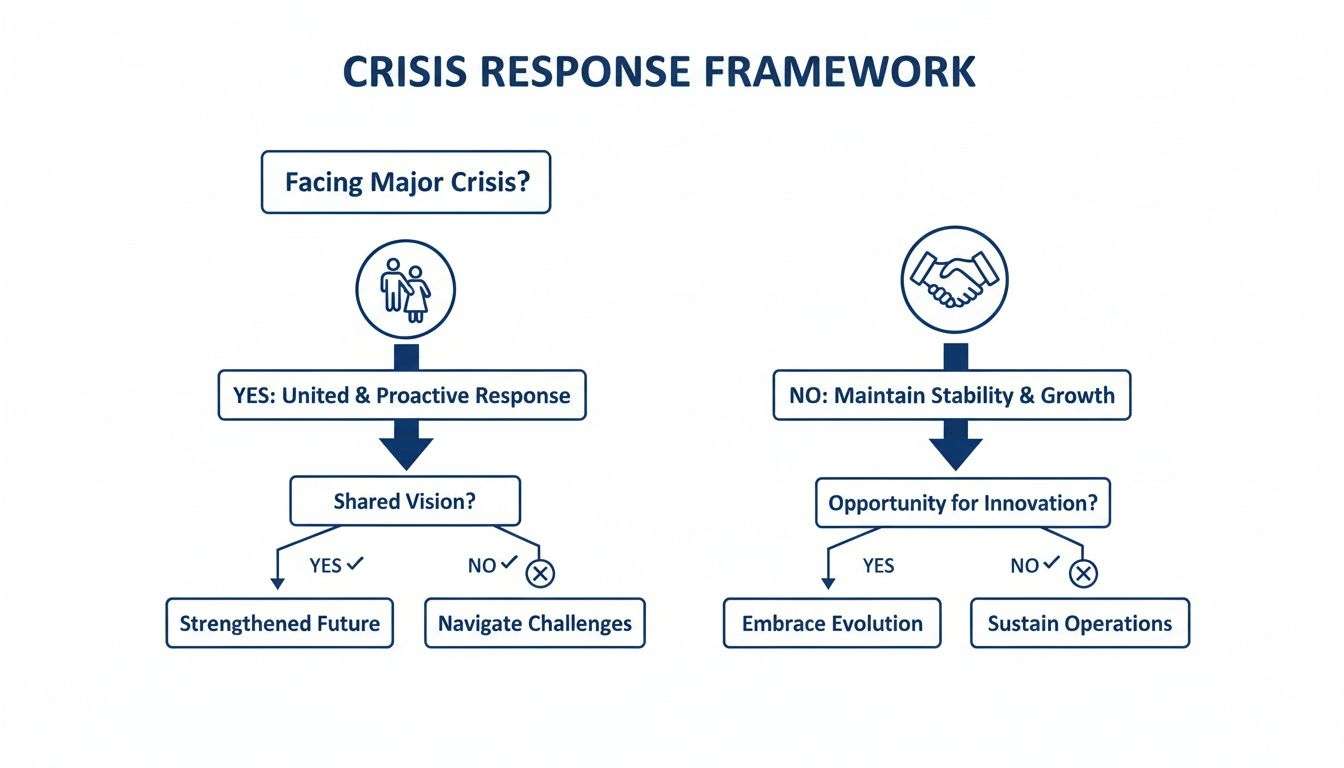
As you can see, professional guidance is just as valuable for persistent, ongoing issues as it is for a major crisis. You can explore the specific benefits of marriage counselling in our detailed guide to learn more.
Frequently Asked Questions About Saving a Marriage
When you're trying to figure out how to save your marriage, your mind is likely filled with questions. It's a place of doubt, hope, and uncertainty. Here are compassionate answers to some of the most common concerns we hear.
Can a marriage really be saved after trust is broken?
Yes, it is possible, but it requires a deep commitment from both partners. The person who broke the trust must take on the work of being transparent, accountable, and consistent over the long term. For the partner who was hurt, the journey involves processing that pain and, eventually, finding a willingness to be open to forgiveness. It’s a challenging process that is often more manageable with professional guidance.
What if I’m the only one who wants to save the marriage?
This is an incredibly difficult and painful position to be in. Ultimately, a marriage is a partnership, and you cannot force someone to participate. However, one person's genuine effort can sometimes be a catalyst for change. When you focus on what you can control—how you communicate, how you show up in the relationship, and your own personal growth—it can shift the dynamic in a way that invites your partner to see things differently. It is also important to be realistic: you can only control your own actions, not their decision.
How long should we keep trying before giving up?
There’s no magic timeline, and focusing on the calendar is often counterproductive. A more helpful measure is the direction your relationship is moving. Are you starting to have more productive, albeit difficult, conversations? Are you noticing small moments of connection or kindness returning? Is there a shared effort to use new skills you're learning? The key indicator isn't perfection; it's progress.
Is it possible to fall back in love?
Many couples discover that the love they build on the other side of a crisis is different—and often deeper and more resilient—than what they had before. It may not have the same intensity as the initial "falling in love" stage. Instead, it’s a love built on a solid foundation of choosing each other again, day after day, and creating new shared meaning. It becomes less about waiting for a spark and more about intentionally tending to the fire together.
The path to saving a marriage is a courageous one. It is filled with difficult conversations and moments of uncertainty, but it also holds incredible opportunities for growth, both as individuals and as a couple. No matter where you are in this process, remember that asking for help is a sign of strength.
If you feel you could benefit from a safe space and expert guidance to navigate these challenges, we are here to support you. Learn more about our approach to couples counselling and see how we can help you find a path forward, together.