
TL;DR: For more information, see our couples counselling.
- Setting boundaries with in-laws before marriage reduces long-term relationship strain and improves marital satisfaction.
- Proactive, clear communication of expectations helps prevent resentment and family tension.
- Working with a therapist can strengthen boundary-setting skills and address family-of-origin patterns early.
Most couples spend months planning their wedding and almost no time planning their in-law relationships. It feels like something that will sort itself out once you’re officially family. But strained mother-in-law relationships negatively correlate with women’s marital satisfaction and psychological well-being, which means the cost of waiting is real. This article walks you through why boundaries matter before the wedding, what challenges to expect, and exactly how to set agreements that protect your marriage and your family relationships at the same time.
Table of Contents
- Why setting in-law boundaries matters before marriage
- Common in-law boundary challenges couples face
- How to approach conversations about boundaries with your partner
- Strategies for setting and maintaining boundaries with in-laws
- A fresh perspective: What most couples get wrong about in-law boundaries
- Build stronger relationships with professional support
- Frequently asked questions
Key Takeaways
| Point | Details |
|---|---|
| Start boundary talks early | Proactive conversations with your partner before marriage prevent future conflict with in-laws. |
| Identify and address patterns | Recognising family dynamics now makes setting clear expectations easier and reduces stress. |
| Use expert guidance | Therapeutic support offers tools for role-playing, communication, and maintaining healthy boundaries. |
| Consistency is key | Sticking to your boundaries with in-laws builds respect and supports lasting marital satisfaction. |
Why setting in-law boundaries matters before marriage
There’s a comforting story many couples tell themselves: once we’re married, everyone will respect us as a unit. Families will naturally fall into line. Things will settle. It’s a hopeful story, but it rarely holds up. The truth is that patterns established early in a relationship tend to stick. If your in-laws learn they can drop by unannounced, offer unsolicited parenting advice, or override your decisions as a couple, those patterns become the norm. Changing them later is significantly harder than setting expectations from the start.
Research backs this up. Negative in-law relations impact marital satisfaction more for women, and proactive boundaries mitigate long-term harm. This isn’t about blame; it’s about understanding that relationship strain has measurable consequences, and that you have the power to reduce that strain before it takes root.
Ignored boundaries can affect a couple in several compounding ways:
- Chronic stress from repeated intrusions or unwanted advice
- Reduced marital satisfaction when one partner feels unsupported or caught in the middle
- Family tension that spreads to children, siblings, and extended relatives
- Resentment that builds quietly over years before it surfaces
- Loss of couple identity, where the partnership feels secondary to family-of-origin loyalties
Women tend to feel these effects more acutely, partly because cultural expectations often place them closer to the emotional labour of managing family relationships. That’s not fair, but it is real. Understanding this helps both partners take the issue seriously, rather than dismissing it as one person being oversensitive.
“Addressing family-of-origin dynamics before marriage, rather than after conflict arises, is one of the most protective things a couple can do for their long-term wellbeing.” This is exactly what the marriage counselling benefits literature consistently supports.
The window before your wedding is genuinely precious. You have time to reflect, discuss, and plan without the pressure of an immediate conflict. Use it.
Common in-law boundary challenges couples face
Now that we see why proactive boundaries are essential, let’s get specific about the challenges couples often encounter. Negative in-law dynamics are a leading source of marital dissatisfaction, and they tend to cluster around predictable themes.
| Boundary area | Common challenge | Why it creates friction |
|---|---|---|
| Visits and drop-ins | Unannounced arrivals or extended stays | Erodes couple privacy and autonomy |
| Advice-giving | Unsolicited opinions on finances, parenting, or lifestyle | Feels like criticism or lack of trust |
| Cultural expectations | Differing norms around family obligation | Creates loyalty conflicts for partners |
| Gift expectations | Gifts with strings attached or used as leverage | Introduces power imbalances |
| Parenting styles | In-laws undermining agreed-upon rules | Confuses children and disrespects the couple |
Boundary breakdowns rarely happen all at once. They follow a pattern:
- A small line is crossed. An in-law makes a comment about your home décor or shows up during a private dinner.
- You let it go. It feels too minor to address, or you don’t want to cause conflict early on.
- It happens again. The behaviour repeats because there was no signal that it was unwelcome.
- Resentment builds. One or both partners starts to feel frustrated, but the issue still feels too small to name.
- A larger conflict erupts. Eventually, the accumulated tension surfaces in a disproportionate argument, often about something unrelated.
Recognising this progression is powerful. It shows you that setting healthy boundaries early isn’t about being rigid or unfriendly. It’s about preventing a much harder conversation later. As saying no clearly demonstrates, limits actually improve mental health and relationship quality for everyone involved.
The effects on family dynamics extend beyond the couple, too. Children, when they arrive, are especially sensitive to tension between parents and grandparents. Protecting the couple’s alliance now is also protecting your future family.
Pro Tip: Start with the smallest, most manageable agreements first. Decide together how much notice you’d like before a visit, or how you’ll respond to unsolicited advice. Small wins build confidence for bigger conversations.
How to approach conversations about boundaries with your partner
With a clear sense of what could go wrong, you and your partner can get on the same page. This is the most important step: aligning with each other before you speak to anyone else. Your partnership is the foundation. Everything else is built on top of it.

Begin by creating a low-pressure space for the conversation. Not during a stressful week, not right after a difficult family event. Choose a calm moment, and frame it as a planning conversation rather than a complaint session. You’re building something together, not assigning blame.
Key topics to cover include:
- Holiday plans: Which holidays will you spend with which family, and how will you handle competing expectations?
- Frequency of contact: How often do you both feel comfortable seeing each set of in-laws?
- Privacy: What information stays between the two of you and doesn’t get shared with parents?
- Financial decisions: Are major purchases or financial choices shared with family, or kept private?
- Parenting (future): What role will grandparents play, and who has final say on parenting decisions?
- Conflict protocol: If an in-law crosses a line, who speaks to them, and how?
As you talk, pay attention to each other’s comfort zones and family-of-origin patterns. Someone who grew up in a very enmeshed family may not realise how frequently they share personal information with their parents. Someone from a more distant family may feel overwhelmed by close contact. Neither pattern is wrong; they just need to be understood and negotiated.
Communication in marriage research consistently shows that couples who discuss expectations explicitly before conflict arises report higher satisfaction. The goal isn’t to predict every scenario. It’s to build a shared language and a habit of talking openly.
Pro Tip: Premarital counselling is especially effective for role-playing boundary conversations and addressing family-of-origin dynamics. A therapist can help you rehearse difficult exchanges in a safe setting, so the real conversation feels less daunting.
Strategies for setting and maintaining boundaries with in-laws
Once your partnership is solid, you’re ready to set and maintain boundaries with your in-laws directly. The key word here is together. Boundaries are far more effective when both partners present them as a shared decision, not one person’s preference.
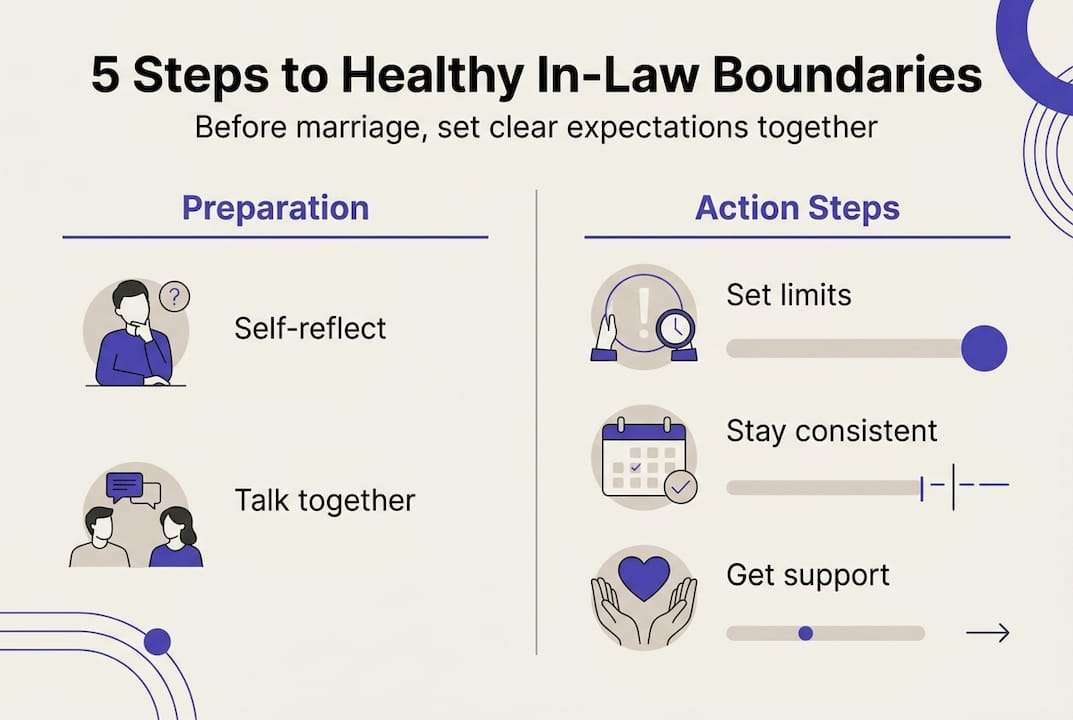
Here are practical scripts and responses for common situations:
| Boundary | Example script | If the boundary is crossed |
|---|---|---|
| Scheduled visits only | “We’d love to see you. Can we plan visits a few days ahead?” | Calmly restate: “We do need advance notice. Let’s find a time that works.” |
| Privacy about finances | “We’re keeping our financial plans between us for now.” | Redirect: “That’s something we’re handling privately as a couple.” |
| Parenting decisions | “We’ll let you know if we need input on parenting choices.” | Reaffirm: “We appreciate the thought, but we’ve made our decision.” |
| Holiday scheduling | “We’re alternating holidays this year. We’ll confirm dates soon.” | Hold firm: “We’ve already committed to this plan. Let’s look at the next holiday.” |
Signs your boundaries may need reinforcing:
- You feel dread before family visits
- You find yourself venting about the same situations repeatedly
- One partner consistently feels unsupported after family interactions
- You avoid telling your in-laws about major life decisions
Proactive boundaries mitigate long-term harm from difficult in-law relationships, but only when they’re maintained consistently. Setting a boundary once and then letting it slide sends a confusing message.
Consistency is what transforms a boundary from a one-time request into a clear expectation. It protects the relationship with your in-laws as much as it protects your marriage.
For deeper guidance on family relationship strategies, it helps to remember that boundaries are not walls. They’re agreements that allow everyone to feel safe and respected. And when children enter the picture, maintaining your couple connection depends on having these structures already in place.
A fresh perspective: What most couples get wrong about in-law boundaries
Here’s the uncomfortable truth: most couples don’t avoid boundary conversations because they’re lazy. They avoid them because they’re afraid. Afraid of seeming ungrateful, afraid of damaging a relationship that’s just beginning, afraid of conflict before the wedding even happens.
So they wait. And what goes unspoken becomes a quiet assumption on both sides, an assumption that often turns out to be wrong.
The couples who navigate in-law relationships well aren’t the ones with the easiest families. They’re the ones who talked early, talked honestly, and kept talking. They treated healthy boundary setting as an act of care, not confrontation. They understood that naming a family pattern before it causes damage is far kinder than addressing it after years of resentment have accumulated.
Therapeutic support is especially valuable here because it reveals blind spots. You may not even realise which of your own family patterns you’re carrying into the marriage. A counsellor helps you see them clearly and choose intentionally, rather than repeating by default.
Pro Tip: Name one family-of-origin pattern each of you wants to change before marriage. That single conversation can prevent years of unspoken tension.
Build stronger relationships with professional support
Setting in-law boundaries is one of the most loving things you can do for your future marriage. And you don’t have to figure it out alone. At Interactive Counselling, our licensed therapists offer a compassionate, non-judgmental space where couples can explore expectations, practise difficult conversations, and build the communication skills that last a lifetime.
Our family counselling services are designed to support couples and families through exactly these kinds of transitions. Whether you’re navigating cultural differences, managing competing family expectations, or simply wanting to start your marriage on solid ground, we’re here to help. Explore our types of counselling services to find the right fit, available in person across British Columbia and Alberta, and online nationwide.
Frequently asked questions
When should we start discussing in-law boundaries?
Start talking about in-law boundaries early in your engagement, ideally well before the wedding, so you can address proactive boundary-setting before patterns become entrenched and harder to shift.
What if my partner disagrees with my boundary concerns?
Approach it as a shared planning conversation rather than a disagreement, and consider working with a therapist since premarital therapy is particularly effective at helping couples align on family-of-origin dynamics and differing expectations.
How do we enforce boundaries if in-laws push back?
Stay calm and consistent, restate your boundary using the same clear language each time, because proactive consistency is what signals that the boundary is a genuine expectation rather than a temporary request.
Is it okay to limit contact with in-laws before marriage?
Yes, it’s entirely valid to set contact limits that protect your well-being and your relationship, as long as both partners agree, since setting boundaries with in-laws supports both marital satisfaction and mental health.
Recommended
- Navigating religious differences in marriage: harmony tips
- Recognise signs your marriage is over and decide next steps
- When to separate vs when to work on it: a guide for couples
- 6 Practical Ways to Improve Communication in Marriage
If in-law tension is already straining things, our couples counselling in Kelowna can help you set those boundaries as a team.