
Struggling with anxiety or depression can leave you feeling like your daily life is out of sync. For many Canadian adults, the challenge is not just finding the right coping strategies, but staying aligned with them over time. Mental consistency is the key concept that connects your beliefs, actions, and recovery practices, helping you build a stable foundation for healing. Discover how learning to align your thoughts and routines can transform your therapeutic experience and support lasting progress.
Table of Contents
- Defining Consistency As A Mental Skill
- Cognitive Consistency Versus Physical Habit
- The Role Of Consistency In Emotional Health
- Building Mental Consistency In Therapy
- Common Pitfalls And How To Avoid Them
Key Takeaways
| Point | Details |
|---|---|
| Cognitive Consistency is Essential | Aligning beliefs and behaviours enhances decision-making and emotional health, fostering a reliable self-image. |
| Commitment Supports Change | Making specific commitments increases follow-through, facilitating progress in therapy and personal growth. |
| Consistency in Routine Matters | Stable daily patterns contribute to emotional safety, reducing symptoms of anxiety and depression. |
| Avoid Common Pitfalls | Recognise that all-or-nothing thinking, rigid routines, lack of accountability, and poor environment design can hinder consistency; adapt strategies accordingly. |
Defining Consistency as a Mental Skill
Consistency as a mental skill is fundamentally about alignment. It’s your ability to keep your beliefs, actions, and statements working together in a coherent way. When you say you value health but skip workouts, or claim you prioritize relationships yet ignore your partner’s calls, that misalignment creates internal friction. This mental skill refers to the ability to maintain alignment between what you believe, what you do, and how you present yourself to the world. It’s not about being rigid or never changing your mind. Rather, it’s about creating a stable sense of self that others can rely on and that you can trust within yourself.
Your drive for consistency runs deeper than just wanting to look good. Psychologically, you maintain consistency because you need a stable self-image to navigate the world effectively. When your actions contradict your stated values, something in your brain registers the mismatch. That uncomfortable feeling? That’s cognitive dissonance at work. Your mind works constantly to resolve that tension by either changing your behaviour to match your beliefs or rationalising why the contradiction actually makes sense. This internal need for stability affects how you make decisions, how you show up in relationships, and ultimately, how you progress through therapy or personal development work.
Commitment acts as the glue that strengthens consistency. When you commit to something, you’re essentially creating a binding agreement with yourself. That commitment increases the likelihood you’ll follow through, even when motivation wanes or obstacles appear. In therapeutic settings, this is why therapists often ask you to make specific commitments about your recovery goals. When you commit to attending sessions consistently, to practising coping strategies at home, or to challenging unhelpful thought patterns, you’re leveraging this mental skill to support your own healing. This isn’t manipulation. It’s working with how your mind naturally operates to build momentum toward genuine change.
Understanding consistency as a mental skill matters for recovery because it reveals something crucial: your brain wants to maintain harmony between what you believe, what you do, and who you are. This is the foundation for sustainable progress in mental health work. Rather than relying on willpower alone, which depletes over time, you can harness your natural drive for consistency by making small, deliberate commitments and building aligned behaviours that reinforce your recovery goals. When you understand this mechanism, you stop fighting your own psychology and start working with it.
Pro tip: Start identifying one area where your actions misalign with your values, then make a specific commitment to close that gap this week, allowing your natural drive for consistency to help carry you forward.
Cognitive Consistency versus Physical Habit
You experience these two forces constantly, and they don’t always work in the same direction. Cognitive consistency is the active mental process where you align your beliefs and values with your behaviour. It requires conscious effort and creates that drive we discussed earlier. Physical habit, by contrast, is something your brain automates. When you brush your teeth without thinking about it, or reach for your phone the moment you feel anxious, that’s habit operating on autopilot. The key difference is this: cognitive consistency demands awareness, while physical habit thrives on the absence of it.
Automatic behaviours develop through neural pathways built by repetition and environmental cues. Your brain essentially learns “when X happens, do Y” without requiring your conscious approval each time. This is efficient. It frees up mental energy for other tasks. But here’s where it gets complicated in recovery work: physical habits can contradict your cognitive consistency. You might deeply believe you’re ready to manage your anxiety (cognitive consistency), but when stress hits, your habit loop kicks in and you reach for avoidance behaviours before your conscious mind even registers what’s happening. These two systems are operating independently.
When you’re working through anxiety or depression with a therapist at Interactive Counselling, understanding this distinction becomes crucial. Your therapist isn’t just trying to change what you believe. They’re also working with you to build new habits that support those beliefs. You might spend a session gaining insight into why you avoid difficult conversations (cognitive work), but unless you practice having those conversations repeatedly, your nervous system won’t update its automatic response patterns (habit work). Both need attention. Cognitive consistency creates the motivation and the “why” behind change. Physical habit makes that change stick through repetition and environmental design. Cognitive consistency involves managing conflicting beliefs actively, whereas habits are cue-driven and operate more automatically, which means recovery requires you to work with both systems intentionally.
The most effective recovery path leverages both. You build cognitive consistency by understanding your values and committing to aligned behaviours. You build new physical habits by creating environments and routines that support those commitments. Someone managing depression might intellectually understand that movement helps their mood (cognitive consistency), but they’ll only change their behaviour sustainably if they restructure their morning routine so exercise happens automatically before resistance kicks in (physical habit). Interactive Counselling therapists help you identify both the mental alignment you need and the behavioural patterns worth installing. That dual approach is what transforms temporary motivation into lasting change.
Here’s how cognitive consistency and physical habit differ in mental health work:
| Aspect | Cognitive Consistency | Physical Habit |
|---|---|---|
| Awareness Required | High—needs conscious effort | Low—runs on autopilot |
| Driven By | Beliefs and values | Repeated behaviours and cues |
| Role in Recovery | Motivates change | Makes change sustainable |
| Main Challenge | Managing internal conflicts | Breaking automatic unhelpful loops |
| Therapist’s Approach | Cultivate insight and motivation | Reinforce new routines and patterns |
Pro tip: Design your environment to support the habits you want by removing friction from helpful behaviours and adding friction to unhelpful ones, then let your automatic responses do the heavy lifting while your cognitive consistency handles the deeper “why” behind your goals.
The Role of Consistency in Emotional Health
Your emotional health isn’t a fixed state. It’s something you actively influence through the patterns you establish. When you maintain consistency in your daily routines, your nervous system gets the message that the world is predictable and safe. That sense of safety matters more than you might realize. Your brain evolved to detect threats, and inconsistency feels like one. Irregular sleep schedules, sporadic exercise, unpredictable meal times, and chaotic daily patterns all signal to your nervous system that something is unstable. This activates your threat-detection system, which keeps you in a low-grade state of alertness. Over time, this exhausts your emotional reserves and makes anxiety and depression more likely. By contrast, maintaining consistency in daily routines like sleep and exercise contributes measurably to better mental health outcomes and reduces symptoms of both anxiety and depression. When your routines are predictable, your nervous system can relax.

There’s another layer to this that directly connects to recovery work. Emotional consistency means you develop a reliable relationship with your own feelings. Instead of being tossed around by emotional waves, you begin to recognise patterns in how you feel and respond. Someone managing depression might notice that their mood dips consistently on Monday mornings or after social withdrawal. That recognition is the beginning of real change. You start to anticipate your emotional patterns rather than being blindsided by them. Emotional awareness and regulation are enhanced through consistency in how you perceive and respond to your feelings, and individuals who develop this consistency experience fewer depressive and anxiety symptoms. This isn’t luck. It’s the result of building predictable patterns in how you notice and respond to your internal experience.
When you work with a therapist at Interactive Counselling on managing anxiety or depression, part of what makes therapy effective is the consistency you bring to your practice. You show up for sessions at the same time, you practice coping strategies between appointments, you apply insights repeatedly rather than haphazardly. That consistency between sessions is where real transformation happens. Your therapist might introduce you to a grounding technique in session, but if you use it inconsistently, your brain never fully internalises it as a reliable tool. Consistency converts insights into skills. It converts skills into automatic responses. When you’re struggling emotionally, that automation becomes your lifeline.
Consistency also builds trust in yourself. When you say you’re going to do something and you follow through, even small things like taking a 20-minute walk every morning or writing three things you’re grateful for before bed, you send a message to your nervous system that you can be relied upon. You become your own ally rather than your own adversary. Many people dealing with anxiety or depression have damaged that self-trust through broken promises, avoidance, or shame cycles. Rebuilding consistency is how you repair it. Start small. Choose one routine that aligns with your recovery goals and commit to it for at least two weeks. Let your nervous system experience the safety of predictability. From there, other changes become possible.
Pro tip: Anchor one new consistent behaviour to an existing daily habit you already perform automatically, like having your coping strategy ready during your morning coffee or practising emotional check-ins right after lunch, so consistency requires minimal willpower.
Building Mental Consistency in Therapy
Therapy isn’t something that happens only in the session. It’s something you build through consistent practice between appointments. When you’re working with a therapist at Interactive Counselling to manage anxiety or depression, the real transformation comes from what you do in the days and weeks between sessions. Your therapist introduces concepts, teaches skills, and helps you gain insights. But unless you apply those concepts repeatedly, practise those skills in real situations, and return to those insights when challenged, they remain intellectual knowledge rather than lived experience. Building mental consistency in therapy means committing to this practice. It means showing up for your own recovery the same way you show up for your sessions. That consistency is what converts a good therapy experience into genuine, lasting change.
One evidence-based approach that emphasises consistency is acceptance and commitment therapy, which builds mental consistency through acceptance and committed actions aligned with your values. Rather than trying to eliminate all anxious thoughts or depressive feelings, ACT teaches you to accept them while taking consistent action toward what matters to you. Someone struggling with social anxiety might practise acceptance of nervous feelings while consistently showing up to social situations anyway. Another person managing depression might accept their low mood while consistently moving their body or connecting with others. That’s mental consistency in action. It’s not about feeling better first and then acting. It’s about acting consistently aligned with your values, and letting behaviour gradually shift your internal experience. Your therapist helps you identify what those values are, then you practise aligning your actions with them repeatedly.
Another powerful framework involves mindfulness-based cognitive therapies that build consistency by integrating acceptance, behavioural change, and mindfulness skills. These approaches teach you to observe your thoughts and emotions without automatically reacting to them. Instead of your anxiety dictating your behaviour, you notice the anxiety, breathe through it, and choose your next action deliberately. That chosen action becomes consistent practice. Maybe you’re noticing catastrophic thoughts, recognising them as thoughts rather than facts, then taking a grounding action anyway. You do this repeatedly until your brain develops a new pattern. Consistency here means practising the same response to similar triggers until it becomes automatic. Your therapist guides you through this process, but your responsibility is the repetition between sessions.
The beauty of building mental consistency in therapy is that it’s completely within your control. Your therapist cannot heal you through sessions alone. They can guide you, teach you tools, and help you understand yourself better. But you heal through consistent application of what you learn. Start small. If your therapist suggests a daily grounding practice, do it daily, not randomly. If they recommend practising a particular conversation skill before your next session, do it. If they ask you to journal about your triggers, actually journal. These aren’t assignments meant to keep you busy. They’re the mechanism through which therapy works. Mental consistency is the bridge between insight and change. Every time you practise a skill, you’re rewiring your nervous system slightly. Every time you show up for yourself, you’re rebuilding self-trust. Over weeks and months, these small consistencies compound into genuine transformation. That’s not an exaggeration. That’s how the brain actually works.
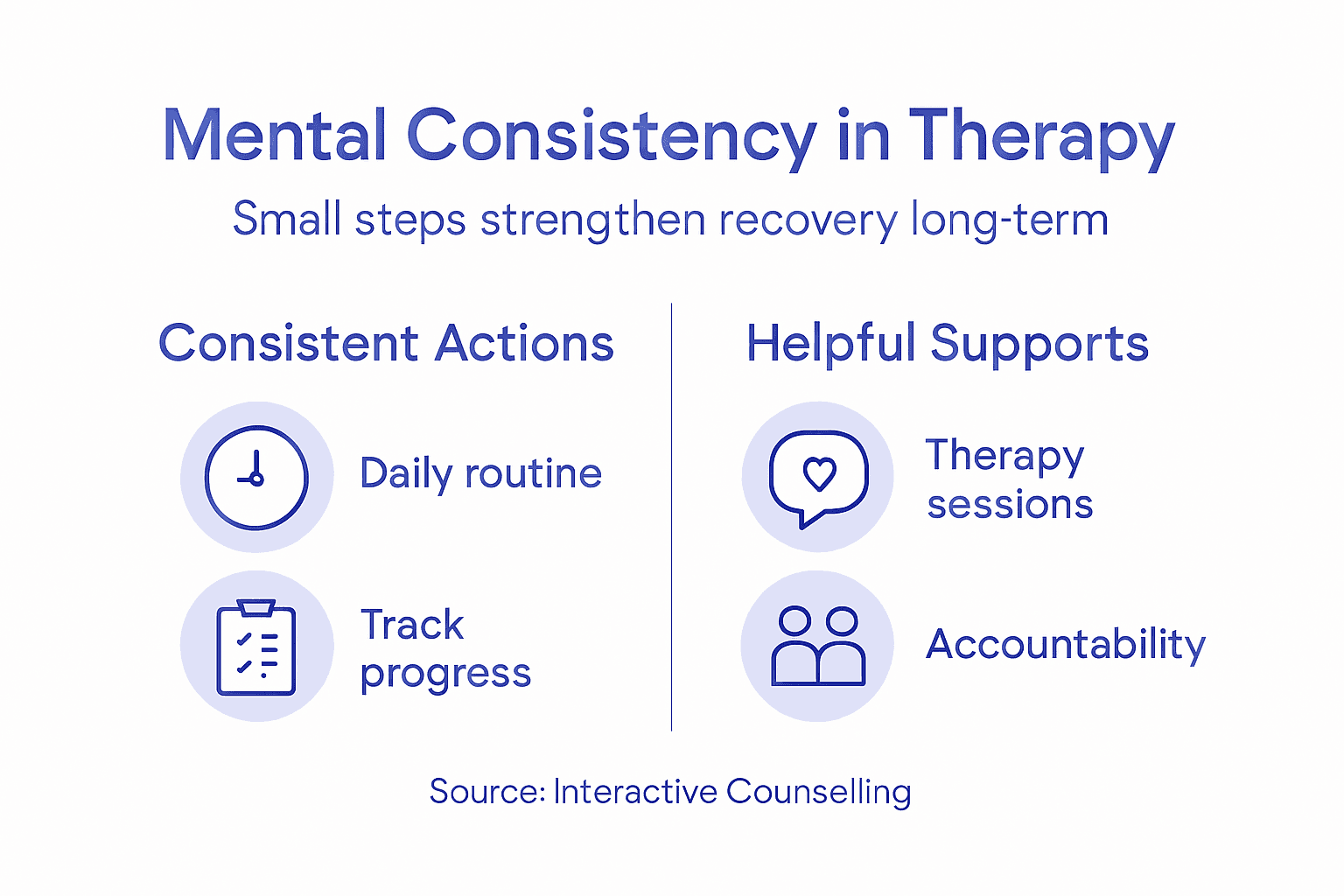
Pro tip: Create a simple weekly tracker listing one to three therapy practices you’re committing to that week, then check them off daily; this visible accountability makes consistency tangible and helps your brain recognise that you’re following through on your own recovery.
Common Pitfalls and How to Avoid Them
Building mental consistency sounds straightforward in theory, but in practice, people stumble over predictable obstacles. The first major pitfall is treating consistency as perfection. You miss one day of your grounding practice and suddenly you feel like you’ve failed completely, so you abandon it entirely. That all-or-nothing thinking sabotages recovery. Consistency doesn’t mean never missing a day. It means returning to your practice the next day regardless. Someone managing anxiety might practise a coping skill four days out of seven and still build momentum. The person who does it perfectly for two weeks then quits has made less progress. Your therapist at Interactive Counselling understands this, which is why they rarely expect flawlessness. They expect you to keep showing up. That’s the only consistency that matters.
Another common pitfall is failing to adapt your approach when circumstances change. You establish a morning routine that includes 20 minutes of exercise, but then work changes and your mornings become chaotic. Instead of adjusting your routine to fit the new reality, you abandon it entirely because it no longer fits the old plan. This is where mental set causes you to persist with ineffective solutions even when circumstances shift/09%3A_Thinking_and_Intelligence/9.05%3A_Pitfalls_to_Problem_Solving). The remedy is cognitive flexibility. Build consistency around the principle, not the specific implementation. Your principle might be “I move my body daily to support my mental health.” That could mean morning exercise when life allows, an evening walk when it doesn’t, or a 10-minute stretch routine when you’re pressed. The consistency lies in the commitment to movement, not in the exact activity. Your therapist can help you identify these flexible principles and create multiple pathways to fulfil them.
A third pitfall is ignoring the role of accountability. You promise yourself you’ll practise your coping strategies, but without anyone knowing about it, the commitment feels abstract. Your brain doesn’t register it as binding. This is why therapy sessions work. You tell your therapist what you’ll practise, then you report back. That external accountability strengthens the commitment. If you’re working alone, create your own accountability system. Text a trusted friend your goal, post it somewhere visible, or use a tracking app. Knowing someone else knows about your commitment increases follow-through significantly. Many people find that simply writing their goals down makes them more real. The act of putting words on paper signals your nervous system that this matters.
People also underestimate how much their environment shapes consistency. You decide to stop reaching for unhelpful coping behaviours, but your phone sits on your nightstand, your comfort food is stocked in your kitchen, and nothing in your physical space supports your new direction. Avoiding these obstacles requires attention to detail and understanding how environmental factors influence your consistent choices. The solution isn’t willpower. It’s design. Move your phone to another room. Stock your kitchen with foods that support your goals. Create a dedicated space for your grounding practice. Place your journal where you’ll see it. Design your environment to make the consistent choice the easy choice. Your therapist can help you identify which environmental changes would have the biggest impact on your specific goals. Small design changes often produce bigger results than increased willpower.
The following table outlines common pitfalls in building consistency and recommended strategies to overcome them:
| Pitfall | Why It Happens | How to Overcome |
|---|---|---|
| All-or-nothing thinking | Equating consistency with perfection | Treat missed days as neutral resets |
| Failure to adapt | Rigid routines despite life changes | Focus on flexible underlying principles |
| Lack of accountability | No external or visible commitment | Share goals or use tracking tools |
| Poor environment design | Environment supports old behaviours | Adjust surroundings for new habits |
Pro tip: When you miss a day of your practice, don’t try to double up the next day or judge yourself harshly; instead, simply return to your usual routine the following day, treating the missed day as neutral rather than as failure that requires compensation.
Harness Consistency to Strengthen Your Recovery Journey
The challenge of maintaining consistency in mental health recovery is one many face. When your actions feel out of sync with your values or you struggle to build lasting habits, the path to healing can seem overwhelming. This article highlights how consistency as a mental skill, cognitive alignment, and building predictable emotional routines are essential for meaningful progress. At Interactive Counselling, we know these struggles well and offer personalized support that respects your unique experience while helping you build flexible yet dependable routines that align with your values.
Take control of your recovery now by connecting with skilled therapists who focus on integrating mental consistency and habit formation across anxiety, depression, and more. Whether through in-person sessions in Kelowna, Vernon, Grande Prairie, Penticton or convenient online therapy, you can build momentum by practising new coping strategies with professional guidance. Begin your journey of transformation by visiting Interactive Counselling where compassionate, accessible mental health care awaits. Your consistency grows stronger with action—start today by booking a session that fits your lifestyle and goals.
Frequently Asked Questions
What is consistency as a mental skill?
Consistency as a mental skill refers to the ability to align your beliefs, actions, and statements coherently. It involves maintaining a stable self-image and making commitments that support your values and goals.
How can I improve my consistency in mental health practices?
To improve consistency, start by making small, specific commitments aligned with your values. Identify areas where your actions misalign with your beliefs, and practice the new behaviour consistently over time to build momentum.
What is the difference between cognitive consistency and physical habits?
Cognitive consistency involves the active mental alignment of beliefs and values with behaviours and requires conscious effort. Physical habits, on the other hand, are automatic behaviours established through repetition and don’t typically require conscious thought.
Why is consistency important for emotional health?
Maintaining consistency in daily routines helps communicate to your nervous system that the world is predictable and safe, which can reduce anxiety and improve emotional resilience. Predictable patterns in behaviour lead to better emotional awareness and regulation.
Recommended
- Mental Recovery for Athletes After Setbacks
- Returning to Sport After Injury: A Guide to Your Mental Comeback
- Why Confidence Fluctuates in Sports Performance
- Mental Skills Training: Boosting Athletic Confidence