You've been dependable at work, yet bills still go unpaid, appointments slip through the calendar, and unfinished projects seem to multiply at home. You may have spent years calling yourself disorganised, careless, or lazy, only to wonder whether adult ADHD could explain the pattern. In Grande Prairie, counselling can offer practical support while you explore assessment, manage anxiety or low mood, and build systems that make everyday responsibilities more manageable. For more information, see our Grande Prairie counselling.
Adult ADHD counselling in Grande Prairie can support both sides of the process. It can help you understand what's happening, prepare for a careful assessment, and practise executive-function strategies before a formal diagnosis is confirmed. It can also fit alongside family-doctor, psychiatry, or Alberta Health Services pathways when medication or diagnostic clarification becomes part of your care.
When Adult ADHD Starts Making Sense
A working parent in Grande Prairie might spend a decade apologising for late arrivals, forgotten bills, unfinished home repairs, and school forms completed at the last minute. They may perform well during a crisis, then struggle with routine tasks that seem simple to everyone else. The difficult part isn't only the missed deadline. It's the shame that builds around it.
Then something clicks. They learn that ADHD doesn't necessarily disappear at eighteen, and that adult symptoms can look less like visible hyperactivity and more like inconsistent attention, time-management problems, impulsive decisions, or difficulty starting ordinary tasks. The recognition can feel relieving, although it can also bring grief for the years spent blaming themselves.
ADHD is a neurologically based neurodevelopmental difference, not a character flaw. It can affect attention regulation, impulse control, working memory, motivation, and executive function. Executive function includes the mental processes used to begin, organise, sequence, monitor, and complete tasks.
A useful starting point: difficulty doing something consistently doesn't mean you don't care about it.
Counselling won't replace a diagnostic assessment, and a counsellor doesn't prescribe medication. It can, however, help you identify the situations where functioning breaks down and develop supports that match your actual life. A clinician might help you prepare questions for a physician, map work and relationship impairment, address anxiety or burnout, and practise routines that reduce daily friction.
This is especially important because adult ADHD support often begins through broader mental-health pathways rather than a single-condition clinic. Grande Prairie has a clearly defined local access point at the Aberdeen Centre, where Alberta Health Services lists Adult Addiction and Mental Health walk-in counselling Monday to Friday from 9:00 AM to 4:00 PM, with ICAT intake available on weekdays at the same location. Alberta Health Services lists the Aberdeen Centre's adult services and North Zone connections, including outpatient psychiatry and walk-in counselling.
You don't need to solve the whole question at once. You can begin by noticing patterns, seeking support, learning what a thorough assessment includes, and choosing strategies that help now.
What Adult ADHD Actually Looks Like Day to Day
Adult ADHD affects the regulation of attention rather than creating a shortage of attention. Someone may focus intensely on an interesting project while being unable to start a routine form. They may hear every word in a conversation but lose the thread when their working memory becomes overloaded.
The popular image of a constantly hyperactive child misses many adult experiences. Adults may have predominantly inattentive or combined patterns, and some learn to hide restlessness by over-preparing, working late, or avoiding situations where their difficulty will be noticed. After high school, reduced external structure can expose problems that were previously managed by parents, teachers, bells, and fixed routines.
Common patterns in adult life
You might notice:
- Time blindness: An appointment at three o'clock feels distant until it suddenly becomes urgent.
- Task initiation difficulty: You understand exactly what needs to happen, but can't make yourself begin.
- Working-memory slips: You walk into a room, forget why, or lose track of a conversation while forming a response.
- Object and document loss: Keys, receipts, tools, chargers, and paperwork repeatedly disappear.
- Uneven performance: You can complete demanding work under pressure but struggle with ordinary follow-through.
- Impulsive responses: You interrupt, make a quick purchase, send a reactive message, or agree before considering the consequences.
- Emotional intensity: Frustration rises quickly, criticism feels unusually painful, and conflict may take a long time to settle.
- Restless undercurrent: Even while sitting still, your mind may feel driven, crowded, or unable to slow down.
These patterns can appear at work, at home, and in relationships. A supervisor may see missed details rather than the hours spent trying to catch up. A partner may experience repeated arguments about chores, not because either person wants conflict, but because invisible planning and follow-through have become a source of resentment. Financial chaos can develop when bills, subscriptions, receipts, and spending decisions aren't held in one reliable system.
Anxiety, depression, trauma, sleep problems, burnout, substance use, and learning difficulties can overlap with ADHD or make concentration worse. Canadian adult ADHD prevalence estimates vary from 2.71% to 7.33%, depending on the study and case definition, as summarised in a 2022 review of Canadian adult ADHD research. That range reinforces that adult ADHD is a common neurodevelopmental condition, while also showing why a symptom checklist alone isn't enough.
If your experience feels confusing rather than neatly labelled, that's understandable. Adults can find practical ideas for reducing overwhelm in this guide for overwhelmed executives, but personal counselling is often needed when attention problems sit alongside grief, anxiety, shame, trauma, or relationship strain.
How a Thorough Adult ADHD Assessment Works
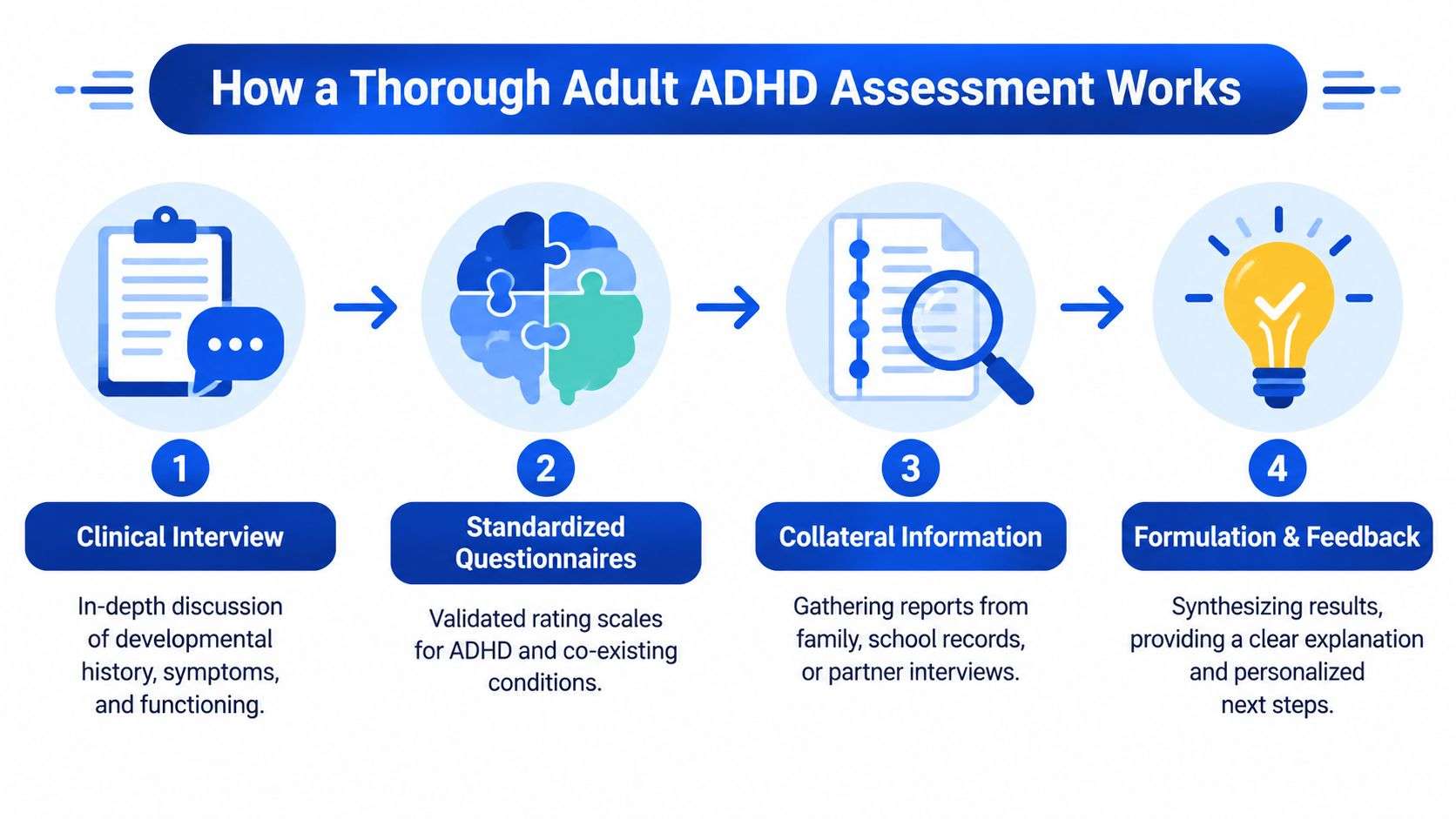
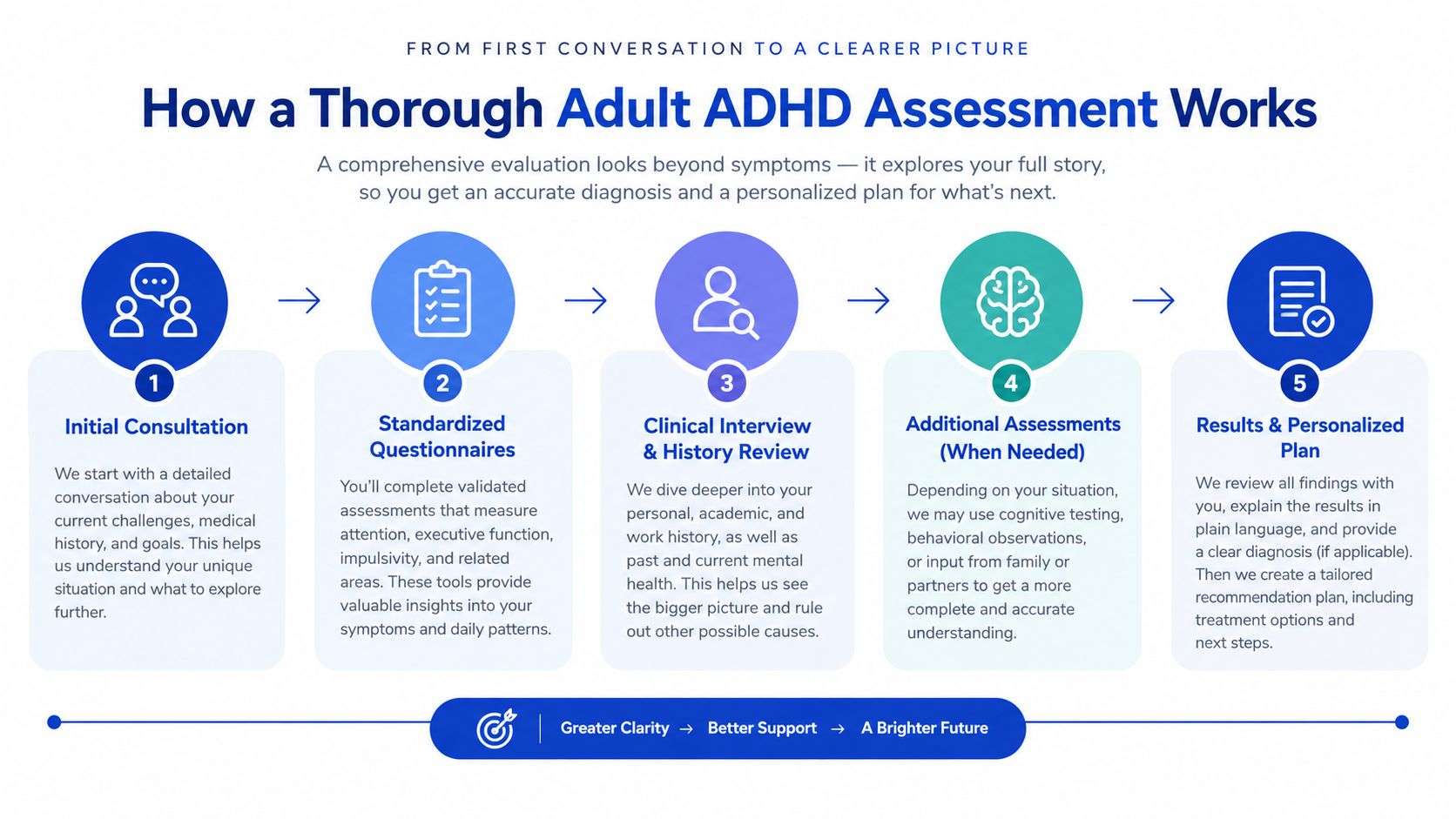
A careful adult ADHD assessment asks more than, “Do you lose things?” It examines whether symptoms developed early, continue across settings, and create meaningful impairment. Canadian guidance recommends a diagnostic interview, developmental history, screening for comorbidities and differential diagnoses, medical review, and collateral information when available. CADDRA's Canadian ADHD Practice Guidelines describe rating scales as supportive tools, not stand-alone diagnostic tests.
The main parts of the process
Clinical interview: The assessor asks about childhood behaviour, school experiences, family observations, current symptoms, work, home responsibilities, and relationships. Adults need evidence that relevant symptoms began in childhood, even if nobody used the word ADHD at the time. Old report cards, family memories, and examples of long-standing patterns can help.
Standardized questionnaires: Tools such as the Adult ADHD Self-Report Scale, WURS, Conners measures, and DIVA-based interviews can organise information and quantify symptom patterns. They can indicate areas that need closer exploration, but a high score doesn't prove ADHD.
Comorbidity screening: Anxiety, depression, trauma-related symptoms, sleep disruption, substance use, autism, mood disorders, medication effects, and learning issues can resemble or intensify ADHD. The assessor needs to understand what began first, what changes with sleep or mood, and which difficulties remain when other symptoms improve.
Collateral information: A partner, parent, sibling, school record, or former report card may provide useful evidence. Collateral information isn't a test of your credibility. It adds another view of patterns that can be difficult to remember accurately from adulthood.
Medical and functional review: A clinician may review health history, medications, sleep, and possible medical explanations. Cognitive testing may examine working memory, processing speed, and executive function when clinically appropriate, but testing alone doesn't establish the diagnosis.
Why impairment matters
Assessment should connect symptoms to real consequences. The College of Family Physicians of Canada adult ADHD presentation handout notes the importance of a thorough interview, symptoms lasting at least 6 months, evidence of childhood onset, and supportive rating scales and collateral information.
A feedback appointment should explain the formulation in plain language. It may identify ADHD, another condition, overlapping conditions, or an unresolved question that needs further assessment. The next step might involve counselling, medical care, skills training, sleep support, or a combination.
Counselling Approaches and Medication Support That Help
No single approach fits every adult. Someone whose main concern is missed deadlines may need task systems and time estimation practice, while someone experiencing panic, depression, or relationship conflict may need emotional and interpersonal support before planning tools can stick.
Adult ADHD support options at a glance
| Approach | Primary focus | Typical fit |
|---|---|---|
| Cognitive behavioural therapy for ADHD | Identifying unhelpful thoughts and practising structured behaviour changes | Adults who understand strategies but struggle to apply them consistently |
| ADHD-focused skills training | Psychoeducation, routines, task breakdown, reminders, and follow-through | Adults who want practical tools for work, home, or school |
| Executive-function coaching | Planning, prioritising, time estimation, accountability, and environmental design | Adults managing complex responsibilities or demanding work |
| Supportive counselling | Anxiety, depression, burnout, trauma responses, shame, and emotional regulation | Adults whose attention difficulties overlap with mood or stress symptoms |
| Medication liaison counselling | Shared goals, symptom tracking, functional measures, and communication with prescribers | Adults considering medication or reviewing whether treatment is helping daily life |
Counselling sessions may be weekly or biweekly at first, then less frequent as systems become more familiar. The right pace depends on safety, symptom burden, goals, and whether other concerns require attention.
Medication decisions belong to a physician or psychiatrist. CADTH's 2024 review of ADHD medications for adults identifies methylphenidate, dexamfetamine, and lisdexamfetamine as first-line options for adults, with atomoxetine or guanfacine as second-line options when stimulants are contraindicated, not tolerated, or ineffective. A counsellor doesn't adjust doses, but can help you track sleep, appetite, anxiety, focus, task completion, and relationship effects to discuss with the prescriber.
CADDRA recommends that medication sit within a treatment plan, with symptom frequency, severity, and functional impairment documented over time. In practice, counselling can translate treatment into observable goals, such as submitting reports, arriving prepared for shifts, completing household tasks, or reducing conflict during transitions.
Interactive Counselling is one local option for adults who want evidence-informed counselling focused on real-life functioning, mood, relationships, and practical coping. The important question isn't which label sounds most appealing. It's which support matches the problem you need to change.
Practical Daily Strategies You Can Start This Week
You can test useful supports before formal diagnosis. Treat them as experiments, not proof that you have ADHD or a replacement for professional care.
Make attention easier to direct
Choose one task at a time and define the first visible action. Instead of writing “clean the kitchen,” write “put dishes beside the sink.” Use a phone timer for a short work block, silence nonessential notifications, and reduce visual clutter around the area where you need to focus.
External cues work because they reduce the amount you must hold in your head. A written start card beside your laptop might say:
- Open the document: Find the correct file before doing anything else.
- Write the rough first line: Don't wait to feel ready.
- Set the timer: Stop when it rings, or choose another short block.
Build a small planning system
A weekly review can help you notice appointments, bills, work deadlines, meals, and household responsibilities before they become emergencies. Keep the daily list short, with three meaningful tasks, and place high-friction work into a calendar block rather than hoping you'll remember it.
The two-minute rule can prevent small tasks from becoming an intimidating pile. If a task takes about two minutes, complete it immediately when you notice it. If it requires more, write the next action somewhere reliable.
For more ideas about sustainable ADHD habit building, focus on systems that survive difficult days. A routine that works only when motivation is high isn't a dependable routine.
Reduce emotional spillover
When rejection sensitivity or frustration flares, pause before replying. Name the feeling, slow your breathing, and delay a difficult message until your body has settled. Late-night screen use, irregular sleep, and excess caffeine can also make emotional regulation harder, so notice whether reducing those triggers changes your reactivity.
In relationships, pre-script difficult conversations. Say, “I want to solve the missed chores problem, and I need us to agree on who does what and when,” rather than beginning with a global criticism. Put the agreement in writing and review it together.
What Counselling Sessions Actually Look Like
A first counselling session usually begins with intake information about your history, current concerns, medications, relationships, safety, and goals. The clinician may ask for specific examples rather than relying on broad statements such as “I'm always a mess.” You might describe a missed work task, a difficult morning with your children, or an argument about unfinished chores.
The conversation should include strengths as well as struggles. Perhaps you're creative, calm during emergencies, skilled at problem-solving, or committed to your family. Counselling uses those strengths as building materials rather than treating you as a list of deficits.
A collaborative pace
You and the clinician can discuss whether in-person counselling, secure video from home, or a phone check-in fits your circumstances. A common starting rhythm is weekly or biweekly 50-minute sessions for the first two months, with the pace tapering as skills become more reliable. Progress can be reviewed at four to six weeks, using practical observations rather than relying only on whether you feel more hopeful that day.
Early sessions may focus on one manageable target. You might organise a medication list, create a departure routine for work, map the steps in a recurring task, or practise a conversation with your partner. Later sessions can examine what worked, where the system failed, and what needs changing.
Confidentiality has limits related to safety and legal requirements, and your clinician should explain those limits clearly. With your consent, a counsellor can communicate relevant observations and goals to a family doctor or psychiatrist when medication is part of the picture. That communication supports coordinated care, but it doesn't authorise the counsellor to prescribe or change medication.
ADHD Support in Grande Prairie and Northern Alberta
Grande Prairie adults have more than one possible entry point. A family physician or nurse practitioner may assess initial concerns and refer to psychiatry or neuropsychology when appropriate. Alberta Health Services also provides adult mental-health intake through local services, including the Aberdeen Centre pathway described earlier.
Public services can be valuable, but non-urgent adult referrals may remain in queues for many months and sometimes 1 to 2 years or longer, according to this Alberta ADHD assessment wait-time overview. Private or online assessments may be faster, but the same source describes costs ranging from roughly $399 to $4,200, depending on the provider and depth of assessment. Those options aren't accessible or appropriate for everyone, so timing, coverage, clinical quality, and follow-up all deserve careful consideration.
Choosing a practical starting point
- Start with primary care: Bring examples from childhood and adulthood, a medication list, sleep concerns, mood symptoms, and questions about referral options.
- Use local mental-health intake: Walk-in counselling can be an entry point for anxiety, depression, burnout, and related concerns while diagnostic questions remain open.
- Consider counselling alongside assessment: A registered psychologist, provisional psychologist, or master's-level counsellor may provide ADHD-focused therapy, executive-function support, or care for overlapping mood and relationship concerns.
- Ask about logistics: Check extended-health benefits, session format, documentation, privacy, and whether the clinician can coordinate with providers outside Grande Prairie.
- Explore community support: Peer ADHD groups and library-hosted workshops may offer practical ideas and reduce isolation, although they don't replace clinical assessment.
Some employment or vehicle-related funding pathways don't apply to ordinary ADHD counselling. Workplace accommodations may be possible after a documented diagnosis, but the appropriate documentation and process depend on the employer, insurer, and situation.
The local network doesn't need to be perfect for you to begin. A Grande Prairie counsellor can help you function while you wait, prepare useful information for specialists in larger centres, and address the anxiety, low mood, trauma, or family strain that may be making attention problems harder.
Common Questions and a Gentle Next Step
Do I need a formal diagnosis before starting counselling?
No. You can begin counselling for procrastination, emotional regulation, anxiety, burnout, relationship conflict, or organisation while assessment is underway. A responsible clinician won't declare ADHD based on a brief checklist, and they can keep the work focused on functional needs while encouraging appropriate medical or diagnostic follow-up.
How long does counselling take to help?
Some people notice an early benefit from one practical change, such as a departure checklist or a single calendar system. More durable change usually requires practice, review, and adjustment. Progress depends on the goals, overlapping conditions, consistency of support, and whether the strategies fit your work and home environment.
Are online sessions as useful as in-person sessions?
Secure video can work well for skills practice, planning, psychoeducation, and supportive counselling, while in-person sessions may feel easier for some people. The best format is the one that allows you to attend consistently, speak openly, and apply the work between appointments.
What should I bring to a first appointment?
Bring examples of what's going wrong, when the pattern may have started, relevant school or family information, current medications, sleep concerns, and questions about referrals. You don't need a perfect timeline. A short list of work, home, and relationship impacts is enough to begin.
Can a counsellor answer medication questions?
A counsellor can help you track symptoms, side effects, sleep, mood, and functional changes, then prepare questions for your family doctor or psychiatrist. Stimulants and non-stimulants require prescribing by an authorised medical professional. Therapists provide skills work and monitoring, not prescriptions, and combined care can offer a more complete response when symptoms cause significant impairment.
Seeking support is itself an executive-function strategy. You're creating an external structure around a problem that has probably demanded too much private effort for too long.
Interactive Counselling offers evidence-informed support for adults working through ADHD-related organisation problems, emotional strain, anxiety, depression, trauma, and relationship conflict, with in-person, phone, and secure virtual options. Visit Interactive Counselling to learn more or arrange a no-commitment conversation, including evening virtual sessions, at a pace that feels manageable.
Clinically Reviewed By
Amy Mosset, MCP, RCC-S
Amy Mosset is a Master Practitioner in Clinical Counselling, Clinical Supervisor, and the owner of Interactive Counselling. She provides trauma-informed, evidence-based care and clinical supervision to registered therapists, with a focus on ethical practice, client safety, and high-quality therapeutic outcomes.