You're sitting at the kitchen table, trying to decide whether asking for counselling is worth the long drive to the nearest provider. The roads may be difficult, your work schedule may not bend easily, and the person you'd usually ask for help may know your family. In a small community, even arranging an appointment can raise privacy concerns.
Online counselling in rural and remote Canada can remove some of those barriers, but it isn't a magic solution. A reliable service needs to account for internet access, confidential space, therapist licensing, emergency planning, and practical backup options when technology fails. This guide explains how virtual care works, where it can help, what to check before booking, and how to prepare for a session from home.
Finding Support When Help Feels Far Away
For someone outside a major centre, a counselling appointment can require time off work, transportation, road-condition checks, and travel to another community. A long waitlist may add another barrier. Weather can turn a routine visit into a difficult choice, while shift work, caregiving, farming, fishing, forestry, and other location-dependent responsibilities can make regular travel hard to maintain.
Privacy raises a different concern. You may worry about meeting someone you know in a waiting room or having a local provider recognise your name. Those worries do not mean you are unwilling to seek help. They show that access includes whether care feels safe, practical, and respectful of your circumstances.
During the pandemic, virtual care became a common route to mental health support in Canada. The proportion of physician mental health services delivered virtually rose from 4% in 2019–2020 to 57% in 2020–2021, while virtual delivery accounted for 47% of mental health services for rural and remote patients, compared with 53% in urban areas. Delivery for anxiety or depression varied by province, reaching 58% in Ontario, 49% in Manitoba, 28% in Alberta, and 53% in British Columbia, according to national Canadian health data. These figures show both the reach of virtual care and the uneven access that remains.
A useful starting point: Online counselling should bring professional support closer to you, while still accounting for distance, weather, privacy, and connectivity.
A video appointment can reduce travel, but it does not remove every practical barrier. A dependable service should offer a phone or low-bandwidth option, explain what happens if the connection drops, and confirm that the counsellor can work with clients in your province or territory. Before booking, you can also identify a private place, test the connection, and decide how you will reconnect if the session ends unexpectedly.
Connectivity is part of the care pathway, much like a road leading to an in-person clinic. Because virtual care depends on that pathway, an overview of broadband deployment for ISPs can help explain what the underlying network infrastructure looks like.
The goal is not to persuade every person that virtual therapy fits. It is to help you ask informed questions and choose care that works with your safety, privacy, connection, and daily life.
How Online Counselling Works in Rural and Remote Canada
You may be sitting at home, in a health centre, or in another private place when your appointment begins. Online counselling is a scheduled therapeutic appointment with a qualified counsellor or therapist through a secure video platform or telephone connection. It involves clinical care, consent, privacy procedures, and professional responsibility, rather than occasional messages to a self-help app, general wellness videos, or an ordinary social video service.
A useful comparison is a private office that travels to you. The office still has boundaries, professional rules, records, and a therapist responsible for your care. You enter it from a location where you can speak safely, such as a private room at home, a trusted family member's space, or another confidential setting. In a small community, check who might overhear you before the session begins, including people nearby or others who can see your screen.
What happens before the first appointment
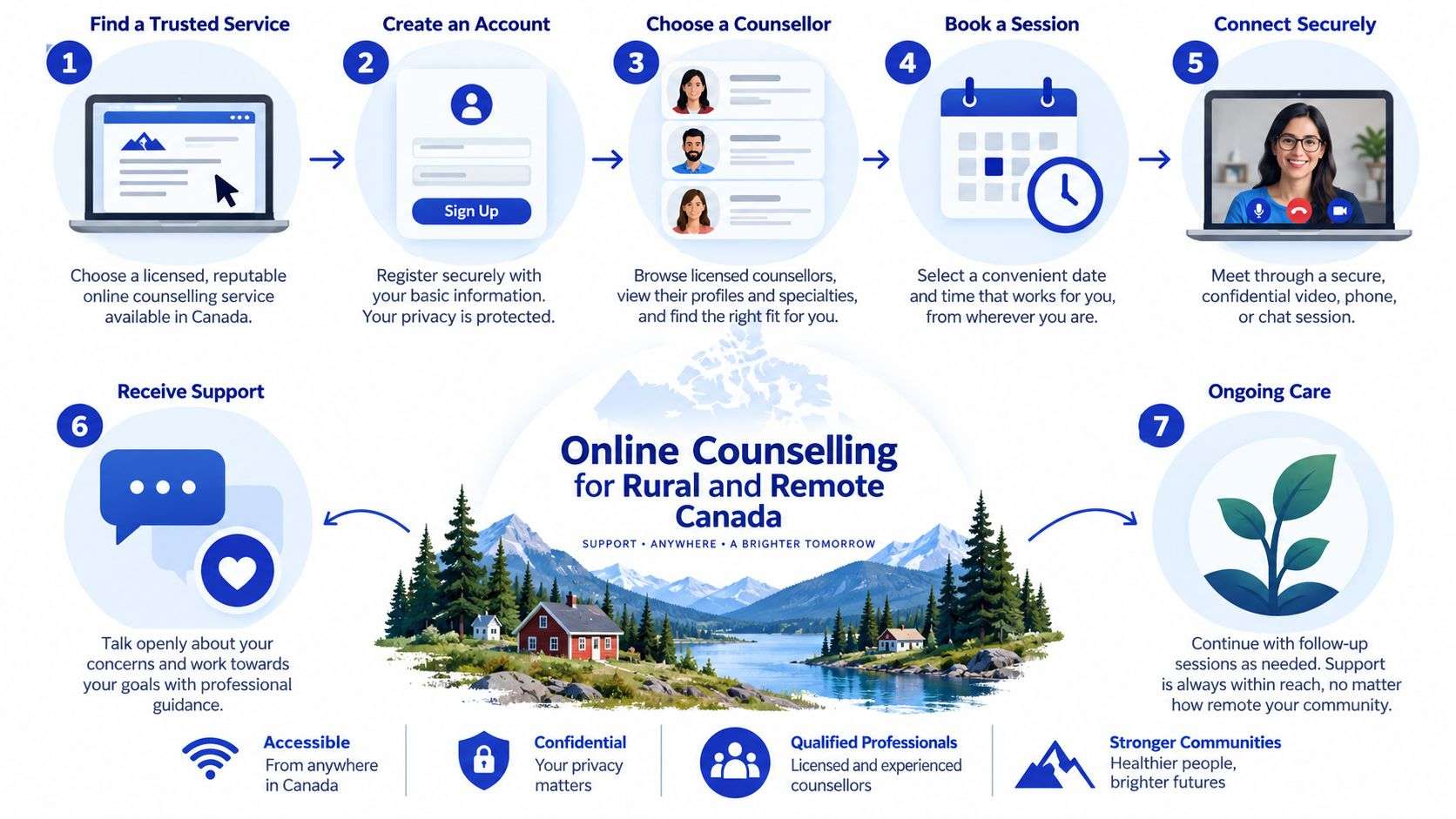
The process generally starts with an intake conversation or form. You'll usually discuss what brings you to counselling, the support you want, your physical location, your availability, and any immediate safety concerns. The provider should explain confidentiality, limits to privacy, communication methods, cancellation expectations, and the plan if the connection stops.
Ask what will happen if video is unreliable. A phone appointment, an audio-only connection, or another low-bandwidth option may be available. It also helps to agree on how you will reconnect, and to identify a private place before booking.
Confirm that the therapist is permitted to practise where you are physically located during the appointment. Virtual care can depend on professional registration, provincial or territorial requirements, and the location of both client and clinician. A provider should answer this clearly rather than leaving you to work it out alone.
What happens during a session
At the appointment time, you use a computer, tablet, or phone to join the secure session. Your therapist may ask you to confirm your current location and a reliable way to reach you. This supports safety planning if you become distressed or the connection fails during an important conversation.
The session can include exploring emotions, understanding patterns, practising coping strategies, improving communication, processing difficult experiences, or setting goals. Your therapist may adjust the pace and method for video or telephone care. Video can help some clients feel connected through facial expression and visual presence. Telephone counselling may suit clients who have a steadier phone connection or feel less exposed without a camera.
How secure technology fits in
The counselling practice should choose a professional platform with privacy safeguards and provide clear joining instructions. A guide to the best video conferencing software 2025 can explain the broader tool category, but the therapist or practice must decide whether a platform is appropriate for clinical care.
You do not need advanced technical skills. Use a private device when possible, protect your login details, and join from a space where others cannot overhear. Ask whom to contact if you cannot connect, and keep the agreed backup method nearby. These small preparations make the appointment more predictable when broadband service varies.
Benefits and Honest Limitations of Virtual Care
Virtual counselling works especially well when travel is the main obstacle. You can avoid a long journey, attend from a familiar environment, and use appointment times that fit around work or family responsibilities. The Mental Health Commission of Canada identifies practical benefits of e-mental health tools, including reduced travel time and costs, fewer missed appointments, improved service availability, greater convenience, and increased perceived privacy in rural and remote settings (rural and remote mental health evidence brief).
Remote care can also widen the range of professionals you're able to consider. You may not have a local therapist with experience relevant to trauma, grief, parenting, relationships, or youth mental health. A virtual appointment can make specialised assessment or support more reachable, although availability still depends on licensing and scheduling.
Canadian reviews describe tele-mental-health as a high-impact access intervention because videoconference and telephone care can reduce travel-dependent service delivery, help reduce waitlists, lower costs, improve appointment attendance, and preserve access to specialised assessment (Canadian tele-mental-health review). In northern Labrador, tele-psychiatry became routine, and most child psychiatry services were delivered through telehealth. That example shows that remote clinical care can be workable when local systems, scheduling, and connectivity support it.
Virtual care still has limits. A weak connection can interrupt the session. You need a private place to talk, which may be difficult in a crowded home or shared accommodation. Some people find it harder to feel emotionally connected through a screen, while others may become distracted by household responsibilities. Phone sessions can help with bandwidth, but they remove visual cues that some therapists use to understand how a client is responding.
Online counselling also isn't the right response to every urgent situation. If you're at immediate risk of harming yourself or someone else, experiencing a medical emergency, or unable to remain safe, contact emergency services or a local crisis resource rather than waiting for a routine appointment. Discuss an emergency plan with your therapist before difficult material arises.
| Situation or Need | Virtual Care Fit | Consideration |
|---|---|---|
| Long travel to the nearest provider | Often a strong fit | Confirm that video or phone service is available in your community. |
| Limited local specialisation | Potentially helpful | Check the therapist's qualifications, experience, and authority to practise where you are. |
| Unstable internet | Possible with adjustments | Ask about telephone or audio-only fallback arrangements. |
| Need for urgent crisis intervention | Usually not a routine-care fit | Use emergency or crisis services when immediate safety is at risk. |
| No private room at home | May require planning | Consider a trusted private location, headphones, or telephone care. |
| Young children or family counselling | Can be suitable | Ask how the therapist adapts activities, consent, and privacy for each participant. |
Technology and Connectivity Tips for Steady Sessions
Internet access is a real clinical access issue, not a minor inconvenience. A 2026 Canadian review notes that only 53% of rural households have access to high-speed internet, while qualitative research describes Wi-Fi in rural, northern, and Indigenous communities as intermittent or difficult to rely on (Canadian review of virtual care modalities). If video isn't dependable where you live, that doesn't mean counselling is impossible. It means the service needs a realistic fallback.
Canada's connectivity strategy set targets for 50/10 Mbps service, including 90% of households by 2021, 95% by 2026, and 100% by 2030. A 2023 Parliamentary Library review reported that only 62% of rural households had access at that level, which illustrates why a provider shouldn't assume every client can sustain high-quality video (Parliamentary Library review).
The Auditor General reported that in 2021, minimum internet speeds were available to 90.9% of Canadian households overall, compared with 59.5% of rural and remote households and 42.9% of households on First Nations reserves (Auditor General report). These figures help explain why audio-only sessions and telephone counselling remain important options.
Prepare the setup before the appointment
Use a short checklist before your first session:
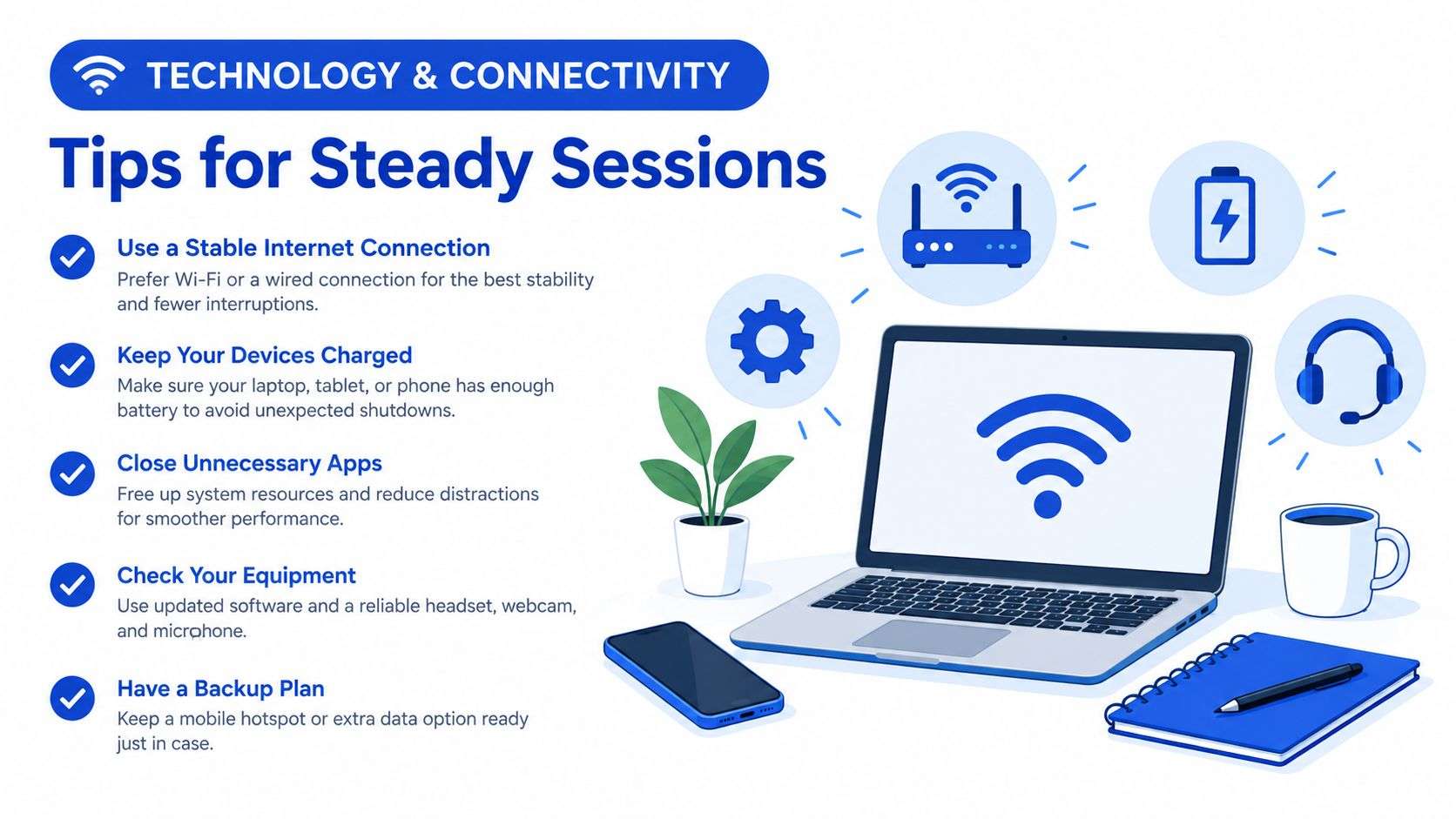
- Test the device: Confirm that your camera, microphone, speakers, and charging cable work. A phone can be perfectly adequate if it's stable and positioned at eye level.
- Choose the strongest connection: Move closer to the router if possible, pause large downloads, and ask others in the home to avoid heavy internet use during the appointment.
- Use headphones: Headphones can improve sound quality and reduce the chance that someone nearby hears the therapist.
- Have a backup: Keep the therapist's office number or agreed contact method available. Ask whether the plan is to reconnect, switch to telephone, or reschedule if the call drops.
- Protect the environment: Close unrelated apps, silence notifications, and place a sign on the door if others might enter.
If the connection drops
Try the agreed backup immediately rather than spending the rest of the appointment troubleshooting. If you reconnect, tell your therapist what you missed and whether you still feel comfortable continuing. If the interruption happens during a highly emotional discussion, the therapist should help you settle, confirm your safety, and decide whether to continue by phone or pause the work.
Audio-only care can be a sound clinical option when video creates repeated interruptions. Ask about it at the beginning, not only after a difficult session has already been disrupted.
Privacy Licensing and Funding Essentials to Know
Privacy involves both technology and the physical space around you. A secure platform helps protect the digital connection, but it can't stop a family member, housemate, or coworker from overhearing. Before your first session, ask how the provider protects records, what information is collected, where records are stored, and which situations require confidentiality to be broken for safety or legal reasons.
Small communities create particular privacy concerns. You might not want to use a local clinic, or you may worry that a provider knows someone in your family. Online counselling can allow you to attend from a different setting, but you still need to choose a private room, use headphones when appropriate, and avoid public spaces where conversations can be heard.
Licensing follows location
Ask the therapist to confirm where they're authorised to practise and whether that permission covers your province or territory. Don't assume that a provider located elsewhere can automatically provide counselling to you online. Professional colleges, regulatory bodies, and certification organisations may have different requirements.
You should also tell the provider where you'll be physically located during sessions, including if you plan to travel within Canada. The therapist needs accurate location information for clinical, ethical, and emergency planning.
Funding questions to ask early
Coverage depends on your benefits plan, provider designation, jurisdiction, and the kind of service you receive. Rather than assuming online counselling is covered, contact your insurer and ask whether your plan includes the specific professional title of the therapist you're considering. Ask what documentation the insurer needs and whether virtual or telephone appointments are eligible.
Useful questions include:
- Privacy: What platform do you use, and how do you protect my information?
- Records: How are clinical notes stored, and who can access them?
- Licensing: Are you authorised to practise where I'm located?
- Continuity: What happens if you're unavailable or the service is interrupted?
- Coverage: What receipt or provider details will I receive for my insurer?
- Safety: What information do you need from me in case of an urgent concern?

Transparent answers are part of ethical care. A counsellor shouldn't make you feel difficult for asking how privacy, licensing, records, or coverage work.
Practical Steps to Access and Make the Most of Virtual Therapy
You may open the appointment window after a long shift, with a child nearby and no clear sentence ready. That is common. A simple plan works like a handrail, giving you something steady to hold while you decide what to share.
Begin with the concern, not the perfect wording
You do not need a diagnosis or a polished explanation. Before the session, note what has changed, what feels hardest, and what you would like to be different. “I'm not sleeping well and I'm struggling to manage work” is enough. So is, “My family is having conflict after a major change.”
Choose the type of support that fits your situation, such as individual, couples, family, child, or youth counselling. If a child will participate, ask how the therapist manages consent, caregiver involvement, private conversations, and communication suited to the child's age.
Check fit and practical availability
Review the therapist's qualifications and areas of practice, then ask clear questions about whether their approach fits your needs. Daytime, evening, and weekend appointments can make care workable around shift work, caregiving, or a long distance from services. A useful fit also includes feeling safe enough to speak openly, ask questions, and say when an approach does not feel right.
If you want a Canadian team offering secure video and phone sessions, Interactive Counselling works with individuals, couples, families, children 5+, and youth through a licensed, diverse team. Support includes concerns such as anxiety, depression, grief and loss, trauma and PTSD, parenting, relationships, life transitions, divorce, and mediation. Daytime, evening, and weekend appointments may suit changing work or caregiving schedules. Review the online counselling options and check whether the format and clinical scope match what you are seeking.
Make the appointment easier on yourself
Give yourself a few minutes before the session to settle in. Keep water nearby, silence notifications, and place your phone on a stable surface. If privacy or bandwidth is uncertain, prepare a quieter location and keep a telephone available as a possible backup. These small preparations matter in rural settings, where a dropped connection or an unexpected visitor can interrupt the conversation.
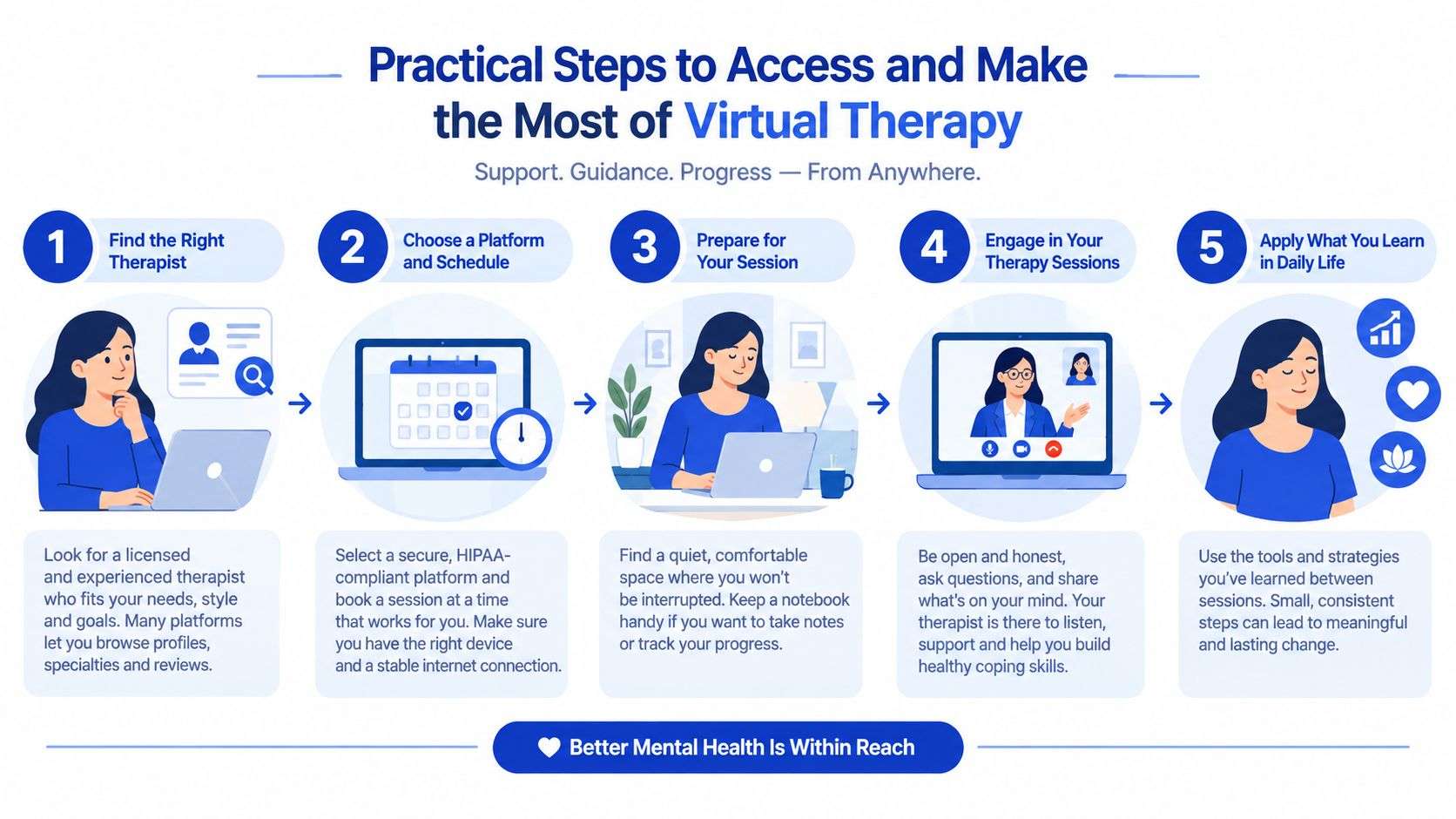
You do not need to perform wellness for your therapist. Tears, pauses, uncertainty, and changing your mind about where to begin are workable parts of counselling. Tell your therapist if the sound is unclear, someone enters the room, or you need a pause. Ask for a technique to be explained, request a slower pace, or discuss whether telephone care would be more reliable.
Afterward, allow transition time if you can. A session may bring up feelings that need attention before work, driving, caregiving, or household tasks. Write down one idea to remember and one small action to try, without turning therapy into another source of pressure.
Frequently Asked Questions and a Gentle Next Step
Can online counselling stay private in a small community?
It can, with planning. Choose a room where you won't be interrupted, use headphones, and ask the provider about platform security and record handling. If home privacy isn't possible, discuss alternatives such as a trusted private location or telephone counselling.
What happens if my internet fails during a difficult conversation?
Your therapist should agree on a backup plan before the session begins. That may involve reconnecting, switching to telephone, or pausing after confirming your immediate safety. Keep the provider's contact information nearby, and tell them if the interruption leaves you distressed or unsure what to do next.
Can virtual counselling support children and families?
It can be appropriate for children, youth, parents, couples, and families, but the format should match the participants' ages, needs, privacy, and attention span. Ask how the therapist includes caregivers, creates private opportunities for a child or youth to speak, and adapts activities for remote sessions.
Is online counselling suitable if I'm in crisis?
Routine virtual counselling isn't a substitute for immediate emergency support. If you can't stay safe, contact emergency services or a local crisis resource, and tell the provider about urgent safety concerns so an appropriate plan can be made.
What if video doesn't feel comfortable?
You can discuss telephone sessions, shorter steps toward video, or a different therapeutic approach. Feeling comfortable enough to speak openly matters more than using a particular technology.
Rural and remote clients deserve care designed around real conditions, including distance, weather, limited providers, inconsistent broadband, and community privacy. You're allowed to ask questions before committing, and you can take time to decide what support feels workable.
Interactive Counselling offers secure virtual counselling and phone sessions for individuals, couples, families, children aged 5 and older, and youth across rural and remote Canada. Visit Interactive Counselling to learn about available support and find an option that fits your location, needs, and comfort with virtual care.
Clinically Reviewed By
Amy Mosset, MCP, RCC-S
Amy Mosset is a Master Practitioner in Clinical Counselling, Clinical Supervisor, and the owner of Interactive Counselling. She provides trauma-informed, evidence-based care and clinical supervision to registered therapists, with a focus on ethical practice, client safety, and high-quality therapeutic outcomes.