A parent is calling from a parked car between work and school pickup. One teenager is in a bedroom several kilometres away. A younger child needs support, but the household can't find a quiet hour when everyone can travel to the same office. Meanwhile, family tension keeps growing, and arranging help starts to feel like another problem the family has to solve. For more information, see our family counselling.
Online family counselling across Canada can make that first step more workable. A secure phone or video session may allow family members to join from different homes, towns, or provinces, while a counsellor helps everyone slow down, speak safely, and understand what's happening beneath the conflict.
Virtual care still needs thoughtful planning. Families must consider privacy, internet reliability, children's ages, consent, emergency arrangements, and whether every participant can engage comfortably from home. This guide explains those practical questions in plain language, with the same care you'd expect when learning about supporting recovery through family therapy.
Finding Support for Your Family Without Leaving Home
Families often seek counselling during periods when ordinary routines have already become difficult. Parents may be managing separation, co-parenting disagreements, a child's anxiety, grief, school concerns, or conflict between siblings. One caregiver may work evenings, another may live in a different community, and a young person may feel more at ease speaking from a familiar room than entering an unfamiliar office.
Online counselling doesn't remove those pressures, but it can reduce some of the practical barriers around them. A family might join one appointment from a kitchen table, a private office, and a bedroom in another household. The counsellor can help everyone agree on expectations before the conversation begins, including who is present, how people take turns, and what happens if someone needs a pause.
Canada's experience with virtual mental health care changed significantly during the COVID-19 period. In an analysis covering Ontario, Manitoba, Saskatchewan, Alberta, and British Columbia, the Canadian Institute for Health Information found that virtual visits represented 4% of physician mental health services in 2019–2020 and then rose to 57% in 2020–2021. During the same January-to-March comparison, total physician mental health services increased by 15% to 502,007 services, showing how phone and online care helped people receive support from home. CIHI's analysis of virtual mental health care in Canada documents that shift.
That change matters for families because remote care became more than a temporary workaround. It established a familiar way to speak with mental health professionals without making every participant travel to the same place.
A supported conversation, not just a video call
Family counselling works best when the technology serves the relationship. The screen is the meeting room. The counsellor remains responsible for creating structure, watching for distress, and helping family members hear one another without turning the session into a debate.
The process may begin with a shared conversation, followed by separate check-ins with a parent, child, or couple. A counsellor might help the family identify one immediate goal, such as reducing shouting during transitions, making space for a teenager's privacy, or creating a calmer co-parenting routine.
Seeking help from home isn't a sign that a family has failed. It can be a practical way to make room for a difficult but important conversation.
What Online Family Counselling Means in Canada
In Canada, virtual counselling generally means synchronous counselling, where the client and counsellor communicate at the same time by telephone, videoconference, or chat. It isn't the same as reading self-help material or sending occasional messages without a live appointment. The family and counsellor meet together in real time, with a planned therapeutic purpose.
A useful analogy is a shared table. In an office, everyone sits around the same physical table. Online, each person brings a different part of that table into the virtual room. The counsellor helps decide who speaks, notices when someone has withdrawn, and keeps the conversation from becoming a series of interruptions.
A typical video session may follow this pattern:
- The counsellor confirms attendance and privacy. Each person identifies where they are and who else may be nearby.
- The family names the immediate concern. The counsellor may ask what has changed since the previous session or what brought everyone together.
- Participants take turns. Speaking rules help prevent the loudest or fastest speaker from controlling the entire conversation.
- The counsellor reflects patterns. They may identify cycles such as criticism followed by withdrawal, or a parent's worry followed by a child's resistance.
- The family practises a different response. This might involve a communication exercise, a parenting plan, or a calmer way to request space.
- Everyone leaves with a clear next step. The plan may include a conversation to practise, an observation to record, or another appointment.
Why remote care became a normal access route
CIHI found that virtual delivery became embedded across several parts of the mental health system. In Ontario, physicians delivered 69% of family physician mental health services virtually, while pediatricians delivered 65% and psychiatrists delivered 61% virtually during the period described in the report. These figures show that home-based mental health care expanded across different professional roles, not just one type of appointment. The CIHI report provides the Canadian context.
Statistics Canada also reported that among Canadians who spoke with a health professional about their mental health, 51.4% used the telephone and 27.7% used a video call. Those findings help explain why many families now regard phone or video counselling as a credible route to care rather than an unusual substitute. Statistics Canada's mental health service data offers further detail.
The same principle appears in technology-assisted CBT benefits. Structured, guided support can use technology without allowing technology to replace the human relationship at the centre of counselling.
Benefits and Realistic Limitations to Consider
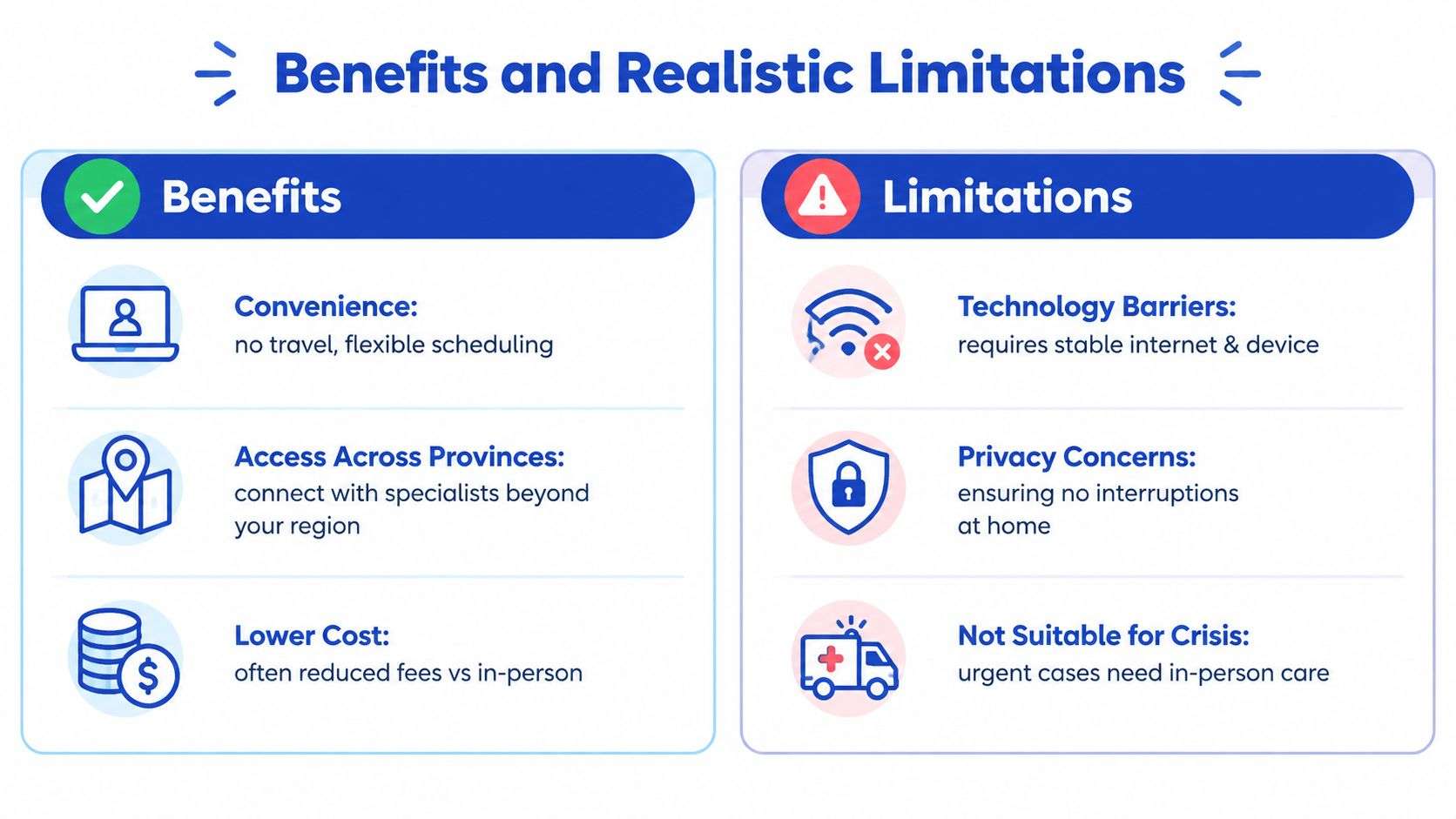
Virtual family counselling can be a strong fit when travel, distance, or scheduling prevents people from meeting in one place. A parent might attend during a work break, while a young person joins from home after school. Families living in rural or remote communities may also connect with a counsellor who understands their needs when local options are limited.
Convenience matters, but it shouldn't be confused with simplicity. A family may avoid driving, yet still need to arrange private rooms, headphones, childcare for younger siblings, and a plan for what happens when someone becomes upset. Home can feel comfortable, but it can also contain the very relationships and tensions being discussed.
Where online sessions can work well
The strongest fit often includes families who can:
- Join reliably: Each participant has a working device, enough battery, and a reasonably stable connection.
- Create emotional space: People can speak without a partner, child, roommate, or other household member listening unexpectedly.
- Follow session agreements: Family members can practise turn-taking and pause when the counsellor asks them to slow down.
- Use a backup plan: The counsellor and family know whether they'll switch to telephone if video fails.
- Work toward shared goals: Everyone understands that counselling is not a courtroom where one person must be declared right.
Canadian evidence reviews generally find that therapist-guided remote psychotherapy can be as effective as face-to-face care for mood, anxiety, and traumatic stress disorders. A Canadian meta-analysis found little to no difference in primary outcomes between in-person and remotely delivered cognitive behavioural therapy, reporting an SMD of -0.02 with a 95% confidence interval from -0.12 to 0.07. The Canadian evidence review supports online care when it's structured, clinician-led, and appropriate for the situation.
Where the limits become important
Engagement may be weaker online than in person for some families. A counsellor can't always see what happens outside the camera frame, and a child may move away from the screen just as an important moment begins. People may also mute themselves, check another device, or leave the room without explaining what happened.
Virtual counselling isn't appropriate for crisis intervention. Canadian social work guidance warns that online counselling can't guarantee privacy and confidentiality in the same way as face-to-face care, and that virtual counselling isn't suitable for crisis intervention. Canadian Association of Social Workers guidance explains these limits.
A practical rule: If someone may be at immediate risk, don't wait for a virtual appointment. Contact emergency services or an appropriate crisis service in your area.
The right question isn't whether online counselling is always better. It's whether the format is safe, private, technically workable, and clinically suitable for this family at this point in time.
Who Online Family Counselling Helps Most
Family counselling can help when the problem lives between people, not only inside one person. Parents may want to respond differently to a child's anxiety. Co-parents may need a calmer way to discuss schedules and boundaries. A blended family may be adjusting to new roles, while siblings struggle with resentment after a move, separation, illness, or loss.
A counsellor may combine formats rather than expecting every concern to fit one shared appointment. Family sessions can address patterns in the household. Parent-only meetings can focus on consistency and caregiving decisions. Child-only or youth sessions can give a young person room to speak about experiences they don't want to describe in front of parents.
Age and participation need careful attention
Children and teenagers don't all use virtual counselling in the same way. Federal mental health support listings distinguish programs for children ages 3 to 12, youth ages 12 to 17, and an online counselling offer for people aged 14 and older. These age groupings show why a family shouldn't assume one online service or one consent process will suit everyone. Health Canada's virtual care recommendations provides this age-based context.
Younger children may need play, movement, drawing, caregiver observation, or parent coaching rather than a standard conversation across a screen. Adolescents may value the privacy and flexibility of virtual sessions, especially when attending an office feels exposing. The counsellor should explain who participates, what information remains private, and when parents receive general updates.

Location and bandwidth affect the whole family
A video session involving several people needs more than one person's connection to work well. Rural and remote access remains uneven. Only 37% of rural households and 27.7% of First Nations households on reserves had access to 50/10 Mbps service, compared with 84.1% of other Canadians, according to the Canadian virtual care evidence cited in the national discussion of access gaps. The Canadian access information highlights why video reliability can't be assumed.
A family may need telephone fallback, shorter sessions, asynchronous check-ins, or a hybrid arrangement. If one parent is remote and another is in an office, the counsellor can clarify how everyone will participate and how privacy will be protected. Online counselling may be the only practical option for one family and a poor fit for another. Good care leaves room for both realities.
How to Prepare for Secure and Private Sessions at Home
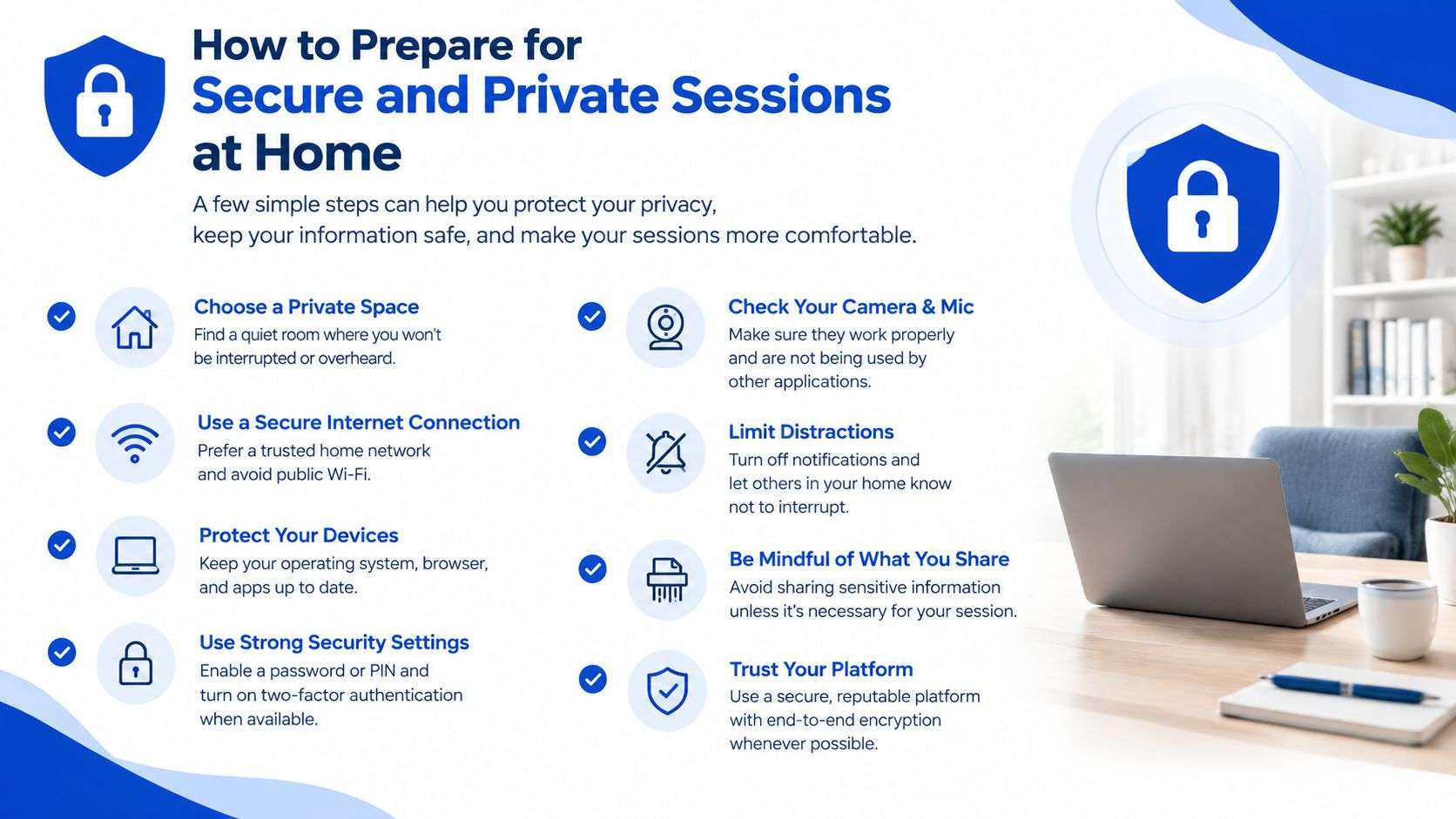
Preparation reduces the chance that a technical problem will become an emotional interruption. Families don't need a perfect home or expensive equipment. They need a realistic plan that protects privacy and gives each participant a dependable way to reconnect.
Start with the practical setup
Before the first session, discuss these points with the counsellor:
- Test the device: Check the camera, microphone, speakers, charging cable, and the appointment link.
- Choose the quietest available space: A bedroom, home office, parked vehicle, or separate part of the home may work, provided the person can speak safely.
- Use headphones when appropriate: Headphones can reduce the chance that sensitive information travels through the room.
- Plan for interruptions: Tell household members not to enter unless there's an urgent reason. Consider a note on the door or a white-noise machine outside the room.
- Arrange attendance across homes: Confirm each person's location before the appointment and make sure the counsellor knows who is expected.
- Keep contact information available: The counsellor needs to know how to reach each participant if the connection ends.
- Agree on a technology fallback: Decide whether the session will continue by telephone, pause, or be rescheduled if video becomes unreliable.
- Prepare water and a grounding object: A blanket, mug of tea, stress ball, or familiar object can help someone settle after a difficult conversation.
Understand privacy and consent
Virtual counselling requires informed consent before internet-based communication is used. Canadian professional ethics guidance also calls for digital security measures, including encryption and firewall software when electronic records are kept. The Canadian Counselling and Psychotherapy Association Code of Ethics supports asking clear questions about communication, records, and security.
Ask the counsellor:
- How will information be stored?
- Who may access the records?
- What happens if someone else enters the room?
- What are the limits of confidentiality?
- What is the safety plan if a family member discloses immediate danger?
Privacy also includes family agreements. A parent may assume they'll hear everything a teenager says, while the counsellor may offer the young person some confidential space within ethical and legal boundaries. Clarifying this at the beginning prevents later misunderstandings.
Choosing Your Counsellor and Getting the Most From Virtual Sessions
The right counsellor brings more than video software. Look for someone who can explain their approach in plain language and who has experience with the concern your family is facing, whether that involves parenting, separation, trauma, grief, blended-family stress, or conflict between a parent and child.
Ask practical questions before booking:
- Does the counsellor work with families, children, and youth in the age ranges involved?
- Can family members join from different locations?
- Are phone sessions available if video isn't workable?
- Does the counsellor offer daytime, evening, or weekend appointments?
- How are cultural identity, family structure, language, disability, gender, and sexual orientation included in the work?
- How will the counsellor respond if a session becomes unsafe or too intense?
A trauma-informed counsellor won't treat silence, anger, or missed appointments as simple defiance. They'll consider what the behaviour may be protecting and help the family build enough safety for honest conversation.
What a well-held virtual session feels like
The counsellor may begin by naming the purpose of the meeting and setting turn-taking rules. They might ask participants to use names before speaking, raise a hand, or pause when another person becomes overwhelmed. These details can sound small, but they give the family a predictable structure.
Confidentiality needs special care in family work. Canadian professional standards state that information discussed individually outside joint couples or family appointments should be treated as confidential unless the person consents to sharing it with the partner or other family members. The CCPA Standards of Practice explains this important boundary.
Build continuity between appointments
Families often get more from counselling when they choose one manageable practice between sessions. That might mean using a specific phrase to request a pause, holding a short weekly planning conversation, or noticing when a familiar conflict cycle begins.
At the next appointment, review what happened without treating imperfect follow-through as failure. Progress may look like a disagreement ending sooner, a child feeling heard, or a parent repairing after reacting sharply. These changes become easier to notice when the family and counsellor agree on what they're watching for.
Interactive Counselling offers family counselling through secure virtual and phone sessions, including support for family members joining from different locations. Families can learn more about its online counselling services and consider whether the available format, scheduling, and clinical approach fit their needs.
Common Questions and a Gentle Next Step
Can insurance or ICBC cover online family counselling?
Coverage depends on the specific plan, the type of provider, and the reason for counselling. Families should contact their insurer and ask whether virtual sessions are eligible, what documentation is required, and whether every participating family member must be listed. ICBC-funded counselling may apply to eligible clients recovering from motor vehicle accidents, but the details should be confirmed directly with the provider and ICBC.
Can family members attend from different provinces or time zones?
Possibly, but the counsellor must confirm that they can provide care to each participant in their current location. Families should share everyone's province or territory, location during the appointment, and time zone before booking. This also helps the counsellor create an appropriate safety plan for each person.
What happens if someone can't join by video?
A family member may be able to join by telephone if the counsellor agrees and privacy can be maintained. The group should decide how that person will participate, how turn-taking will work, and what information they can hear. If the connection is too unstable for meaningful participation, the counsellor may suggest a different arrangement.
Can a child join from home?
Many children can participate in some form, but age, attention, privacy, communication style, and clinical needs matter. A counsellor may involve a parent, use drawing or play-based activities, or recommend parent coaching when a child isn't ready for standard video counselling.
What if the family is in crisis?
Online family counselling isn't a crisis response service. If someone may be in immediate danger, contact emergency services or a local crisis resource rather than waiting for a scheduled appointment. Tell the counsellor about safety concerns as early as possible so they can help identify an appropriate level of care.
Choosing support is a caring action, even when the family isn't sure how to begin. A secure online appointment may offer a practical starting point, but the most important ingredients remain safety, consent, respectful structure, and a counsellor who understands the family's circumstances.
Clinically Reviewed By
Amy Mosset, MCP, RCC-S
Amy Mosset is a Master Practitioner in Clinical Counselling, Clinical Supervisor, and the owner of Interactive Counselling. She provides trauma-informed, evidence-based care and clinical supervision to registered therapists, with a focus on ethical practice, client safety, and high-quality therapeutic outcomes.
Interactive Counselling offers secure online, phone, and in-person counselling for individuals, couples, children, youth, and families across real-life concerns. Visit Interactive Counselling to learn about family support, scheduling options, and how to take a thoughtful first step from home.