You turn down an invitation because you assume people would rather you weren't there. You read a job offer and immediately think you'll disappoint them. Later, a familiar voice tells you that you don't deserve the opportunity anyway. Nothing dramatic has happened, yet your world feels a little smaller. For more information, see our Kelowna couples counselling.
Self-esteem counselling in Kelowna can help you understand those moments and change the patterns beneath them. The work isn't about forcing cheerful affirmations or pretending self-doubt never appears. It's about rebuilding a more accurate relationship with yourself, one that can hold mistakes, boundaries, relationships, and new opportunities without treating every difficulty as proof that you're not enough. For more information, see our counselling in Kelowna.
When Confidence Quietly Slips Away
Low self-esteem often develops over time. You might stop applying for positions that interest you, avoid speaking in meetings, or wait for someone else to make a decision because you don't trust your own judgement. You may accept too much from other people, then feel resentful because saying no seems unsafe. For more information, see our couples counselling.
These patterns can be easy to miss because daily life continues. You still work, care for family, answer messages, and show up for responsibilities. Inside, though, you may be comparing yourself with everyone around you, replaying conversations, or treating ordinary setbacks as evidence of a personal flaw.
A useful question: “What did I decide this moment means about me?”
That question separates the event from the story attached to it. A declined invitation might mean someone was busy. A mistake at work might mean you need clarification or practice. A relationship ending may be painful without proving that you're unlovable. Low self-esteem tends to collapse these distinctions, turning one experience into a verdict about your entire identity.
Counselling interrupts that cycle through curiosity rather than pressure. A therapist helps you notice the belief underneath the behaviour, examine where it came from, and test whether it still describes your life accurately. You may practise expressing a preference, accepting a compliment without arguing, or taking a manageable step toward something you've avoided.
Kelowna residents may also recognise how local life can intensify these pressures. Work, family expectations, social comparison, school demands, and changing relationships can all affect how secure you feel in yourself. In British Columbia, the proportion of students in grades 7–12 who reported feeling good about themselves fell from 86.5% in 2008 to 80.2% in 2013, with a sharper decline among females, from 81.7% to 71.4%, according to the BC Adolescent Health Survey indicator. These figures don't define any individual, but they show why confidence and self-worth deserve serious, compassionate attention.
What Self-Esteem Actually Means
Self-esteem is the ongoing story you hold about your worth. It answers a deeper question than “Can I do this?” It asks, “Who am I when I make a mistake, disappoint someone, or don't perform well?”
Confidence is usually more specific. You might feel confident driving a familiar route but uncertain in a new workplace. Self-esteem is broader and more persistent. It influences whether you believe you're entitled to ask for help, set a limit, receive affection, or try again after something goes wrong.
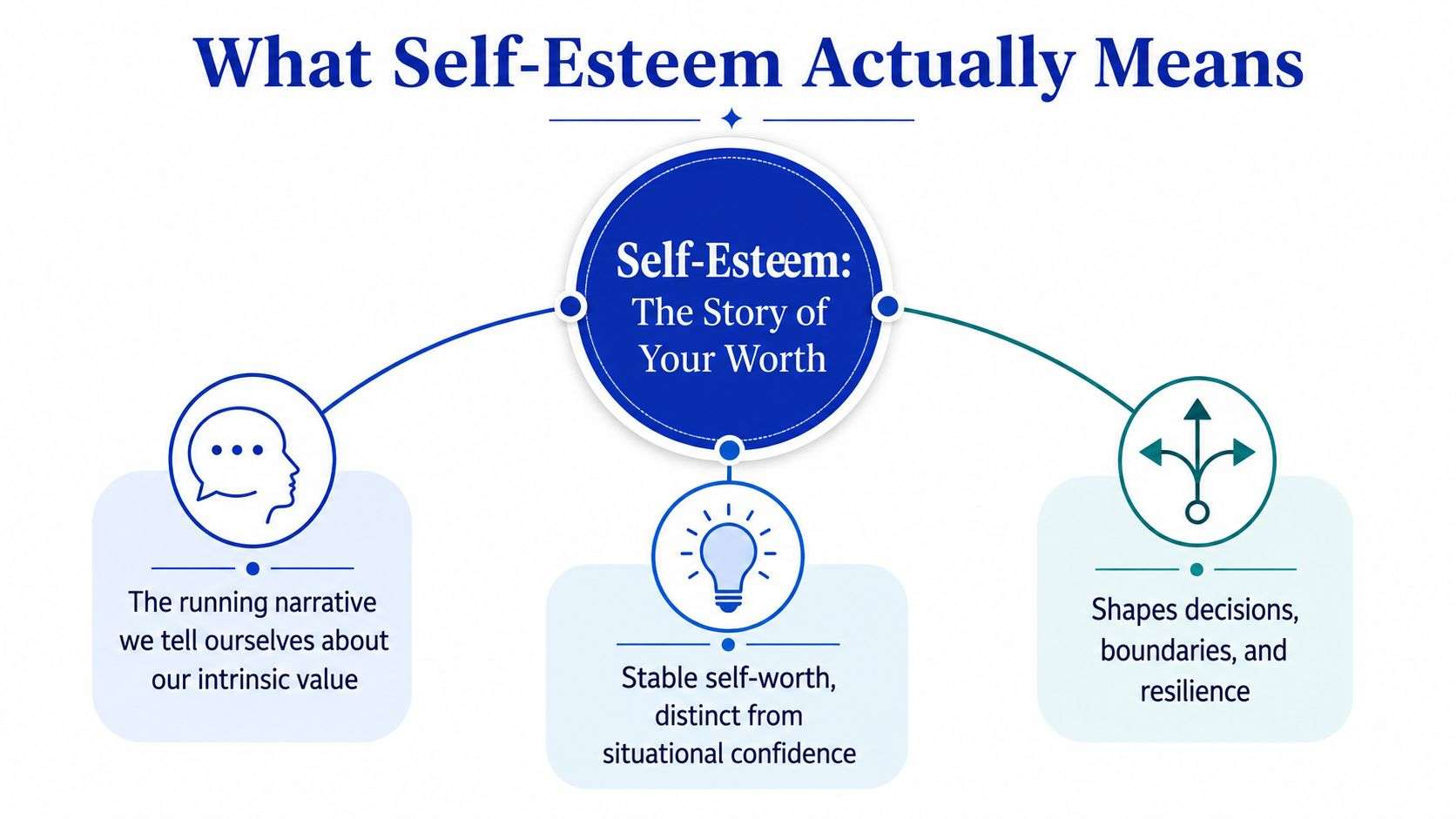
Healthy self-regard doesn't mean you like everything about yourself or feel assured every day. It means your value isn't constantly renegotiated through achievement, appearance, approval, or productivity. You can acknowledge a weakness without turning it into an identity, and you can accept feedback without assuming you're defective.
Low self-worth often shows up through familiar habits:
- Chronic self-criticism: You notice what went wrong and dismiss what went well.
- People-pleasing: You agree quickly, even when the request conflicts with your needs.
- Comparison: Other people's successes become evidence that you're falling behind.
- Difficulty accepting compliments: Praise feels inaccurate, embarrassing, or undeserved.
- Avoidance: You don't risk rejection because rejection seems to confirm what you already fear.
These beliefs often begin through repeated experiences and messages. Criticism, bullying, family conflict, exclusion, perfectionistic expectations, and painful relationships can all shape the inner narrative. The important point is that a learned story can be examined.
In Kelowna, the need for support sits within a wider mental-health context. A Statistics Canada profile reported that 65.6% of residents in the Kelowna census metropolitan area rated their mental health as very good or excellent, compared with 68.7% in British Columbia and 72.2% nationally. The same profile found that 92.4% of Kelowna-area residents were satisfied or very satisfied with life, a strong overall result that still leaves room for people experiencing distress or disconnection. You don't need to wait until your life looks unmanageable before taking your inner experience seriously.
Evidence-Informed Approaches That Rebuild Self-Worth
A counsellor doesn't choose a therapy model just because it has a familiar name. They consider what maintains your self-doubt, what feels safe to explore, and which methods can help you practise change in daily life.
Cognitive Behavioural Therapy
Cognitive Behavioural Therapy, or CBT, focuses on the connection between thoughts, emotions, and actions. A counsellor may help you identify an automatic thought such as, “If I ask a question, everyone will think I'm incompetent.” Together, you examine the evidence, identify the thinking pattern, and create a more balanced alternative.
CBT can fit well when perfectionism, fear of failure, rumination, or harsh self-talk keeps you stuck. The work is practical. You may track a difficult situation, the thought that appeared, the feeling it triggered, and what you did next. Over time, this helps you recognise that thoughts can feel convincing without being facts.
Acceptance and Commitment Therapy
Acceptance and Commitment Therapy, or ACT, doesn't require you to win an argument with every negative thought. Instead, you learn to notice thoughts as mental events and choose actions based on your values.
For example, you might feel unworthy at a social gathering. ACT can help you acknowledge that feeling without allowing it to decide whether you leave immediately. If connection matters to you, a values-based action might be staying for one conversation, even while anxiety is present.
Compassion-Focused Therapy
Compassion-focused work is often helpful when shame and self-attack are central. Rather than replacing the inner critic with exaggerated praise, the counsellor helps you understand what that critic is trying to prevent and develop a steadier, kinder response.
This approach can feel unfamiliar to people who believe criticism keeps them productive. Sessions may explore how you speak to yourself after a mistake and what you would say to a friend in the same situation. The aim isn't indulgence. It's a less threatening internal environment in which learning and repair become possible.
Other approaches may also have a place. Schema Therapy examines longstanding patterns formed through early experiences. Attachment-based work considers how relationships shaped your expectations of acceptance and rejection. Mindfulness-based approaches help you notice thoughts, emotions, and body sensations without immediately treating them as commands.
| Approach | Core focus | Best fit for |
|---|---|---|
| CBT | Identifying and restructuring unhelpful thoughts | Perfectionism, rumination, self-criticism |
| ACT | Making room for difficult thoughts while taking valued action | Avoidance, fear-driven decisions, identity concerns |
| Compassion-focused therapy | Reducing shame and building a supportive inner voice | Strong inner criticism, guilt, chronic shame |
| Schema or attachment-based work | Understanding deeper relational patterns | Longstanding insecurity, rejection sensitivity |
| Mindfulness-based approaches | Developing present-moment awareness | Emotional reactivity, overthinking, difficulty grounding |
Motivational work can support people who feel ambivalent about change or unsure where to begin. This plain-language explanation of what motivational interviewing therapy is may help clarify how a counsellor can explore readiness without pushing you.
Practical Strategies and Exercises From Counselling
Therapy exercises work best when they're connected to your specific pattern. A worksheet alone won't resolve years of shame, but it can give you a clear place to start and something concrete to discuss with a counsellor.
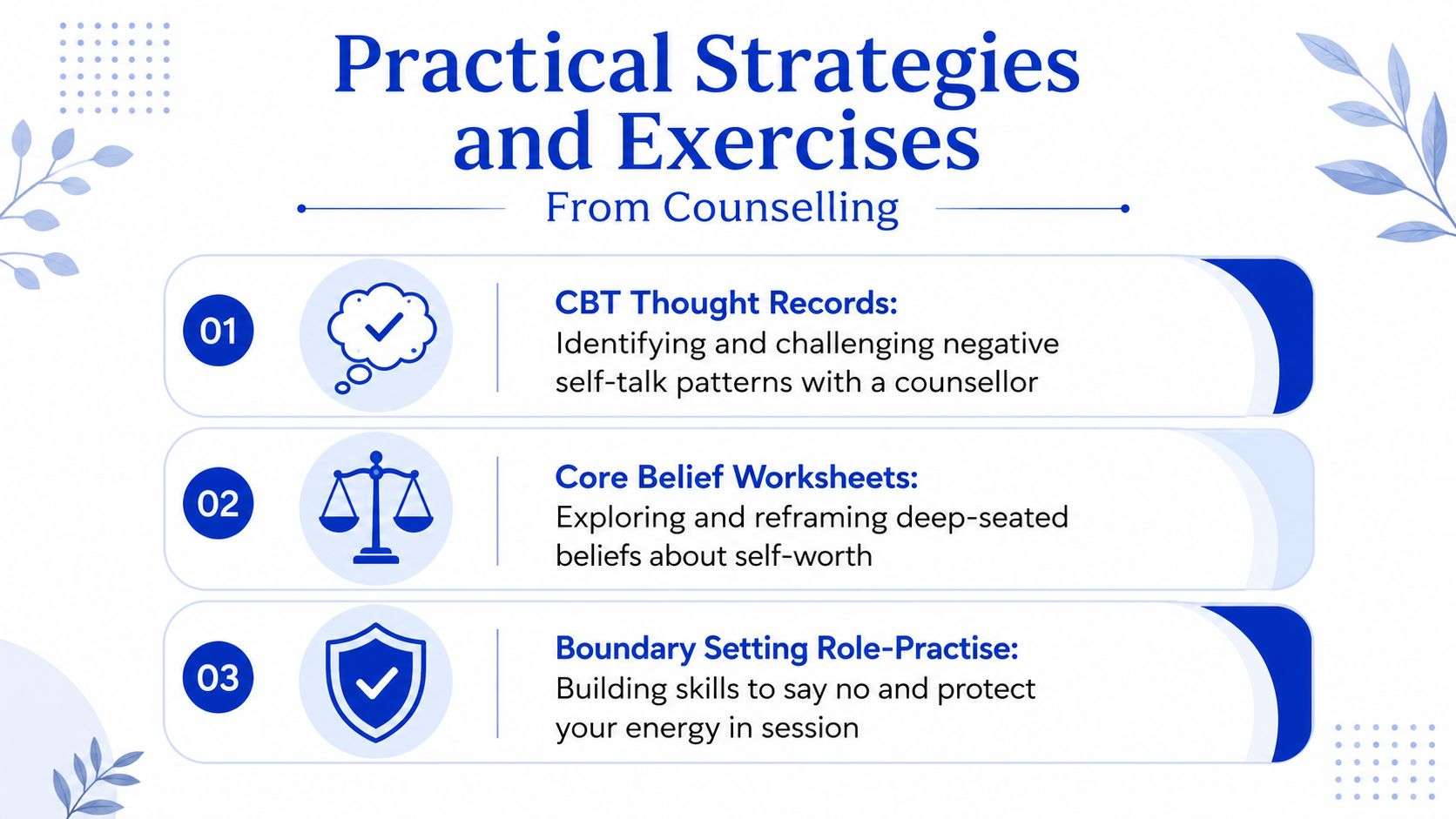
A thought record
Write down a recent moment when your self-esteem dropped. Record:
- What happened.
- What you immediately told yourself.
- What emotion and body sensation followed.
- What you did next.
- A more balanced interpretation.
A counsellor may notice that your thought says “always” or “never,” treats an assumption as fact, or ignores information that doesn't fit the criticism. The replacement thought doesn't need to sound positive. “I'm learning this, and one mistake doesn't define my ability” is more useful than a statement you don't believe.
A small confidence action
Confidence often follows action rather than appearing first. Choose something manageable, such as sharing an opinion, replying to a message, attending part of an event, or asking for clarification at work. Behavioural activation helps you reconnect with activity and evidence of capability instead of waiting until you feel completely ready.
A values check
ACT-based values clarification asks what kind of person you want to be in a situation. Do you want to act with honesty, connection, courage, fairness, or creativity? The question shifts attention from “How am I being judged?” to “What matters to me here?”
You can also write a short letter to yourself as though you were speaking to a friend who had made the same mistake. Notice whether your tone changes. A therapist can help you make the exercise feel genuine, particularly if kindness toward yourself initially feels undeserved.
For acute self-doubt, place both feet on the floor, name what you see around you, slow your breathing, and describe the present moment in plain language. Grounding doesn't prove that the feared outcome won't happen. It gives you enough steadiness to choose your next response. These practices deepen through feedback, repetition, and gentle accountability.
What a Session Feels Like at Interactive Counselling
The first contact is usually a chance to ask practical questions and describe what brings you in. You might say that you avoid opportunities, struggle with compliments, or feel confident in one part of life but inadequate everywhere else. You don't need a polished explanation.
In an initial session at a practice such as Interactive Counselling, the counsellor may ask about your history, current stressors, relationships, and goals. They'll work with you to identify priorities and discuss an approach that fits. The conversation should feel collaborative, not like an examination you have to pass.
The rhythm of ongoing work
A typical session may begin with a check-in about the week. You might review an exercise, describe a difficult conversation, or bring in something unexpected that has been occupying your mind. The counsellor can then help set an agenda, practise a skill, explore a belief, or slow down around an emotion that feels difficult to name.
You're allowed to move at your own pace. You can pause when a topic feels heavy, ask why an exercise is being suggested, or say that a particular approach isn't working for you. Confidentiality and respectful communication provide the foundation for discussing experiences you may have hidden from other people.
People who want a broader introduction to counselling education and professional development can explore these health and social care resources. For therapy itself, what matters most is that the relationship gives you room to be honest, curious, and involved in shaping the work.
Signs It May Be Time to Reach Out
Everyone doubts themselves sometimes. A difficult day, criticism, or a disappointing result can temporarily affect how you see yourself. The concern grows when the pattern persists, spreads across areas of life, and keeps you from doing things that matter to you.
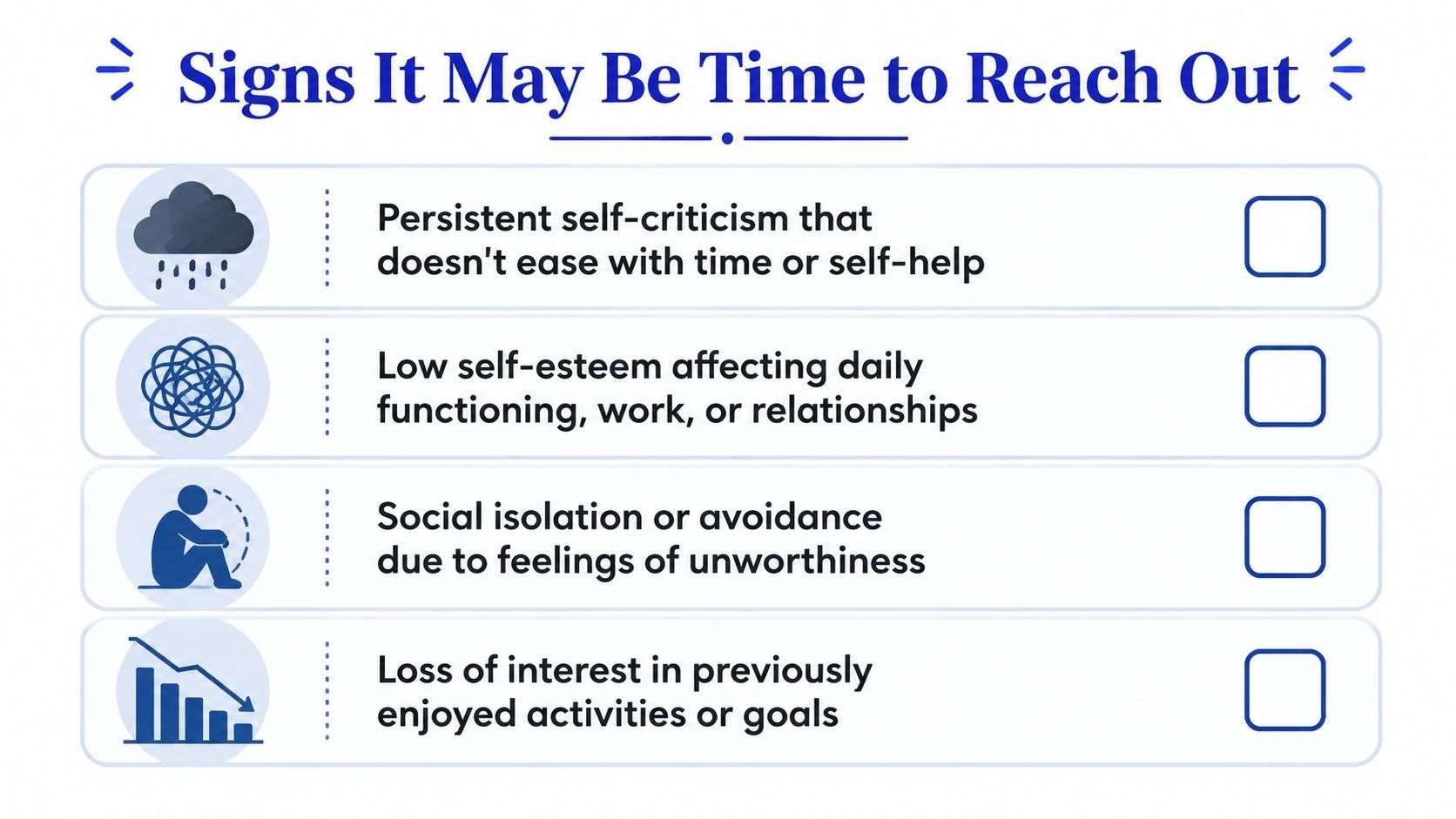
Consider reaching out if you notice several of these experiences:
- Persistent self-criticism: Reassurance doesn't settle the feeling that you're failing or flawed.
- Avoidance: You decline opportunities, social contact, feedback, or responsibilities because you expect rejection or embarrassment.
- People-pleasing: You regularly ignore your needs and agree to things to prevent conflict.
- Rumination: You replay past conversations and mistakes long after the situation has ended.
- Difficulty receiving success: Praise, progress, and achievement create discomfort rather than satisfaction.
- Shrinking goals: You stop pursuing interests because you assume you won't manage them.
- Reduced connection: You withdraw from friends or family because you feel like a burden or an outsider.
Low self-esteem can overlap with anxiety, depression, burnout, and the effects of bullying, criticism, or trauma. In British Columbia's 2023 adolescent health data, only 52% of youth reported feeling good about themselves, down from 59% in 2018, while 73% could identify something they were good at, down from 79% in 2018, according to the 2023 BC Adolescent Health Survey summary. The same dataset reported that youth who rated their health as good or excellent were more likely to feel good about themselves, 64% compared with 18%, and more likely to feel they had a good life, 86% compared with 47%. That relationship supports counselling that combines thought work, strengths identification, and practical goals.
Reaching out doesn't mean you're broken. It means a pattern has become difficult to shift alone, and you're choosing support before it limits your life further.
Accessing Counselling in Kelowna Your Way
The right format is the one that makes it easier for you to participate consistently. In-person sessions can offer a clear separation from home life and a face-to-face connection. Phone counselling may feel less exposed if eye contact or being seen while emotional makes self-doubt stronger. Secure virtual sessions can reduce travel across the Okanagan and let you meet from a familiar, private space.
| Format | How it works | Best fit for | Key considerations |
|---|---|---|---|
| In person | Meet at a Kelowna counselling office | People who value physical separation from daily routines | Consider travel, parking, transit, and the accessibility of the space |
| Phone | Speak with a counsellor by telephone | People who prefer privacy or have limited travel options | Choose a quiet setting where you won't be interrupted |
| Secure virtual | Meet by encrypted video from a private location | Rural clients, busy schedules, or people who feel safer at home | Check your internet connection and arrange confidential space |
Scheduling also matters. Daytime appointments may suit people with flexible work or school schedules, while evening or weekend availability can help working adults and caregivers. During an intake call, ask about appointment times, accessibility, privacy, and whether your benefits plan may cover counselling.
If self-esteem concerns followed a motor-vehicle collision, ICBC's Enhanced Care program automatically pre-approves injured people for treatment during the first 12 weeks after a crash, and counselling is included among covered care-and-recovery benefits in its official treatment information. For urgent emotional distress, use crisis or emergency supports rather than waiting for a routine counselling appointment. British Columbia also has multiple entry points, including 92 Child and Youth Mental Health intake clinics, while Foundry provides free virtual services for people aged 12–24 and caregivers through its youth support system information from the Government of British Columbia.
Common Questions About Self-Esteem Counselling
Do I need to be in crisis before I seek help?
No. You can book counselling because self-doubt is exhausting, your relationships feel harder, or you're avoiding opportunities. Early support can help you understand a pattern before it becomes more entrenched. British Columbia's mental-health system snapshot reported that more than 14,000 individuals accessed counselling in the first half of fiscal year 2025/2026, including over 4,000 first-time clients, as described in the provincial mental-health system information. Seeking support is a common and valid step.
How can I tell whether a counsellor is a good fit?
Notice whether you feel listened to, respected, and able to ask questions. The counsellor should explain the approach in understandable language and include you in decisions about goals and pace. If the relationship doesn't feel right after honest discussion, you can ask about changing providers.
How long does self-esteem counselling take?
There isn't one reliable timeline. It depends on whether your concerns are recent or longstanding, whether trauma or depression is involved, and how much support you want. Some people focus on a specific pattern for a shorter period, while others use longer-term therapy to work through relational and identity-based beliefs.
Can counselling eliminate self-doubt?
Counselling can't promise that you'll never question yourself again. A more realistic aim is learning to recognise self-doubt, respond to it with less cruelty, and make choices that reflect your values rather than fear. Progress may look like recovering sooner, setting a boundary, accepting praise, or trying again after disappointment.
What should I bring to the first session?
Bring whatever feels relevant, including a recent situation, a recurring thought, a relationship concern, or a goal you've been postponing. You don't need to remember everything or tell your whole life story immediately. In-person and virtual counselling both require privacy, and your counsellor can explain confidentiality and its limits at the beginning.
Interactive Counselling offers individual counselling in Kelowna through in-person, phone, and secure virtual sessions, with evidence-informed support for confidence, self-worth, anxiety, trauma, and related concerns. If you're ready to explore what's keeping you stuck, visit Interactive Counselling to learn about available options and take a measured first step toward a kinder relationship with yourself.
Clinically Reviewed By
Amy Mosset, MCP, RCC-S
Amy Mosset is a Master Practitioner in Clinical Counselling, Clinical Supervisor, and the owner of Interactive Counselling. She provides trauma-informed, evidence-based care and clinical supervision to registered therapists, with a focus on ethical practice, client safety, and high-quality therapeutic outcomes.