In BC, eligible children under 6 can access up to $22,000 per year in autism funding for approved supports including counselling, and children ages 6 to 18 can access up to $6,000 per year. Virtual sessions are eligible when billed through the provincial direct payment or Request to Pay process. For more information, see our autism counselling.
A lot of parents reach this point late at night, after a diagnosis, a school call, or a long day of trying to hold everything together. The questions come fast. Can therapy happen online, will funding help, and do we have to figure out the billing maze before we can even begin?
The reassuring answer is yes, online autism counselling in BC can fit within the provincial funding system when the provider and the service meet the program rules. The harder part is understanding which payment path applies, what paperwork has to be in place, and what the 2027 transition means for ongoing care.
Finding Your Way to Online Autism Counselling in BC
A parent in Victoria opens three tabs after bedtime. One shows a diagnosis resource, one shows school supports, and one shows counselling options, because the next steps feel too important to leave for tomorrow. They're tired, they're hopeful, and they're trying to understand whether virtual care can work for their child.
That moment is familiar to many BC families. Online autism counselling can be a practical fit for families who live outside major urban centres, have busy school routines, or need support that doesn't add travel stress to an already full week. Provincial autism funding exists to help with approved supports, and the funding structure can work with remote sessions when billing is set up correctly.

Why online care feels workable for many families
Virtual counselling removes a few of the biggest barriers at once. There's no drive across town, no parking stress, and no need to get a child through a crowded waiting room after a long day at school. For some children, that predictability makes the first conversation easier.
Families also like having care that can fit around routines they already protect closely. A session can happen from home, then life can return to normal without the long transition back from an appointment. That matters when a child is already working hard to cope with sensory overload, fatigue, or change.
If a child does better at home than in a clinic room, that's not a small preference. It can be the difference between starting support and avoiding it altogether.
What usually happens first
Most families begin by checking whether their child's autism funding is active and whether the counsellor is approved to bill through the right pathway. Once that's clear, the rest gets much simpler. The session itself can focus on the child, the parent, or the whole family, depending on what's needed.
The biggest emotional shift for many parents is this. They stop treating therapy like a mystery and start seeing it as a service that can be coordinated. That sense of order can ease a lot of the fear that shows up after diagnosis.
Understanding BC Autism Funding Eligibility and Amounts
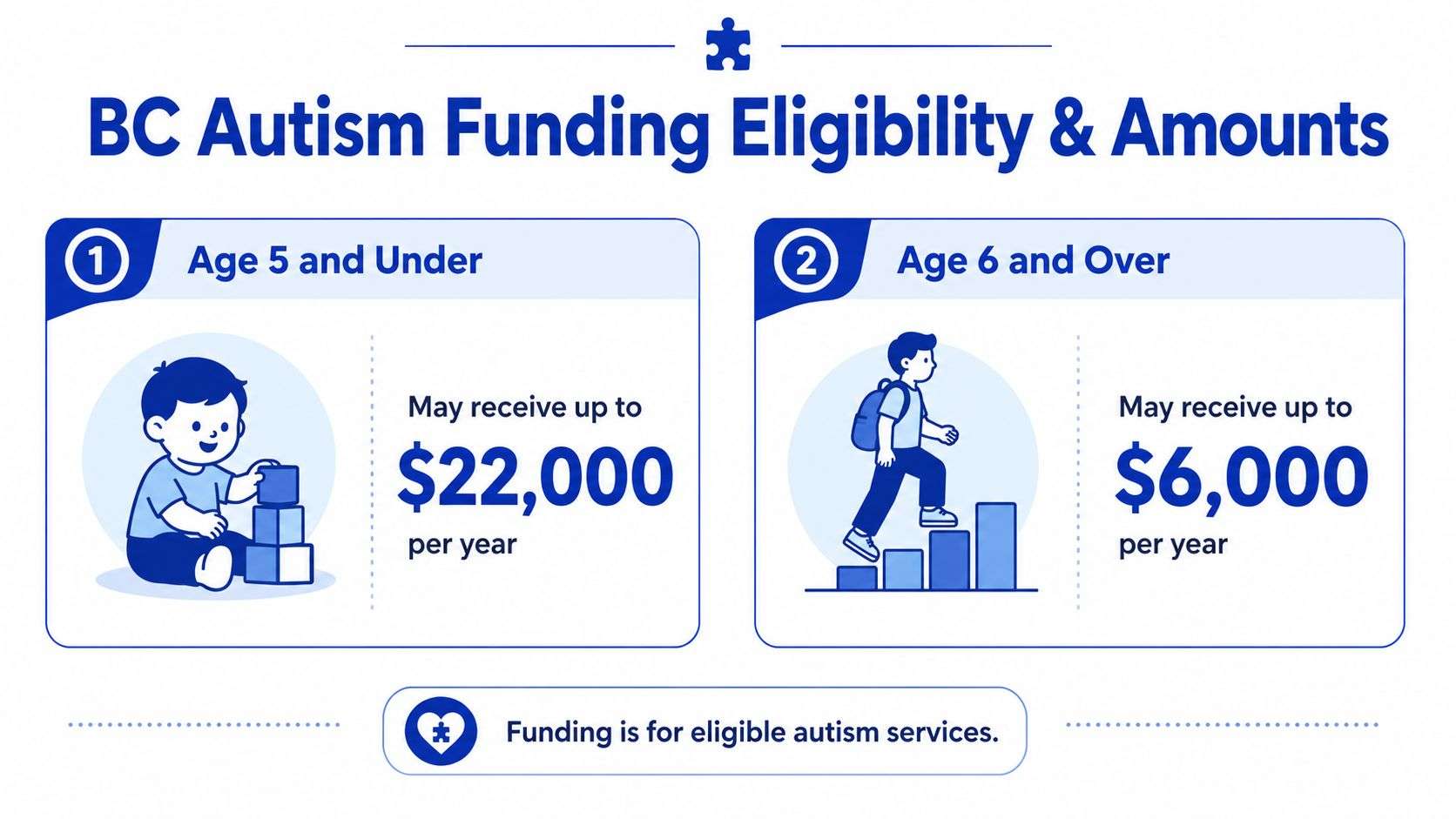
BC Autism Funding is a public program that has been in place since 2002. The province says eligible children five and younger may receive up to $22,000 per year, while children ages 6 to 18 may receive up to $6,000 per year for approved supports, including evidence-informed services, through the program's rules and payment structure. BC Autism Funding amounts and program details
What the age bracket means in real life
The age bracket matters because it determines the funding ceiling, not the counselling itself. A young child and a teenager may both benefit from therapy, but the province places them in different funding categories. That's why families often need to know the child's age-based funding group before they choose a billing route.
For families outside Vancouver or the Lower Mainland, this can be especially helpful. Virtual sessions can be scheduled without travel, and the approved support can often be coordinated around school, work, and sibling routines. The result is a system that can feel more workable than a one-size-fits-all clinic visit.
What counts as eligible support
The province says the funds can be used for evidence-informed services, which is why the fit between the child's needs, the provider's billing setup, and the program rules matters. Autism funding is not a general spending account. It's tied to eligible services and an approval process.
A simple way to think about it is this.
- Age 5 and under: May receive up to $22,000 per year for approved supports.
- Age 6 to 18: May receive up to $6,000 per year for approved supports.
- Service fit: The counselling needs to align with provincial program rules and the provider's billing setup.
That last part is the piece many families miss at first. The service can be clinically appropriate and still need the correct administrative pathway before payment works cleanly.
How Direct Billing and Direct Payment Work Differently
BC families often use “direct billing” and “direct payment” as if they mean the same thing. They don't. The difference matters because it changes who handles the money, when the provider is paid, and what the family needs to authorise before the first session.
The province's Request to Pay process is the direct billing pathway. The family authorises payment through My Family Services before the provider bills the Autism Funding Branch, and the invoice is then sent to the Branch rather than being paid out-of-pocket first. The province also says the provider must be an approved service provider. BC Autism Support Services and therapy payment process
The two paths side by side
| Feature | Request to Pay (Direct Billing) | Direct Payment |
|---|---|---|
| Who receives the funds first | The service provider is paid through the Autism Funding Branch after authorisation | The parent receives the funds |
| Family action needed | Authorise payment in My Family Services before service begins | Pay the provider themselves from the direct payment account |
| Who handles invoices | Provider sends the invoice to the Autism Funding Branch | Parent is responsible for paying the provider |
| Best fit | Families wanting lower-friction billing when the provider is set up correctly | Families approved for the direct payment route |
| Age-related access | Available when the provider and funding rules align | Available for parents of children 12 or older, and for other children 6 to 12 in families with more than one autistic child. Children under 6 do not qualify for direct payment |
Why the distinction matters
Direct billing is not a guarantee of coverage. It's a payment workflow. If the provider's billing profile isn't set up correctly, or if the family hasn't authorised payment in advance, the session can't be treated as billable by default.
Direct payment works differently. Under BC's rules, once approved, $6,000 is paid to the agreement signatory at the start of the first funding period, and the funds must be kept in a separate bank account for the child, with only eligible autism expenses withdrawn from that account. BC Autism Funding direct payment handbook
Practical rule: If you're unsure which route you're on, don't guess. Check the child's age category and confirm whether the family is using Request to Pay or direct payment before the first invoice.
Preparing Documentation Before Your First Online Session
A first virtual appointment goes more smoothly when the paperwork is already lined up. That doesn't mean the process is complicated. It means the provider, the family, and the funding system all need to be pointing in the same direction before the meeting starts.
For an online session, families are usually asked to have proof of diagnosis, the child's age and funding bracket, and the My Family Services authorisation details ready. The parent or guardian also needs to understand whether they're using Request to Pay or direct payment, because the consent and payment steps are different. When the counselling provider is accepting funded sessions, this information helps them book and bill correctly from the start.
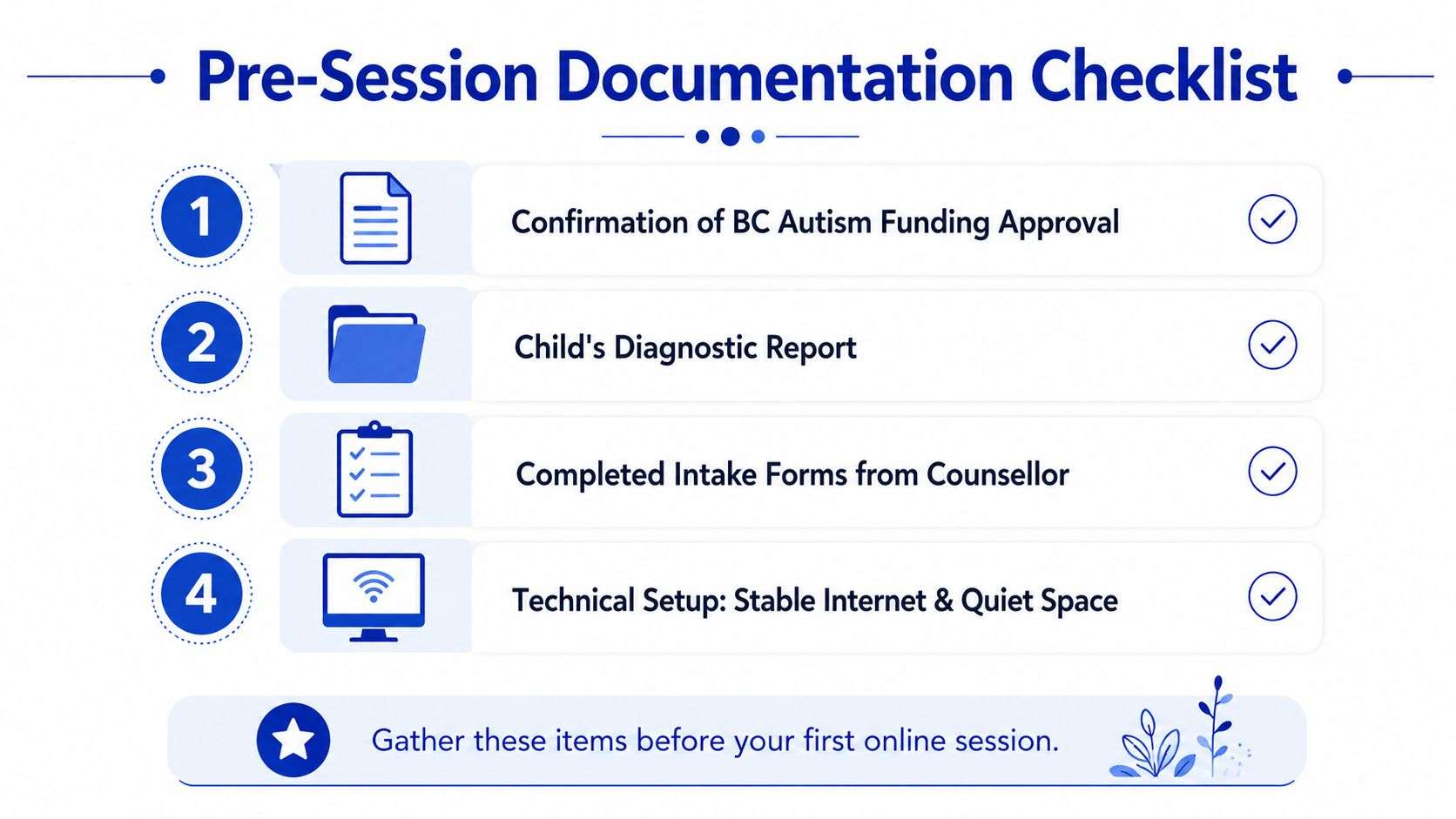
A simple pre-session checklist
- Diagnosis confirmation: Have the child's autism diagnosis documentation available.
- Age and funding bracket: Confirm whether the child is in the five and under group or the 6 to 18 group.
- My Family Services details: Keep the authorisation information close by for billing reference.
- Parent consent: Make sure the direct payment or Request to Pay terms are understood before the first appointment.
If you're still waiting on authorisation
Families often worry that a missing form means they've missed their chance to begin. That's usually not how it works. A provider can often start planning while the administrative side is being completed, especially when everyone knows the child's funding category and the remaining piece is authorisation.
That said, no one should assume payment is automatic just because the first appointment is emotionally urgent. The billing step has to be aligned with the provincial process, and the family should know whether the session is being set up for Request to Pay or direct payment. Clear admin at the start protects the family from surprises later.
What helps most before the camera turns on
A stable internet connection matters, of course, but so does the room itself. A quiet space, a charged device, and a parent nearby for younger children can make the first online appointment feel much less daunting. For children who struggle with transitions, that predictability often matters more than the platform itself.
What a Virtual Autism Counselling Session Looks Like
The first online session is usually calm, structured, and a little slower than parents expect. A counsellor will often begin by checking the connection, reviewing privacy, and making sure the child knows who is in the room and what the plan is. The goal is not to rush into “work”, it's to help the child feel safe enough to participate.
Many families want to know whether virtual care is private enough. In practice, privacy depends on the secure video platform the counsellor uses and the family's setup at home. A closed door, headphones when needed, and a simple plan for who else is in the house can make a big difference.
What the session may include
The first conversation often focuses on three things. The child's communication style, the family's concerns, and the sensory or emotional barriers that make support harder right now. From there, the therapist can tailor the approach to the child rather than forcing a standard format.
Some children use more words. Some use pauses, movement, drawing, or parent support in the background. The point is to create enough safety for the child to engage in the way that fits them.
If you're trying to understand how virtual and in-person child therapy differ in practice, this understanding child psychiatry differences resource from Children Psych offers a helpful way to think about the settings without making online care feel lesser.
A good online session isn't about perfect technology. It's about whether the child can settle, connect, and feel understood enough to keep going.
Common worries parents bring into the room
Parents often ask whether their child is too young for virtual care or whether the connection might drop. Those are real concerns, and they're not silly ones. Yet many children can do well online when the session is paced carefully and the family has a simple home setup.
Families in rural and remote areas often feel the relief most strongly. They don't have to spend the whole afternoon organising travel just to get one hour of support. That can make therapy feel more sustainable over time.
Navigating the 2027 Policy Transition for Ongoing Care
BC has announced that Autism Funding will end on March 31, 2027 and be replaced by a new Disability Benefit. The province also says families will be contacted during the transition, while existing autism funding continues through the current program period. BC financial supports and transition information
For families already using online autism counselling, that announcement raises practical questions. If a therapist relationship is helping, what happens to it when the funding model changes? If sessions are already underway, what happens to billing, authorisation, and approvals while the system shifts? The public guidance confirms the change is coming, but it does not yet spell out the day-to-day billing details families ask about most.
What families can reasonably watch for
The clearest approach is to use the current funding rules as active through 2026, while watching official transition notices closely. Families should check whether their provider still fits the existing billing pathway, and keep an eye on any changes to invoices, authorisation, or eligibility under the new benefit.
A few questions are worth watching early.
- Will the same therapist remain eligible? The public guidance does not clearly answer this for online counselling providers.
- Will invoices change? The transition pages do not say how online counselling invoices should be coded.
- Will direct billing still look the same? Families can expect that to be clarified as the Disability Benefit rollout gets closer.
Why this uncertainty matters
Beyond the funding amount, families need a plan they can trust for continuity. If a child is already comfortable with a therapist, the main concern is usually keeping that support in place. Parents want to know whether they will need to reapply, whether a provider can keep billing, and whether care can continue without another round of stress.
That uncertainty feels even heavier when a family has already done the work of finding a good fit. Therapy is not just a service line on a form. It is a relationship, and relationships are harder to protect when the rules around payment are still changing.
The government pages direct families to My Family Services to check balances and invoices, but they do not yet explain the transition details that matter most for online counselling. That gap is why specific questions matter now, before the changeover creates confusion later.
Keep the focus on continuity. If care is working now, ask what needs to stay in place so it can keep working through the transition.
Common Questions About Funded Online Autism Counselling
Can siblings share autism funding for counselling?
BC's direct payment rules allow some flexibility in multi-child families, but the child's age and the program route still matter. The safest move is to confirm the funding setup for each child before booking.
What happens if a session is missed?
Missed-session handling depends on the provider's policies and the billing pathway already in place. If payment has been authorised through My Family Services, the billing process still needs to match the actual service provided.
Can a family switch providers partway through the year?
Yes, families often change providers when the fit isn't right, but the new counsellor still has to fit the funding and billing rules. Continuity of care matters, so it's best to make the change with the billing side clearly documented.
Will a child lose online support if school gets busy?
Not necessarily. Many families use virtual sessions precisely because they fit better around school calendars and daily routines. The important part is making sure the funding authorisation stays current.
If you're sorting through BC Autism Funding, online sessions, or the transition ahead, Interactive Counselling offers autism counselling for children, teens, and adults, along with secure virtual appointments across BC. You can learn more about their approach and services at Interactive Counselling, especially if you want support that fits both the therapeutic and administrative sides of care.
Clinically Reviewed By
Amy Mosset, MCP, RCC-S
Amy Mosset is a Master Practitioner in Clinical Counselling, Clinical Supervisor, and the owner of Interactive Counselling. She provides trauma-informed, evidence-based care and clinical supervision to registered therapists, with a focus on ethical practice, client safety, and high-quality therapeutic outcomes.