
Three days after a rear-end collision, your living room may be the only place that feels manageable. Your neck is stiff, your sleep is broken, and the thought of driving to a clinic feels like one more task than you can handle. You may also wonder whether counselling makes sense while you're still waiting for the physical effects of whiplash to settle. For more information, see our ICBC counselling.
Online ICBC counselling in BC exists for this early, unsettled part of recovery. A secure video session lets you speak with a registered counsellor from home, without travelling on a painful day or postponing support while your mobility is limited. The process involves more than a video link, though. You'll want to know what stays private, what ICBC covers, how direct billing works, and what your first session will feel like.
Starting Recovery from the Living Room
At first, recovery can feel strangely quiet. You may be resting on the couch, avoiding unnecessary movement, while your mind keeps returning to the crash. Some people feel tense whenever they hear traffic. Others notice irritability, poor concentration, fear of driving, or a body that stays alert long after the collision has ended.
Counselling can help with those reactions even when your physical injuries are still being assessed. You don't need to wait until you have a formal mental-health diagnosis or until your whiplash symptoms disappear. A counsellor can help you understand what you're experiencing, develop grounding skills, and make daily routines feel more manageable.

Why home-based care can matter
Driving to an appointment may be difficult because of pain, dizziness, driving anxiety, lack of transportation, or the simple exhaustion that follows an accident. A virtual appointment removes that particular barrier. You can settle into a quiet room, position your body comfortably, and take part without adding a trip to your day.
The home setting can also make the first conversation feel less exposed. You're not entering an unfamiliar waiting room. You're speaking from a place where you may already have a blanket, water, medication, or another support nearby.
A useful starting point: You don't have to feel “bad enough” to ask for help. If the crash has changed your sleep, mood, sense of safety, concentration, relationships, or confidence, counselling may be worth discussing.
Online care doesn't mean you're left to manage everything alone. A regulated BC counsellor can guide the conversation, explain the next steps, and work at a pace that respects both your emotional state and your physical recovery.
What Online ICBC Counselling Really Means
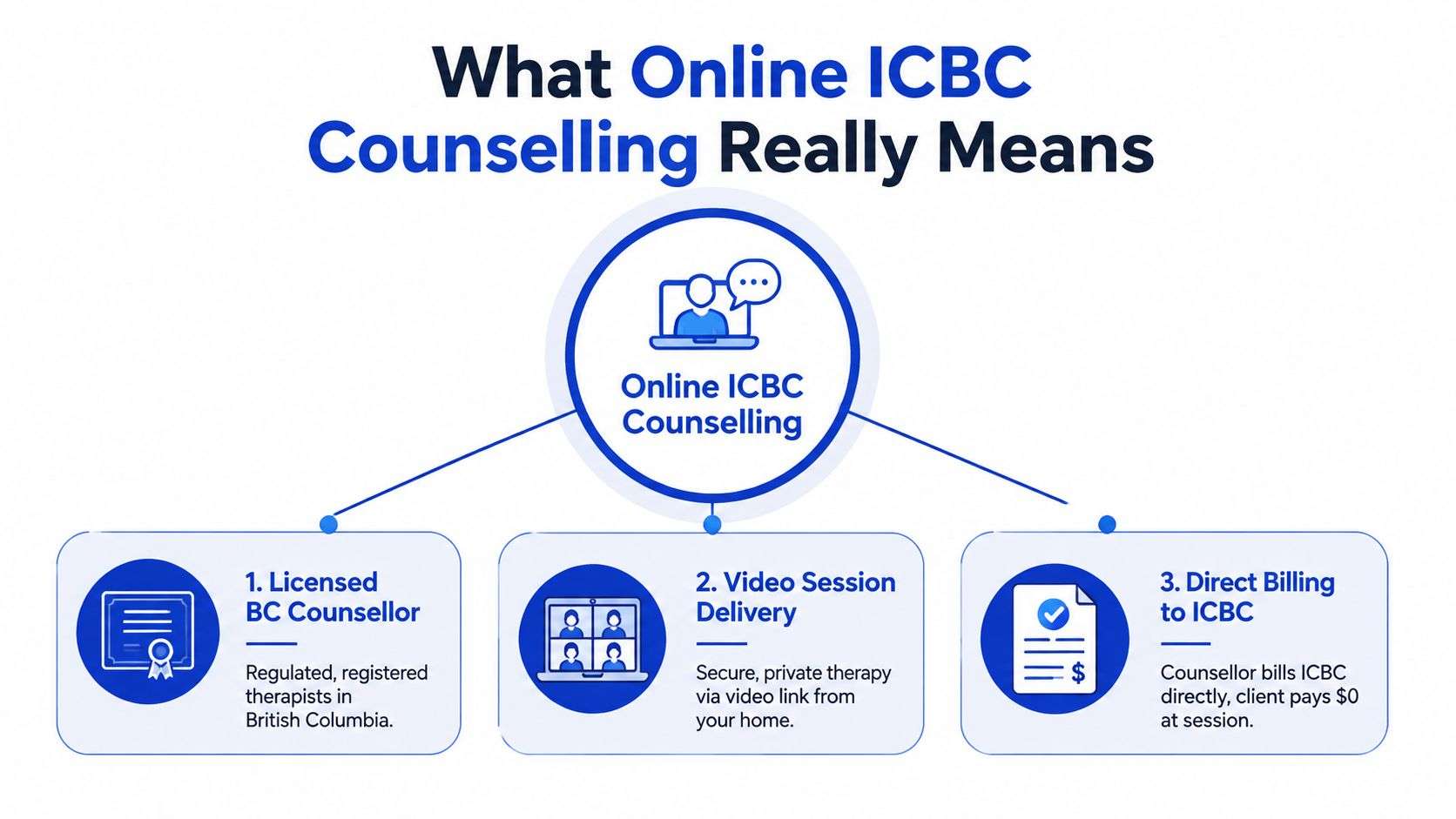
Online ICBC counselling is counselling delivered by a registered BC provider through secure video, with eligible treatment billed directly to ICBC. Direct billing means the counsellor submits the approved session information to ICBC instead of asking you to pay at the appointment and submit receipts yourself.
The current Enhanced Care model applies to crashes on or after May 1, 2021, and automatically pre-approves rehabilitation care for the first 12 weeks after a crash. ICBC specifically includes counselling and psychology among covered treatments, and says those early treatments are available without a doctor's referral. You can review the current treatment and recovery information through ICBC's care and recovery benefits.
The provider matters
Look for a counsellor whose professional registration allows them to provide the service and direct-bill ICBC. You may see designations such as Registered Clinical Counsellor, Registered Social Worker, or another recognised professional designation. A peer-support group, coaching service, or general wellness program may be helpful in another context, but it isn't the same as ICBC-funded counselling.
ICBC's provider directory can identify whether a psychologist or counsellor offers virtual sessions. That gives you a practical way to look for a provider who can meet you at home rather than assuming every listed provider works online.
Virtual and office sessions
The counselling conversation may happen through a laptop, tablet, or phone, but the clinical relationship remains the central part of the work. Approved virtual treatment can be used for covered counselling categories, and ICBC's fee schedule reimburses a virtual 1:1 direct-care session at the same base rate as an in-person standard treatment visit. The schedule lists $157 per visit effective May 1, 2025, and $160 per visit effective April 1, 2026. You can find those details in the ICBC fee schedule for health-care providers.
The point of direct billing is simple. When the claim, provider, treatment category, and billing process line up, home-based care doesn't require you to carry the financial administration while you're trying to recover.
Who Qualifies and What You'll Need to Prove It
The first practical question is whether you have an active ICBC claim. You'll generally need a valid claim number and an accident that falls within the relevant Enhanced Care framework. ICBC's current system applies to crashes on or after May 1, 2021, while some older guidance and online explanations refer to different dates. If your claim is older or your circumstances are unusual, ask the counsellor or ICBC to confirm which rules apply rather than trying to resolve the date from memory.
A doctor's referral isn't required for the pre-approved rehabilitation treatments in the first 12 weeks. You can contact a registered counsellor yourself, and a family doctor or nurse practitioner may also be involved in your care. The counsellor can then confirm the claim details and discuss whether the service fits your recovery needs.
Information that usually helps
Have these details nearby when you make contact:
- Claim number: This lets the provider connect treatment to the correct ICBC file.
- Accident date: The date helps determine which coverage framework applies.
- Basic identification: The counsellor may need to confirm that you're the claimant.
- Health information: Notes from a doctor, nurse practitioner, physiotherapist, or other treating provider can be useful if available, although you don't need to arrive with a complete medical file.
The provider usually handles much of the communication and billing. You may still be asked to sign consent forms or provide information needed for a treatment plan, but you shouldn't have to become an insurance specialist before your first appointment.
You don't need a particular label
People often assume they need a PTSD diagnosis before counselling can begin. That isn't the practical starting point. Post-crash counselling may address anxiety, sleep disruption, panic, driving fear, emotional overwhelm, pain-related stress, irritability, or difficulty returning to ordinary responsibilities.
A pre-existing mental-health condition doesn't automatically prevent support. The important question is whether the accident has contributed to, worsened, or become connected with the current difficulties. A registered counsellor can help clarify that connection and explain what information ICBC may need.
Booking and Attending Your First Virtual Session
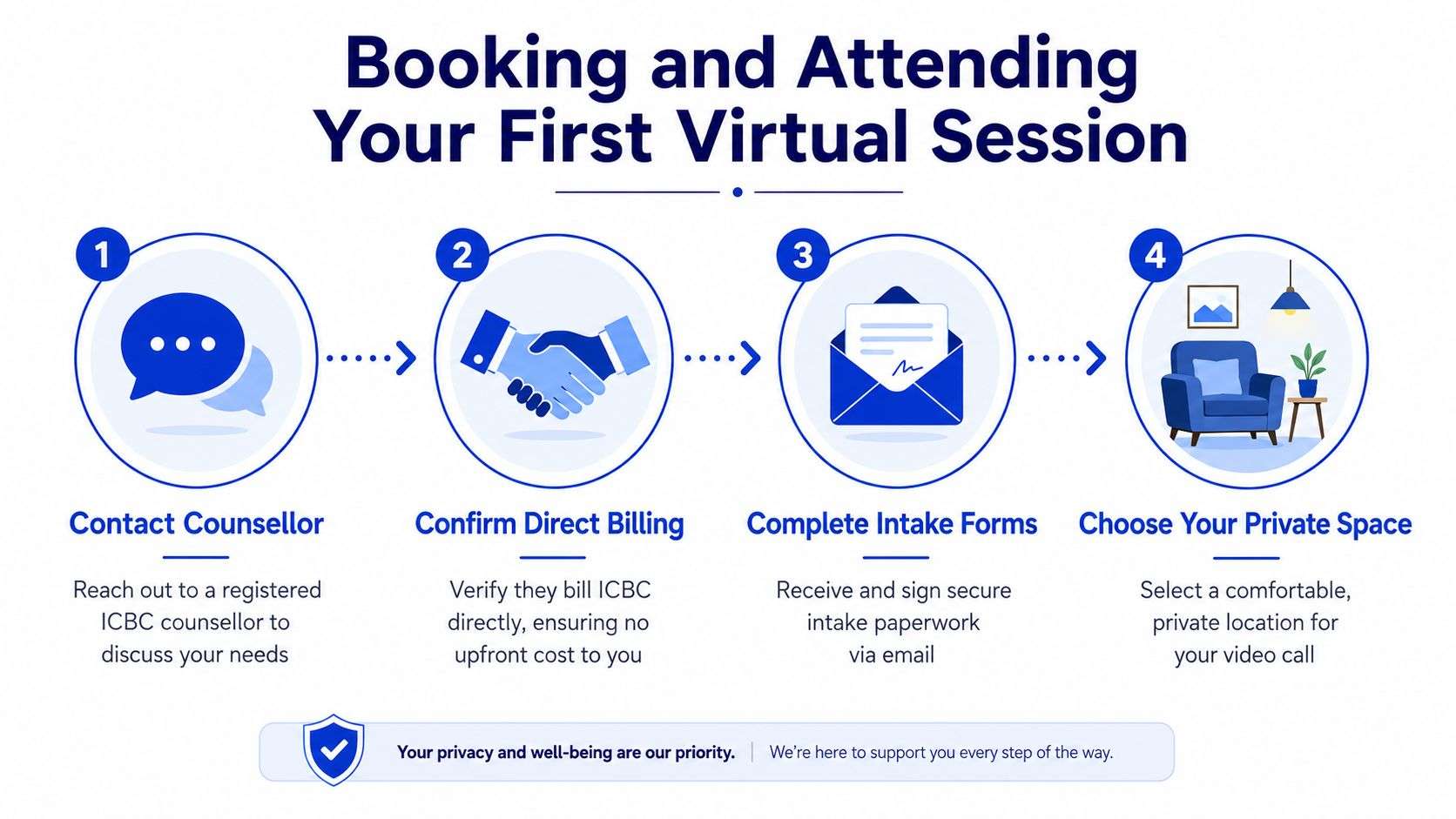
Starting is usually less complicated than it feels from the couch. You contact a registered ICBC counsellor, explain that you have a motor-vehicle claim, and ask whether they offer secure virtual appointments and direct billing. The provider can tell you what information they need before the first session.
Once the appointment is arranged, you may receive intake forms electronically. Read them when you have enough energy, and ask about anything that isn't clear. The forms commonly cover consent, privacy, emergency contacts, claim information, and the concerns that brought you to counselling.
Preparing your space
Choose a place where you can speak without being overheard. It doesn't need to look perfect. A bedroom, a parked vehicle when you're not driving, or a quiet corner with headphones may work if the space is safe and private.
Use a device with a camera and microphone. A stable internet connection helps, but you don't need specialised equipment. Keep your phone nearby in case your counsellor needs to contact you if the video connection fails.
The first few minutes
Your counsellor will usually confirm your identity, review the claim number and consent process, and explain confidentiality. They may ask where you are located and what to do if the connection drops. These questions are about safety and continuity, not an examination.
The conversation often begins with a simple check-in. You might talk about pain, sleep, driving, work, family, or the moment that made you decide to reach out. You don't need to tell the entire accident story in perfect order.
If your Wi-Fi fails, stay calm. The counsellor may reconnect, switch to telephone, or reschedule the remaining portion, depending on the circumstances and the agreed plan. Tell them early if you're uncomfortable with the technology. A good first session makes room for technical uncertainty.
What a Typical Session Looks and Feels Like
A virtual counselling session often follows a familiar rhythm, even though you're sitting at home. The conversation may begin with how the week went, what symptoms changed, and whether anything felt easier or harder. From there, you and the counsellor choose a focus rather than trying to solve every part of recovery at once.
Sessions may use trauma-informed care, cognitive-behavioural therapy, EMDR, somatic awareness, grounding, or other evidence-informed approaches suited to your situation. The method should be explained in plain language, and you should be able to ask questions before trying an exercise.
A steady pace
Some sessions involve detailed discussion of the collision. Others focus on sleep, breathing, driving confidence, communication with family, or managing a nervous system that feels constantly switched on. Progress isn't always dramatic. It may look like noticing a trigger sooner, recovering more quickly after a difficult moment, or completing one ordinary task with less fear.
The counsellor should check your comfort and consent throughout the work. You can pause, ask to slow down, or say that a particular exercise doesn't feel right. Collaborative care doesn't mean avoiding difficult topics. It means approaching them in a way you can tolerate and understand.
Privacy and documentation
A professional counsellor should explain what remains confidential and what may be documented for treatment or ICBC communication. Clinical notes are not the same as a word-for-word transcript, and sessions shouldn't be recorded without your consent. Ask what platform is used, how privacy is protected, and who may receive a progress report.
Remote counselling can also fit alongside physical rehabilitation. If you're coordinating emotional care with pain treatment or another recovery service, you may find it useful to browse our treatment services for information about related rehabilitation options.
ICBC's fee schedule also recognises telephone consultation separately at $15 per 15 minutes, and progress reports at $135 per report. Those figures apply to provider billing arrangements, not an instruction for you to pay the counsellor directly.
Timelines, Outcomes, and the First 12 Weeks
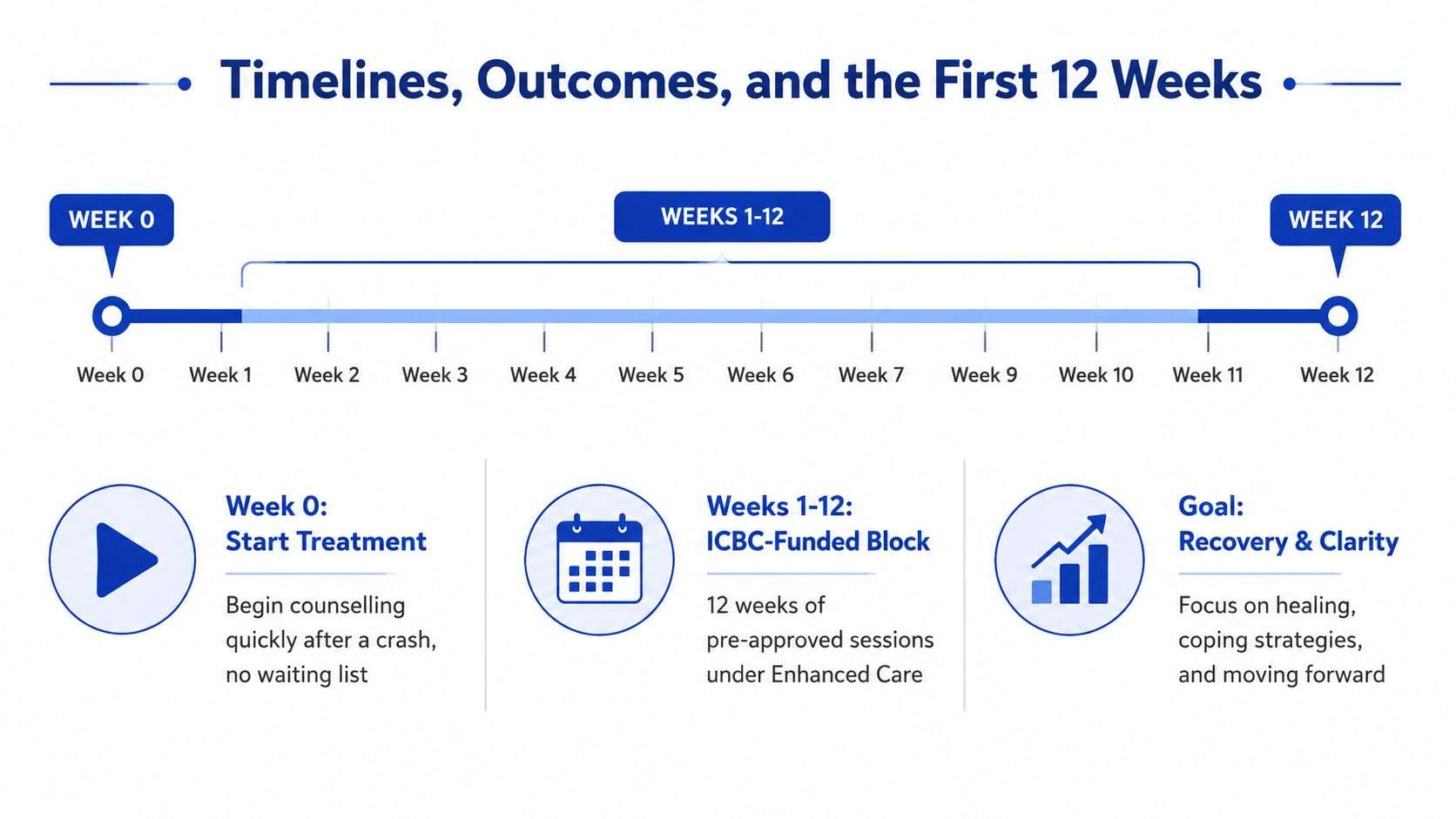
The first 12 weeks after a crash provide a structured entry point to counselling under Enhanced Care. ICBC says injured people are automatically pre-approved for covered rehabilitation treatment during this period, and counselling is among the included services. That removes a common delay, waiting for an insurer to approve the first appointment before support can begin.
Your early work may focus on stabilising daily life. You might learn ways to reduce hyperarousal, settle your body before sleep, manage intrusive memories, organise your thoughts, or begin returning to driving and other routines. These changes often develop gradually rather than appearing as a single clear turning point.
When recovery takes longer
Twelve weeks is a starting structure, not a promise that every person will be finished. If symptoms continue, the counsellor can discuss the clinical reasons for ongoing care and help with the next part of the claims process. ICBC reviews requests for additional treatment according to the circumstances and information provided.
ICBC also says that family members may be eligible for counselling under Enhanced Accident Benefits when recovery takes longer than the initial period. The relevant counselling expenses apply to qualifying crashes on or after May 1, 2021, with expenses incurred as of May 1, 2025, as described in ICBC's guidance for longer recovery.
That matters when a partner, co-parent, or child is affected by the changes at home. The injured person may need help, but family members can also be carrying fear, extra responsibilities, disrupted routines, or uncertainty.
Physical discomfort and emotional strain often influence each other. Alongside counselling, practical information such as these osteoarthritis recovery tips may be useful for people managing broader pain concerns, although post-crash treatment should always be discussed with the appropriate health professional.
Common Questions About Online ICBC Counselling
Is online counselling as private as an office appointment?
It can be, provided you use a secure platform and a private space. Your counsellor should explain confidentiality, documentation, and any limits at the beginning. At home, privacy also depends on your surroundings, so headphones and a closed door may help if others are nearby.
What technology do I need?
A phone, tablet, or computer with a camera and microphone is usually enough, along with an internet connection that can support video. You don't need a complicated setup. Ask the provider whether you need to download anything, and test the link before the appointment if you're uncertain.
What happens if the connection drops?
Your counsellor should agree on a backup plan with you. They may reconnect through the same link, call you by telephone, or arrange another appointment if the interruption prevents safe and useful care. Keep your phone close and make sure the provider has the correct number.
Can I change counsellors?
You can ask to speak with another registered provider if the fit doesn't feel right. Counselling works best when you feel safe enough to be honest, so discomfort about the relationship is worth raising rather than abandoning care. Ask how the new provider will receive relevant claim and treatment information so you don't have to repeat everything unnecessarily.
Can family members attend?
Family participation depends on the purpose of the appointment, consent, and the applicable ICBC benefits. A partner or other family member may be involved in a joint session, and ICBC says family members may also qualify for counselling in certain longer-recovery circumstances. Ask the counsellor to explain whether the family member needs a separate appointment or claim-related documentation.
If ICBC requests more information, don't assume you've done something wrong. Your counsellor can explain what the request concerns, what needs to be documented, and whether any further consent is required. ICBC's provider guidance says invoices should be submitted within 45 days of the treatment date, and late invoices may not be paid at ICBC's sole discretion, so timely provider administration matters.
A Gentle Next Step When You're Ready
If you're recovering from a crash in BC, online counselling can give you a practical way to begin without travelling. Under Enhanced Care, eligible counselling is included among the pre-approved rehabilitation treatments for the first 12 weeks, and approved providers can direct-bill ICBC. You can attend from home, ask questions about privacy and consent, and move through the work without treating recovery like a race.
Before booking, gather your claim number and accident date, then ask the counsellor whether they offer secure virtual care and direct billing. You can also confirm how they handle interruptions, family involvement, progress reports, and requests for continued treatment.
Interactive Counselling provides ICBC-funded counselling through secure virtual and telephone sessions, with registered counsellors supporting post-accident anxiety, trauma, sleep disruption, driving concerns, pain-related stress, and changes in daily life. When you feel ready, you can reach out to confirm eligibility, ask about your claim, or arrange an initial conversation.
Recovery may begin with something small. From the living room, a secure conversation can be one steady step forward.
Interactive Counselling offers registered, evidence-informed support for people recovering emotionally after a motor-vehicle accident, including secure online sessions and ICBC direct billing for approved care. Visit Interactive Counselling to learn more or contact the team when you're ready to ask about your next step.
Clinically Reviewed By
Amy Mosset, MCP, RCC-S
Amy Mosset is a Master Practitioner in Clinical Counselling, Clinical Supervisor, and the owner of Interactive Counselling. She provides trauma-informed, evidence-based care and clinical supervision to registered therapists, with a focus on ethical practice, client safety, and high-quality therapeutic outcomes.