You're sitting with a coffee in Penticton, scrolling through counsellor profiles and wondering whether the person behind the website will understand your life. Will they use your pronouns without making you explain them? Will they assume every partner is cisgender and heterosexual? Could you run into them at the farmers' market, or will a private conversation somehow become visible in a smaller community? For more information, see our Penticton counselling.
Those concerns are reasonable. LGBTQ2S+ affirming counselling in Penticton should offer more than polite acceptance. It should provide a setting where 2S/LGBTQIA+ clients can discuss anxiety, depression, trauma, relationships, family, identity, transition, grief, or substance use without defending who they are.
This guide explains what affirming care looks like in practice, why it differs from general counselling, how intake and sessions may work, what virtual and in-person options can offer, and how to identify a therapist who is prepared to support you. Take your time reading. The questions already on your mind deserve clear, compassionate answers.
Starting the Search for a Counsellor You Can Trust
For someone in Penticton or elsewhere in the Okanagan, looking for a counsellor can bring a particular kind of uncertainty. You may want local support, but local visibility can feel complicated. A therapist might know people in your community, shop at the same places, or work in a building you pass regularly. Even when confidentiality is carefully protected, the possibility of being recognised can make reaching out feel exposed.
You may also be wondering whether a counsellor will understand the difference between being lesbian, bisexual, gay, trans, non-binary, Two-Spirit, queer, questioning, or another identity. Perhaps you've already had an experience where someone was friendly but still made assumptions about your body, relationships, family, or future. You shouldn't have to spend your session teaching a clinician basic language before you can talk about what hurts.
A useful starting point: You're allowed to ask whether a counsellor has experience supporting clients with identities and concerns similar to yours before sharing personal details.
Affirming counselling begins with the therapist's approach, but it also includes the practical environment around therapy. That can mean inclusive intake forms, respectful questions about pronouns, careful conversations about confidentiality, and referrals that don't force you to explain your identity repeatedly. It also means understanding that coming out, transition, family conflict, discrimination, relationship stress, and trauma may overlap, but they aren't problems caused by LGBTQ2S+ identity.
A Penticton practice may support clients in person, through secure video, or by phone, depending on location, privacy, accessibility, and preference. Virtual sessions can be especially useful if you live in Summerland, Oliver, or another Okanagan community, or if attending a local office could raise privacy concerns.
You don't need to decide everything before making contact. A brief intake conversation can help you ask about fit, pronouns, privacy, session format, and the therapist's experience. Keep reading at your own pace, and notice which questions feel most important to you.
What LGBTQ2S+ Affirming Counselling Actually Means
LGBTQ2S+ affirming counselling is therapy where your sexual orientation, gender identity, gender expression, relationship structure, and lived experience are treated as valid parts of your life. You aren't expected to prove your identity, explain why it matters, or make yourself easier for the therapist to understand.
Affirming care doesn't mean the therapist assumes every difficulty comes from discrimination or identity. Instead, the counsellor stays curious about the whole person. They might explore family relationships, work, health, grief, sexuality, culture, spirituality, body image, or trauma while recognising that minority stress can shape how those experiences feel.
General counselling can still be respectful and helpful. A well-meaning therapist may offer warmth and strong clinical skills but lack familiarity with chosen family, gender-affirming language, coming-out decisions, relationship diversity, or the effects of repeated misgendering. Affirming practice adds specific awareness to the therapeutic relationship.
A simple analogy can help. A clinic may be friendly to wheelchair users, but an accessible clinic considers the entire experience, from the entrance to the exam room. Similarly, an affirming counsellor considers the full client experience, from the first form and email to the language used in session and the referrals offered afterward.
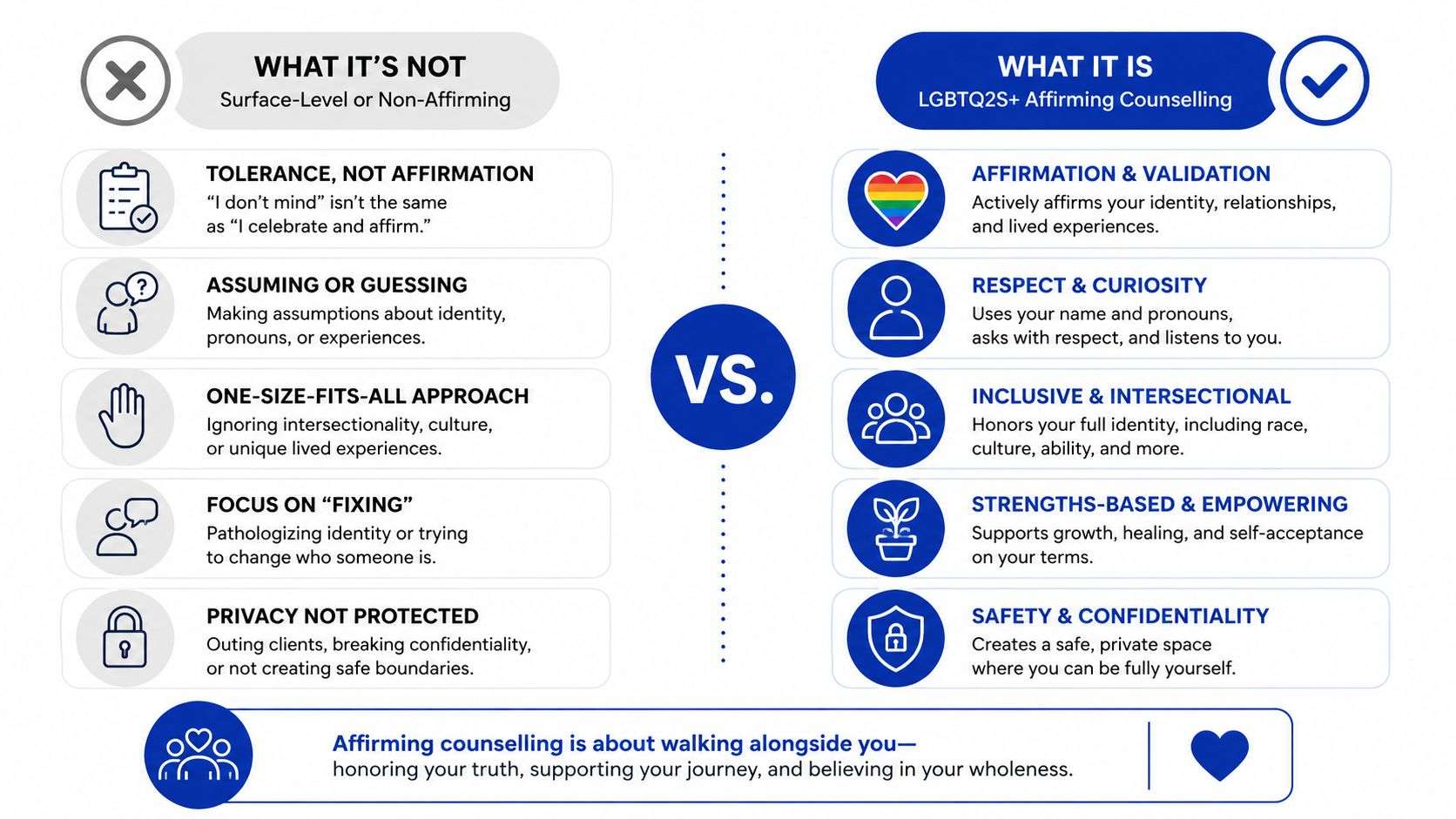
What affirming practice changes
Affirming care is not one therapy technique. It's a stance that influences how the counsellor listens, asks questions, documents information, and responds when something is difficult.
- Language: The therapist asks what name and pronouns you use, and follows your lead.
- Relationships: They don't assume monogamy, heterosexuality, or biological family structures.
- Identity: They understand that questioning, changing, or keeping parts of your identity private can all be valid.
- Safety: They consider the social, family, workplace, and community context around your goals.
- Referrals: They aim to connect you with services that are respectful and relevant.
The therapist's role isn't to tell you who you are or what decisions to make. It's to help you understand your experiences, strengthen coping skills, make choices that fit your values, and recover from pain without treating your identity as something that needs correction.
Why Affirming Care Matters for 2S/LGBTQIA+ Clients
A person in Penticton may contact a counsellor after being misgendered in healthcare, dismissed by family, or pressured to explain an identity before feeling safe. Finding support should not require repeating that experience. The need for affirming care is rooted in unequal access and unequal mental-health burden, while LGBTQ2S+ identity itself is not a problem to correct.
In British Columbia, a federal survey found that only 16% of BC respondents had access to LGBTQ2-specific mental-health services. 55% reported access only to general mental-health services, and 16% had no access to mental-health services. These findings are reported by Women and Gender Equality Canada.
Nationally, 4.4% of Canadians aged 15 and older, about 1.3 million people, identify as 2SLGBTQ+. The population is significant, yet specialised support remains uneven. 29.7% of 2SLGBTQ+ people aged 15 and older rated their mental health as fair or poor, compared with 9.1% of non-2SLGBTQ+ people, according to national 2SLGBTQ+ mental-health data.
Youth face particularly serious concerns. In 2022, 27% of 2SLGBTQ+ youth met criteria for a major depressive episode, compared with 11% of cisgender heterosexual youth. About 25% reported thoughts of suicide, compared with 5% of cisgender heterosexual youth, as reported in Statistics Canada's youth mental-health findings. A BC report also found that 47% of non-binary youth self-harmed in the past year, a finding included in federal facts and statistics on 2SLGBTQI+ communities.
| Indicator | 2S/LGBTQIA+ population | General population |
|---|---|---|
| Mental health rated fair or poor | 29.7% | 9.1% |
| Major depressive episode among youth in 2022 | 27% | 11% |
| Thoughts of suicide among youth in 2022 | About 25% | 5% |
| Access to LGBTQ2-specific mental-health services in BC | 16% | Not provided |
These figures can reflect experiences of dismissal, misgendering, forced disclosure, or treatment that frames identity as the central difficulty. In a Penticton practice, affirming care can begin during intake by asking what name and pronouns to use, what privacy boundaries matter, and whether in-person or virtual sessions feel safer. Virtual care may also help someone who is not out locally, while in-person counselling can offer a steady space away from home or work.
A supportive session leaves room for the client's own pace and choices.
Therapy Approaches and Services Offered
Affirming counselling isn't a fixed menu that every client must follow. A therapist may recommend an approach based on your goals, history, nervous-system responses, relationships, and comfort level. You remain part of the decision, and the focus can change as your needs change.
Working with trauma and strong emotions
Trauma-informed talk therapy creates space to understand what happened without forcing a detailed account before you feel ready. It can support clients dealing with discrimination, family rejection, violence, medical trauma, or earlier experiences that still affect trust and safety.
EMDR may help process distressing memories and reactions. Somatic or body-based work pays attention to sensations, tension, shutdown, and activation, which can be useful when your body reacts before you can explain why.
CBT helps identify patterns between thoughts, feelings, and behaviour. DBT skills can offer practical tools for emotional regulation, distress tolerance, boundaries, and communication. IFS uses a parts-based framework to explore inner conflict with curiosity rather than shame.
Grief and loss counselling can address the death of a loved one, the end of a relationship, changes in family connection, loss of community, or the complicated feelings that can accompany identity and transition.
Identity, relationships, and life changes
Some clients want support with coming out, while others need help deciding whether, when, or where disclosure feels safe. Therapy can also support transition-related mental health, body distress, family conversations, workplace concerns, and the emotional impact of navigating systems that don't always understand gender diversity.
Relationship and family therapy can include couples, chosen family, parents, siblings, and co-parents. An affirming counsellor may also offer poly-aware and kink-aware support, without treating consensual relationship structures as symptoms.
Substance-use counselling should honour lived experience and avoid shame. It can explore coping, safety, harm reduction, trauma, relationships, and the reasons a substance may have become important.
Services may be available to individuals, couples, and families across the Okanagan. Where appropriate, ICBC-related injury and trauma counselling can also be part of care. Interactive Counselling is one practice that lists LGBTQ2S+ affirming counselling among its Penticton service areas, alongside broader counselling for individuals, couples, families, children, and youth.
The best approach is the one that fits your goals and feels emotionally manageable. You can ask why a modality is being suggested, what a session might involve, and whether you can pause or change direction.
What to Expect from Intake and Sessions
The first contact may happen through an online form, email, or phone call. You don't need to tell your entire story at this stage. A brief intake conversation usually helps the practice understand what brings you in, what kind of support you're seeking, and whether a particular counsellor or format may fit.
You can ask for the therapist's experience with 2S/LGBTQIA+ clients, how names and pronouns are recorded, whether virtual sessions are available, and what privacy arrangements exist. It's also reasonable to mention accessibility needs, preferred communication, language, sensory considerations, or concerns about being seen entering an office.
The first session
A first session often begins with introductions and a conversation about informed consent. The counsellor should explain confidentiality, its limits, how records are handled, and how you can ask questions. You can share what feels safe, and you can say that there are topics you aren't ready to discuss.
The therapist may ask about your goals, current stressors, support system, health, relationships, and previous counselling. Affirming questions are open rather than assumptive. For example, they may ask who matters to you or what language feels right, instead of guessing your partner's gender or your family structure.
Ongoing sessions may be in person at a Penticton office, by secure video, or by phone. Clients in Summerland, Oliver, and other Okanagan communities may prefer virtual care because it reduces travel and can offer more control over the setting.
Choosing the setting that feels safest
In-person sessions can provide a clear separation between therapy and home life. Virtual sessions can help if you aren't out locally, if transportation is difficult, or if entering a familiar office feels uncomfortable. A walk-and-talk session may be appropriate for some clients when the therapist offers that format and the setting supports privacy and safety.
Before a virtual appointment, consider whether headphones, a private room, or a planned explanation for your absence would help. If you live with family or roommates, you can discuss privacy risks with the counsellor before beginning.
There isn't one correct way to attend therapy. The useful format is the one that allows you to speak with enough privacy and steadiness to participate.
How to Choose an Affirming Therapist
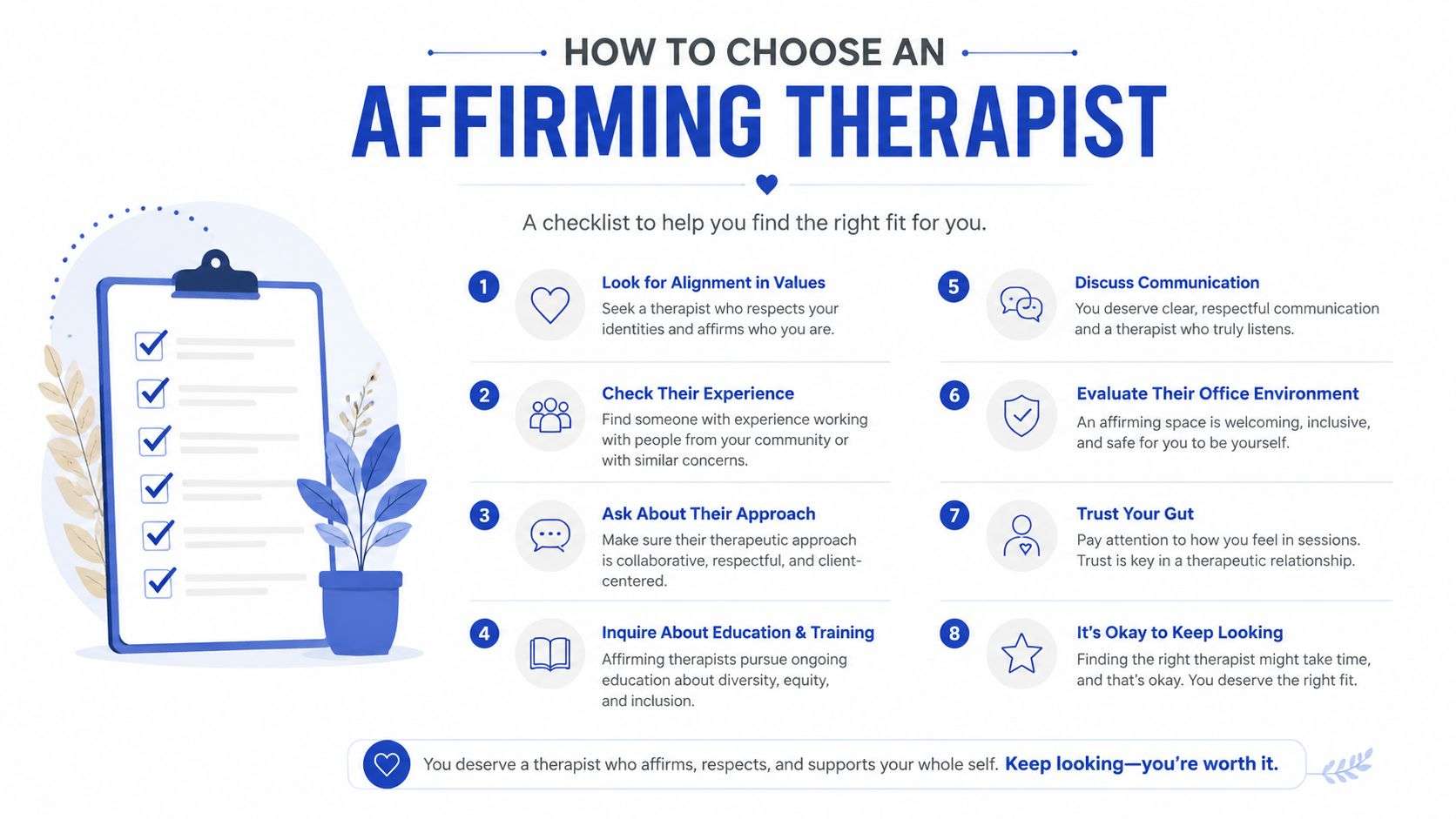
Choosing a counsellor shouldn't feel like an exam you have to pass. Think of it as checking whether the therapist can offer the kind of relationship you need.
Start with the public information available on a counsellor's website or biography. Look for explicit mention of 2S/LGBTQIA+ experience, inclusive language, and support for concerns such as coming out, gender identity, relationships, or minority stress. Pronouns can be helpful, though their presence alone doesn't prove clinical experience.
A short consultation can answer questions that a profile can't. You might ask:
- Relevant experience: “What experience do you have supporting queer, trans, Two-Spirit, non-binary, or questioning clients?”
- Responding to mistakes: “If you use the wrong name or pronoun, how do you handle it?”
- Clinical coordination: “Can you coordinate with trans-affirming medical providers if I want that support?”
- Privacy: “How do you protect confidentiality in a smaller community?”
- Therapy style: “How do you decide which approach may fit my goals?”
A good response doesn't need to sound perfect. It should be direct, respectful, and willing to explain the therapist's training and limits.
You can evaluate the relationship, not just the credentials: Notice whether you feel more at ease after asking a question, or more responsible for protecting the therapist's feelings.
Warning signs include deflecting identity questions, describing queerness as a problem to solve, refusing to discuss training, insisting on language that doesn't fit you, or treating every concern as an identity issue. A therapist may make an occasional language mistake. The important question is whether they acknowledge it, repair the moment, and adjust.
You can also seek practical family-building information outside counselling. For example, people researching LGBTQ-friendly adoption resources may review friendly adoption agencies in Texas as a separate legal and family-planning resource. It isn't a substitute for counselling, but it may help clarify questions you want to bring into therapy.
Switching therapists is allowed. Fit can take more than one conversation, and changing direction doesn't mean you failed.
Privacy, Safety, and Local Considerations
Privacy can feel especially important in Penticton when social circles overlap. You may know people who work in health care, share services with neighbours, or worry about seeing your counsellor outside the office. Ethical counselling includes confidentiality, but you're entitled to ask how confidentiality works in that specific practice.
Ask who can access your records, how electronic information is protected, what appears in appointment reminders, and whether you can use a chosen name or nickname in routine communication. You can also ask how much detail the counsellor needs to document and whether there are notes you want to discuss before they're entered into the record.
For youth who aren't out to family, planning matters. A young person may need help choosing a private place for a video session, arranging safe contact, or deciding what can be discussed with parents, schools, doctors, or other supports. A counsellor can coordinate with school staff or health professionals only with appropriate consent, except where legal or serious safety obligations apply.
Planning for a safer appointment
- Choose communication carefully: Ask whether email, phone, or text creates the least risk for you.
- Protect your setting: Use headphones and a private room for virtual sessions when possible.
- Discuss logistics: Ask about entrances, waiting areas, parking, and appointment timing.
- Name your concern: Tell the therapist if being recognised or outed is a fear.
- Make a safety plan: If home isn't private, identify another safe location before booking virtual care.
A counsellor should explain the limits of confidentiality clearly, including circumstances involving an immediate safety concern or legal reporting responsibility. The details depend on the client's age, situation, and applicable professional obligations, so ask rather than guessing.
BC has a province-wide gender-affirming care infrastructure through Trans Care BC, described by the provincial health authority as a clinical program created in 2015 to coordinate and improve trans health and wellbeing services. Provincial health messaging also describes movement toward trauma-informed, gender-affirming, and gender-additive care, with attention to trans, Two-Spirit, and non-binary people. The Provincial Health Services Authority briefing on gender-affirming care provides this background.
Privacy works best as a partnership. You can tell your counsellor what feels risky, ask for adjustments, and revisit the plan as your circumstances change.
FAQ and Your Next Steps
Are virtual sessions as useful as in-person affirming counselling? They can be, when the setup supports privacy and connection. Interactive Counselling can explain the secure platform used, help you test your camera and microphone, and discuss what to do if the connection drops. Ask how records, messages, and session access are protected, and choose a private room, headphones, and a device that others cannot monitor. In-person care may feel better if home technology or privacy is unreliable.
Do I need to be out before starting counselling? No. You can discuss identity, uncertainty, disclosure, or safety without telling family, friends, workmates, or anyone else. Intake can begin with only the information you feel ready to share.
How can I start a conversation with a partner or family member? Begin with a small statement about needing support rather than explaining everything at once. A counsellor can help you plan the timing, language, boundaries, and safety considerations. You can also decide what topics remain private.
To begin, call Interactive Counselling at the number on its website, send a message through the contact form, or ask about a brief intake conversation before booking.
Interactive Counselling offers LGBTQ2S+ affirming counselling in Penticton for individuals, couples, families, children, and youth through in-person and secure virtual sessions. Visit Interactive Counselling to learn more and consider whether the service fits your needs.