You may be searching for a counsellor in Vernon while wondering whether you'll need to explain your identity before anyone can help. Perhaps a previous healthcare experience left you cautious, or your teenager has been struggling with school, family tension, anxiety, or coming out. Finding LGBTQ2S+ affirming counselling in Vernon should mean more than finding a website that says everyone is welcome. It should mean finding care that respects who you are in the small, practical moments that shape trust. For more information, see our Vernon family counselling.
Starting the Search for a Counsellor Who Truly Sees You
A person might begin searching late at night, moving between counselling websites and trying to interpret a few carefully chosen words. “Inclusive,” “safe,” and “welcoming” can sound reassuring, but they don't always explain what will happen when you share your name, pronouns, relationship, family structure, or fears about discrimination. For more information, see our counselling in Vernon.
Someone in Vernon may be looking for support after being misgendered in another healthcare setting. A parent may be trying to help a child who has become withdrawn after conflict at school. A couple may want to discuss transition, intimacy, family expectations, or the impact of stigma without having to educate the therapist first. For more information, see our family counselling.
These concerns are understandable. In Canada, 29.7% of 2SLGBTQ+ people aged 15 and older reported fair or poor mental health, compared with 9.1% of non-2SLGBTQ+ people, according to the Government of Canada's 2SLGBTQI+ facts and statistics. That gap reflects the effects of discrimination, minority stress, isolation, and barriers to care. It doesn't mean an LGBTQ2S+ identity is a mental illness. It means social conditions can place an unfair burden on people.
You're allowed to be selective. A counselling relationship should give you room to be understood, not require you to defend your identity.
Vernon and the surrounding Interior communities can bring particular access questions. You may need to consider whether in-person care feels comfortable, whether phone or secure virtual sessions would reduce travel and privacy concerns, and whether a provider can support the whole picture, including family relationships, school stress, trauma, depression, anxiety, or grief.
Seeking counselling isn't a small step. You don't have to wait until distress becomes overwhelming, and you don't have to choose the first provider you contact. A thoughtful search begins with knowing what affirming care looks like in practice.
What LGBTQ2S+ Affirming Counselling Means
Affirming counselling is active care, not a slogan. It works like adjusting a doorway so people can enter without having to change themselves first. A therapist does not decide what an identity means to you. They create room for you to describe yourself in your own words and choose what you want to discuss.
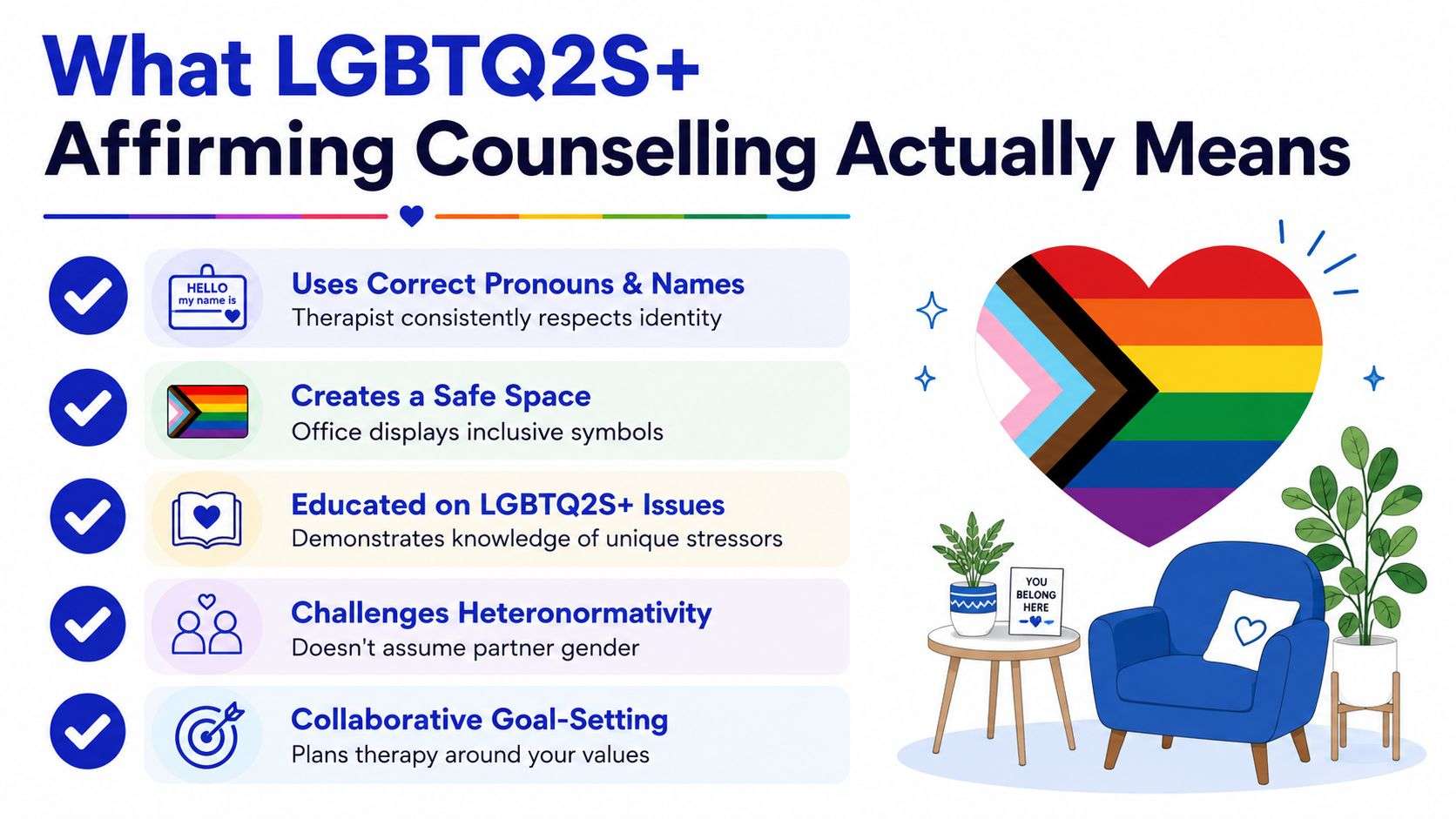
The Canadian Psychiatric Association's guidance for 2SLGBTQ+ patients points to practical behaviours that make care inclusive. These include using a patient's chosen name and pronouns, writing forms and interview questions in inclusive language, avoiding assumptions about sexual orientation or gender identity, displaying inclusive materials, offering gender-inclusive bathrooms, and maintaining a nondiscrimination policy that names sexual orientation, gender identity, and gender expression. For someone seeking counselling in Vernon, these details can reveal whether inclusion is part of everyday practice or only a statement on a website.
What you can observe
A practice may demonstrate affirming care by:
- Using correct names and pronouns: Intake records and session communication follow the client's stated language.
- Asking open questions: A therapist might ask, “Who are the important people in your life?” rather than assume a husband, wife, boyfriend, or girlfriend.
- Making forms flexible: Clients can describe gender, relationships, parenting roles, and family structures without selecting inaccurate categories.
- Naming boundaries clearly: Privacy, confidentiality, and nondiscrimination policies are easy to locate and understand.
- Recognising specific stressors: The counsellor understands how misgendering, family rejection, workplace discrimination, and fear of disclosure can affect mental health.
Affirming care includes repair when something goes wrong. A therapist should acknowledge the mistake, correct their language, and avoid making the client comfort them. The Centre for Addiction and Mental Health's counselling resource describes creating an environment where LGBTTTIQ clients feel comfortable discussing sexual orientation and gender identity.
“Everyone is welcome” may be a starting point. The stronger evidence appears in ordinary routines, where respect becomes visible and safety feels practical.
Why Affirming Care Matters for Mental Health
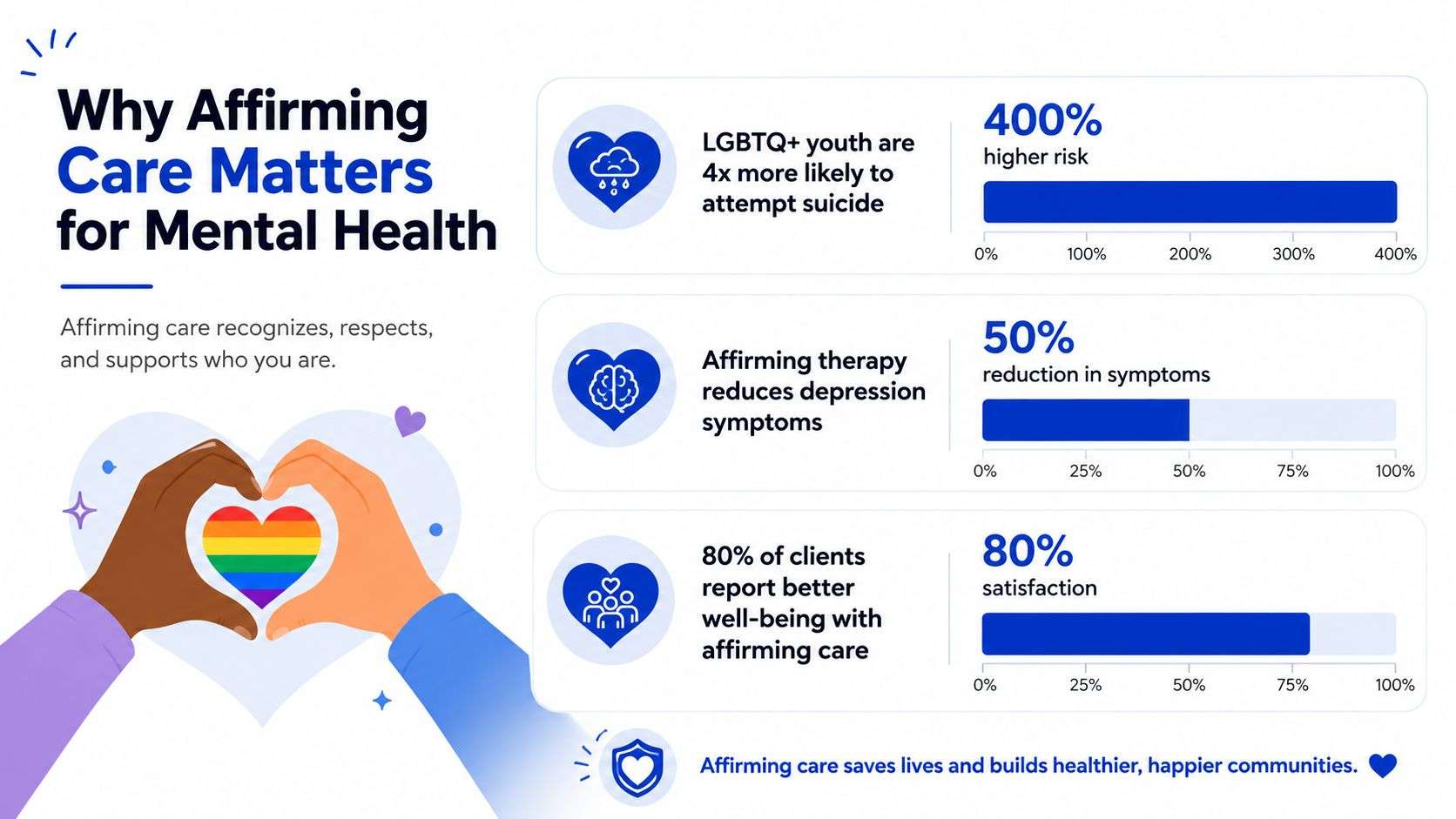
A client in Vernon may enter counselling carrying anxiety, depression, or thoughts of self-harm, while also deciding how much to reveal about a partner, family conflict, or gender identity. Minority stress helps explain why these concerns cannot be understood only as individual problems. Stigma, discrimination, concealment, rejection, harassment, and repeated questioning can create an added strain. Affirming care cannot remove every outside stressor, but it can reduce the need to anticipate judgment in the counselling room.
Canadian research shows the seriousness of this need. Transgender and gender-diverse people face substantially poorer mental health outcomes than the general population, while access to 2SLGBTQI+-specific services remains limited. The federal survey findings on health and wellbeing also point to gaps that matter in British Columbia, including uncertainty about where identity-affirming support is available. In a smaller community such as Vernon, finding a provider with relevant training may require more deliberate searching, especially when travel, privacy, or wait times affect access.
Safety supports honest therapy
Safety works like a clear doorway. When clients expect respect, they can bring more of their actual experience into the room. Someone may discuss a partner openly, describe family rejection, or mention suicidal thoughts without first having to explain or defend their identity. That fuller context helps a counsellor assess risk and choose support that fits the person's life.
Youth require particular care. Statistics Canada reports that more than half of 2SLGBTQ+ youth met criteria for a mental health or substance use disorder in the past 12 months, and about 25% reported suicidal thoughts, compared with 5% of cisgender heterosexual youth, as described in Statistics Canada's article on the mental health of 2SLGBTQ+ Canadians. These findings do not mean identity causes mental illness. They show why family responses, school pressures, isolation, and access to supportive care deserve careful attention.
For adults and young people alike, competence is part of safety. An affirming counsellor can explore identity-related stress while still treating the concern that brought the client in. The result is care that makes room for the whole person, rather than asking them to separate mental health from the conditions shaping it.
What You Can Expect in an Affirming Counselling Session
A first session should feel like an orientation, not an examination. The counsellor may ask what brought you in, what you hope will change, and what language you'd like them to use. Questions about identity should be relevant, open-ended, and paced according to your comfort.
You might say, “I use they and them pronouns, but my family still uses my old name.” Or you might not want to discuss gender at all during the first appointment. Both choices deserve respect. Your identity can be relevant to therapy without becoming the only topic of therapy.

The work follows your goals
Affirming counselling may include support with:
- Anxiety or depression: Exploring symptoms alongside workplace discrimination, family stress, isolation, or fear of disclosure.
- Identity exploration: Making space for questions without treating uncertainty as a problem to solve.
- Coming out decisions: Considering safety, timing, support networks, housing, school, and employment.
- Dysphoria or body-related distress: Discussing the client's experience without imposing a particular transition path.
- Relationship concerns: Working with partners on communication, intimacy, transition, or differing levels of readiness.
- Microaggressions: Processing a comment at work or school, identifying its impact, and deciding what response fits the client's values.
A teenager might describe feeling tense every morning before school. The counsellor can explore whether that anxiety relates to academic pressure, bullying, name use, changing rooms, family communication, or several factors at once. A client who experienced misgendering at work might want emotional support, practical boundary-setting, or a place where the incident doesn't need to be explained away.
If a counsellor slips with a pronoun, the repair matters. A brief correction and sincere apology should return attention to the client rather than turning the session into reassurance for the therapist. Good care is not defined by never making a mistake. It's defined by accountability, learning, and respect.
How to Choose a Provider in Vernon
A first email or phone call can reveal how a counsellor works before you book. Ask whether chosen names and pronouns are recorded in the intake form and client file, how staff use them in messages, and what training or supervision supports their 2SLGBTQ+ practice. You can also ask whether they have worked with concerns such as coming out, family conflict, transition, trauma, or youth mental health.
The details matter because intake language sets the tone for later care. A form that offers space for a chosen name, pronouns, gender identity, and relevant relationships gives you room to describe yourself without correcting the record at every appointment. Clear documentation should also protect privacy, especially when a family shares a home or receives messages on the same phone.
Access can be less straightforward in the North Okanagan. MindMapBC indexes LGBTQ/2S*/+-affirming, low-barrier mental health and substance-use services, including self-referral, remote, free, low-cost, and sliding-scale options. In Vernon, compare in-person, phone, and secure virtual sessions, then ask about referral requirements, wait times, cancellation policies, and how confidential contact is handled.
BC respondents reported limited access to LGBTQ2-specific mental health services, as noted earlier. That gap makes practical questions part of choosing care, rather than an afterthought. A provider's answer should help you understand the route from first contact to an ongoing appointment.
| Area to Explore | Affirming Practice Looks Like | Red Flag to Notice |
|---|---|---|
| Names and pronouns | The provider asks what language you use and records it accurately. | You're told to use a legal name in ordinary communication without discussion. |
| Training | The counsellor can describe relevant education, supervision, or ongoing learning. | Their only response is a broad statement that they “work with everyone.” |
| Clinical fit | They can explain how they support your specific concern. | They treat identity as the problem rather than considering social stress. |
| Youth privacy | Confidentiality and its limits are explained in clear, age-appropriate language. | A parent's assumptions automatically replace the youth's stated identity. |
| Modality | You can discuss in-person, phone, or secure virtual care. | Access details are unclear until after you commit. |
If you are comparing broader counselling options, information about therapy services at Wald Behavioral Health can help you see how another service describes its areas of care. Compare the practical details, the intake process, and the provider's response to your questions, not only the label “affirming.”
Supporting Youth, Couples, and Families in the Okanagan
Affirming counselling often involves more than one person. A teenager may need individual space, while parents need guidance on how to respond without turning every conversation into a debate. A couple may be working through one partner's transition, changes in intimacy, or pressure from relatives who don't understand their relationship.
British Columbia has made an important inclusion milestone through SOGI 123. By May 17, 2019, the program had reached all 60 school districts in the province, according to the federal action plan context. That province-wide reach provides an established foundation for identity-inclusive language in schools, although the daily experience of a particular student can still vary between classrooms, peer groups, and family settings.
Consider a teenager in a smaller Okanagan community who is worried that coming out will change friendships. Counselling might begin with anxiety and sleep, then gradually include school safety, online spaces, trusted adults, and how much information the teen wants to share with parents. The counsellor shouldn't force disclosure or treat family involvement as automatically helpful or harmful. The right level of involvement depends on safety, age, capacity, and the young person's needs.
Parents often need support too. A parent may love their child while still learning new language, grieving expectations, or feeling afraid of making mistakes. Counselling can help them practise respectful communication and separate their own uncertainty from the child's right to be recognised.
Couples and families may bring different perspectives into the same room. One partner may feel ready to discuss transition while the other feels frightened. Co-parents may disagree about names, school communication, or boundaries with extended family. An affirming therapist can hold these tensions without allowing identity to become a weapon.
Family sessions aren't about making everyone agree instantly. They're about improving safety, communication, and understanding while keeping the LGBTQ2S+ person's dignity central.
How Interactive Counselling Provides Inclusive Care
Interactive Counselling describes a safe, inclusive, and non-judgmental environment for individuals, couples, families, children aged five and up, and youth. Its services include anxiety, depression, grief and loss, trauma and PTSD, parenting and co-parenting, step-parenting, relationship and marriage counselling, family counselling, life transitions, and divorce support and mediation.
The practice offers daytime, evening, and weekend availability, with in-person, phone, and secure virtual sessions. Those options can matter for Vernon-area clients who have transportation concerns, live farther away, need privacy at home, or feel more comfortable beginning remotely.
Its approach also includes clear self-referral pathways and personalised strategies. For LGBTQ2S+ clients, that can mean discussing identity-related stress alongside the concern that brought them to counselling, whether that concern is panic, grief, relationship conflict, family change, or trauma.
Canada doesn't currently have a national standardised training pathway for 2SLGBTQIA+ curricula in health education. A Canadian review in PubMed Central notes that no Canadian guidelines or resources exist to transform the current lack of 2SLGBTQIA+ curricula in health education. That makes a practice's ethics, supervision, continuing education, and willingness to describe its approach especially important.
Inclusive care isn't a separate technique used only with LGBTQ2S+ clients. It's a way of organising the relationship, documentation, language, assessment, and goals so clients don't have to trade authenticity for support.
Gentle Answers to the Questions You Might Still Be Holding
Can counselling be affirming in a smaller city?
Yes, but you're entitled to verify what a provider means by affirming. Ask about names and pronouns, intake forms, experience with your concern, confidentiality, and how the counsellor responds when they don't know something. A provider who welcomes those questions will usually understand why they matter.
What happens if I'm in acute distress?
Tell the counsellor clearly if you're experiencing suicidal thoughts, immediate danger, or concerns about someone else's safety. A counsellor can assess the situation and coordinate with BC crisis and referral systems when needed, but acute danger requires immediate emergency support rather than waiting for a routine appointment.
MindMapBC is designed to help people find LGBTQ/2S*/+-affirming mental health and substance-use services, including lower-barrier and remote options. The Vernon clinical counselling services listing can also help readers identify local referral pathways.
Can a young person access counselling if a parent is still learning?
This depends on the young person's circumstances, the service, and applicable confidentiality requirements. Ask the counsellor to explain privacy and its limits before sharing personal details. A parent's learning process shouldn't require a youth to surrender their chosen name or identity, but safety planning and consent need to be handled carefully.
What should the first session feel like?
You should have space to describe what's happening, ask questions, and decide whether the relationship feels respectful. The counsellor may gather background information and discuss goals, but you don't need to disclose everything immediately. Fit can be evaluated over time, and it's reasonable to say when a question feels too personal or unrelated to your goals.

You don't need to prepare a perfect explanation before reaching out. A simple message can say what support you're seeking, the name and pronouns you use, your preferred session format, and any access or safety question that matters to you.
Interactive Counselling offers in-person, phone, and secure virtual counselling for individuals, couples, families, children aged five and up, and youth, including support for anxiety, depression, trauma, relationships, parenting, and life transitions. When you're ready, visit Interactive Counselling to learn more about its inclusive approach and consider whether the available care fits your needs.
Clinically Reviewed By
Amy Mosset, MCP, RCC-S
Amy Mosset is a Master Practitioner in Clinical Counselling, Clinical Supervisor, and the owner of Interactive Counselling. She provides trauma-informed, evidence-based care and clinical supervision to registered therapists, with a focus on ethical practice, client safety, and high-quality therapeutic outcomes.