You may be in Kelowna, searching for counselling after a difficult conversation with family, a painful relationship pattern, a stressful medical experience, or months of feeling unseen. You may have tried therapy before and found yourself explaining basic language, correcting pronouns, or wondering whether your identity had become the problem in the room. Hesitating before booking again makes sense. For more information, see our Kelowna couples counselling.
LGBTQ2S+ affirming counselling in Kelowna should offer more than a welcoming sentence on a website. It should provide a clinically safe space where 2S/LGBTQIA+ clients can discuss anxiety, depression, trauma, grief, relationships, family conflict, gender, sexuality, and life transitions without having to defend who they are. For more information, see our counselling in Kelowna.
Why Affirming Counselling Matters in the Okanagan
An adult in the Okanagan may read “inclusive” in a counselling directory and still hesitate before making contact. They may wonder whether the therapist will use their chosen name, respect their partner, or understand conversations about transition, family rejection, and minority stress. A previous session may have left them explaining basic language while the clinician listened kindly but offered little relevant knowledge. For more information, see our couples counselling.
That hesitation can reflect careful self-protection, not resistance to therapy. Choosing a therapist involves asking whether the clinician can address identity-related stress alongside the concern that prompted counselling. For an adult, that might mean working on panic, workplace stress, grief, or depression without turning every session into a discussion of gender or sexuality. For a queer couple, it may mean relationship counselling that respects their family structure. A parent may seek help supporting a child while also working through personal fear or uncertainty.
Canadian survey findings suggest that access to specialized care remains limited. In the federal 2SLGBTQI+ Action Plan survey, 15% of respondents reported access to 2SLGBTQI+-specific mental health services, while 17% reported no access to mental health services at all. In British Columbia, 16% reported access to LGBTQ2-specific mental health services and 16% reported no access, according to the Government of Canada's survey findings on health and wellbeing.
Searching is a form of self-advocacy
For clients in Kelowna and across the Okanagan, searching for affirming care can be part of protecting the conditions needed for honest counselling. Useful questions include whether the clinician works with adults, couples, and families, how they approach identity-related stress, and whether they can discuss these experiences without treating identity as a disorder. The aim is a therapist who can hold both parts of the work: the client's identity and the anxiety, trauma, relationship strain, or life transition they want help addressing.
British Columbia has a measurable gender-diverse population. Statistics Canada reported that 0.44% of B.C. residents aged 15 and older identified as transgender or non-binary in the 2021 Census, compared with 0.33% nationally, representing more than 18,000 people in B.C. and more than 100,000 across Canada, as reported by CBC News' coverage of the census findings.
Before booking, fit can be assessed through a brief consultation or direct questions. The following sections explain how affirming care works clinically, how safety and rights connect in B.C., and what clients can expect from sessions.
What Affirming Counselling Actually Means
In everyday language, affirming counselling means treating a client's sexual orientation, gender identity, gender expression, and relationships with respect rather than suspicion or correction. Clinically, it means more than avoiding overt discrimination. The therapist understands that identity-related stress can affect trust, disclosure, self-esteem, relationships, and the nervous system, while keeping the client's identity out of the category of illness.
You can look for affirming practice in the details of how care is organised:
- Chosen-name and pronoun documentation: Intake staff ask what name and pronouns to use, then make sure that information reaches the clinician and appears appropriately in records.
- Flexible forms: Forms allow people to describe gender, relationships, family structures, and emergency contacts without forcing every client into a narrow template.
- Relevant clinical knowledge: The counsellor understands minority stress, coming-out decisions, family rejection, discrimination, internalised stigma, and the ways these experiences can interact with anxiety, depression, trauma, or grief.
- Ongoing professional development: The therapist can explain how they maintain competence in 2S/LGBTQIA+ mental health through training, consultation, and clinical supervision.
- Client-led identity conversations: The therapist doesn't assume that every concern is about gender or sexuality, and doesn't avoid those topics when they matter to the client.
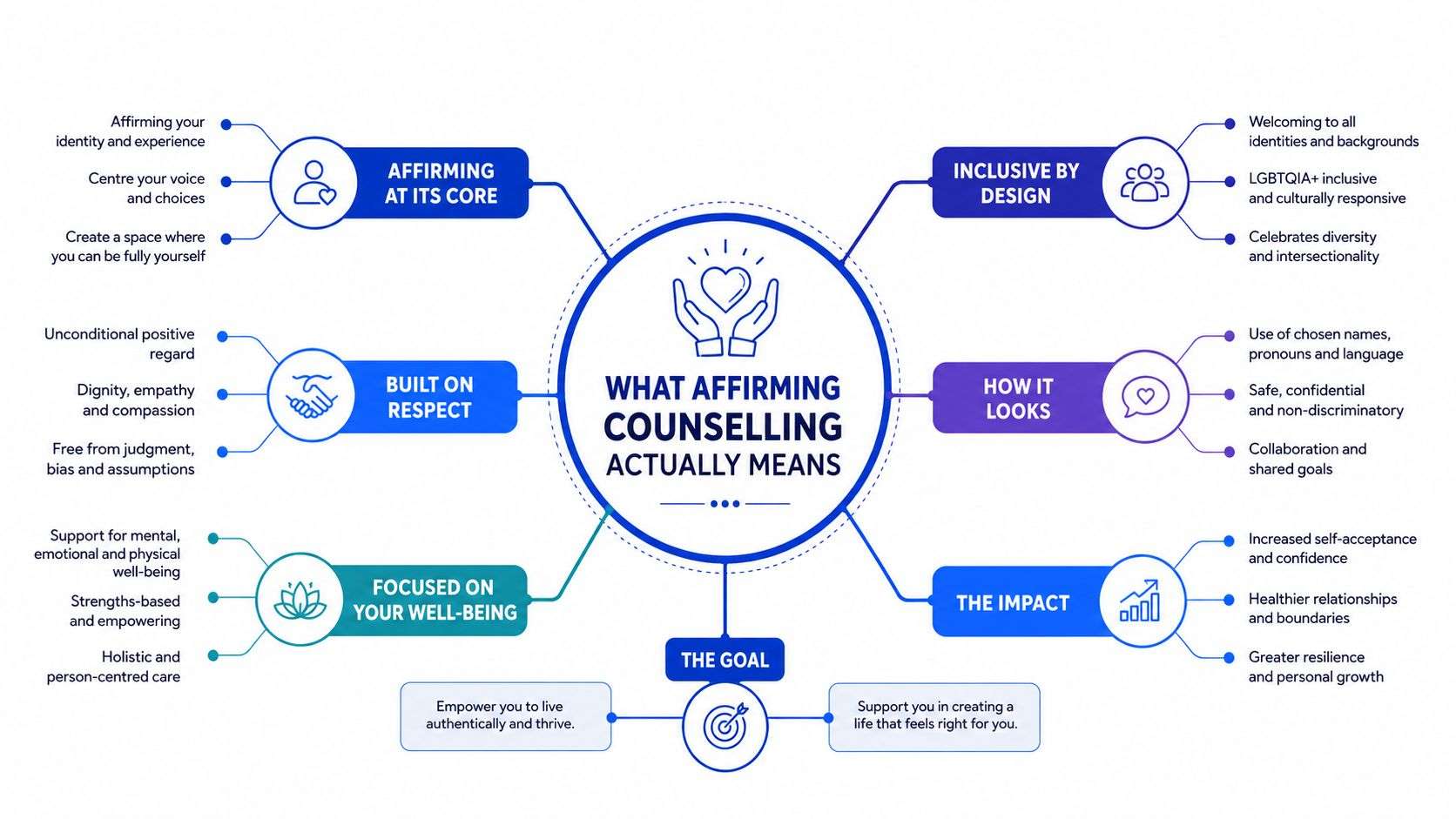
Acceptance and active affirmation aren't the same
A therapist who passively accepts a client may avoid saying anything openly harmful. An affirming therapist takes an active role in creating conditions where the client doesn't need to monitor every word. They may ask how identity-related stress affects daily life, check whether a safety plan accounts for family or community risks, or explore whether a client wants support with disclosure.
An analogy can help. Generic counselling may give you a room and ask you to adjust to its temperature. Affirming counselling pays attention to the conditions that affect your nervous system, then works with you to make the room usable. The therapist still applies evidence-informed treatment, but the treatment isn't separated from the social realities shaping the client's distress.
A useful question: “How do you support clients when identity-related stress overlaps with trauma, relationships, or family conflict?”
A strong answer won't require a client to reveal intimate details before trust exists. It should describe a respectful, collaborative approach and acknowledge the limits of the therapist's training when a referral or consultation would better serve the client.
The Access Gap and Why Specialized Care Helps
An adult in Kelowna may find several general counselling listings yet still struggle to find a therapist who understands minority stress, gender-affirming care, or the needs of LGBTQ2S+ couples and families. Access affects treatment itself. If a client anticipates misgendering, judgment, or intrusive questions, they may share less, delay care, or leave before evidence-based therapy has had time to help. Warmth matters, though good intentions do not replace the knowledge needed for a safe assessment.
Earlier survey findings show that access to 2SLGBTQI+-specific mental health services remains limited, while some people report no access to mental health services at all. The gap helps explain why general directories can be easier to search than specialized adult care in the Okanagan. Finding a name on a directory is one step. Finding a clinician whose training fits the client's concerns is another.
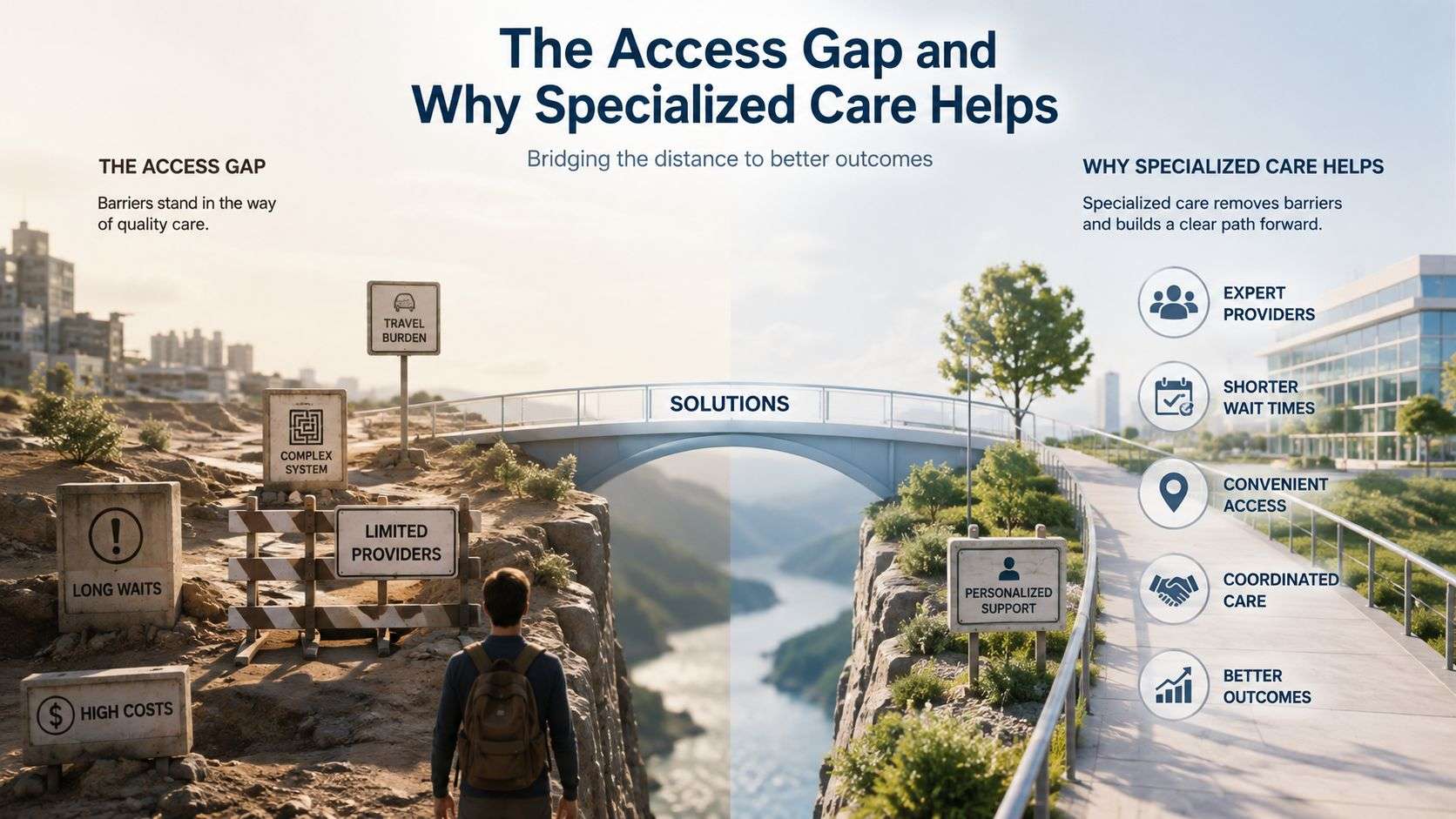
Why skills matter alongside warmth
Affirming counselling needs more than supportive listening. Statistics Canada's research on the mental health of 2SLGBTQ+ Canadians identifies increased mental-health risks among 2SLGBTQ+ youth aged 15 to 24 compared with cisgender heterosexual peers. That evidence also matters for clinicians supporting young adults and families, particularly when current concerns connect with earlier rejection, isolation, or unsafe relationships.
A therapist with relevant preparation may combine identity-affirming practice with:
- Emotion regulation, to recognise and manage intense responses.
- Cognitive restructuring, to examine shame-based or threat-based beliefs without dismissing lived experience.
- Safety planning, when family rejection, housing concerns, self-harm risk, or interpersonal violence is present.
- Social-support mapping, identifying affirming people, communities, healthcare providers, and crisis resources.
- Trauma-informed pacing, so disclosure does not become another loss of control.
Kelowna has youth-focused supports, but those programs do not automatically meet an adult's needs. An adult may be seeking ongoing individual counselling, couples work, or family therapy. Specialized care can address identity-related stress within the wider clinical picture, rather than sending every concern to a separate youth resource. During an initial consultation, ask how the therapist's training applies to the concerns you want to bring.
Safety, Rights, and Trauma-Informed Practice in BC
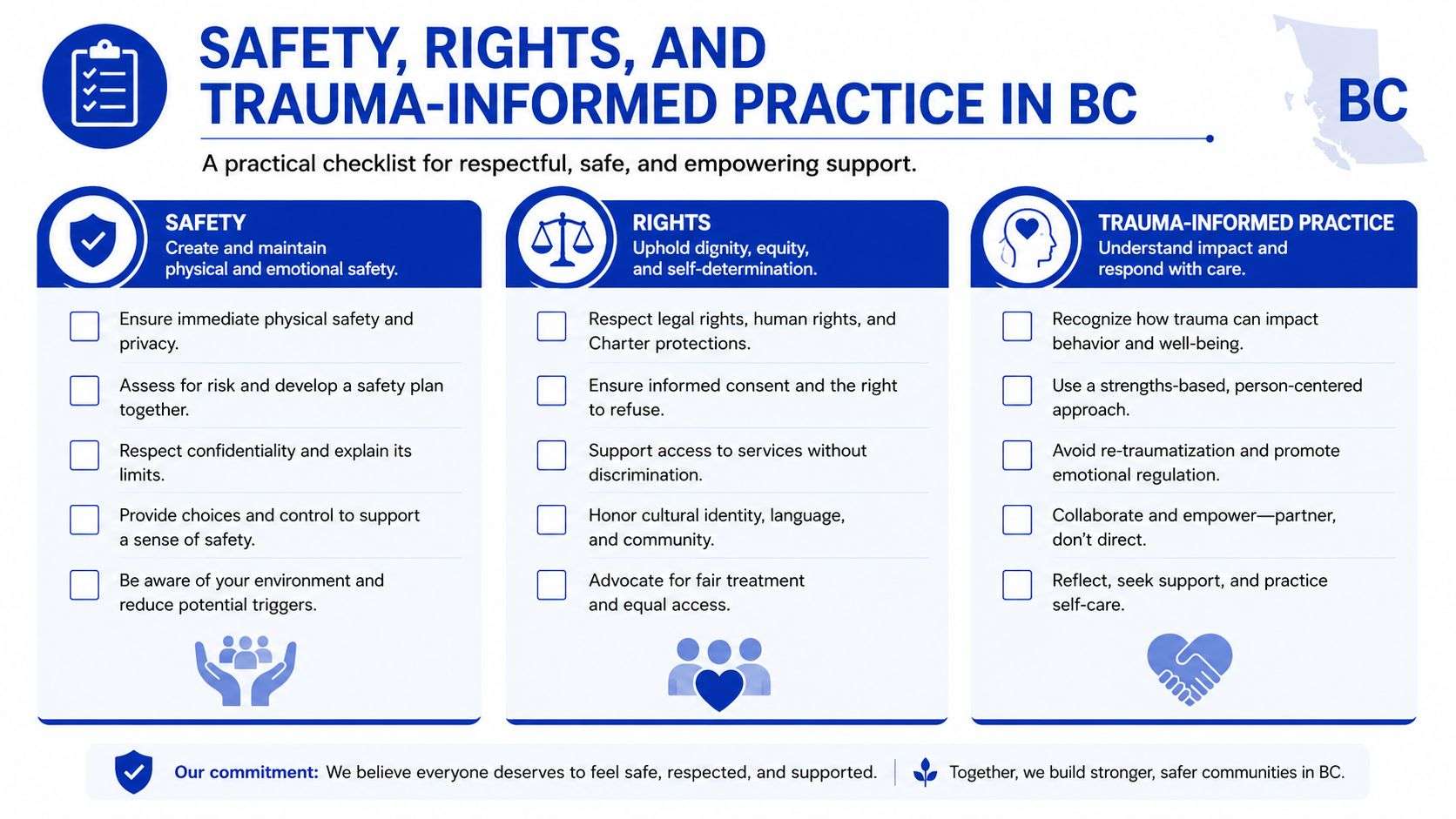
Safety has legal, procedural, and relational parts. British Columbia's Human Rights Code protects people from discrimination based on sexual orientation, gender identity, and gender expression. It says a person must not be denied a public service or facility without bona fide and reasonable justification because of those protected grounds. The B.C. Human Rights Code also provides a route to the B.C. Human Rights Tribunal when someone believes discrimination has occurred, and complaints generally must be filed within six months of the event.
The province's guidance on gender diversity states that people have the right to define and express their gender. In counselling, those principles become practical behaviours. A clinician should use an affirmed name, respect pronouns, avoid unnecessary questions about a person's body or transition, and provide service without treating identity as a reason to withdraw care.
What trauma-informed intake can feel like
A trauma-informed intake doesn't demand a complete personal history before a client understands how information will be used. The counsellor can explain confidentiality, ask permission before exploring sensitive identity experiences, and let the client decide whether a topic belongs in the first session.
For example, a client who has been misgendered repeatedly may say they're afraid it will happen again. A responsive clinician might acknowledge the concern, ask what language feels right, and clarify how the practice records and communicates that information. They don't insist that the client recount every previous incident to justify the request.
Safety is built through consistency. One respectful greeting matters, but so do accurate records, careful communication, informed consent, and a therapist who responds responsibly when something goes wrong.
Minority-stress screening can also be clinically useful. It may explore discrimination, concealment, family rejection, isolation, or fear of harm, not to imply that being 2S/LGBTQIA+ is pathological, but to understand the conditions affecting wellbeing. A client's identity can be a source of connection and strength while also being connected to painful experiences that deserve care.
What to Expect in Your Sessions
The first session usually begins with context rather than conclusions. You may discuss what prompted you to seek counselling, relevant history, current stressors, goals, supports, and any immediate safety concerns. You should also be able to decide how much of your identity story you want to share and whether identity-related experiences are central to the work.
Some clients want direct skills for panic, sleep, or emotional regulation. Others need space to process grief, family conflict, shame, or a relationship rupture. A therapist may use cognitive behavioural strategies, trauma-informed approaches, emotion-focused work, narrative techniques, or other evidence-informed methods, but the approach should be connected to your goals rather than imposed as a fixed script.
In-person and virtual care
In-person sessions in Kelowna can make it easier for some clients to settle into a distinct therapeutic environment. Secure virtual sessions can be useful when travel, privacy, mobility, health, scheduling, or emotional energy makes an office visit difficult. Phone sessions may also suit clients who feel safer without video or who have limited internet access.
The format should support your privacy and concentration. Before a virtual appointment, consider whether you have a private room, reliable technology, and a plan for what you'll do if strong emotions continue after the session. Choice itself can be affirming because it recognises that access needs differ.
Questions that help you judge fit
You don't need to commit to long-term therapy before learning how a clinician works. You can ask:
- Experience: “What kinds of 2S/LGBTQIA+ concerns do you regularly support?”
- Clinical complexity: “How would you approach trauma, PTSD, grief, or relationship conflict alongside identity-related stress?”
- Language: “How do you record and use chosen names and pronouns?”
- Collaboration: “What happens if my needs fall outside your scope of practice?”
- Format: “Are in-person, phone, or secure virtual sessions available?”
Red flags include defensiveness about pronouns, intrusive curiosity about medical transition, assumptions about sexuality or relationships, and reluctance to acknowledge discrimination or family rejection as possible sources of stress. A respectful therapist can answer questions without making you feel responsible for protecting their feelings.
Therapist Credentials, Funding, and Practical Access
Credentials don't tell you everything about fit, but they help you understand professional accountability. In British Columbia, a registered clinical counsellor may provide counselling within their training and professional scope. Ask whether the clinician receives clinical supervision, how they maintain competence in 2S/LGBTQIA+ mental health, and whether they have experience with the concerns you want to address.
Practical access deserves the same attention as clinical fit. Before booking, ask about:
- Scheduling: Daytime, evening, or weekend availability may matter if work, school, caregiving, or privacy affects your options.
- Format: Confirm whether the service is available in person, by phone, or through secure video.
- Coverage: Ask your extended-health insurer whether counselling with the provider's credentials is covered, and whether a physician's referral is required.
- ICBC funding: If you're recovering from a motor vehicle accident, ask whether ICBC-funded counselling may apply to your situation.
- Payment procedures: Clarify when payment occurs, what documentation is provided, and how cancellations are handled before you reserve a regular time.
You can also ask what happens when cost, transportation, or scheduling creates a barrier. A responsible practice may discuss available options, referral pathways, or a different format without promising services it cannot provide. Public and community resources can also be part of a care plan, particularly when someone needs immediate support or specialised assistance.
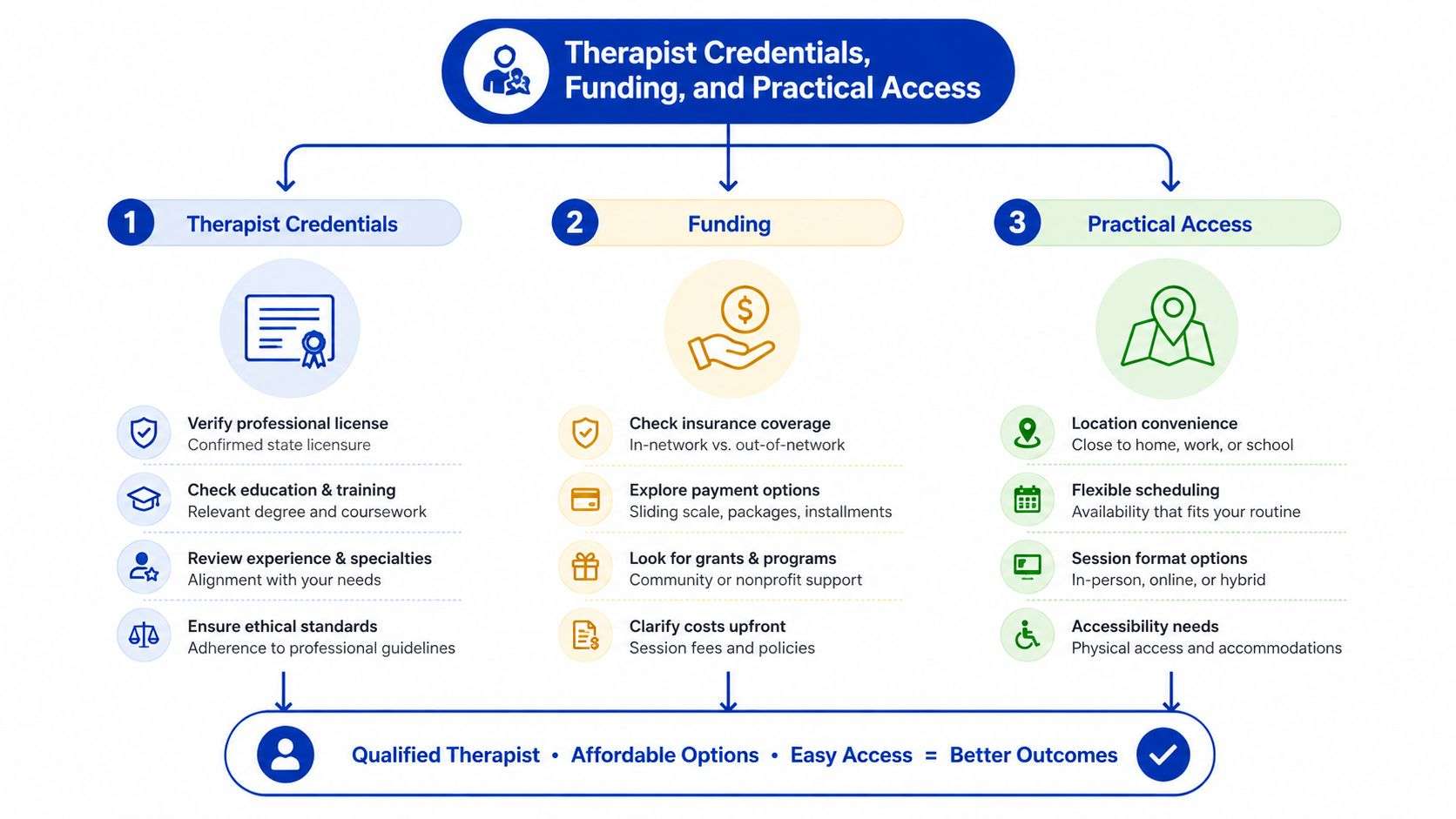
A first conversation can be exploratory. You're allowed to ask enough questions to decide whether the clinician's training, communication style, availability, and approach match what you need.
Affirming Care Across Identities and Life Stages
A young person questioning their identity may need support with school stress, family conversations, or fear about being misunderstood. The therapist can help them build coping skills and identify safe adults without pressuring them to come out before they're ready. Work with a young client may also involve caregivers, when appropriate and with careful attention to the young person's privacy and safety.
An adult may arrive with anxiety, depression, grief, or trauma that has been intensified by workplace discrimination, family rejection, or years of hiding important parts of themselves. Affirming counselling doesn't reduce every concern to identity. It recognises the context, then treats the clinical issue the client wants help with.
Couples counselling should make room for diverse relationship structures, agreements, histories, and goals. Partners may be working through communication problems, trust after a rupture, decisions about commitment, or conflict involving family and community. The therapist's task is to understand the relationship, not to compare it with a heterosexual or cisgender template.
Intersecting identities shape care as well. An Indigenous Two-Spirit client, a racialised client, a disabled client, or a neurodivergent client may encounter overlapping barriers that a single-identity framework misses. Good assessment asks what safety, belonging, communication, and accessibility mean for this particular person.
Counselling can also sit alongside other supports. A therapist may coordinate, with consent, with primary care, an assessment provider, or crisis services. Clients considering hormone-related care may find it useful to review practical medical information, such as Pause Medical's transgender care guide, while keeping medical decisions with appropriately qualified healthcare professionals.
Common Questions and a Gentle Way Forward
How do I know whether a therapist is a good fit?
Notice whether the clinician answers direct questions clearly, respects your language, and shows curiosity without making you educate them. You should feel able to say what isn't working.
What if past therapy went badly?
You can begin by naming that experience and asking how the therapist handles repair, consent, and mistakes. You don't have to disclose everything at once.
Are virtual sessions suitable for identity-related work?
They can be. Secure video or phone counselling may work well when privacy, travel, mobility, or emotional comfort makes in-person care difficult. The setting should support confidentiality and focus.
Can my partner or family member join?
Often, counselling can include a partner or family member when that supports your goals and everyone understands the boundaries of confidentiality. Ask how the therapist manages separate perspectives and safety concerns.
Choosing counselling doesn't need to be rushed. You can learn about the approach, ask practical questions, and take the time you need to decide whether the space feels respectful.
Interactive Counselling offers individual, couples, family, youth, trauma, grief, relationship, and life-transition counselling in an inclusive setting, with in-person, phone, and secure virtual options in Kelowna. Visit Interactive Counselling to learn more about available support and consider whether its approach fits what you're looking for.
Clinically Reviewed By
Amy Mosset, MCP, RCC-S
Amy Mosset is a Master Practitioner in Clinical Counselling, Clinical Supervisor, and the owner of Interactive Counselling. She provides trauma-informed, evidence-based care and clinical supervision to registered therapists, with a focus on ethical practice, client safety, and high-quality therapeutic outcomes.