You're sitting in a Kelowna staff meeting, listening for a natural moment to speak. You've rehearsed your comment several times, but when the conversation turns toward you, your chest tightens and your mind goes blank. Later, you replay the moment and wonder whether everyone noticed how nervous you were. For more information, see our Kelowna anxiety counselling.
Maybe your version happens at a birthday gathering, during a phone call, or while ordering coffee. You might almost say yes to an invitation, then cancel because the thought of making conversation feels exhausting. You might delay a simple call for days, not because you don't care, but because you're already imagining embarrassment, criticism, or silence. For more information, see our counselling in Kelowna.
Social anxiety counselling in Kelowna can help make sense of these patterns without treating them as a character flaw. Confidence usually returns through small, supported experiences that show your nervous system you can participate in everyday life, even when anxiety is present. For more information, see our anxiety counselling.
What Social Anxiety Actually Feels Like in Everyday Life
Social anxiety often begins before a social situation starts. You may plan what to say on the drive to work, consider where to sit at a gathering, or draft and delete a text message. The mind searches for possible mistakes, while the body prepares for danger that other people may not even see.
A flush rises into your face. Your hands feel unsteady. Your chest becomes tight, your voice changes, or your thoughts disappear at the exact moment you want to use them. Afterward, you may examine every word, facial expression, and pause, looking for proof that you performed badly.
A nervous response is not evidence that you've done something wrong.
Consider someone in Kelowna who agrees to attend a friend's birthday dinner. On the way there, they imagine arriving late, having nothing to say, and sitting alone while everyone else connects easily. They turn around before reaching the restaurant, then feel temporary relief followed by disappointment and self-criticism.
That relief matters because it can teach the brain that avoiding the dinner kept you safe. The next invitation may feel even harder. Similar patterns can spread across work, family, friendships, school, volunteering, and community activities throughout the Okanagan.
Social anxiety can also affect dating and relationships. People may want connection but worry that their disability, appearance, communication style, or emotional needs will be judged. For someone looking for an inclusive way to meet others, a dating site for people with disabilities may offer a more comfortable starting point, although it won't replace counselling when fear and avoidance are interfering with daily life.

These experiences become easier to understand when clinicians look beyond the momentary nerves and examine the fear of being evaluated, the behaviours used to feel safer, and the avoidance that keeps the alarm active.
Understanding Social Anxiety Beyond Shyness
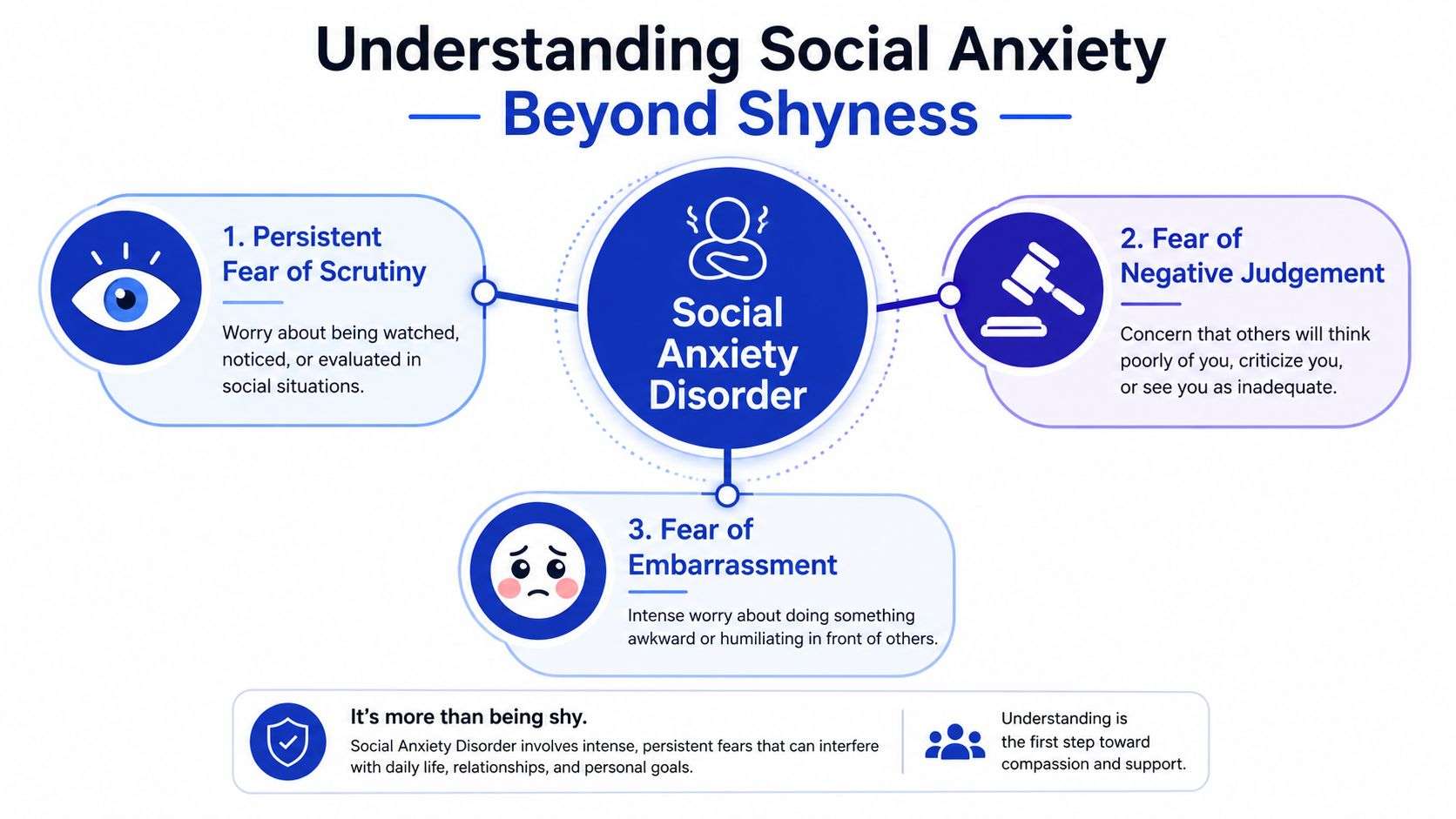
Social anxiety is less a personality trait than a learned response to social uncertainty. An introverted person may prefer smaller groups and still speak comfortably when it matters. Social anxiety becomes a concern when fear of scrutiny, negative judgement, or embarrassment repeatedly narrows a person's choices.
You might understand that a presentation is unlikely to end badly, yet still feel unable to attend. You may avoid eye contact, speak briefly, keep your camera off, arrive early to choose a safe seat, or ask a friend to speak for you. These actions lower distress for a moment, while also leaving fewer opportunities to discover that you can manage the situation.
The pattern is similar to walking around a puddle until the detour feels safer than crossing it. Each avoided moment strengthens the expectation that direct participation is risky.
The avoidance cycle
The cycle often follows a predictable path:
- A social situation appears. You receive an invitation, notice a group conversation, or need to make a request.
- A prediction arrives. You expect people to judge you, reject you, or notice your anxiety.
- Your body reacts. Your heart may race, your face may feel hot, or your thinking may narrow.
- You avoid or use a safety behaviour. You cancel, stay quiet, over-prepare, or leave quickly.
- Relief follows. Your brain registers avoidance as protection from the perceived threat.
This response does not mean you are weak. Your nervous system is attempting to protect you, but it has learned to treat ordinary social uncertainty as danger. Counselling helps examine that learning and practise a different response, such as ordering coffee despite anxious thoughts, offering one comment in a meeting, or staying at a birthday long enough to have a real conversation.
Social anxiety can appear at any age, although Canadian data show a particularly high burden among younger people. A national report found that 15-to-24-year-olds had a 24.7% 12-month prevalence of social phobia, and among Canadian women aged 15 to 24, prevalence rose from 6.1% in 2002 to 24.7% in 2022. These figures are reported in Canadian mental-health data on social phobia. BC youth summaries have also estimated that 6.5% of youth have an anxiety disorder, while another survey found 39% of surveyed 15- to 17-year-olds screened positive for generalized anxiety (Doing OK: a report on youth mental health in BC).
Support may be useful when avoidance shapes work, education, relationships, parenting, errands, or community participation. You do not need to wait until every social situation feels impossible.
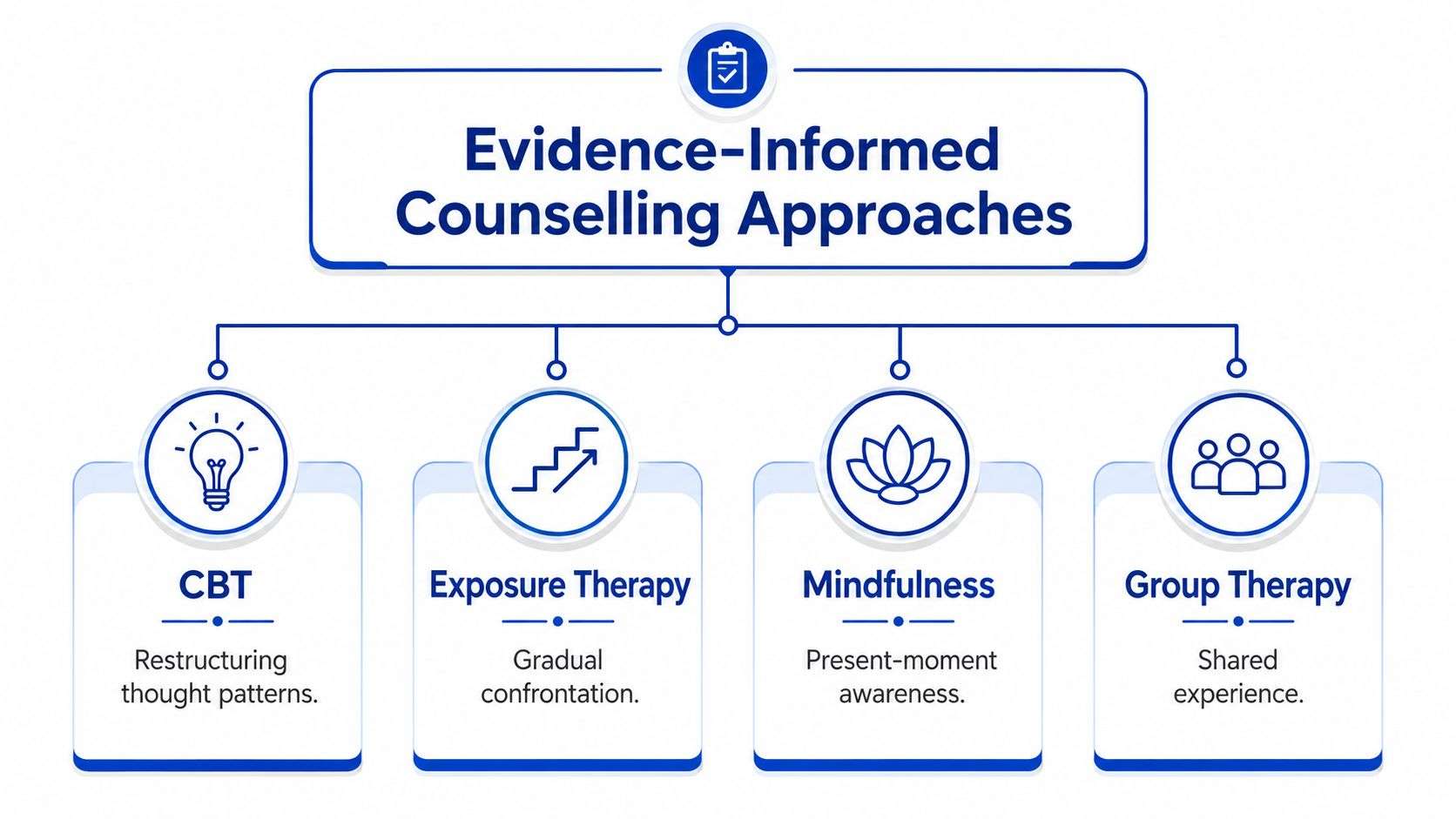
Evidence-Informed Counselling Approaches
Effective counselling doesn't ask you to become a different personality. It helps you participate more freely, reduce avoidance, and respond to anxious thoughts with greater flexibility.
Cognitive behavioural therapy
Cognitive behavioural therapy, or CBT, is described by the Canadian Psychological Association as the gold-standard psychological treatment for social anxiety (CPA fact sheet on social anxiety). CBT examines the connection between thoughts, physical sensations, behaviours, and consequences.
A counsellor may help you identify predictions such as, “If I pause, everyone will think I'm incompetent,” then examine the evidence and test a more balanced response. CBT can also address self-focused attention, such as monitoring your face, voice, posture, and words instead of noticing what's happening in the conversation.
Graded exposure
Exposure isn't a demand to jump into your most frightening situation. It's a collaborative process of approaching avoided experiences in manageable steps. Canadian clinical anxiety guidelines include exposure-based methods in treatment planning (Canadian clinical anxiety guidelines).
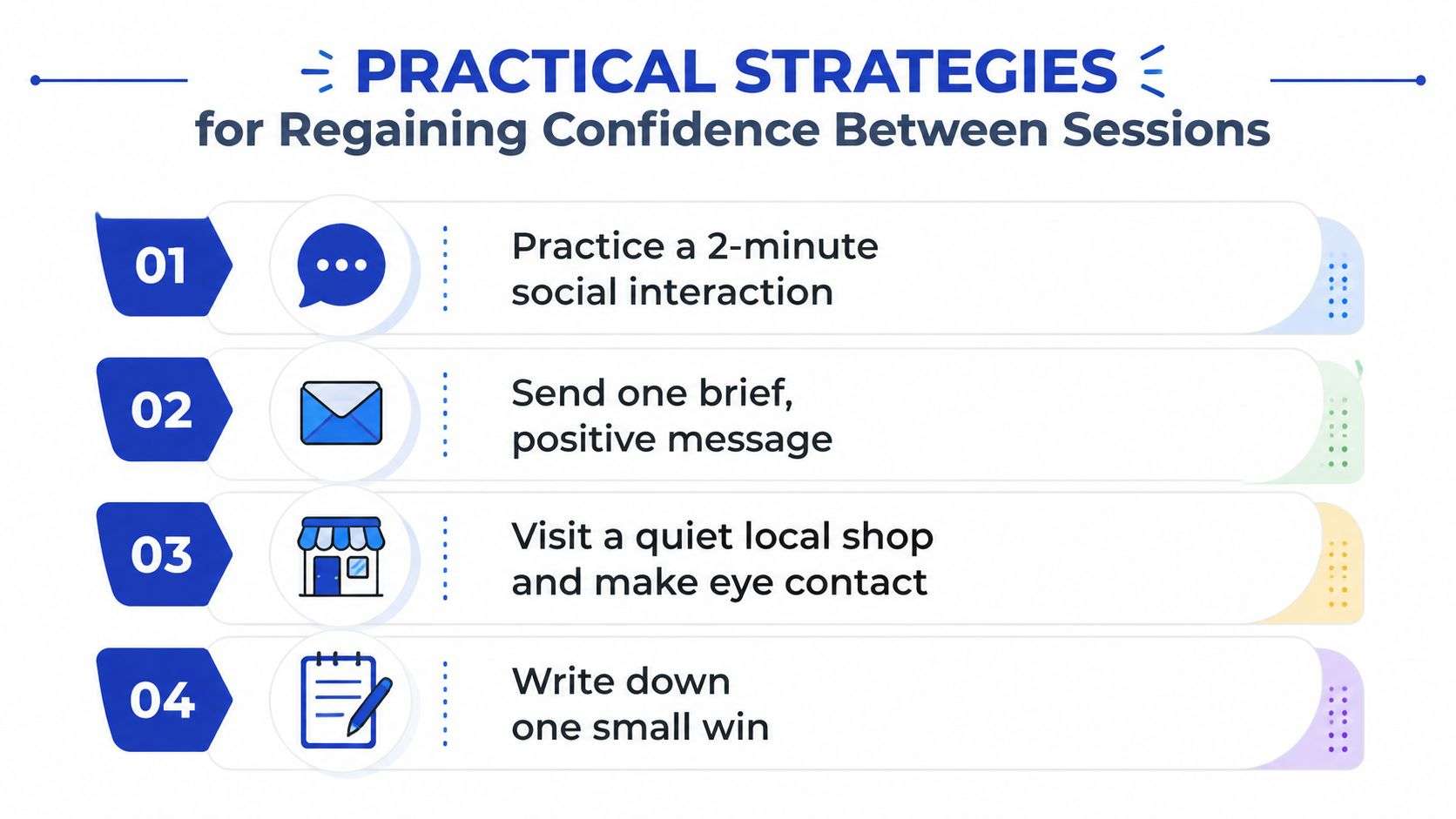
A personal exposure ladder might begin with making eye contact and saying hello to a shop employee. Later steps could involve asking a question in a meeting, ordering a coffee with a small change, or attending a brief gathering and staying long enough to have one conversation. The counsellor helps you choose the pace, review what happened, and adjust the next step.
Acceptance and commitment therapy
Acceptance and commitment therapy, or ACT, focuses less on eliminating every anxious thought and more on changing your relationship with those thoughts. You might notice, “My mind is telling me I'll be rejected,” without treating that prediction as a command.
ACT can be useful when years of arguing with anxious thoughts have left you tired. You identify values such as friendship, contribution, learning, or family connection, then practise taking small actions in those directions while making room for discomfort.
Group therapy
A structured group can provide a carefully supported place to practise speaking, listening, setting boundaries, and receiving attention. The shared setting may also challenge the assumption that everyone else feels confident and untroubled.
Counsellors may combine these approaches rather than follow a rigid formula. Early sessions are generally devoted to understanding your history, goals, triggers, and preferences before deciding which techniques fit.
What Counselling Looks Like in Kelowna
Starting therapy can feel like the first social challenge. You may wonder what to say, whether you'll be judged, or whether you'll be expected to explain everything perfectly. A good intake conversation doesn't require a polished story. You can begin with what you're avoiding and what you'd like to be different.
Kelowna clients may consider three formats. In-person counselling offers face-to-face connection in a private office. Phone counselling removes the pressure of being seen while still allowing direct conversation. Secure video counselling can be useful when leaving home, travelling across the Central Okanagan, or sitting in a waiting room feels like a major barrier.
| Format | What it looks like | When it tends to fit best |
|---|---|---|
| In-person | A private conversation at a counselling office | When you value physical separation from home and want face-to-face contact |
| Phone | A scheduled session by telephone | When video feels distracting or being seen increases anxiety |
| Secure video | A confidential appointment through an online video system | When travel, mobility, privacy at a waiting room, or leaving home creates extra stress |
The first session usually covers your current concerns, relevant history, goals, and preferences. You can ask how the counsellor works with social anxiety, whether exposure is part of the plan, and how progress will be reviewed. Therapist matching isn't about finding someone who has the same personality as you. It's about finding a style and background that help you feel safe enough to be honest and challenged enough to grow.
Privacy and practical access
BC counselling practice guidance says remote services must protect privacy and confidentiality and follow relevant privacy legislation. BC standards also require informed consent before using internet-based communication, including email, texting, and related online contact (BCACC guidance on remote counselling and privacy).
Ask whether you'll need a private room, headphones, and a reliable connection. Daytime, evening, and weekend scheduling can matter when anxiety is strongest around work or school obligations. ICBC-funded counselling is also available for clients recovering from motor vehicle accidents, with intake steps handled by the practice.
BC reporting shows substantial demand for counselling access. In the first half of FY 2025/26, more than 14,000 people accessed counselling, including over 4,000 first-time clients, while more than 362,000 counselling sessions had been provided since 2019, including 72,000 first-time clients (BC mental-health and substance-use system snapshot). CIHI's 2025 data found that only half of Canadians referred to community mental-health counselling received care within 30 days. That makes it reasonable to ask about format, scheduling, and the practical steps involved before you commit.
Practical Strategies for Regaining Confidence Between Sessions
Between-session practice works best when it's small, deliberate, and connected to your real life. The purpose isn't to force yourself through overwhelming fear. It's to interrupt automatic avoidance and gather new information about what happens when you stay engaged.
Choose one situation that feels uncomfortable but possible. Sending a short text to a friend, asking one question in a meeting, or making a phone call early in the day can be enough for a first practice. If ordering coffee feels difficult, you might start by making eye contact, then later add a simple request or question.
Shift attention outward
Social anxiety often directs attention inward. You may monitor your face, voice, hands, and perceived mistakes so closely that you miss the other person's actual response. During a conversation, gently notice three details about the other person, such as the topic they're discussing, their tone, or something in their surroundings.
This isn't a performance trick. It's a way to widen attention and reduce the habit of treating your internal sensations as proof of danger.
Practical rule: Make the next step small enough that you can repeat it, not so large that you need to recover from it.
A behavioural experiment might test a specific prediction. If you believe a short pause will make a conversation fail, allow one pause and observe what happens. If you expect a cashier to react negatively when you ask for clarification, ask the question and record the actual response rather than the feared one.
Alcohol or other substances can seem to make social situations easier, but relying on them can complicate anxiety and make it harder to learn that you can cope without them. Mention this pattern in counselling so your therapist can help you consider safer, sustainable options.
Progress won't be perfectly smooth. A difficult interaction doesn't erase previous effort, and a cancelled plan can become useful information rather than a verdict about your ability to change.
Keep this short checklist on your phone:
- Choose one step: Pick a manageable interaction.
- Name the prediction: Write down what you fear will happen.
- Stay present: Notice the other person and the surroundings.
- Review fairly: Record what happened.
- Credit effort: Count participation, not perfect confidence.
These exercises are not a substitute for therapy. A counsellor can help you choose an appropriate pace, identify safety behaviours, and make sense of setbacks.
What Meaningful Progress Actually Looks Like
Recovery from social anxiety usually develops in layers. Early sessions may focus on trust, language, and understanding the cycle. As the work becomes more active, you may practise exposure, attention shifting, thought records, values-based action, or communication skills. Later, counselling can help you maintain gains and respond when an old fear returns.
A client might begin by avoiding team meetings entirely. Over time, they may attend most meetings, contribute one prepared comment, and remain present even when their voice feels shaky. Another person may move from skipping birthday gatherings to attending smaller celebrations with a plan for arrival, conversation, and leaving without treating discomfort as failure.
The important change isn't always that anxiety disappears. It may be that anxiety no longer makes every decision.
Pacing protects the work
A counsellor should check how an exercise affected you, what you learned, and whether the next step needs to be smaller. Between-session support may include a brief practice plan, reflection questions, or a coping strategy for the physical sensations that arise.
If an exercise feels too intense, that's information to bring back rather than a reason to quit. CBT gives structure to predictions and experiments, ACT connects action with values, and secure phone or video sessions can make practice more accessible when attending an office feels difficult.
Meaningful progress may look ordinary from the outside. You make the call, stay at the gathering, ask for clarification, or speak once in the meeting. Those choices gradually rebuild trust in your ability to handle everyday uncertainty.
Gentle Answers to Common Questions
Is my experience serious enough for counselling? If fear or avoidance is affecting work, school, relationships, errands, or activities you value, support may be appropriate. You don't need a formal diagnosis or a crisis to begin.
How is this different from being shy or quiet? Shyness and introversion don't automatically cause impairment. Social anxiety becomes a concern when fear of judgement consistently restricts your choices or causes ongoing distress.
Can virtual or phone sessions help? They can, especially when entering a waiting room or leaving home is part of the difficulty. Privacy, informed consent, and secure communication procedures matter. Physical symptoms such as a racing heart can also raise questions, and an expert guide on anxiety and arrhythmia may help you identify when to discuss symptoms with a medical professional.
What happens in the first session? You'll discuss what's happening, what you want to change, and whether the counsellor's approach feels suitable. Interactive Counselling offers daytime, evening, and weekend sessions in person and virtually, with counsellors experienced in anxiety, trauma, life transitions, and ICBC-funded recovery work.
Interactive Counselling offers evidence-informed support for social anxiety through practical approaches such as CBT, ACT, and exposure-based work, with in-person, phone, and secure virtual sessions available in Kelowna. When you feel ready, visit Interactive Counselling to learn more about the options and take a manageable first step toward participating more freely in everyday life.
Clinically Reviewed By
Amy Mosset, MCP, RCC-S
Amy Mosset is a Master Practitioner in Clinical Counselling, Clinical Supervisor, and the owner of Interactive Counselling. She provides trauma-informed, evidence-based care and clinical supervision to registered therapists, with a focus on ethical practice, client safety, and high-quality therapeutic outcomes.