You might be lying awake in Penticton, replaying tomorrow's errands, the workday, the school pickup, the appointment you nearly cancelled again. Your body is tired, but your mind won't settle, and even ordinary things can start to feel strangely hard to do. For more information, see our Penticton anxiety counselling.
"Anxiety counselling in Penticton can help you understand what's driving the worry, reduce the pressure it puts on your day, and find a steadier way back to routine." For more information, see our counselling in Penticton.
A lot of people wait until they are completely overwhelmed before reaching out, but anxiety usually gives earlier warnings. Sleep gets lighter. Plans start getting skipped. Your jaw stays tight, your chest feels busy, and rest doesn't feel restful anymore. For more information, see our anxiety counselling.
That pattern is common, and it's also workable. Anxiety counselling gives you a place to slow things down, make sense of what's happening, and practise new ways of responding before the worry takes over the whole day.
Recognizing When Anxiety Has Become Too Much
Maya keeps telling herself she should be able to handle it. She still goes to work in Penticton, still answers messages, still makes dinner, but she's started checking the clock at night, dreading the next morning, and saying no to things she used to enjoy. Nothing looks dramatic from the outside, yet everything feels harder.
That's often how anxiety shows up first, subtly and repeatedly. It doesn't always arrive as a panic attack. Sometimes it looks like racing thoughts before bed, irritability with people you care about, or a habit of avoiding anything that might set off another wave of worry.
Everyday stress versus anxiety that needs support
Stress usually has a clear cause and eases when the pressure passes. Anxiety can linger after the immediate problem is over, or show up even when nothing obvious is happening. When worry starts shaping your sleep, your focus, your relationships, or your willingness to leave the house, it's no longer just background stress.
The BC government's health information describes generalized anxiety disorder as excessive worry occurring more days than not for at least 6 months, with symptoms such as restlessness, fatigue, difficulty concentrating, irritability, muscle tension, and sleep disturbance. Treatment commonly includes psychotherapy, medication, or both, with cognitive behavioural therapy noted as a standard evidence-based approach.
If worry is changing how you live, not just how you feel, that's a good reason to talk to someone.
Counselling is not only for crisis. It can also be the place where you interrupt the pattern before it starts shrinking your life. The goal is not to become carefree, it's to get back enough calm and confidence that your days feel manageable again.
What Anxiety Counselling Actually Involves
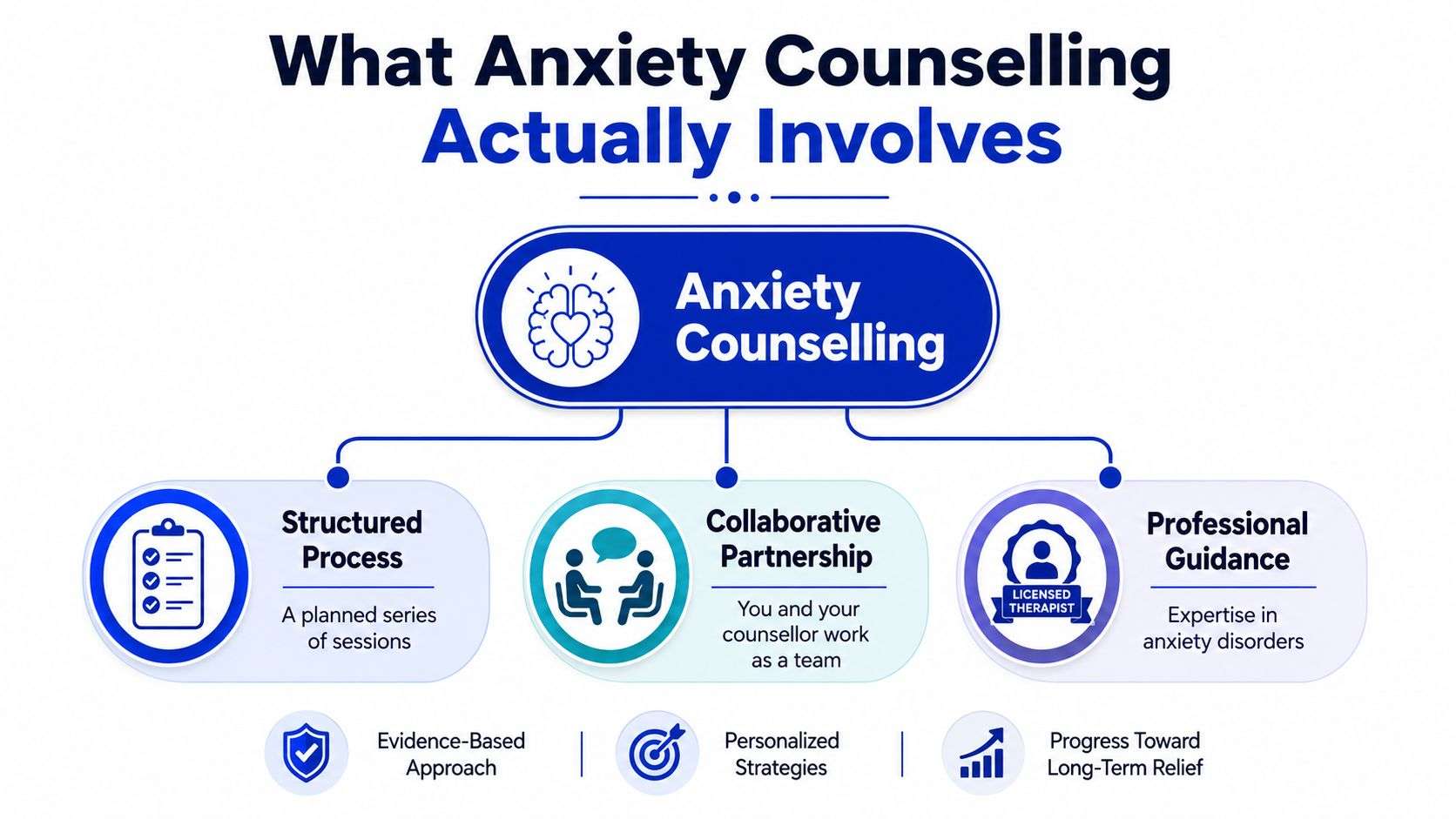
Anxiety counselling is a structured process, not an hour of generic advice. You and the counsellor work together to understand what keeps the anxiety going, what helps it settle, and what changes are realistic in your life right now. That collaboration matters, because anxiety often thrives when people feel they have to figure everything out alone.
The practical side of the work
A counsellor may help you notice patterns like catastrophic thinking, avoidance, or constant reassurance-seeking. Then you test different responses in a planned way, so the work is about practice, not just insight. For some people, that means learning to ride out physical symptoms without adding more fear. For others, it means building routines that protect sleep, concentration, and emotional regulation.
The BC information above is useful because it reminds you that anxiety becomes clinical when worry is persistent and starts showing up in the body and daily life. That's also why counselling tends to be more effective when it's grounded in symptoms and goals, not just feelings in the moment.
Treatment can include psychotherapy, medication, or both, depending on the person and the severity of symptoms. In counselling, you're usually working on the psychotherapy side, which may include CBT, skills practice, emotional processing, or a combination of approaches matched to your needs.
What makes it different from self-help
Books, videos, and calming exercises can help, but they're not the same as guided care. A trained counsellor notices when avoidance is growing, when panic is masking trauma, or when anxiety is getting tangled with grief, burnout, or perfectionism. That kind of guidance keeps the work focused and personal.
If you're also coping with jaw tension or sleep loss from pain, a resource like TMJ relief meditation techniques can be a useful adjunct while you're building broader anxiety skills. The point isn't to collect tips, though. It's to build a plan that helps your nervous system settle in real life.
Evidence-Based Approaches to Treating Anxiety
Different people need different tools. Some want something practical and structured. Others need help with trauma, body-based fear, or the habit of trying to push anxiety away so hard that it gets louder. Good counselling matches the method to the problem.
CBT, ACT, EMDR, and mindfulness
Cognitive Behavioural Therapy, or CBT, is often a strong fit when worry loops feel sticky and repetitive. It helps you notice the thought pattern, test it against reality, and replace all-or-nothing reactions with something more workable. If you've ever gone from “I'm late” to “the whole day is ruined,” CBT gives you a way to interrupt that spiral.
Acceptance and Commitment Therapy, or ACT, takes a different route. Instead of arguing with every anxious thought, it helps you make room for discomfort while still moving toward what matters to you. That can be especially helpful when anxiety shows up around parenting, work, relationships, or health concerns.
EMDR is usually considered when anxiety is tied to a distressing or traumatic experience. It's a more specialised approach, and the work often focuses on helping the brain reprocess events that still feel emotionally “stuck.” For people whose anxiety is linked to an accident, assault, or another overwhelming experience, that distinction matters.
Mindfulness-based techniques help you notice what's happening in the present without immediately fighting it. That might mean paying attention to breathing, body sensations, or the urge to escape a situation. Mindfulness doesn't erase anxiety, but it can reduce the extra layer of struggle that makes symptoms feel bigger.
What the evidence says
In Canadian clinical evidence, therapist-guided remote CBT performed at the same level as in-person CBT for many anxiety-related outcomes. A CMA systematic review of 51 randomized controlled trials involving 5,384 patients found little to no difference in primary outcomes between therapist-guided remote CBT and in-person CBT. For many people, that makes virtual care a legitimate option rather than a backup plan.
A useful way to think about it is this. CBT is often about changing the thought loop, ACT is about changing your relationship to the thought loop, EMDR targets unresolved experiences, and mindfulness helps you regulate your attention and body. None of these approaches is automatically right for everyone, but each has a clear job.
What to Expect in Your Counselling Sessions
The first session usually feels less polished than people expect, and that's okay. You don't need to tell your whole life story in perfect order. A counsellor will usually ask what brought you in, what anxiety looks like for you, and what you'd like to be different if counselling helps.
The first session
That early conversation is about fit as much as it is about symptoms. You're looking for someone who can listen carefully, explain their approach clearly, and make the process feel safe enough to continue. If you leave with a better sense of what's happening and a little more hope, that's a good sign.
Ongoing sessions tend to build around a few repeating pieces. You might review the week, notice triggers, practise a coping skill, and set one small task for between sessions. The work is collaborative, so you're not being handed a script and sent away.
Progress in anxiety work is often quieter than people hope, but it's still real.
A Cochrane review found that counselling improved short-term mental health outcomes versus usual care with a standardized mean difference of -0.28, and symptom improvement often appears between sessions 8 and 15 in therapy outcome research. That timeline can be reassuring if you're expecting immediate transformation and worrying that slower change means failure.
What the process feels like over time
Early sessions can feel vulnerable. You might notice relief, embarrassment, or even the urge to minimise what you're saying. That doesn't mean counselling isn't working. It usually means you're talking about things that matter.
The goal is not to force confidence. It's to build enough steadiness that your day stops being organised around anxiety. That often starts with small wins, like sleeping a little better, getting through a difficult errand, or being able to stay in a conversation without mentally escaping.
How to Choose the Right Counsellor in Penticton
Penticton has more counselling options than many people realise. Psychology Today's Penticton directory lists hundreds of local therapy profiles, including a dedicated anxiety-therapist category with counsellors, social workers, and registered clinical providers. That variety is helpful, but it can also make the choice feel overwhelming.
What to look for
Start with credentials. In BC, many people look for a Registered Clinical Counsellor or Registered Social Worker because those designations usually signal training, accountability, and a clear ethical framework. Then look at whether the counsellor names anxiety work specifically, not just general wellness.
Consider these points:
- Clinical focus. Look for someone who works regularly with anxiety, panic, trauma, or related stress patterns.
- Therapeutic style. Some people want structured CBT. Others want a more reflective, values-based, or trauma-informed approach.
- Personal fit. You need a voice that feels calm, respectful, and understandable to you.
- Practical access. Appointment times, virtual options, and location can matter as much as the method itself.
Questions that help you decide
Ask how the counsellor approaches anxiety, what a first few sessions usually look like, and how progress is tracked. If they can explain their process in plain language, that's a good sign. You're not interviewing for perfection, you're checking whether this person can guide you in a way that feels workable.
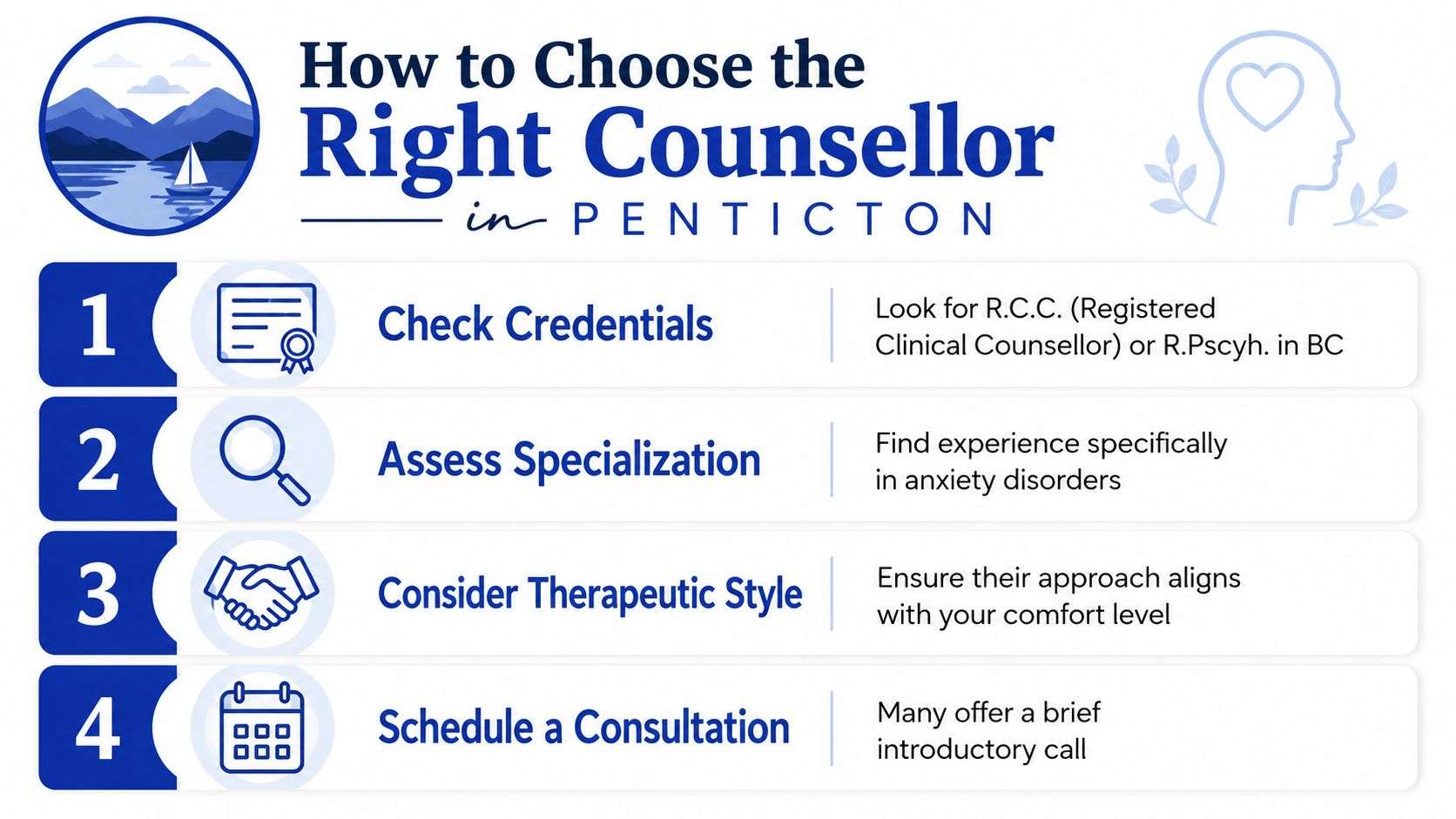
A brief consultation can tell you a lot. If you feel rushed, confused, or judged, keep looking. If you feel heard and the next step sounds clear, you're probably moving in the right direction.
Navigating Access and Logistics for Therapy in Penticton
Getting help often becomes a scheduling problem before it becomes an emotional one. In Penticton, Interior Health's Penticton Mental Health & Substance Use centre operates Monday to Friday from 8 a.m. to 4 p.m., and the South Okanagan EPI program adds evening and weekend crisis response from 4:30 p.m. to 11:00 p.m. That local pattern matters, because many people are trying to fit anxiety care around work, parenting, and transportation.
What the local landscape means
Public services can be important, but their hours are limited. That's one reason private counselling often fills a gap. It can offer wider appointment windows, including after work, plus in-person, phone, or secure virtual sessions.
That flexibility matters because not every client can reliably cross town in the middle of the day. It also matters if anxiety makes travel difficult. Secure virtual counselling can lower the friction enough that people get started and keep going.
Practical rule: If getting to an office is the reason you keep delaying care, ask about phone or video sessions first.
Virtual care, accident-related care, and coverage
A CMA systematic review of 51 randomized controlled trials found little to no difference between therapist-guided remote CBT and in-person CBT for anxiety-related conditions, which supports virtual care as a serious option rather than a lesser one. For Penticton residents, that can mean continuity even when weather, distance, or time blocks in-person attendance.
ICBC-funded counselling can also matter if your anxiety is linked to a motor vehicle accident. Insurance and direct-billing questions come up often too, especially when people are trying to understand what's covered and what isn't. Asking those questions early saves a lot of stress later.
Interactive Counselling offers Penticton sessions by in-person, secure online video, or phone, which is one of several access models available in the local market. That kind of flexibility can be useful when someone needs to start care without waiting for the perfect calendar opening.
Common Questions About Anxiety Counselling
How do I know if my anxiety is bad enough for counselling?
If worry is affecting sleep, focus, relationships, or your ability to do normal things, counselling is worth considering. You do not need to wait until everything falls apart.
What if I don't click with the first counsellor?
That happens. Fit matters, and it's okay to try someone else if you feel misunderstood or uneasy after a few sessions.
What should I do if I need help outside business hours?
Use crisis supports instead of waiting. The Crisis Line provides 24-hour confidential telephone crisis intervention and support, and the Crisis Text Line can be reached by texting HOME to 686868.
How long does anxiety counselling take?
It varies by person, the type of anxiety, and what else is going on in your life. Some people notice movement gradually over the first several sessions, while others need longer-term support.
Can counselling help if my anxiety is tied to an accident or trauma?
Yes. That's one reason it helps to choose a counsellor who can explain trauma-informed care and discuss whether approaches like EMDR or other structured methods are a good fit.
Taking the Next Step Toward Calm
Reaching out for help can feel like one more hard thing on a long list, especially when anxiety has already made everything feel heavier. Still, getting support is not a sign that you've failed. It usually means you've decided to stop carrying it alone.
Penticton has real options, from public crisis supports to private counselling with flexible appointment formats. The right next step is usually the one that feels possible, not perfect.
Clinically Reviewed By
Amy Mosset, MCP, RCC-S
Amy Mosset is a Master Practitioner in Clinical Counselling, Clinical Supervisor, and the owner of Interactive Counselling. She provides trauma-informed, evidence-based care and clinical supervision to registered therapists, with a focus on ethical practice, client safety, and high-quality therapeutic outcomes.
If you're ready to talk about anxiety in a calm, practical way, Interactive Counselling offers counselling in Penticton and nearby communities with in-person, phone, and secure virtual options. You can learn more about the support available and choose the format that fits your life right now.