To begin with EMDR and trauma counselling in Kelowna, start by understanding what EMDR is and how it works, then focus on finding a properly trained therapist who can explain their safety process and whether they have experience with concerns like complex trauma or neurodivergence. In British Columbia, EMDR is reported to help 77 to 90% of people treated for PTSD, and single-incident trauma may respond in as few as three 90-minute sessions when the treatment is appropriately planned and delivered. For more information, see our Kelowna trauma counselling.
Some people arrive at this question after months of trying to “push through.” You might be getting through work and family life on the outside while your nervous system stays on high alert inside. Maybe sleep feels shallow, memories hit without warning, or your body reacts before your mind can catch up. In a place as outwardly calm as Kelowna, that inner strain can feel especially confusing. For more information, see our counselling in Kelowna.
“EMDR and trauma counselling in Kelowna often begins with learning how the therapy works, then choosing a clinician who prepares you carefully before any trauma processing starts.”
If that's where you are, you don't need to have everything figured out before reaching out. You only need a starting point. For some people, that starting point is reading about trauma therapy. For others, it's making a short list of questions to ask a therapist. If your healing also includes spiritual support, a broader guide to faith-based recovery options may help you think about what kind of care feels aligned with your values.
Taking the First Step Toward Healing in Kelowna
You may already know something is wrong, even if you haven't put the word trauma to it. A loud sound makes you jump. A familiar road brings up dread. You keep replaying something that happened years ago, or you feel numb and disconnected without knowing why.
Those responses aren't signs of weakness. They're common responses to overwhelming experiences. Trauma can come from a single event, such as an accident or assault, or from repeated experiences that taught your body to stay braced for danger.
What beginning often looks like
For many people, the first step is not a dramatic breakthrough. It's something smaller.
- You notice a pattern: You realise the same triggers keep showing up.
- You get curious: You start asking whether there's a therapy designed for trauma, not just general stress.
- You want a map: You don't want to retell everything to the wrong person and leave feeling worse.
That last point matters. Trauma therapy should feel structured and safe. It shouldn't feel like being pushed into the deep end.
A good starting question is simple: “How do you help clients feel steady before working with difficult memories?”
Why EMDR comes up so often
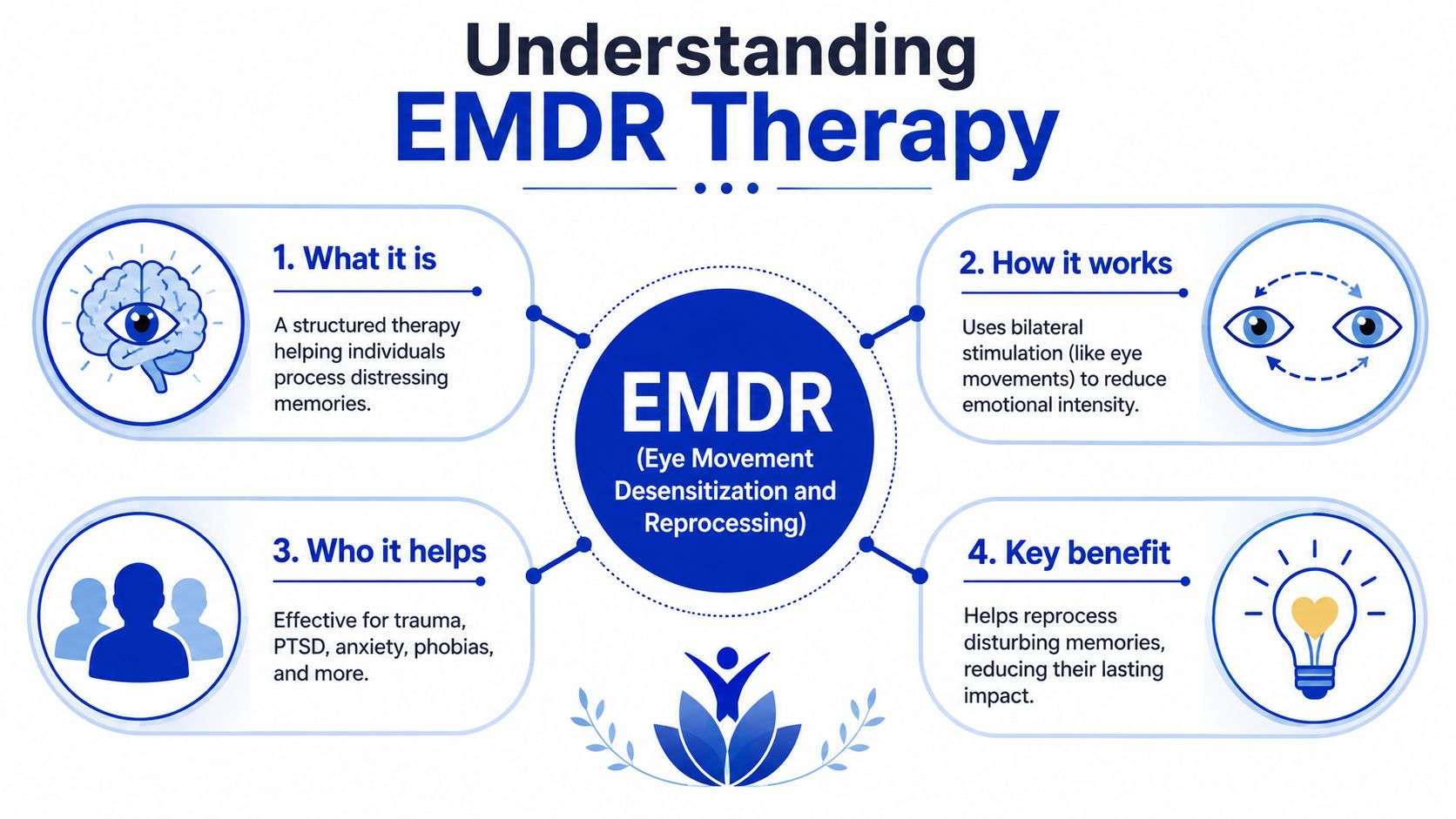
EMDR stands for Eye Movement Desensitization and Reprocessing. People often hear the acronym before they understand the process. That can make it sound mysterious or more intense than it is.
In practice, EMDR is a structured trauma therapy that helps the brain process distressing memories differently. It isn't about erasing the past. It's about reducing the emotional and physical charge that keeps the past active in the present.
This matters in Kelowna because many people looking for trauma support aren't just asking, “Does EMDR work?” They're also asking, “How do I know if this therapist is careful, qualified, and a good fit for me?” That's the heart of informed therapy choice, and it's where this guide can help.
What Is EMDR and Who Can It Help
People often assume EMDR is just about eye movements. That's only one piece of it. The larger idea is that some memories get “stuck” in a way that keeps your body and mind reacting as if the danger is still current.
A simple way to think about EMDR is this: when a distressing memory hasn't been fully processed, it can sit in the nervous system like an open tab that never closes. EMDR helps the brain revisit that memory in a controlled way so it can be stored with less intensity and less disruption.
For a gentle outside explanation of eye movement desensitization and reprocessing, it can help to read a plain-language overview before speaking with a therapist.
How EMDR works in simple language
During EMDR, a therapist guides you through a structured process that includes attention to a distressing memory while using bilateral stimulation, often eye movements, taps, or alternating sounds. Many people find it helpful to compare this to the kind of processing that happens during REM sleep, when the brain sorts through experience.
You do not have to give a perfect verbal account of everything that happened. The focus is not on producing a detailed narrative. The focus is on helping the brain process what has remained unresolved.
Practical rule: If a therapist explains EMDR as “just moving your eyes back and forth,” that's too simplistic. The method is broader, more structured, and more safety-focused than that.
Who EMDR may help
EMDR is most widely known for PTSD, but its use is broader than many people realise. According to a Canadian counselling overview, while EMDR is most widely used for PTSD, it is also effective for other mental health issues including panic attacks, phobias, complicated grief, dissociation, and personality disorders, with recent studies confirming its effectiveness in reducing depressive symptoms.
You might ask about EMDR if any of this sounds familiar:
- Intrusive memories: You keep reliving a moment, even when you don't want to think about it.
- Body-based distress: Your chest tightens, your stomach drops, or you freeze when something reminds you of the past.
- Avoidance: You go out of your way to avoid roads, places, conversations, or dates connected to what happened.
- Nightmares or disrupted sleep: Your nervous system doesn't seem to settle, even when life looks “fine” from the outside.
- Phobias or panic: A specific trigger creates an immediate and overwhelming reaction.
- Complicated grief: Loss feels frozen rather than slowly integrating into your life.
- Persistent negative beliefs: Thoughts like “I'm not safe,” “It was my fault,” or “I can't trust anyone” keep repeating.
A local gap worth noticing
In Kelowna, there's another question that deserves attention. Some local EMDR content still frames it mostly as treatment for acute trauma, yet there is a documented local gap in explaining how EMDR may need to be adapted for neurodivergent clients, including people with ADHD or autism, especially when sensory processing and executive functioning affect trauma treatment planning (directory-based discussion of this care gap in Kelowna).
If that applies to you or your family, it's reasonable to ask a therapist how they adapt pacing, sensory supports, session structure, and communication style.
How to Choose a Trained EMDR Therapist
Once you know what EMDR is, the next question is who should provide it. Many people then feel uncertain. A therapist may be kind and skilled in general counselling, but trauma work asks for specific training, good judgement, and a clear safety process.
In Canada, EMDR is typically offered by Registered Psychologists, Registered Social Workers (RSWs), and Registered Clinical Counsellors (RCCs), and it is generally not covered by provincial health plans like MSP in British Columbia. People usually access it through extended health benefits or certain specific programs, including Veterans Affairs Canada for eligible veterans.

What to listen for in a consultation
A first call or intake isn't only for the therapist to assess you. It's also your chance to assess them.
Here are useful questions to ask, especially if you want to be an informed consumer of therapy:
- Training question: “What specific EMDR training have you completed, and how long have you been using it in practice?”
- Scope question: “Do you work with single-incident trauma, complex trauma, or both?”
- Safety question: “How do you decide whether a client is ready for EMDR processing?”
- Preparation question: “What grounding or regulation skills do you teach before starting memory work?”
- Adaptation question: “How do you adapt EMDR for neurodivergent clients, including ADHD or autism?”
- Pacing question: “How do you handle it if someone becomes overwhelmed during or after a session?”
- Closure question: “What do you do at the end of a session to help clients leave feeling steady?”
These aren't “difficult” questions. They're thoughtful ones. A trained therapist should be able to answer them clearly.
Green flags and caution flags
A consultation often feels better when you know what you're listening for.
| What to notice | Encouraging sign | Reason to pause |
|---|---|---|
| Explanation of process | They can explain EMDR in plain language | They rely on jargon or vague promises |
| Readiness for trauma work | They talk about preparation before processing | They want to jump straight into traumatic memories |
| Experience fit | They can describe work with concerns like complex trauma or neurodivergence | They treat all trauma presentations as basically the same |
| Client control | They emphasise pacing, consent, and stopping when needed | They sound rigid or overly formulaic |
You're not looking for a perfect script. You're looking for clarity, steadiness, and evidence that the therapist takes safety seriously.
Questions that matter in Kelowna
Local context matters. If your trauma is related to a motor vehicle accident, ask direct logistical questions early. If you're looking into trauma counselling, it's reasonable to ask whether the clinic offers trauma-focused approaches such as EMDR and whether they handle ICBC-funded counselling for eligible clients.
If your history is more layered, ask whether the therapist treats complex trauma differently from single-incident trauma. A careful therapist should. They should also explain that not everyone starts processing at the same pace.
One more point is easy to overlook. The therapeutic relationship matters. Even a well-trained clinician may not be the right fit if you don't feel respected, understood, and able to speak openly. Trust your body's response as well as your mind's checklist.
Navigating the Logistics of Starting Counselling
Practical details can stop people from reaching out, even when they know they need support. Sometimes the emotional part of starting feels easier than the administrative part.
A good first contact with a clinic should leave you more oriented, not more confused. You don't need to ask every question at once, but a few basics can save you stress later.

In-person or virtual
Some people feel safer beginning in person. Others feel more regulated at home, especially if travel, sensory strain, child care, or fatigue make office visits hard.
When deciding, consider:
- Your nervous system: Do you settle better in a professional office, or in your own space?
- Privacy: Can you speak freely at home without interruptions?
- Trigger management: Does driving across the city add stress, or does staying home make it easier to avoid help?
- Consistency: Which format are you most likely to keep attending?
There isn't a universal right answer. The best format is the one that supports stability and follow-through.
Coverage and paperwork
Coverage questions are especially important because local information can be unclear. In Kelowna, some public-facing information on EMDR access discusses session availability and cost ranges, but there is often less transparency about wait times, modality coverage, and what clients may need to clarify for themselves. The same local discussion notes that this becomes especially important for people seeking care after motor vehicle accidents, because many want to know whether EMDR is covered under an ICBC claim or whether there may be a gap to confirm ahead of time.
That means your questions should be specific.
- Ask about modality: “If I'm using benefits or claim funding, is EMDR included?”
- Ask about claim type: “If this is related to a motor vehicle accident, what paperwork do you need from me?”
- Ask about session format: “Can this treatment be done in person, virtually, or both?”
- Ask about therapist assignment: “Will I be matched with someone who practices EMDR, not just general trauma counselling?”
- Ask about timing: “Are you accepting new clients for trauma work right now?”
Administrative clarity can be a form of emotional relief. The less guessing you have to do, the easier it is to begin.
What to Expect in Your Early EMDR Sessions
You book an EMDR appointment because you want relief, then a new worry shows up. What if the therapist asks you to go straight into the hardest memory on day one?
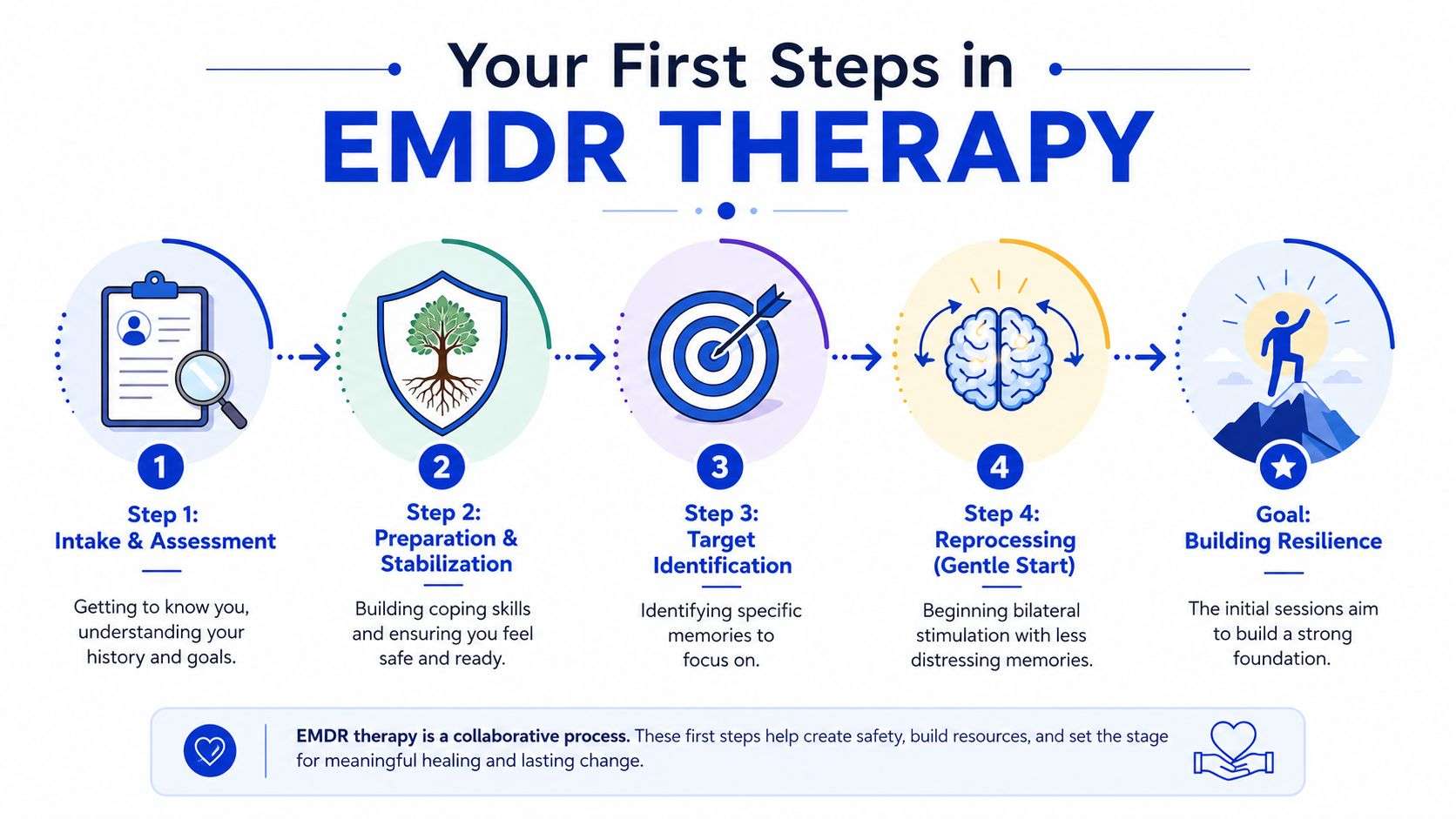
Early EMDR is usually much more measured than that. The process follows a clear structure, and the first sessions often focus on helping you feel oriented, informed, and able to stay within a manageable level of emotion. In Canadian practice descriptions, EMDR is organized into eight phases, including history-taking, preparation, assessment, processing, and closure. Preparation often includes grounding and calming exercises, and closure includes helping the client return to a steadier state before the session ends.
What usually happens first
The first few sessions often feel more like building the frame of a house than decorating the rooms. Before trauma processing starts, your therapist is learning how your nervous system responds to stress, what helps you settle, what makes things worse, and whether EMDR is the right fit right now.
You may spend time on:
- History and goal-setting: identifying what brings you in and what you want to be different
- Mapping triggers: noticing which situations, thoughts, or body sensations set off distress
- Regulation skills: practicing ways to settle when emotion rises
- Pacing agreements: deciding how you will signal “slow down,” “pause,” or “stop”
- Readiness for processing: checking whether you can return to the present after difficult material comes up
If you have complex trauma, dissociation, panic, recent instability, or you are autistic or ADHD and process sensory input differently, this early phase may take longer. That is often good clinical care, not a sign that therapy is stalled.
Questions to ask so you know what kind of EMDR you are getting
This part matters because two therapists can both say they offer EMDR while working very differently.
A careful therapist should be able to explain their early-session process in plain language. If their answers feel vague, rushed, or overly scripted, that tells you something useful. You are allowed to ask direct questions before you begin, or in the first session, such as:
- “What do your first three EMDR sessions usually look like?”
- “How do you decide whether someone needs more preparation before processing?”
- “What do you do if a client starts to feel flooded, numb, or disconnected during session?”
- “Do you adapt EMDR for complex trauma, dissociation, or neurodivergent clients?”
- “How will we know if the pace is too fast for me?”
- “What support do you offer between sessions if strong reactions come up afterward?”
Those questions help you hear whether the therapist has a process, not just a technique. EMDR is more like a guided physiotherapy plan for the nervous system than a one-time procedure. The quality of the setup affects how the deeper work unfolds.
Why preparation is part of the treatment
Some people worry that if they are not processing memories right away, therapy is being delayed. In trauma work, preparation is treatment.
A client who can notice activation, use grounding, and return to the room has a safer base for later processing. A client who has no way to settle may leave session overwhelmed, exhausted, or unsure what happened. For single-incident trauma, preparation may be brief. For layered trauma, childhood trauma, attachment wounds, or clients with dissociation, the setup phase often needs more care and more time. As noted earlier, more complex cases usually require longer treatment planning in BC.
That is also why a fixed promise like “we'll clear this in two sessions” deserves caution.
What processing can feel like
When processing begins, your therapist may ask you to bring up part of a target memory, notice the belief attached to it, track the emotion, and identify where you feel it in your body. Then they use bilateral stimulation in short sets, with pauses to check what you notice next.
Some people feel relief. Some feel tired. Some feel emotion shift in unexpected ways, like moving from fear to anger, or from shame to grief. Others notice body sensations first and words later. None of that automatically means the session is going badly. Trauma processing often works in layers.
A good early EMDR experience usually feels contained, even when it is emotional. You should leave with a sense of reorientation, some understanding of what happened in the session, and a plan for how to care for yourself afterward.
What to listen for in your therapist's explanation
If you are trying to choose carefully, listen less for polished language and more for signs of clinical judgment.
Helpful answers often include concrete details about pacing, consent, grounding, closure, and how treatment is adjusted for your history. Less helpful answers tend to sound generic, overly confident, or dismissive of complexity. You do not need a therapist who makes bold promises. You need one who can explain their method clearly, notice when your system is getting overloaded, and help you work at a pace your body can tolerate.
Your Questions About EMDR Answered
A common place to get stuck is here: you are interested in EMDR, but you are also trying to avoid starting the wrong therapy with the wrong person. That caution makes sense. Good questions can help you choose more carefully.
Is EMDR safe
EMDR can be safe when it is offered by a clinician with proper training who knows how to assess readiness, pace the work, and respond to overwhelm or dissociation. Safety comes from the full treatment process, not from the eye movements or tapping alone.
If you live with complex trauma, panic, shutdown, or a nervous system that shifts fast, ask direct questions before you begin. You might ask, “How do you decide whether someone is ready for processing?” “How do you adapt EMDR for dissociation, autism, ADHD, or sensory sensitivity?” and “What do you do if a client becomes too activated in session?” Clear, concrete answers usually matter more than polished language.
What if I feel worse before I feel better
Some people notice more emotion, vivid dreams, fatigue, or body tension between sessions, especially early on. That can be part of trauma treatment, but it should still be discussed and monitored.
A useful comparison is physical rehabilitation. If you start using an injured part of the body again, you may feel soreness, but you still want the work to be measured and safe. Therapy is similar. Ask, “What should I expect between sessions?” “What signs tell us the pace is too fast?” and “How can I contact you if I am struggling after an appointment?” Those questions help you find out whether a therapist has a plan, not just good intentions.
How long does EMDR take
The honest answer is that the timeline varies. A single upsetting event often looks different from years of layered trauma, childhood neglect, or repeated relational harm. Readiness, current stress, dissociation, sleep, substance use, and day-to-day stability can all affect pacing.
As noted earlier, outcome research on EMDR is encouraging, but numbers do not tell you how your own treatment will unfold. A better consumer question is, “How do you estimate treatment length for someone with my history?” You can also ask, “Do you begin with a specific target, or do you start with stabilisation work first?” and “How will we decide whether EMDR is helping enough to continue?”
How will I know if it's working
Progress is often quieter than people expect. You may still remember what happened, but the memory has less force. Your body may settle faster after a trigger. You may notice more choice, more clarity, or less shame.
Research support for EMDR is well established. A journal summary from the EMDR Center of Canada reports that EMDR has strong evidence for PTSD treatment, including many randomized controlled trials showing meaningful symptom reduction that is maintained at follow-up.
If you want to assess fit as you go, ask your therapist how they track progress. Do they use check-ins, symptom measures, target reviews, or functional markers such as sleep, work, driving, or relationships? Improvement should be noticeable in daily life, not only inside the therapy room.
Is EMDR better than trauma-focused CBT
They are both evidence-based treatments for trauma. According to a 2025 review from the U.S. Department of Veterans Affairs, EMDR is comparably effective to trauma-focused CBT for reducing PTSD symptoms, with meta-analyses showing moderate to strong effects across PTSD symptoms, depression symptoms, and loss of PTSD diagnosis (VA review of EMDR treatment effectiveness).
The better question is often not “Which one is better?” but “Which one fits me better right now?” Some people want a structured, skills-based, language-focused approach. Others find that EMDR fits better because it works with memory, emotion, and body responses in a less verbal way.
If you are speaking with a therapist in Kelowna, it also helps to ask practical questions early. Do they have experience with motor vehicle accident claims and ICBC documentation? Do they offer direct billing, virtual sessions, or shorter appointments if processing feels too intense? Those details may sound administrative, but they can shape whether treatment is realistic and sustainable.
If you're exploring EMDR and trauma support and want a clearer sense of your next step, Interactive Counselling offers information about trauma-focused care, including support for people recovering from difficult life events and motor vehicle accidents. Reading about the process, asking careful questions, and choosing a therapist who explains their approach clearly can help you begin with more confidence and less uncertainty.
Clinically Reviewed By
Amy Mosset, MCP, RCC-S
Amy Mosset is a Master Practitioner in Clinical Counselling, Clinical Supervisor, and the owner of Interactive Counselling. She provides trauma-informed, evidence-based care and clinical supervision to registered therapists, with a focus on ethical practice, client safety, and high-quality therapeutic outcomes.