Anxiety is one of the most common concerns facing young people, and 31% of youth ages 12 to 17 had a mental, emotional, developmental, or behavioural problem in 2022 to 2023, while 20% of adolescents experienced anxiety symptoms in the past two weeks. If you're looking for youth and teen counselling in Grande Prairie, support does exist locally, including a walk-in addiction and mental health clinic model that helps families access an initial intake and triage process. For more information, see our Grande Prairie youth counselling.
You might be here because your teen doesn't seem like themselves lately. Maybe they're snapping over small things, staying in their room more, struggling to sleep, or asking to miss school because of stomach aches that don't seem to have a clear medical cause. For many parents, the hardest part is not knowing whether this is a rough patch, typical teen stress, or something that needs extra support. For more information, see our counselling in Grande Prairie.
'Youth and teen counselling in Grande Prairie provides a safe, confidential space for young people to develop practical skills for managing anxiety, guided by a therapist who specializes in their unique developmental needs.' For more information, see our youth counselling.
Navigating the Challenges of Teen Anxiety in Grande Prairie
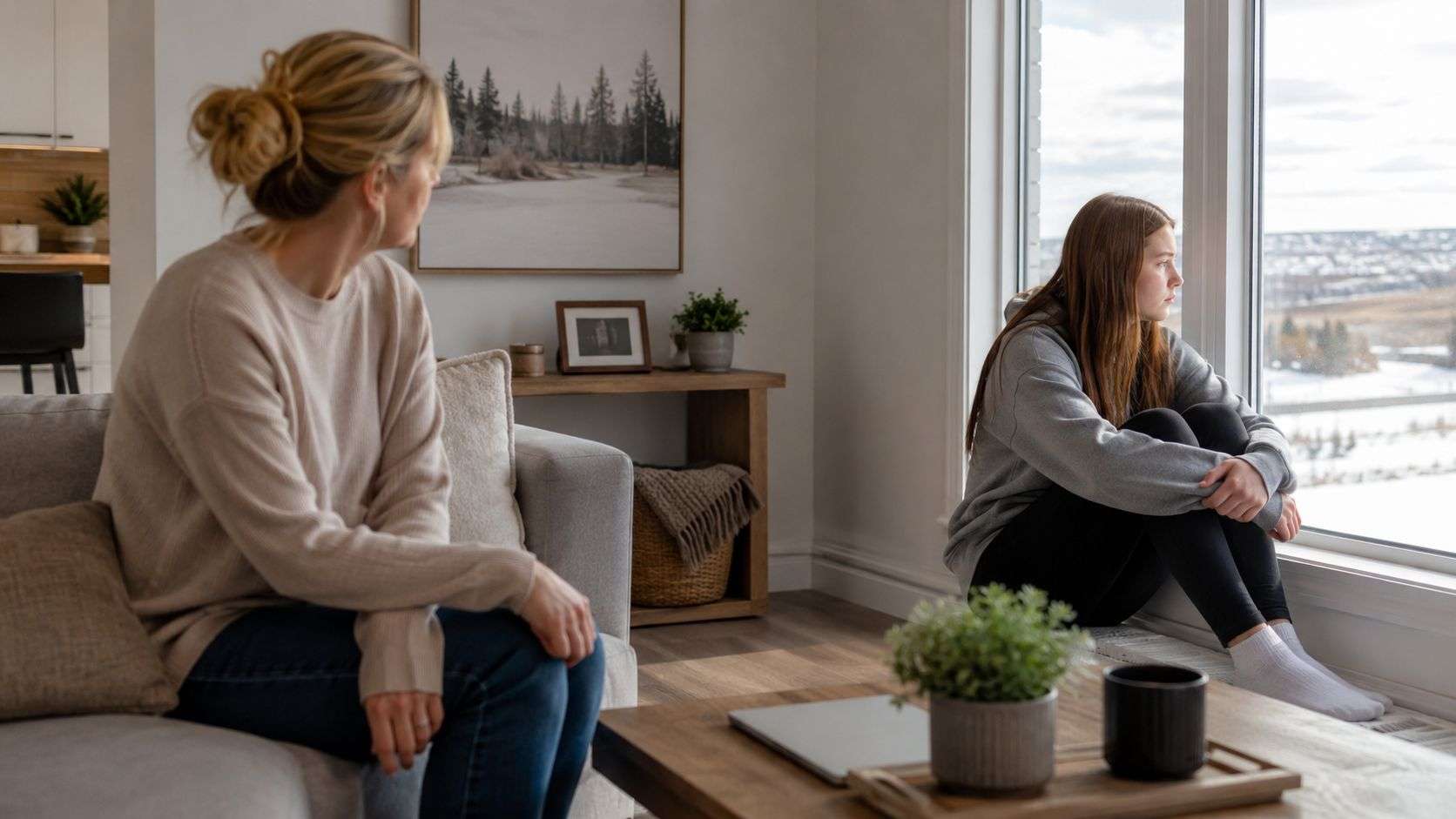
A lot of parents first notice anxiety indirectly. Their teen may not say, “I'm anxious.” Instead, they might seem angry, shut down, perfectionistic, or exhausted. A once-social child might stop seeing friends. A teen who used to manage school well might suddenly avoid homework, miss classes, or panic before tests.
That can leave you feeling unsure of what to do next. Many caring parents wait because they hope things will settle on their own. Sometimes they do. Sometimes they don't.
When worry starts affecting daily life
Counselling isn't only for crises. It can be a helpful step when anxiety begins to interfere with ordinary life, such as school attendance, sleep, family relationships, sports, friendships, or confidence. The earlier a young person learns how anxiety works in the body and mind, the easier it often becomes to respond to it with skill instead of fear.
During the pandemic, Alberta families saw this need more clearly. The proportion of youth in Alberta using mental health care increased from 15.6% in 2018/19 to 18.8% in 2021/22, with anxiety-related care driving much of that growth in outpatient psychiatric and primary care settings, as reported in this Alberta youth mental health care study.
Why parents often miss the early signs
Teen anxiety doesn't always look dramatic. It can look like:
- Irritability at home because your teen is holding it together all day elsewhere
- Avoidance of school, social events, or new situations
- Constant reassurance-seeking about grades, friendships, health, or the future
- Physical complaints like headaches, nausea, or fatigue
- Over-functioning through perfectionism, overstudying, or fear of making mistakes
Practical rule: If your teen's stress is lasting, affecting functioning, or changing how they see themselves, it's worth taking seriously.
For families in Grande Prairie, one reassuring truth matters. You don't need to have everything figured out before reaching out. A counsellor's job is to help make sense of what you're seeing, reduce fear, and give your teen tools they can put to use.
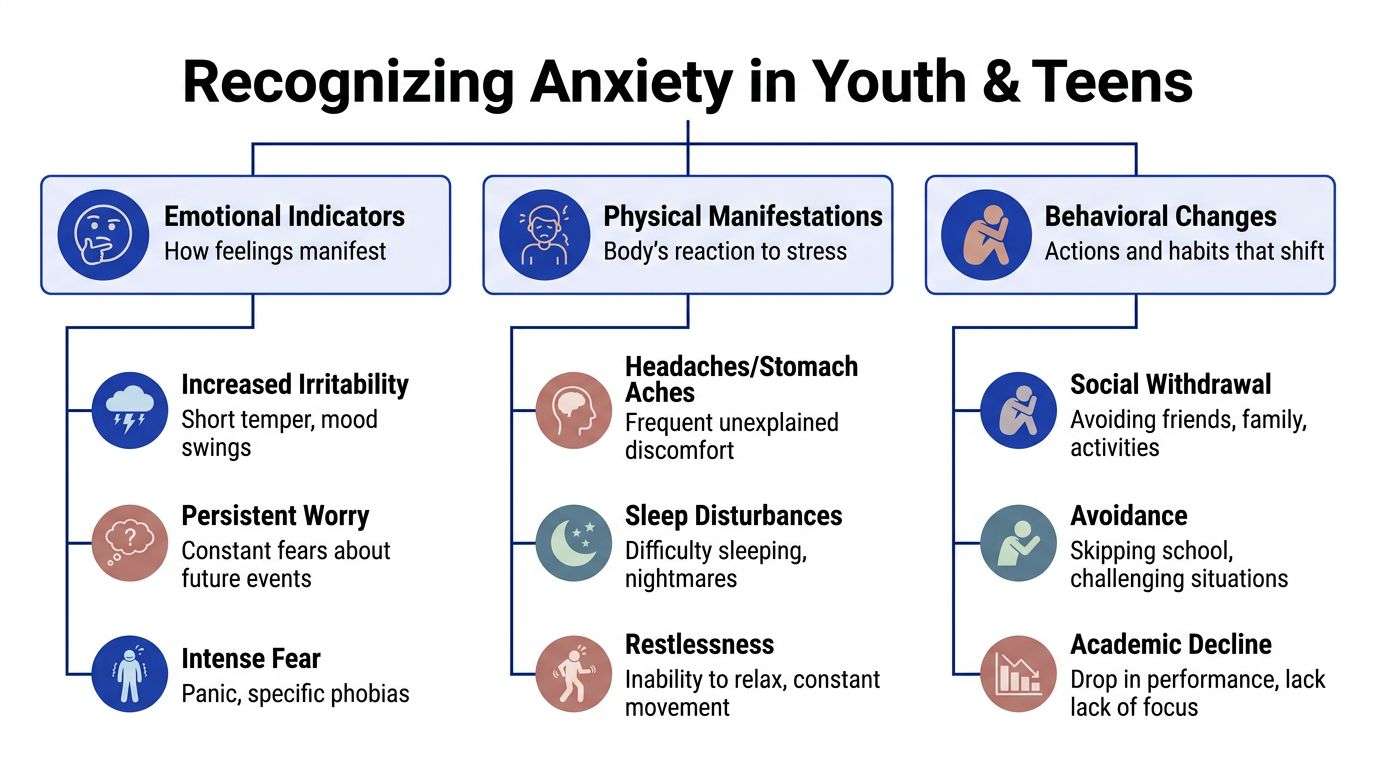
Recognizing the Signs of Anxiety in Youth and Teens
Parents often expect anxiety to look like obvious panic. Sometimes it does. More often, it shows up in quieter ways that are easy to mistake for attitude, laziness, or normal adolescence. Looking at the full picture helps.
Emotional signs
An anxious teen may seem “too sensitive” or “on edge,” but that language can hide what's really happening. Anxiety often creates a constant internal alarm.
Common emotional signs include:
- Persistent worry about school, health, friendships, family safety, or the future
- Irritability that seems out of proportion to the situation
- Fear of embarrassment or making mistakes
- Perfectionism that makes it hard to start or finish tasks
- Need for control when uncertainty feels unbearable
Some teens also become very hard on themselves. They may assume the worst, expect failure, or feel responsible for things outside their control.
Physical signs
Young people often feel anxiety in their bodies before they can name it emotionally.
Watch for patterns such as:
- Stomach aches or headaches with no clear physical explanation
- Trouble sleeping, including difficulty falling asleep or restless sleep
- Fatigue from constant mental tension
- Restlessness or inability to relax
- Changes in appetite during stressful periods
If these symptoms cluster around school mornings, social events, performances, or family stress, anxiety may be part of the picture.
Anxiety is not “all in their head.” Teens often experience it as a full-body state.
Behavioural signs
Behaviour is where parents usually notice the biggest shifts. Anxiety often pushes young people into protection mode.
You may see:
- Avoidance of school or repeated requests to stay home
- Social withdrawal from friends, family, or activities they used to enjoy
- Procrastination because starting feels overwhelming
- Frequent reassurance-seeking from parents
- Anger or shutdown when they feel pressured
- Drop in academic performance because concentration is harder under stress
A teen who says “I don't care” may care a great deal and feel too overwhelmed to cope.
Eco-anxiety in Grande Prairie youth
Not all teen anxiety is about grades or peers. Some young people are carrying genuine fear about the future of the world they're inheriting. In rural Alberta, that can feel especially personal when teens connect climate concerns to land, work, weather, and long-term stability.
A 2025 survey found that 43% of teens in Grande Prairie report persistent worry about climate change affecting their future, and 29% experience sleep disturbances or avoidance behaviours linked to that fear, according to the Alberta Youth Mental Health Alliance survey summary. Very few local resources name eco-anxiety directly, but it is treatable.
That matters because when adults dismiss this worry as “overreacting,” teens often feel even more alone.
Effective Therapy Approaches for Managing Teen Anxiety
A parent often asks this question after a hard week. Their teen is melting down before school, avoiding friends, or lying awake at night, and the parent wants to know what helps. The short answer is that good therapy is not one-size-fits-all. A counsellor chooses methods based on how your teen experiences anxiety, what triggers it, and what support the family can realistically give at home.
Many young people still go without care. Nearly 1 in 3 youth ages 12 to 17 had a mental, emotional, developmental, or behavioural problem in 2022 to 2023, and 40% of adolescents who experienced a major depressive episode did not receive care, as noted in these youth mental health statistics. That gap matters because anxiety rarely stays in one corner of life. It can spread into sleep, school attendance, friendships, appetite, and family routines.
Cognitive Behavioural Therapy
Cognitive Behavioural Therapy, or CBT, helps a teen slow down the anxiety cycle and study it piece by piece. A helpful way to understand CBT is to picture anxiety as a fire alarm that goes off too easily. The alarm is real. The fear feels real. But the system is reacting as if danger is present, even when the situation is only uncomfortable.
In CBT, a counsellor helps a teen notice the sequence:
thought, body reaction, urge to escape, short-term relief, then stronger anxiety next time.
A teen who thinks, “If I answer wrong, everyone will judge me,” may feel shaky, go silent, and avoid participating. CBT works on each part of that chain.
A counsellor might help a teen:
- identify anxious thought patterns
- test whether those thoughts are fully accurate
- practise more balanced self-talk
- gradually face feared situations in manageable steps
Parents often like CBT because it gives their teen something concrete to practise between sessions. It also gives parents a clearer map. Instead of repeating “just relax,” they can learn how to support brave, small steps.
Acceptance and Commitment Therapy
Acceptance and Commitment Therapy, or ACT, helps teens who get stuck in a constant fight with their own thoughts. Some young people spend so much energy trying to get rid of anxiety that they have very little energy left for school, relationships, or rest.
ACT teaches a different skill. It helps teens notice anxious thoughts without treating every thought like an order.
That can be hard for parents to understand at first. Accepting anxiety does not mean giving up. It means helping a teen say, “I feel anxious, and I can still do what matters.”
ACT often helps teens:
- notice thoughts without automatically obeying them
- reduce struggles with trying to control every feeling
- reconnect with values like friendship, learning, creativity, or courage
- build flexibility during uncertainty
This approach can be especially helpful for Grande Prairie teens carrying worries that do not have simple answers, including eco-anxiety. If a teen is very worried about climate, land, weather, or the future of work in their region, therapy should not dismiss that concern. ACT can help them hold that fear with more steadiness while still staying connected to daily life and personal values.
Family therapy
Family therapy is often useful when anxiety has changed the rhythm of the whole home. Parents may start tiptoeing around distress, siblings may feel overlooked, and routines can become organized around avoiding the next upset. In that situation, individual therapy helps, but family work can speed up progress because everyone learns the same language and goals.
Family therapy usually examines patterns, not blame.
A counsellor may help the family:
- reduce conflict around school refusal or avoidance
- change reassurance habits that accidentally feed anxiety
- improve communication during stressful moments
- respond more consistently across caregivers
- create routines that feel steady and predictable
This matters for another reason. A worried parent can, without meaning to, amplify a teen's fear by over-checking, over-explaining, or rescuing too quickly. Family therapy helps parents notice those patterns gently and replace them with responses that communicate calm, confidence, and trust in the teen's coping skills.
Comparing therapies for teen anxiety
| Therapy Type | Main Focus | What Teens Learn |
|---|---|---|
| CBT | Thoughts, feelings, and behaviours | How to question anxious thinking and face fears step by step |
| ACT | Relationship to thoughts and feelings | How to make room for discomfort and still act on personal values |
| Family Therapy | Family patterns and responses | How to communicate better and support progress at home |
A skilled therapist may blend these approaches. That is often a sign of careful care. Teen anxiety does not always fit neatly into one method, and treatment tends to work best when it matches the young person in front of you.
The Parent's Role in a Teen's Healing Journey
Your teen snaps over homework, shuts their bedroom door, and says, “You don't get it.” Meanwhile, you are lying awake wondering whether pushing harder will help, or whether backing off will make things worse. Many parents come to counselling carrying both fears at once.
That tension matters. Anxiety rarely stays inside one person. It moves through a household in small, understandable ways, like smoke setting off alarms in more than one room. A parent's stress can make a teen feel less steady, and a teen's anxiety can keep a parent on high alert. Seeing that pattern is not about blame. It is the starting point for change.
Why your own anxiety matters
Research has consistently found a connection between parent anxiety and child anxiety. That does not mean a parent causes a teen's struggles. It means young people learn from what they see, especially during stress.
If you often scan for danger, explain away every uncertainty, rush to reassure, or avoid distress whenever possible, your teen may absorb the message beneath those actions. The message often sounds like this: discomfort is unsafe, uncertainty must be controlled, and hard feelings should be escaped quickly.
That pattern can show up in Grande Prairie in ways families do not always expect. Some teens worry about grades or friendships. Others carry fear about wildfires, extreme weather, job uncertainty in the region, or what the future will look like here. Eco-anxiety can feel abstract to adults, but to a teen it may feel personal and immediate. If a parent is also feeling overwhelmed by those same concerns, the household can become even more reactive.
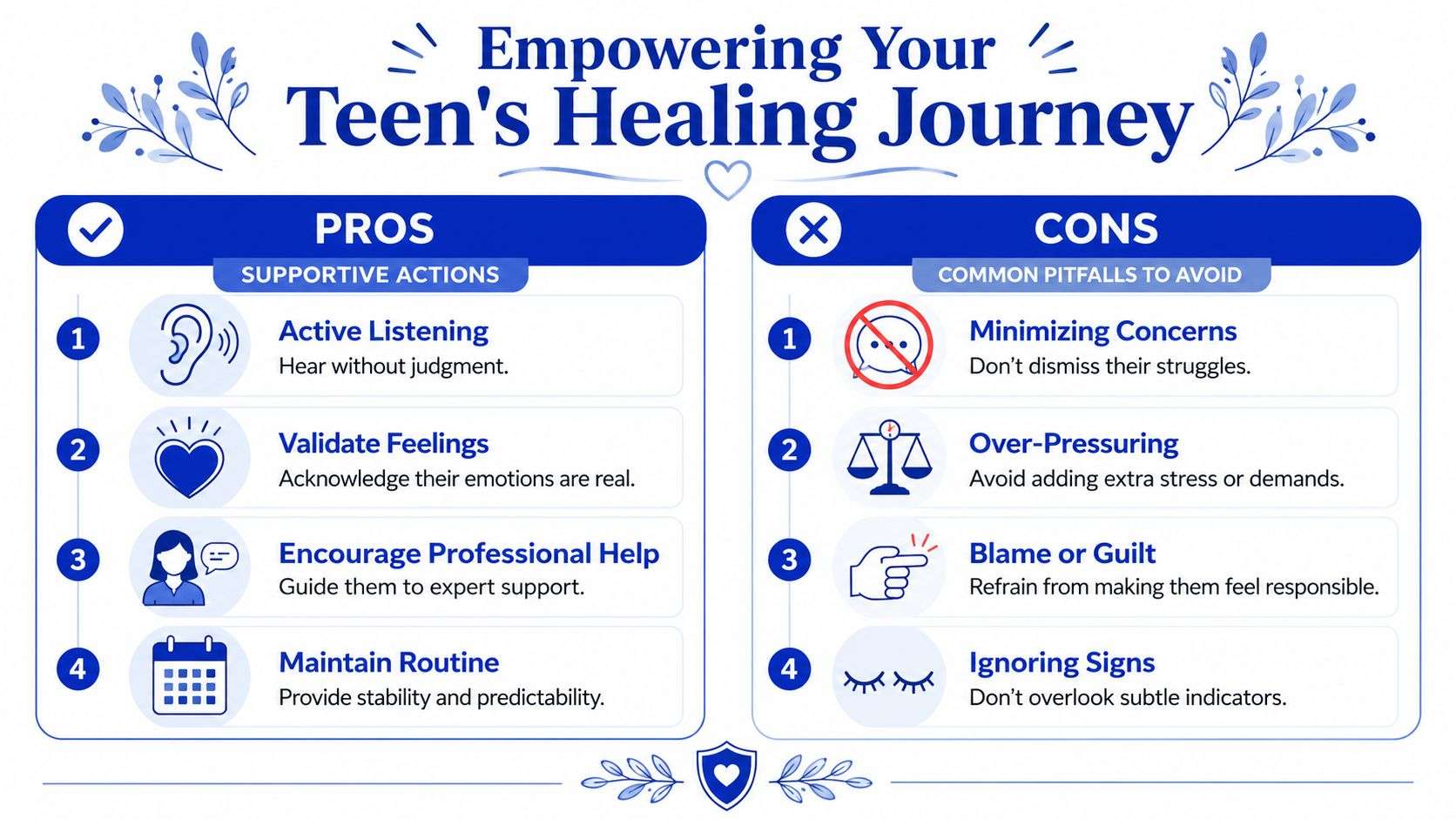
What helps at home
Parents do not need to run therapy sessions in the kitchen. Your role is closer to a coach than a fixer. A good coach does not run the race for the athlete. A good coach helps them pace themselves, practice skills, and recover after hard stretches.
Helpful shifts often include:
Listen first
When your teen starts talking, slow down the urge to solve. Feeling understood helps the nervous system settle.Name the feeling clearly
Try, “That sounds scary,” or, “I can hear how overwhelmed you feel.” Clear naming helps teens feel less alone.Keep your message calm and brief
Long explanations often feed anxiety. Short, steady responses are easier for an anxious brain to absorb.Show your own coping out loud
You might say, “I'm stressed, so I'm going to take a few slow breaths before we keep talking.” This teaches more than a lecture does.Protect routines
Regular sleep, meals, school expectations, and downtime give anxious teens a steadier base.Support small acts of courage
Progress usually looks like manageable practice, not one huge breakthrough.
A simple phrase can help: “I believe this is hard, and I believe you can handle it.”
Common habits that can keep anxiety going
Parents usually do these things out of love. Still, love can get pulled into anxiety's rules.
Watch for patterns like:
- answering the same reassurance question again and again
- allowing avoidance to become the main coping tool
- stepping in too early with tasks your teen can do
- matching your teen's panic with your own visible alarm
- turning worried moments into long lessons
Anxiety works like an overprotective smoke alarm. It goes off even when the toast is only a little burnt. If everyone in the house starts reacting as if there is a fire each time it sounds, the alarm never gets a chance to recalibrate. Calm, predictable responses teach the brain a different lesson.
You deserve support too
Parents often need space to sort out their own fear, guilt, and exhaustion. That is healthy. It can be especially useful if you notice your own anxiety rising alongside your teen's, or if local stressors such as wildfire seasons, economic uncertainty, or environmental worries are already wearing your family down.
Parent support can help you respond with more confidence, set steadier limits, and lower the emotional temperature at home. For many families, that is where hope starts to feel real again.
What to Expect from Youth Counselling Sessions
The unknown can make counselling feel bigger than it is. Parents often worry their teen will be judged, pressured to talk, or expected to reveal everything immediately. Most youth counselling doesn't work like that.
The process is usually gradual, collaborative, and paced to fit the young person in front of the therapist.
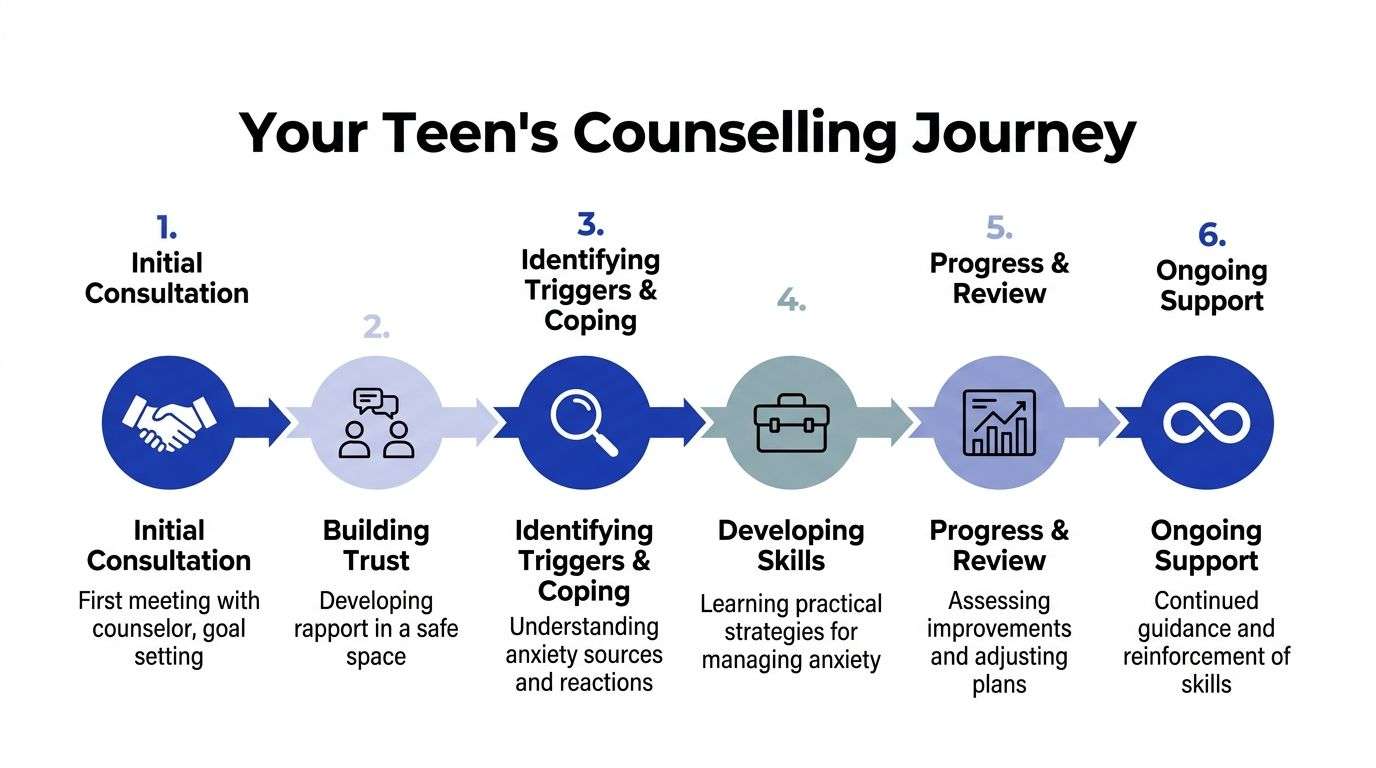
The first contact and intake
In Grande Prairie, public access can include a walk-in addiction and mental health clinic at Nordic Court, operating Monday to Friday from 8:00 AM to 4:30 PM, with walk-in availability from 8:00 AM to 3:30 PM, and initial intake conducted at the Aberdeen Centre through an Alberta Health Services youth clinic pathway. In private or community settings, the first step is often an intake conversation.
During an intake, the therapist usually asks about:
- what your teen is struggling with
- when the anxiety tends to show up
- how it affects school, sleep, relationships, or daily life
- what your family has already tried
- any safety concerns
This first stage is about understanding, not interrogation.
Building trust with your teen
A teen is much more likely to benefit if they feel respected. Good therapists don't force connection. They build it.
That may mean starting with easy topics, talking about daily life before deeper worries, or giving the teen some control over how the session unfolds. Sometimes progress begins when a young person realises they don't have to perform, impress, or say the “right” thing.
Counselling works best when a teen feels safe enough to be honest, not when they feel pushed to open up.
Goals, confidentiality, and parent involvement
Early sessions often include shared goals. One teen may want fewer panic symptoms. Another may want to get back to school consistently. Another may just want the racing thoughts to quiet down at bedtime.
Confidentiality is a common point of confusion. In most cases, teens need some privacy in order to trust the process. Parents are usually included in age-appropriate ways, especially around goals, strategies, and safety concerns. If there is a risk of harm to self or others, confidentiality has limits.
That balance can feel uncomfortable at first, but it's often what makes therapy effective.
In-person, virtual, and phone sessions
Some teens talk more easily in person. Others feel safer starting virtually or by phone. For families juggling school, sports, work schedules, distance, weather, or energy levels, flexible formats can make counselling easier to maintain.
What matters most is not choosing the “perfect” format. It's choosing one your teen will realistically attend and engage with.
How to Get Started with a Teen Counsellor in Grande Prairie
Your teen is melting down before school, lying awake at night, or shutting down whenever stress comes up. You know they need support, but one more worry appears right away. How do you even begin?
Start smaller than you think. You are not trying to solve your teen's anxiety in one phone call. You are looking for a good first conversation with someone who understands young people and can help your family decide on the next step.
A counsellor search works a bit like finding the right teacher. Training matters, but so does the relationship. A teen may learn very little from an expert they do not trust, while a good fit can help them feel safe enough to practise new skills and talk openly about what is happening.
What to look for in a counsellor
Look for a counsellor who regularly works with youth and teens, not only adults. Anxiety can look different in a 13-year-old than it does in a 17-year-old, and the support needs to match your teen's stage of development, daily stressors, and personality.
A strong fit often includes:
- Experience with teens and a clear understanding of how anxiety shows up in behaviour, school struggles, sleep problems, irritability, avoidance, or physical complaints
- A calm, approachable style so your teen does not feel studied or judged
- Evidence-informed therapy approaches such as CBT, ACT, or family-based support
- Thoughtful parent involvement so you are included in helpful ways while your teen still has room to build trust
- Practical flexibility with scheduling or session format, especially for families balancing work, activities, distance, weather, or low energy
It can also help to ask whether the counsellor understands concerns that affect Grande Prairie youth specifically. For some teens, anxiety is tied to school pressure or friendships. For others, it may be connected to family stress, community uncertainty, or eco-anxiety about fires, smoke, changing seasons, and the future. Those worries are real. A therapist does not need to have all the answers, but they should be willing to talk about them in a grounded way.
Simple first steps
You do not need polished language. A simple message is enough. You might say, “My teen seems anxious lately, and I'm not sure what kind of support would fit. Can you tell me how you usually get started with teens and parents?”
Then listen for clear, steady answers.
Helpful questions include:
- What age groups do you work with most often
- How do you help teens who are unsure about counselling
- How are parents involved
- What does the first appointment usually include
- Do you offer in-person, virtual, and phone sessions
- Do you provide support for clients using ICBC funding when counselling is related to a motor vehicle accident
As a parent, notice your own body during this process too. If you feel panicked, urgent, or guilty, that makes sense. Parents often carry their teen's fear and add their own. But anxiety can spread through a family system like static in a room. Slowing yourself down before the first call can help you ask better questions and send your teen an important message. We can handle this one step at a time.
The first counsellor may be a good fit. Sometimes they are not. That does not mean counselling failed. It means you are still finding the right person for your teen to begin with, and that is a normal part of the process.
Frequently Asked Questions About Teen Anxiety Therapy
How long does therapy usually take for teen anxiety
It depends on what your teen is dealing with, how long the anxiety has been present, and how ready they feel to practise skills outside sessions. Some teens benefit from shorter, focused work. Others need longer support, especially if anxiety is tied to family stress, school avoidance, or other emotional concerns.
What if my teen refuses to go to counselling
That's common. Start with curiosity, not pressure. Ask what worries them about counselling. Many teens fear being judged, forced to talk, or treated like they're the problem. It can help to present counselling as support, not punishment, and to give them some choice in the process.
How can I tell if therapy is helping
Progress isn't always dramatic at first. Often you'll notice small changes, such as less avoidance, better sleep, fewer explosive moments, more flexible thinking, or a greater willingness to talk. Your teen may still feel anxious sometimes, but they begin handling it differently.
Should parents be involved in every session
Not always. Many teens need individual space to build trust with the therapist. Parent involvement is still important, just not necessarily constant. A thoughtful balance often works best, especially when the goal is to support change both inside and outside the therapy room.
If this article helped you feel a little more grounded, you can learn more about youth, family, and anxiety support through Interactive Counselling. Sometimes the next best step is getting a clearer picture of what your teen is experiencing and what kind of help would fit them well.
Clinically Reviewed By
Amy Mosset, MCP, RCC-S
Amy Mosset is a Master Practitioner in Clinical Counselling, Clinical Supervisor, and the owner of Interactive Counselling. She provides trauma-informed, evidence-based care and clinical supervision to registered therapists, with a focus on ethical practice, client safety, and high-quality therapeutic outcomes.