If your anger feels explosive, frightening, or unlike you after birth, it may be more than stress. In Canada, nearly 23% of recently postpartum mothers report symptoms of postpartum depression or an anxiety disorder, and nearly 50% are not diagnosed by health professionals, which means many mothers are left trying to make sense of intense emotions on their own. For more information, see our depression counselling.
You might have snapped at your partner over a bottle lid, slammed a drawer after the baby woke again, or felt a surge of heat and fury so strong it scared you. Then came the guilt. Then the question many new mothers whisper to themselves: What is wrong with me?
"Postpartum rage signals that a new mother needs a counsellor because its intensity goes beyond normal mood swings, often indicating an underlying, treatable condition like postpartum depression or anxiety that requires professional support."
That Wasn't Me Acknowledging Postpartum Rage
It is 3:17 a.m. The baby is crying again. Your breasts ache or your incision pulls when you move. You have slept in scraps, not in a real stretch. Then your partner asks where the clean bottles are, and a wave of anger rises so fast it feels almost physical. You snap. You slam a drawer. Or you stay quiet while your whole body feels lit up from the inside.
That moment can be terrifying.
Many new mothers describe it the same way: That wasn't me. What makes it so unsettling is not a lack of love for the baby. It is the feeling that your reactions have become bigger, sharper, and harder to predict than before birth.
That experience deserves care, not shame.
When anger feels bigger than the trigger
Early motherhood asks an exhausted brain and body to do too much at once. Hormone shifts, broken sleep, pain, feeding stress, isolation, and the constant pressure to stay calm can pile up like water behind a dam. Sometimes anger is the first place that pressure breaks through.
For some mothers, this looks loud. Yelling. Slamming a cupboard. Picking a fight over something small. For others, it stays inside as a hot, constant irritability, a feeling of being one cry or one question away from exploding.
Either way, it can leave you wondering whether you are becoming someone you do not recognize.
That fear is common. It is also one reason postpartum rage gets missed. Many mothers were taught to watch for sadness after birth, not fury. So they judge themselves instead of recognizing that they may be having a treatable postpartum mental health symptom.
Why naming it matters
Putting the right name to the experience can change the whole story you tell yourself.
Without a name, rage can feel like proof that you are a bad mother, a bad partner, or not coping well enough. With a name, it becomes a signal. Like a smoke alarm, it is loud because something needs attention. It does not mean your character is defective. It means your system may be overloaded, and there may be depression, anxiety, trauma, or severe depletion underneath it.
Naming postpartum rage also helps you judge when home coping is no longer enough. If the anger is frequent, feels hard to control, scares you, leads to urges to throw things or hurt yourself, or keeps damaging your relationships, that crosses from "I am having a rough week" into "I need professional support." In Canada, many mothers hit that point and still struggle to get timely help because of wait-lists, cost, lack of childcare, rural access problems, or being told to wait it out.
None of those barriers mean your suffering is minor.
The first step is simple: You are not broken. You are not alone. And this can get better with the right support.
Understanding Postpartum Rage Beyond Simple Anger
Some anger is human. Postpartum rage is different. It often feels like your internal system has overloaded, the way a circuit breaker trips when too many demands hit at once.

Postpartum rage is a distinct mood disruption characterized by intense anger and aggression that peaks between six weeks and one year postpartum, occurring independently or with postpartum depression. It is physiologically driven by severe drops in estrogen and progesterone, sleep deprivation, and lack of social support, as described by the Cleveland Clinic overview of postpartum rage.
What it can look like
Some mothers expect postpartum distress to look like crying or sadness. Rage can be much louder, or much more hidden.
- Emotional signs include irritability, simmering resentment, feeling constantly on edge, or going from calm to furious in seconds.
- Behavioural signs can include yelling, snapping, slamming doors, picking fights, or feeling unable to stop an angry outburst once it starts.
- Physical signs may show up as a racing heart, clenched jaw, tight chest, shaking, restlessness, or the sense that your body is bracing for impact.
For some women, the anger is directed outward. For others, it turns inward and becomes harsh self-criticism.
What makes it different from ordinary frustration
Ordinary frustration usually matches the situation. Postpartum rage often doesn't. A minor mess can trigger a major reaction. A delayed text can feel unbearable. A crying spell from your baby can land in your nervous system like an emergency.
That doesn't mean you're dramatic. It often means your body and mind are overloaded.
Practical rule: If the intensity of your reaction keeps surprising you, pay attention. The surprise itself is often a clue that something deeper is happening.
Why mothers miss it
Many mothers don't recognise rage as a mental health symptom. They assume postpartum conditions only involve sadness. Some health professionals miss it too, especially if standard screening focuses more on tearfulness or worry than anger.
That gap matters. When rage isn't named, mothers often try to manage it alone. They focus on being more patient, more grateful, more organised. But when the issue is a treatable postpartum condition, self-blame won't solve it.
Is It Rage PPD or the Baby Blues
A lot of confusion comes from the fact that postpartum struggles can overlap. Anger, sadness, worry, numbness, and guilt can all live together. Still, there are useful differences.
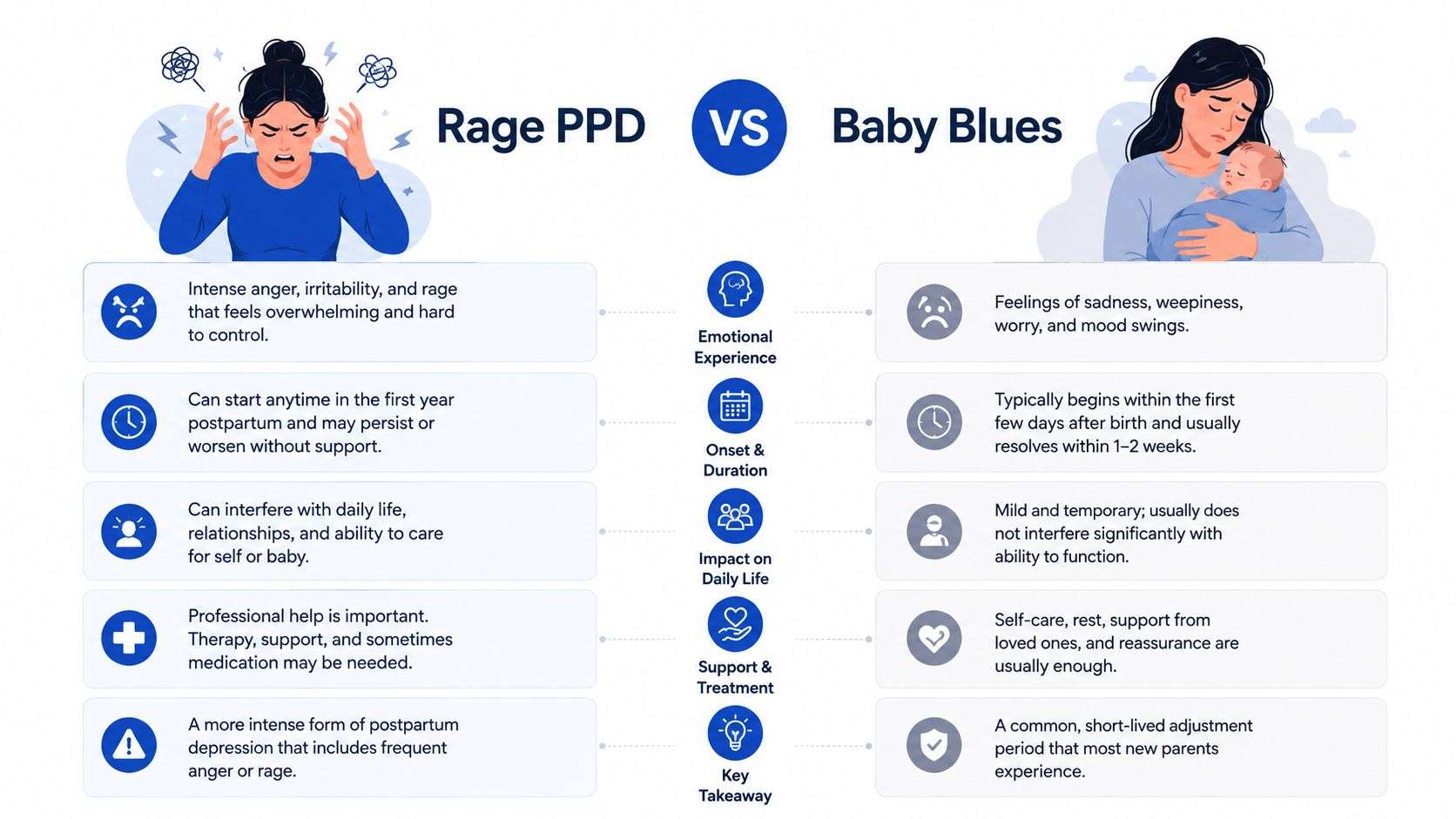
In Canada, nearly 23% of recently postpartum mothers report symptoms of postpartum depression or an anxiety disorder, yet nearly 50% are not diagnosed by health professionals, which means rage symptoms are often under-identified or mistaken for behaviour problems, according to Statistics Canada reporting on postpartum depression and anxiety symptoms.
A simple comparison
| Experience | Core feeling | Typical pattern | What often stands out |
|---|---|---|---|
| Baby blues | Tearful, emotionally sensitive, overwhelmed | Early after birth and tends to ease on its own | Mood swings, crying easily, feeling raw |
| Postpartum depression | Sadness, hopelessness, disconnection | Persists and interferes with daily life | Low mood, loss of interest, guilt, withdrawal |
| Postpartum anxiety | Fear, dread, racing thoughts | Persistent and hard to switch off | Constant worry, checking, feeling keyed up |
| Postpartum rage | Intense anger, irritability, aggression | Explosive or simmering, often with guilt after | Yelling, snapping, feeling out of control |
Where people get mixed up
A mother with postpartum depression may look flat and shut down. A mother with postpartum rage may look volatile and reactive. But these can overlap. Some women feel both hopeless and furious. Some feel chronically anxious, then erupt when their nervous system can't hold any more stress.
That overlap is one reason self-diagnosis can get messy. You don't need to sort yourself neatly into one box before asking for help.
A useful question to ask yourself
Instead of asking, Which label fits me perfectly? ask this:
- Does this feel like me at my best, or like me under strain and not coping well?
- Is this passing, or is it becoming a pattern?
- Do I feel able to regulate myself, or am I scaring myself with how intense this feels?
If your anger feels relentless, unpredictable, or tied to sadness, panic, or disconnection, it deserves the same attention as any other postpartum symptom.
The Triggers and Risk Factors Behind Postpartum Rage
Postpartum rage rarely comes from one thing. It usually grows where several pressures meet at once. Your biology shifts. Your sleep collapses. Your expectations collide with the realities of caring for a newborn. Support may be thin just when you need it most.
A Canadian study from the University of British Columbia found that 31% of Canadian women reported intense anger postpartum, with significant predictors including depressive symptoms, poor sleep quality, and anger specifically about infant sleep, as shown in this UBC postpartum anger study.
Sleep is not a side issue
Sleep loss changes how people cope. It lowers patience, weakens emotional regulation, and makes ordinary stress hit harder. In the postpartum period, infant sleep struggles can become a flashpoint because they affect both your body and your sense of control.
If sleep disruption is one of the biggest stressors in your home, gentle structure can help reduce some of the daily chaos. Some parents find it grounding to review essential baby sleep routines so they can separate realistic infant patterns from the pressure to “fix” everything at once.
The main forces that stack together
- Hormonal shifts after birth can affect mood regulation in ways that feel sudden and bewildering.
- Poor sleep quality can make your stress response more reactive.
- Infant sleep struggles can add frustration that feels personal, even when it isn't.
- Depressive symptoms can sit underneath anger and make it sharper.
- Low support at home can leave you carrying too much without enough relief.
None of those factors means you've done anything wrong. They describe conditions, not character.
The invisible pressure of motherhood
Many mothers also carry a private set of rules. Be patient. Be grateful. Enjoy every moment. Don't complain. Get it right.
When real life doesn't match those expectations, anger can flare. Not because you're unloving, but because pressure without relief creates strain. If you already have a history of mental health challenges, a difficult pregnancy, a hard birth, or a limited support network, that strain can be even harder to absorb.
Some postpartum rage is your nervous system saying, “I cannot keep carrying this level of stress without help.”
The point isn't to find one perfect cause. It's to notice the pattern. Rage often appears where depletion, pressure, and unmet needs have been building for too long.
Recognizing When You Need to See a Counsellor
It is 2:14 a.m. The baby will not settle, your body feels wrung out, and then a surge of anger rises so fast it scares you. A minute later, you are crying in the kitchen, wondering, “What is happening to me?”
That moment can feel lonely. It is also a clinical signal worth taking seriously.
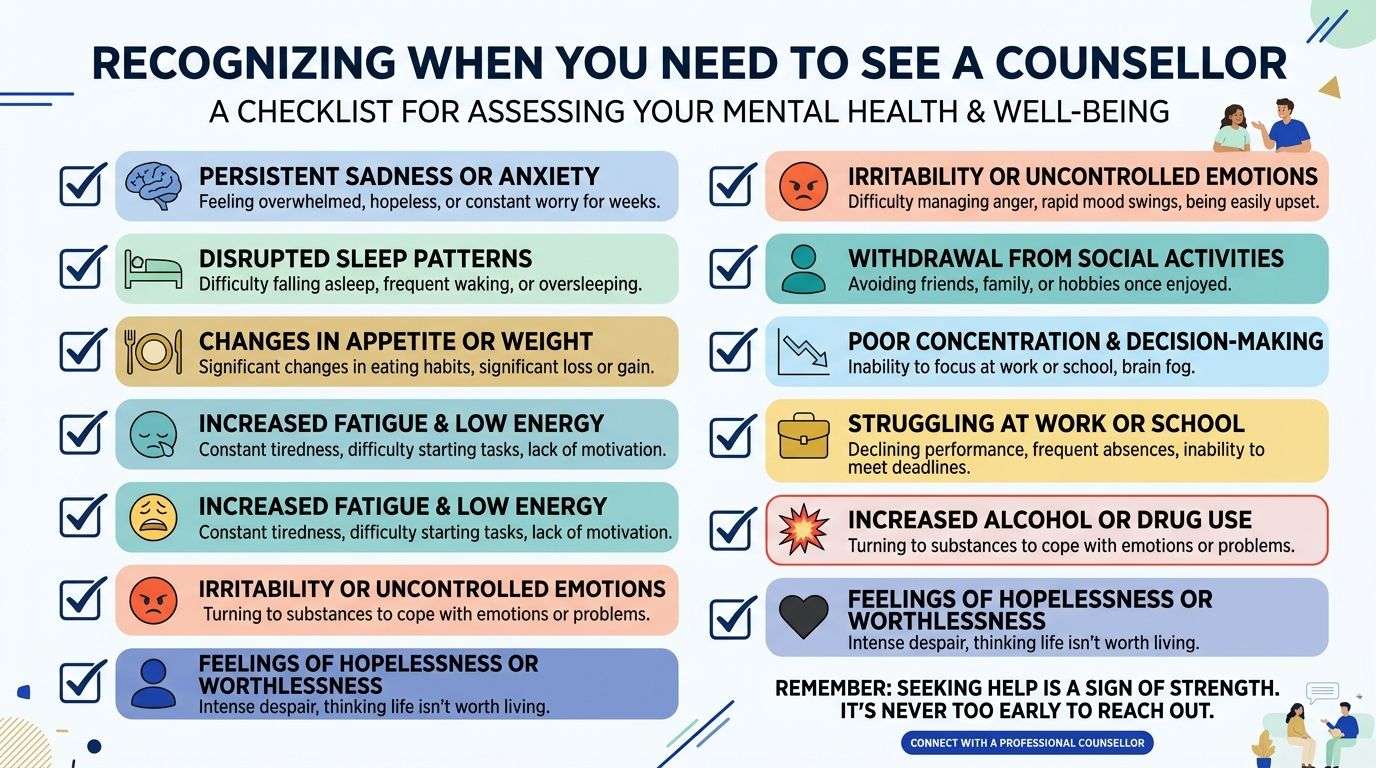
Many mothers delay counselling because they assume they have to wait until things are falling apart. In practice, help is indicated much earlier. The question is less “Can I survive this?” and more “Is this affecting my safety, daily functioning, relationships, or ability to feel like myself?”
A useful way to picture it is a smoke alarm. You do not wait for flames through the roof before you respond. You pay attention when the warning keeps going off.
Signs that counselling is the right next step
Counselling is a good next step if postpartum rage is becoming a pattern instead of an isolated bad moment, especially if you notice any of the following:
- The anger arrives fast and feels hard to control. It goes from irritation to explosive in seconds.
- You are scaring yourself. After an outburst, you feel shocked, ashamed, or unsure how you got there.
- Your home feels tense. You notice yelling, snapping, slammed doors, or family members bracing for your reaction.
- Your bond with your baby feels strained. Love is there, but rage, resentment, or emotional numbness keeps interrupting connection.
- Your day-to-day functioning is slipping. You cannot rest even when the baby sleeps, you are constantly on edge, or simple tasks feel impossible.
- Self-help is not changing the pattern. More sleep, breaks, food, fresh air, or partner support may help briefly, but the same cycle keeps returning.
Those are not signs of failure. They are signs that your nervous system may be overloaded and needs more support than coping strategies alone can provide.
Clinical thresholds that mean do not wait
Some experiences call for prompt professional assessment. Seek help as soon as possible if:
- You have urges to throw, hit, or break things
- You are afraid of what you might do during an outburst
- You feel detached from your baby or family and intensely angry at the same time
- You are having thoughts such as, “My family would be better off without me”
- You do not feel confident that you can stay safe
If there is any immediate risk to you or your baby, call 911 or go to the nearest emergency department.
These thresholds matter because postpartum rage can sit alongside postpartum depression, anxiety, trauma symptoms, or intrusive thoughts. A counsellor, doctor, midwife, nurse practitioner, or psychiatrist can help sort out which pieces are present. That clarity often lowers fear because it turns a frightening blur into something that can be treated.
When practical support is not enough
Sleep deprivation can magnify everything. So can hunger, pain, breastfeeding stress, and carrying too much without relief. But if the rage remains intense after practical changes, or if it returns again and again, that points to a deeper problem that deserves assessment.
In other words, “I am exhausted” may be true and still not be the whole story.
For many Canadian mothers, another problem appears here. You may know you need help and still run into wait-lists, trouble finding someone with perinatal training, lack of childcare, cost, rural access issues, or the mental load of making one more phone call when you are already overwhelmed. Those barriers are real. They are not proof that your need is small.
If getting counselling feels hard, start here
Keep the first step very small.
- Ask your family doctor, midwife, OB, public health nurse, or your baby's physician for perinatal mental health referral options.
- Say the words “postpartum rage” and “I need to be assessed soon.” Clear language often gets a clearer response.
- If private therapy is out of reach, ask about hospital-based programs, community mental health, family health teams, postpartum groups, or virtual care available in your province.
- If making calls feels impossible, ask your partner, friend, or family member to sit with you, make the list, or contact services with you.
- Write down what is happening before appointments. Include how often the rage happens, what it looks like, and whether safety is a concern.
You do not need a perfect explanation. You only need enough words to let someone know that this is more than ordinary stress.
A good rule of thumb: if you keep wondering whether it is “serious enough,” and the pattern is frightening, persistent, or affecting safety or connection, it is serious enough to bring to a professional.
What Counselling for Postpartum Rage Looks Like
Many mothers fear therapy because they imagine being judged, blamed, or told they're dangerous. Good counselling for postpartum rage should feel steady, practical, and compassionate.

What the first sessions often focus on
The first goal is usually understanding, not fixing everything in one hour. A counsellor may ask about:
- your mood and anger patterns
- sleep and exhaustion
- feeding stress
- support at home
- relationship strain
- your mental health history
- whether you feel safe
This helps separate normal adjustment strain from symptoms that need more structured treatment.
Approaches that may help
Two common therapy approaches are often useful here.
Cognitive Behavioural Therapy (CBT) helps you notice the thoughts that intensify rage. For example, “I can never cope” or “No one helps me” may be partly true, distorted by exhaustion, or pointing to a real unmet need. CBT helps you slow that chain down and respond differently.
Interpersonal Therapy (IPT) focuses on relationships and role changes. This can matter a great deal after birth, when identity shifts, partner conflict, family expectations, and loneliness all affect mood.
A counsellor may also help with emotional regulation, practical communication, boundaries with family, and making a plan for moments when anger spikes.
What therapy is trying to change
The aim isn't to make you endlessly calm. It's to help you feel more in control, more supported, and less alone in what you're carrying.
That can include:
- repairing communication with your partner
- processing a difficult birth experience
- reducing shame after angry episodes
- building a realistic support plan
- recognising triggers earlier
- responding before you hit the point of explosion
Telling the truth about your anger in therapy is not a failure. It's often the beginning of relief.
Your Next Steps Finding Support and Staying Safe
It is 2 a.m. The baby is crying again, your body feels wrung out, and a wave of anger hits so fast it scares you. If that is where you are right now, start with safety, not self-judgment.
You do not need to solve everything tonight. You only need to get through this moment safely, then take the next clear step.
What to do in the moment
Postpartum rage can flood your nervous system like a fire alarm that is too sensitive. Your first job is to lower the heat.
- Place your baby somewhere safe such as a crib or bassinet.
- Step into another room for a minute or two if your baby is safe and you need space to regain control.
- Choose one grounding action like cold water on your hands, slow exhaling, or pressing both feet into the floor.
- Contact one trusted person and use plain language: “I am feeling overwhelmed and I need help right now.”
- Reduce stimulation if you can. Dim lights, lower noise, and put down your phone.
If you feel at risk of hurting yourself, your baby, or anyone else, call 911 or go to the nearest emergency department right away. If you are in Canada and need immediate mental health support, call or text 988.
Finding Support When Barriers Exist
Getting counselling is not always as simple as deciding to ask for help. Many mothers in Canada run into long wait times, cost concerns, lack of child care, limited rural services, cultural stigma, language barriers, or the fear that they will be judged if they tell the truth.
Those barriers are frustrating, and they are common. Struggling to access care does not mean your symptoms are not serious enough. It means the system can be hard to use when you are already running on fumes.
A practical approach can help. Treat the search like handing someone a short map instead of your whole life story.
- Start with one medical contact. Your family doctor, midwife, obstetrician, public health nurse, or your baby's doctor can help with referrals and rule out urgent concerns.
- Use direct wording. Try: “I had a baby recently and I am having intense anger that feels out of control. I want a mental health assessment and counselling support.”
- Ask specific access questions. Do you offer virtual sessions? Is there a cancellation list? Do you have sliding-scale fees? Do you have experience with perinatal mood disorders?
- Write down your symptoms before you call so exhaustion does not force you to remember everything on the spot.
- Let someone help with logistics. A partner, friend, or relative can make calls, watch the baby during appointments, or sit with you while you book.
- Ask about community options. In some areas, public health programs, hospital-based perinatal services, family resource centres, and nonprofit agencies offer lower-cost support.
If you are unsure whether your situation has crossed the line into needing professional help, use a simple rule. Seek counselling soon if the rage is happening repeatedly, feels hard to control, is affecting how you function, is harming relationships, or leaves you afraid of what you might do. Seek urgent help the same day if you think you may act on thoughts of harming yourself, your baby, or someone else.
While you are waiting for care, small supports still matter. Some mothers find it easier to begin with gentle, low-pressure reading, such as this guide to essential books for new mums, because it can put words to feelings that have felt frightening or isolating.
FAQ
Is it safe to tell a counsellor how angry I feel
Yes. Honesty helps a counsellor understand risk, triggers, and what kind of support you need. Describing angry thoughts or urges does not automatically mean anyone will assume you are a bad mother. It tells them where care needs to begin.
What can my partner do to help
A partner can help by taking your symptoms seriously, reducing stimulation and practical pressure, protecting time for sleep, and stepping in early when they notice you are nearing your limit. It also helps if they speak about postpartum rage as a health issue that deserves care.
How long does it take to feel better
It varies. Some mothers feel relief once they have language for what is happening and a clear treatment plan. Others need more time, especially if rage is tied to depression, anxiety, trauma, or chronic sleep disruption.
What if I'm embarrassed to ask for help
Embarrassment is common, especially with anger. Many new mothers fear that anger says something terrible about who they are. In reality, speaking up is often the first sign that you are protecting yourself and your baby.
You deserve support that treats this seriously and responds with care. If part of you is reading this and thinking, “I cannot keep doing this alone,” that inner alarm is worth listening to.
Clinically Reviewed By
Amy Mosset, MCP, RCC-S
Amy Mosset is a Master Practitioner in Clinical Counselling, Clinical Supervisor, and the owner of Interactive Counselling. She provides trauma-informed, evidence-based care and clinical supervision to registered therapists, with a focus on ethical practice, client safety, and high-quality therapeutic outcomes.