Online counselling is often covered by Canadian extended health plans, and many plans reimburse it the same way as in-person therapy when the therapist has a recognised professional designation. The details still depend on your specific policy, especially the provider type listed in your benefits and your annual mental health maximum.
You might be sitting with your benefits booklet open, a claims portal half-loaded on your phone, and one practical question running through your mind: if I book this session, will my insurance help pay for it? That uncertainty can stop people right when they're trying to do something caring and important for themselves. Insurance language can feel cold, confusing, and oddly vague, especially when you're already stressed.
"Yes, online counselling is frequently covered by extended health plans in Canada, but coverage usually depends more on your therapist's credentials and your policy details than on whether the session happens online."
If you've been searching for answers to is online counselling covered by extended health Canada, the short version is reassuring. In many cases, yes. The harder part is knowing how to confirm it with confidence before you book, submit, or appeal a claim.

Canada has expanded virtual mental health access in some ways. Prime Minister Justin Trudeau announced a $240.5 million investment in May 2020 to support virtual access to counselling, but non-physician psychological care is still largely paid through private insurance or out of pocket, as described in this Canadian health policy analysis. That's why understanding your extended health plan matters so much.
You don't need to become an insurance expert. You just need a clear framework, the right words to look for, and a few direct questions to ask. Once those pieces are in place, the process usually becomes much more manageable.
Navigating Your Path to Covered Online Therapy
The first confusing part is that many people assume provincial health care will cover counselling if it's medically important. In most provinces, that's not how it works. Public systems such as OHIP or MSP generally don't cover counselling and psychotherapy, so people usually rely on extended health benefits, an employee assistance program, or personal payment.
That can feel discouraging at first. It can also make online therapy seem less certain than in-person care, even when the opposite is true.
Many people don't run into a coverage problem because the session is online. They run into a coverage problem because the plan only pays for certain professional designations.
A helpful way to think about this is: your plan is less interested in the screen and more interested in who is providing the care. If your insurer recognises the therapist's credential, the online format is often treated the same as an office visit.
Why this question feels so murky
Insurance documents rarely use everyday language. Instead of saying “yes, we cover online counselling,” they may list terms such as:
- Psychological services
- Mental health practitioners
- Paramedical services
- Registered social worker
- Psychologist
- Psychotherapist
- Clinical counsellor
If you don't already know which of those applies to your therapist, it's easy to miss the answer even when it's right there in your plan.
What you actually need to confirm
Most readers don't need a legal interpretation of their policy. They need practical clarity on four points:
Which professionals are covered
Your plan may name the exact designations it reimburses.Whether virtual sessions are eligible
Many plans now treat online and in-person counselling the same, but it still helps to verify.How much the plan pays
Coverage often stops once you reach your annual maximum.How claims are submitted
Some plans use reimbursement, not direct billing.
That's the framework that makes this topic easier. Once you know what to look for, you can stop guessing and start asking better questions.
How Extended Health for Mental Health Works
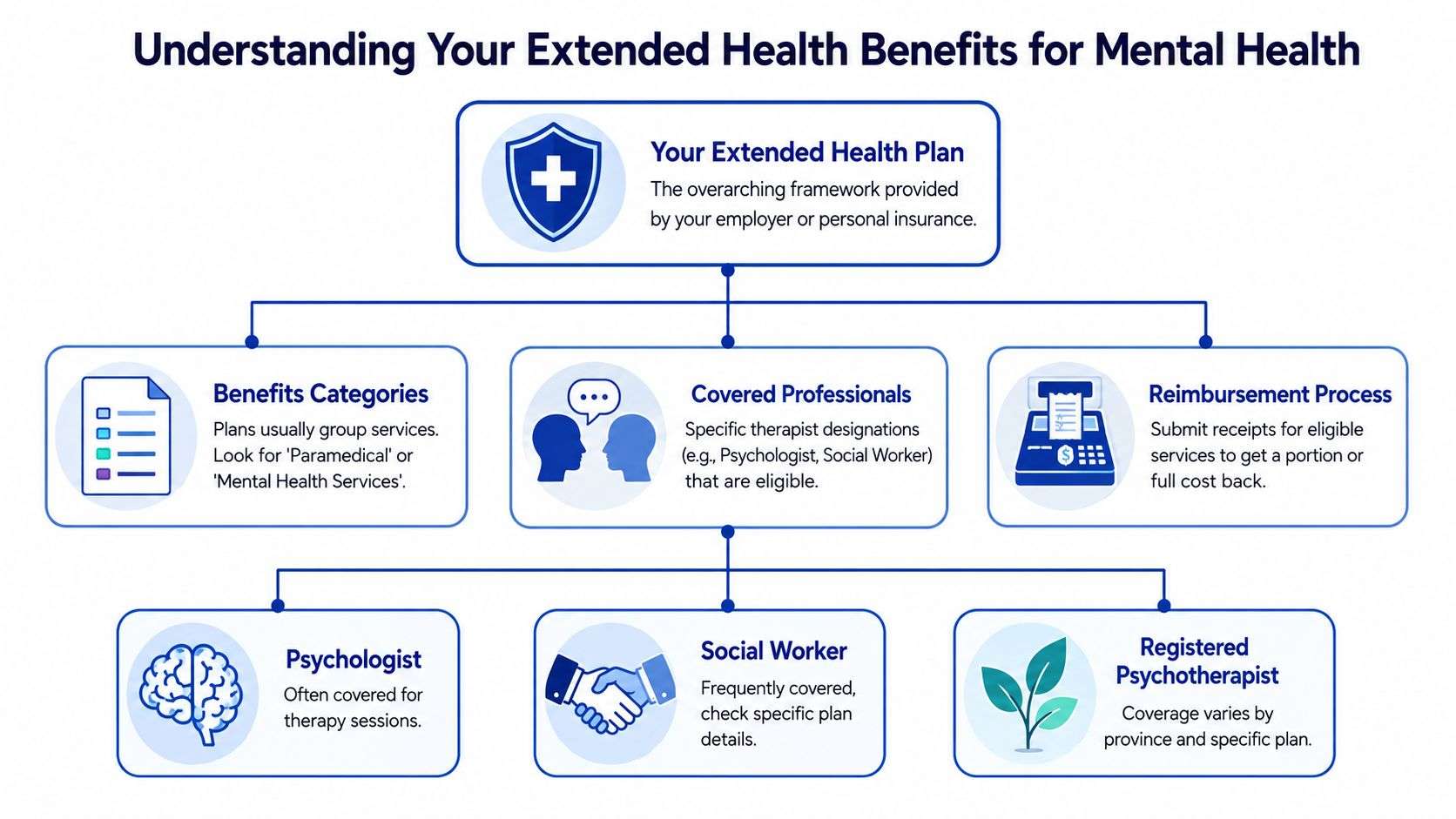
You log in to your benefits portal, search “online counselling,” and end up staring at terms like “psychological services,” “paramedical,” and “eligible provider.” That confusion is normal. Extended health plans often cover mental health care, but they describe it in insurance language instead of everyday language.
Extended health coverage is separate from provincial health coverage. It works like a private top-up plan for services the public system may not fully pay for, including many therapy-related expenses. Some people get this coverage through an employer. Others buy it through an individual or family plan.
Mental health benefits are common, but the dollars attached to them are often limited. The Canadian Psychological Association's 2023 employer benefits report found that about 93% of Canadian organizations provide coverage for psychological services, yet only 2% of the $30.4 billion in supplementary health benefits goes to mental health and psychology-related benefits. The same report says that share is up 75% since 2019, which suggests progress, while still leaving many people with modest annual caps.
A simple way to read your plan
A good way to read mental health benefits is to treat the plan like a small fund with a rulebook attached. One part tells you how much money is available. The other part tells you the conditions for using it.
Those conditions usually answer four practical questions:
- Which type of professional your plan will reimburse
- Whether you pay upfront and submit receipts, or the provider bills directly
- How much is available per year or per visit
- Whether a deductible or co-payment applies
If you have heard U.S. discussions about parity between mental and physical health coverage, Benely's guide to MHPAEA offers helpful background on that idea.
The words to look for
Insurance documents rarely say, “Yes, online therapy is covered,” in plain language. They usually hide the answer inside category labels. Look for terms like these and read them slowly, one by one.
| Term | Plain-language meaning |
|---|---|
| Annual maximum | The most your plan will reimburse in a benefit year for that category |
| Deductible | The amount you pay before reimbursement starts |
| Co-payment | The portion of each claim you still pay |
| Eligible provider | The type of professional your insurer agrees to reimburse |
| Reimbursement | You pay first, then submit the receipt to get money back |
One detail trips people up more than any other. “Mental health coverage” is often a category name, not a guarantee that every therapist under that broad umbrella is included.
How to interpret what you find
Here is the framework to use when you read your benefits booklet or speak with your insurer.
If your plan says “psychological services,” ask which designations fit inside that label. If it says “mental health practitioner,” ask for the exact list of recognised professions. If it says “virtual care” or “telehealth,” confirm whether counselling is included or whether that term only applies to medical visits.
A simple question works well: “Which therapist credentials are eligible under my plan, and are virtual counselling sessions reimbursed under the same benefit category?”
That wording tends to get a clearer answer than asking, “Do you cover therapy?” It moves the conversation from a vague yes-or-no question to the two details that control most claims: provider type and session format.
Why Your Therapist's Credentials Matter Most
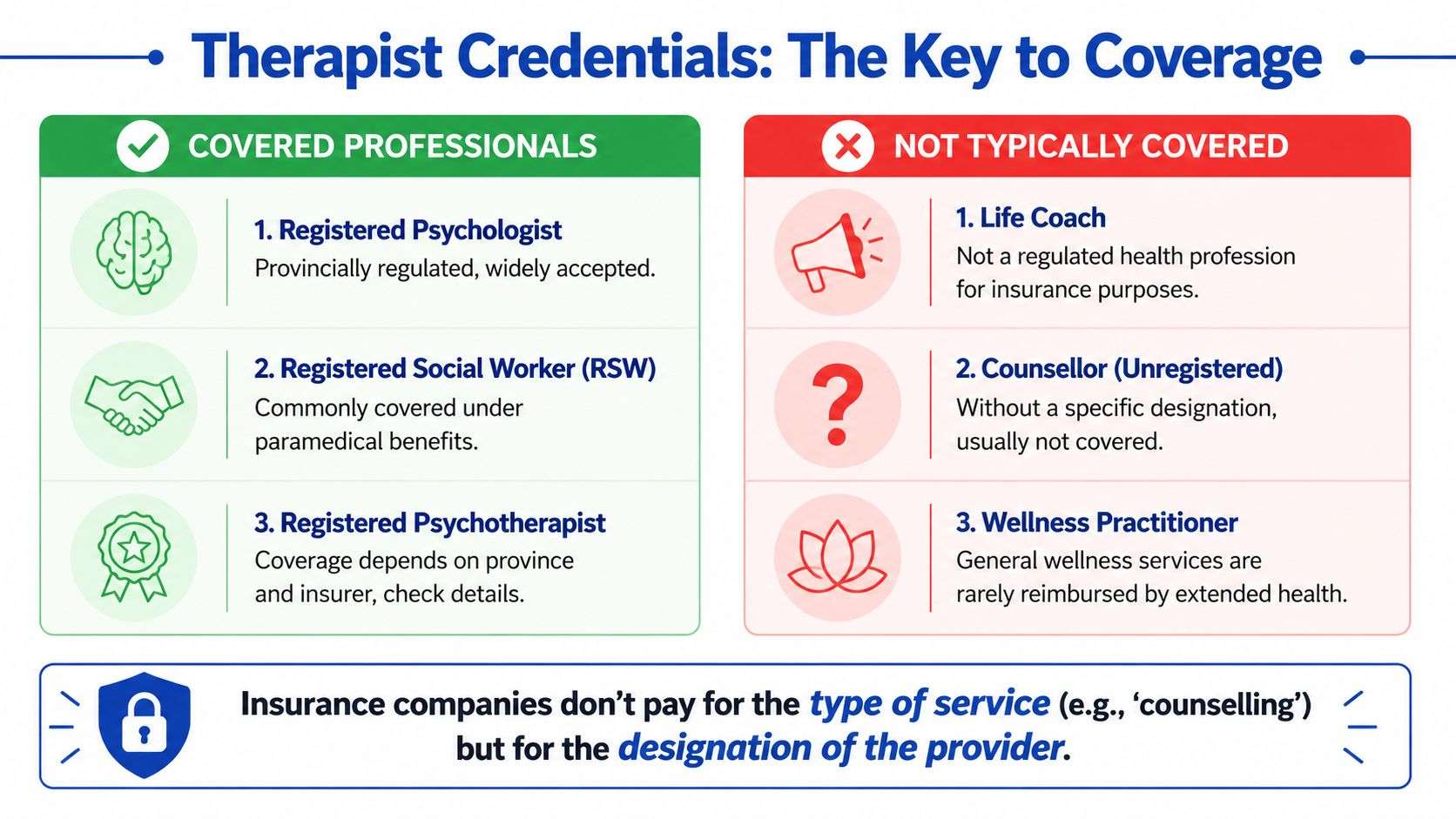
Insurance companies usually don't reimburse “therapy” as a broad idea. They reimburse services delivered by specific regulated or recognised professionals. That's why the therapist's designation is often the single biggest factor in whether your online session is covered.
Most major extended health insurers in Canada reimburse online counselling the same way as in-person sessions when the therapist holds a recognised credential such as Registered Clinical Counsellor (RCC) or Registered Counselling Therapist (RCT).
Why insurers focus on designations
From an insurer's perspective, a professional designation helps answer three questions:
- Is this person accountable to a regulatory body or professional standard?
- Can the insurer verify the provider's identity and scope of practice?
- Does the receipt match a recognised category in the plan?
That's why two people offering similar support may be treated very differently by a benefits plan. One may be reimbursable because they hold a listed designation. The other may not be, even if the client experience feels similar.
Credentials you may see in your plan
Your policy might list one or more of these provider types:
Psychologist
Often explicitly listed in benefits documents.Registered Social Worker or RSW
Commonly included under mental health or paramedical services.Registered Psychotherapist
Coverage can depend on province and insurer wording.Registered Clinical Counsellor or RCC
Frequently reimbursed by major extended health plans when the plan recognises that designation.Registered Counselling Therapist or RCT
Some plans recognise this professional category as well.
You may also come across Canadian Certified Counsellor (CCC) in practice settings. Whether that credential is reimbursed depends on your insurer's wording. If the exact designation is not listed, ask before assuming.
The service description matters too
Credentials are the first filter. The receipt wording is the second.
For example, a claim is easier to process when the receipt clearly identifies the therapist's name, professional designation, registration number, date of service, and a service description that fits the benefits category. If your plan covers psychotherapy, but your receipt uses vague language, your claim may need manual review.
Ask the provider's office a direct question before your first appointment: “What designation appears on your receipts, and what service description do you typically use for insurance claims?”
That's not awkward. It's smart.
A quick example
Suppose two clients each book an online session. One sees a therapist whose designation appears in the benefits plan. The other sees a practitioner whose title sounds supportive but isn't listed by the insurer. Both clients attend online. One claim is likely to move through normally. The other may be denied, not because it was virtual, but because the provider type wasn't eligible.
That distinction answers a big part of the question is online counselling covered by extended health Canada. In many cases, online isn't the obstacle. The recognised designation is the key.
How to Confirm Your Specific Coverage Details
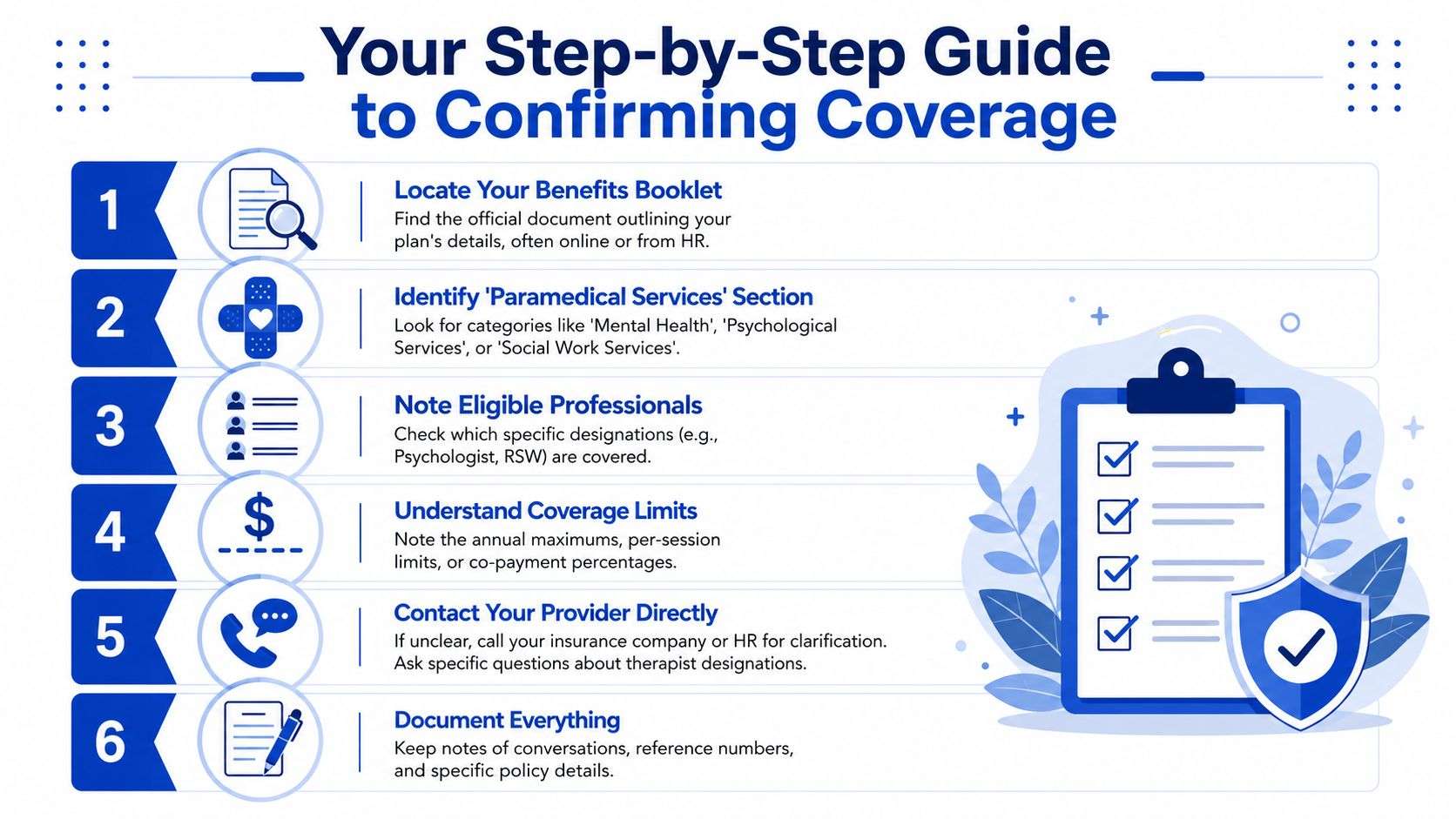
People often hear “check your plan” and still feel stuck. A better approach is to check it in a structured way. You're not hunting for one magic sentence. You're gathering a few pieces of information that work together.
The words to look for in your booklet or portal
Start in your insurer's online portal, your employee benefits booklet, or your HR benefits summary. Scan for any of these categories:
- Mental health
- Psychological services
- Counselling
- Psychotherapy
- Paramedical services
- Social work services
- Psychologist
- Psychotherapist
- Clinical counsellor
Don't worry if the wording isn't elegant. Benefits documents are often inconsistent. Your goal is to find the section that names eligible provider types and coverage limits.
The five-part coverage check
Use this checklist and write the answers down.
Find the category
Identify where mental health services are listed. Sometimes they're grouped under paramedical services.Locate the provider list
Look for exact designations, not general words. “Counselling” alone usually isn't enough.Read the limits carefully
Note the annual maximum, any deductible, and whether there's a co-payment.Check virtual eligibility
Search the portal for terms like “virtual care,” “telehealth,” or “online counselling.” If nothing is stated, contact the insurer.Confirm the claim method
Determine whether your plan uses reimbursement or direct billing for these services.
Questions to ask your insurer or HR
If the wording is unclear, call the insurer directly. Be specific. General questions often lead to general answers.
Use language like this:
- “Is online counselling covered under my extended health plan?”
- “Which therapist designations are eligible for reimbursement?”
- “Are virtual sessions reimbursed the same as in-person sessions?”
- “Do I need a referral from a physician?”
- “Is there an annual maximum for psychological or counselling services?”
- “Are couples or family sessions eligible if the therapist has a covered designation?”
- “What exactly needs to appear on the receipt?”
Write down the date of the call, the name of the representative, and any reference number. If a claim issue comes up later, those notes can help.
How to interpret the answer
Insurer responses can still sound fuzzy. Here's a plain-language translation table:
| If they say this | It usually means |
|---|---|
| “We cover psychologists only” | Other designations likely won't be reimbursed |
| “We cover registered mental health practitioners” | Ask for the exact list of accepted titles |
| “Virtual is covered if the provider is eligible” | The online format is fine, but the credential must match |
| “Submit for assessment” | Coverage isn't guaranteed, and you should get more detail first |
If you're comparing therapists, this is also the moment to ask whether the provider offers electronic receipts and insurance-ready documentation. That small detail can make claims much easier.
Claiming Your Online Counselling Sessions
Once you've confirmed coverage, the claims process is usually straightforward. The most common model is reimbursement. That means you pay for the appointment, receive a receipt, and submit it to your insurer.
Many extended health plans in Canada commonly reimburse online counselling for recognised professionals such as RCCs on a reimbursement basis, where the client pays upfront and then submits the receipt rather than using direct billing.
What should be on the receipt
A strong receipt helps prevent delays. Before your first appointment, confirm that the provider issues receipts containing the details insurers usually expect.
Look for:
- Therapist's full name
- Professional designation
- Registration or licence number
- Date of service
- Service description
- Amount paid
- Proof that payment was received
If your insurer has a digital portal or mobile app, you can often upload the receipt right away. Submitting promptly reduces the chance that paperwork gets lost or forgotten.
A simple claim routine
A practical routine looks like this:
- After the session save the receipt as a PDF or image.
- Before submitting double-check that the therapist's designation matches your policy.
- When uploading choose the claims category that best matches the provider type.
- After submission keep the confirmation email or claim number.
If you want fewer claim problems
Documentation matters in virtual care. While Canadian insurance claims and U.S. privacy rules aren't the same thing, clinicians and clients can still learn from practical documentation standards. This resource on HIPAA and telehealth billing tips is useful for understanding why accurate session records and clear billing language help claims move more smoothly.
Clean documentation helps everyone. The client gets faster reimbursement, and the insurer gets the information it needs without follow-up.
What to do if a claim is denied
Don't assume the denial is final or personal. Claims are often rejected for administrative reasons.
Check these possibilities first:
Wrong provider category
The claim may have been filed under the wrong service type.Missing registration details
The receipt may not include the therapist's designation or registration number.Plan wording mismatch
The provider may be qualified, but not under the exact designation your insurer recognises.Annual maximum reached
Your coverage may already be used up for the benefit year.
If the denial doesn't make sense, contact the insurer and ask for the specific reason in writing. Then compare that reason with your policy wording and your receipt.
Your Online Counselling Coverage Questions Answered
You finally find a therapist who feels like a good fit. Then the practical questions start. Will my plan accept this therapist? Does online care count the same way? What if the session includes my partner or child? Those questions are normal, and they usually have clear answers once you know which words to look for.
What if my plan covers therapy, but not my therapist's exact designation
This usually means your insurer approves mental health care only from certain provider categories. The service may be covered in general, but the claim is paid only if the therapist's title matches the wording in your plan.
A helpful way to read this is to treat the designation like a key. If your benefits booklet says “psychologist” or “registered social worker,” the insurer is checking whether your therapist fits that exact lock.
Ask your insurer:
- “Which provider designations are covered for counselling or psychotherapy?”
- “Is there an equivalent category for my therapist's credential?”
- “Can you confirm the exact title I should select when I submit the claim?”
If the answer is vague, ask for the wording in writing. That gives you something concrete to compare with your therapist's registration details.
Is online therapy considered less valid than in-person therapy
In many plans, the main issue is not whether the session happened online. The main issue is whether the therapist is an approved provider and whether virtual visits are included under the mental health benefit.
Research has supported online therapy as an effective option for many common concerns, including anxiety and depression, and that helps explain why many Canadian benefit plans now accept virtual sessions. Coverage rules still depend on plan wording, so listen for terms such as “virtual care,” “telehealth,” “online psychotherapy,” or “services delivered by video or phone.”
If you do not see those words, call and ask, “Are counselling sessions covered if they are provided virtually rather than in person?”
Can couples counselling or family counselling be covered
Sometimes. Wording matters more than many people expect.
Some plans reimburse only treatment for the plan member, even if a partner or family member joins the session. Others may cover couples or family work if the insured person is the identified client and the therapist uses an eligible designation.
Ask these questions directly:
- “Does my mental health benefit cover couples counselling?”
- “Does it cover family counselling?”
- “Does the insured member need to be listed as the client on the receipt?”
That last question can prevent confusion later. A session can be clinically useful and still fall outside what the insurer agrees to reimburse.
What should I do if I feel too overwhelmed to sort this out
Keep the task small. Start with one sentence: “Can you tell me which therapist designations and virtual counselling services my plan covers?”
You do not need to understand the whole insurance system at once. You just need the next clear answer.
If calling feels hard, ask for help from HR, your insurer's member support team, or the therapist's admin staff. Many clinics, including Interactive Counselling, can often tell you what designation appears on receipts, but only your insurer can confirm whether your plan will pay for that category.
Taking the first step toward therapy already asks a lot of you. Benefits paperwork should not be the barrier. With the right questions and the exact wording from your plan, you can make decisions with much more confidence.