Anxiety is common at work, and in 2024 it became the number one presenting mental health issue among American workers, while 80% of employees reported productivity anxiety, meaning persistent worry about performance. If you're a trades worker in Grande Prairie who looks dependable on the outside but feels keyed up, overprepared, and unable to switch off inside, there's a real name for that experience. For more information, see our Grande Prairie anxiety counselling.
"High-functioning anxiety for trades workers is a pattern of seeming successful and on top of things on the outside, while battling intense anxiety, perfectionism, and self-doubt on the inside, a common experience in the high-stakes environment of the trades." For more information, see our counselling in Grande Prairie.
If that sounds familiar, you're probably the one people count on. You show up early. You check the truck twice. You think through the job before anyone else has their gloves on. Other people may see discipline, pride, and reliability. What they may not see is the mental noise running in the background all day. For more information, see our anxiety counselling.
For many trades workers, that anxiety can act like a hidden engine. It pushes performance, catches mistakes early, and keeps standards high. But running that engine too hard has a cost. Over time, it can wear down sleep, patience, focus, health, and even job site safety.
The Pressure to Perform in the Trades
A lot of people in the trades know this pattern without having words for it.
You might be the welder who rechecks every measurement because the idea of missing something sits in your chest all day. You might be the electrician who takes on extra tasks because trusting someone else feels riskier than doing it yourself. You might be the apprentice who looks calm but goes home replaying every conversation with the foreman.
In trades work, pressure doesn't stay abstract. Mistakes can mean delays, damage, conflict, injury, or lost trust. That makes it easy for anxiety to hide behind traits people praise.
When good work and constant worry get mixed together
A worker with high-functioning anxiety often hears compliments like:
- "You're solid." People trust you with the job because you don't cut corners.
- "You've always got it handled." You look organised, even when your mind is racing.
- "We can rely on you." You take pride in being the person who doesn't drop the ball.
The problem is that those same strengths can be fuelled by fear. Fear of messing up. Fear of being seen as weak. Fear of letting the crew down. Fear of losing work.
High-functioning anxiety doesn't always make someone look distressed. Sometimes it makes them look impressive.
That's one reason this issue gets missed. A worker who's still productive may not think they're "struggling enough" to deserve support. A supervisor may see output and assume everything is fine.
At a broader level, workplace anxiety is not rare. In 2024, anxiety became the number one presenting mental health issue among American workers, and 80% of employees reported "productivity anxiety" in a 2024 workplace mental health analysis. In plain language, that means a lot of people are pushing hard while worrying they're still not doing enough.
What High-Functioning Anxiety Looks Like in the Trades
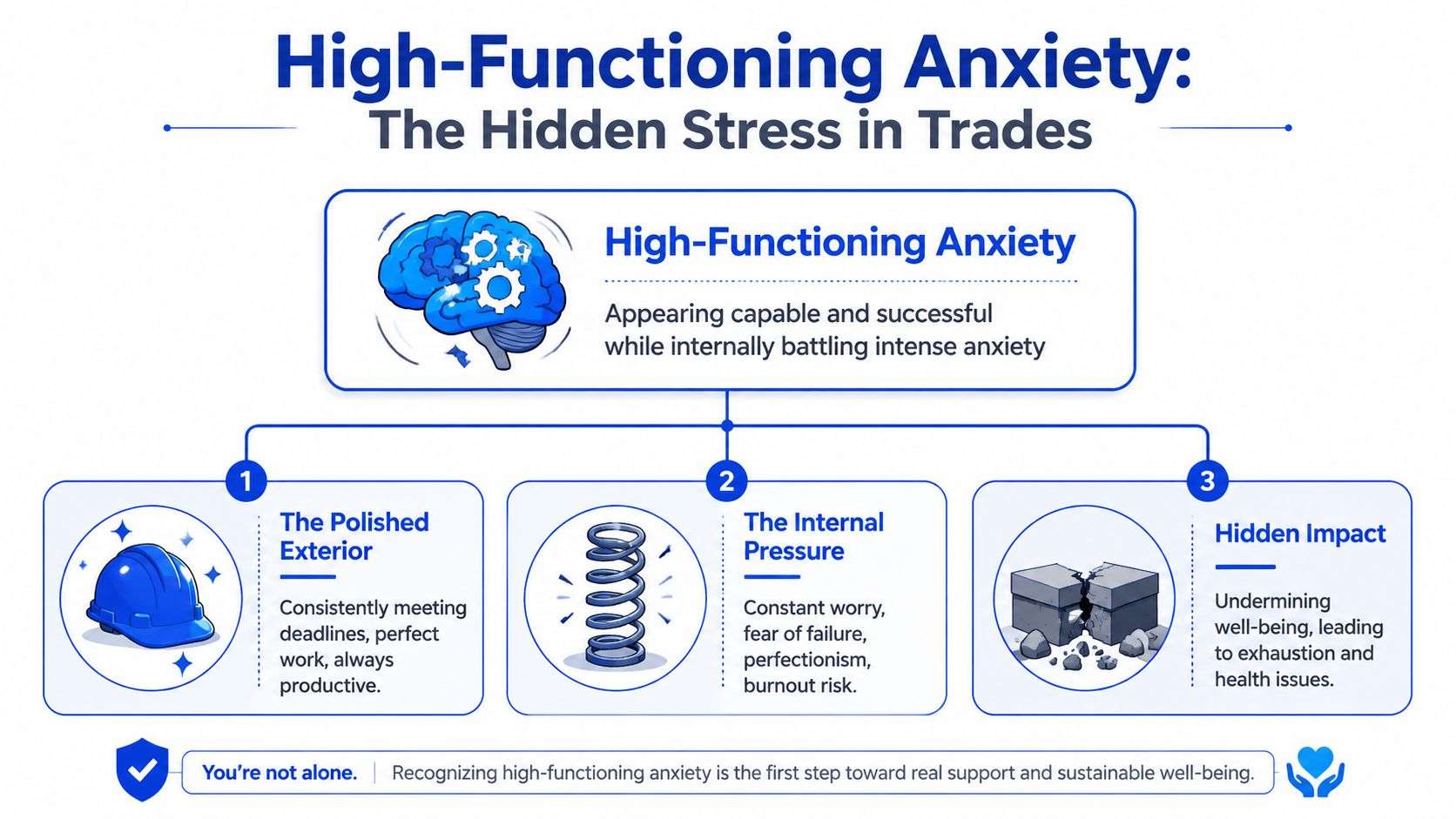
In the trades, high-functioning anxiety can look like a truck that's clean, stocked, and job-ready, but the engine is always revving too high. From the outside, everything seems under control. Under the hood, the system never really rests.
The outside others see
This is often the polished side of the picture. A trades worker with high-functioning anxiety may be:
- Early and highly prepared. Tools are lined up. Materials are checked. Contingencies are already in mind.
- Precise with details. Small errors stand out quickly, and standards stay high.
- Hard to slow down. Rest can feel uncomfortable, even when the body needs it.
- The go-to person. Other workers may lean on them because they seem capable under pressure.
None of those traits are bad. In fact, many are valued in construction, welding, electrical work, heavy equipment, and maintenance. The issue is not the behaviour alone. It's the emotional cost underneath it.
The inside that others miss
Internally, the same worker may be carrying:
- constant scanning for what could go wrong
- difficulty relaxing, even off shift
- guilt when resting
- fear of disappointing others
- a harsh inner voice that says good work still isn't good enough
That mismatch is what confuses people. They think, "If I'm functioning, maybe this isn't really anxiety." But functioning and suffering can happen at the same time.
In Canada's building trades, 47% of tradespeople have suffered from anxiety over the past twelve months, often showing up as compulsive over-preparation and difficulty delegating in a high-stakes, zero-tolerance safety culture, according to a Canadian building trades mental health report. That matters because it shows this isn't just a personality quirk. It is a recognised pattern in trade environments.
Why the trades can amplify it
The trades reward alertness, speed, competence, and personal responsibility. Those are important qualities. But anxiety can piggyback on them.
A useful way to think about it is this:
| Work trait | Healthy version | Anxiety-driven version |
|---|---|---|
| Preparation | Ready for the task | Can't stop checking |
| Pride in work | Wants to do it well | Feels panic about mistakes |
| Responsibility | Owns their part | Takes on too much |
| Focus | Pays attention to detail | Gets mentally stuck on detail |
Practical rule: If your drive helps you perform but you still can't feel settled after the job is done, anxiety may be part of what's powering that drive.
For people searching for help with high functioning anxiety Grande Prairie trades workers often describe this exact split. They don't want to lose their edge. They want to keep the skill, pride, and reliability, while lowering the constant inner pressure.
Hidden Signs and Critical Workplace Risks
Not every anxious worker looks panicked. On a job site, high-functioning anxiety often hides in habits that seem productive until the strain starts affecting performance, safety, and relationships.
Signs that often get brushed off
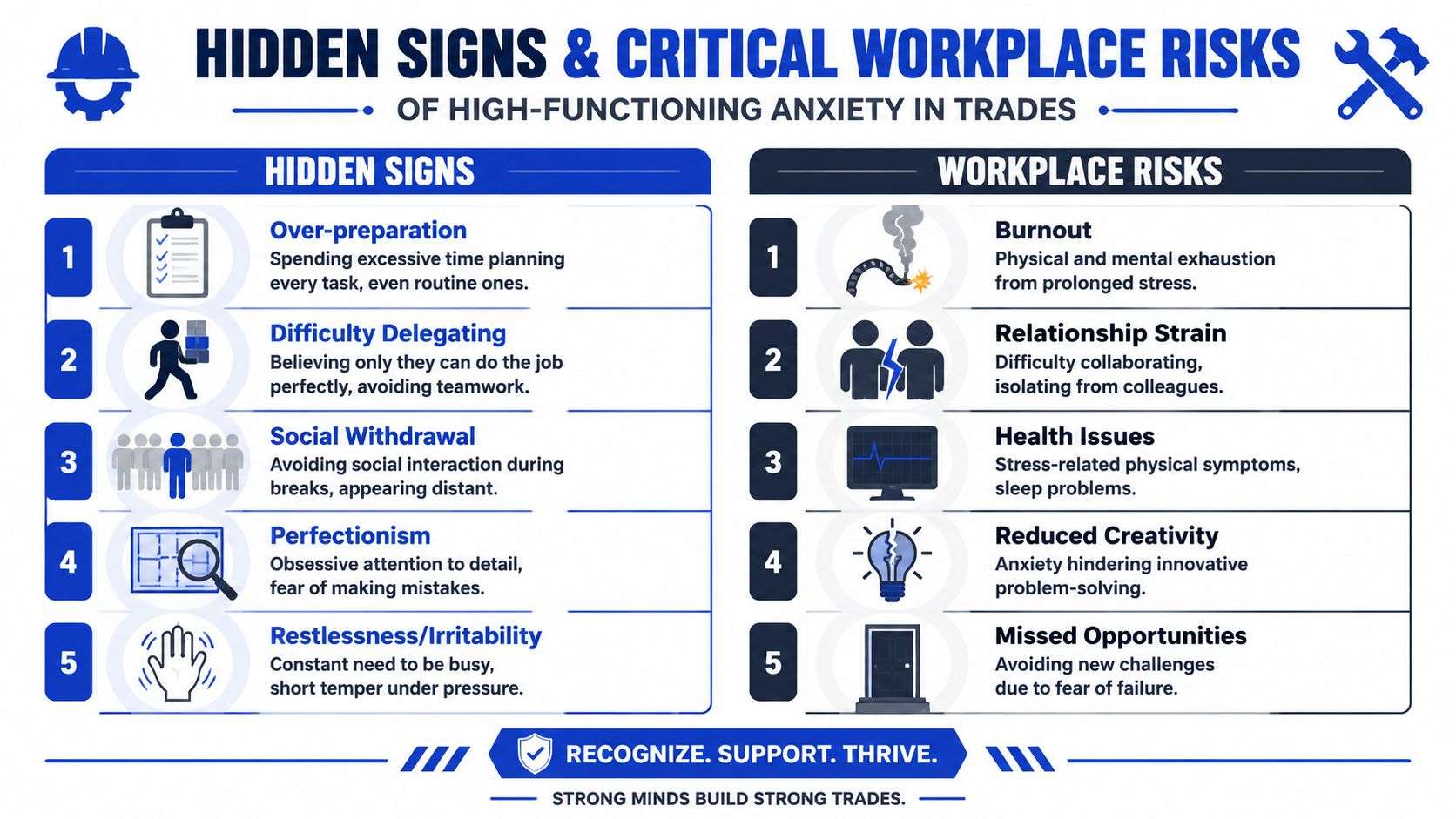
Some signs look like "just how the job is." But when they show up together and don't ease off, they deserve attention.
- Over-prepping routine tasks. You spend far more time than necessary planning simple work because uncertainty feels unbearable.
- Difficulty delegating. You tell yourself it's faster to do it yourself, but underneath that may be fear that someone else will make a mistake you'll have to carry.
- Short fuse under pressure. Irritability can be anxiety in work boots.
- Trouble switching gears. Breaks don't feel restful. Even lunch can feel like lost time.
- Replaying the day at night. You lie in bed reviewing one comment, one decision, or one near-miss.
- Body symptoms. Tight jaw, sore shoulders, headaches, upset stomach, shallow breathing, and poor sleep are all common ways stress shows up physically.
How those signs create job risks
Anxiety changes attention. Sometimes it narrows focus too much. A worker may lock onto one detail and miss the bigger scene around them. Sometimes anxiety scatters attention. The brain keeps jumping ahead to possible problems instead of staying grounded in the task at hand.
That matters on active job sites.
Here's how the link often works:
| Hidden sign | Possible workplace risk |
|---|---|
| Poor sleep from rumination | Slower reaction time |
| Overthinking decisions | Delays or hesitation |
| Irritability | Crew tension and communication breakdown |
| Refusing help | Mental overload and fatigue |
| Constant internal stress | Reduced situational awareness |
A major concern is safety. Canadian construction workers with anxiety have an increased risk of accidents by 35%, and 62% of those with anxiety did not seek mental health care in the past 12 months because of stigma and fear of job loss, according to a construction mental health data bulletin. That's not a small personal issue. It's a job site issue.
Why many workers stay silent
A lot of trades workers don't avoid support because they don't care. They avoid it because they're trying to protect their paycheque, their reputation, or their place on the crew.
Some worry that saying "I'm struggling" will be heard as "I'm not reliable." Others think they should just tough it out because they're still getting the work done. That's where high-functioning anxiety becomes risky. People delay help until the strain spills into burnout, conflict, or injury.
If stress on a site has already contributed to harm, workers may also need practical information beyond mental health support. In situations involving serious incidents, some people look into Legal options for construction site injuries to understand what steps may be available after an accident.
The goal isn't to pathologise hardworking people. It's to recognise when mental load has become heavy enough to interfere with safety, judgment, and recovery.
Practical Coping Strategies for On and Off the Job
When anxiety is wired into your work habits, vague advice like "just relax" won't help. Trades workers usually do better with tools they can use. Think of coping skills as part of your mental toolkit. You don't need every tool every day. You need the right one for the task in front of you.
On the clock
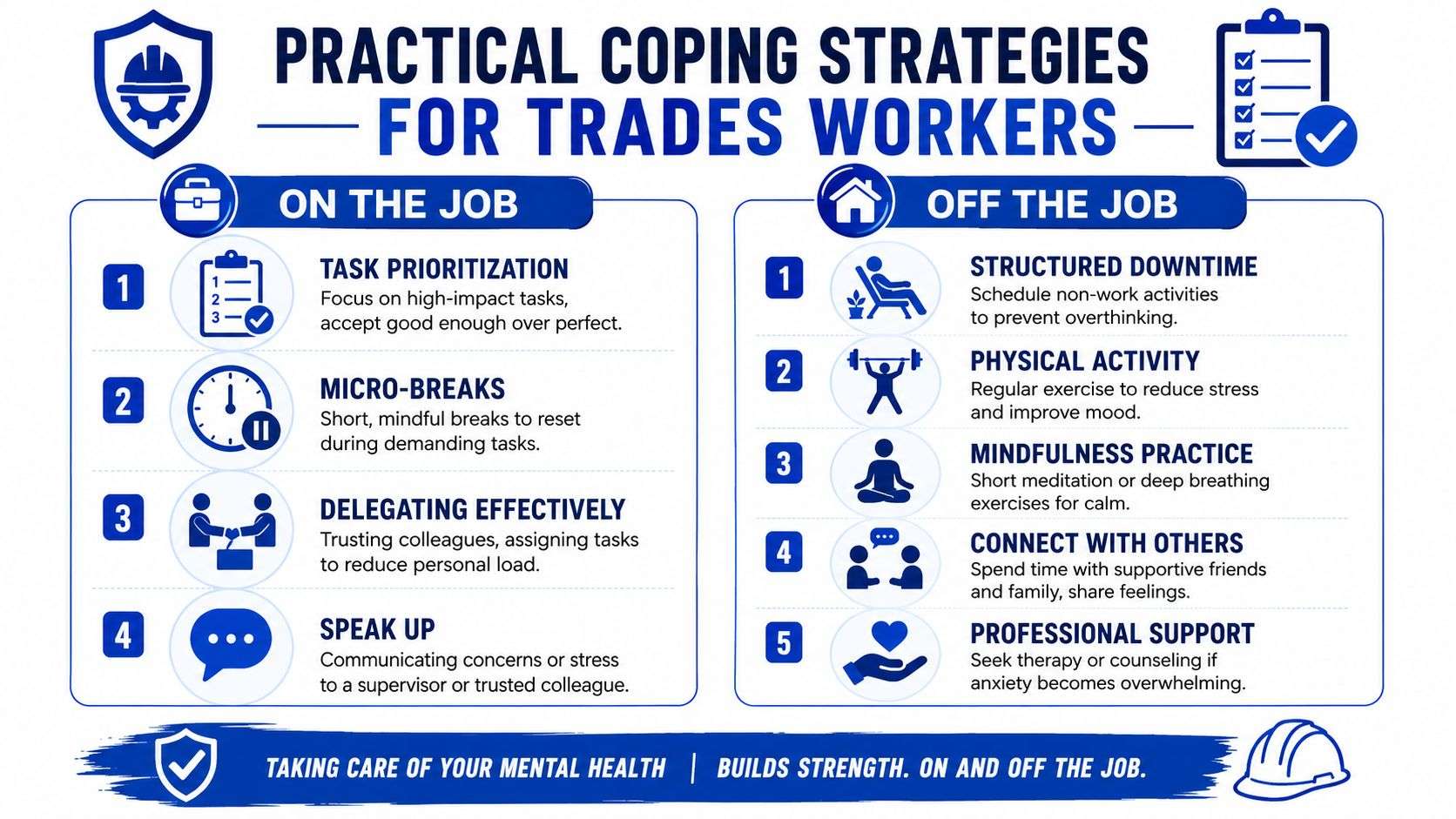
These strategies are meant to be practical, brief, and realistic for a workday.
- Name the next job only. When your mind starts racing through the whole shift, bring it back to one immediate task. Not the whole build. Not the whole week. Just the next right step.
- Use a short breathing reset. Breathe in slowly, then make the exhale a little longer than the inhale. Do that a few times in the truck, the washroom, or on a quick break. A longer exhale helps your body come down from threat mode.
- Check facts, not fears. Ask yourself, "What do I know, and what am I assuming?" That can interrupt the spiral of imagined worst-case outcomes.
- Aim for safe and solid, not perfect. Perfectionism often disguises itself as professionalism. On many tasks, "done correctly" is the target. Not "done with zero discomfort in my mind."
- Share one piece of load. If delegating feels hard, start small. Ask someone to handle one contained task instead of trying to hand over everything.
A simple grounding method
Some workers like a structured reset when their head gets noisy. The 5-4-3-2-1 method can help:
- Notice five things you can see
- Notice four things you can feel
- Notice three things you can hear
- Notice two things you can smell
- Notice one thing you can taste
It sounds simple because it is. The point is to pull your brain out of future threat and back into the present environment.
"If your mind is ten steps ahead, bring your body back to where your boots are."
After you clock out
Recovery doesn't happen automatically just because the shift ended. For workers with high-functioning anxiety, the body may leave the site while the mind keeps working.
Try building a clear transition:
- Create a shutdown ritual. Put away gear in the same order. Mentally list what's finished and what can wait. This signals to your brain that the workday has an end point.
- Move on purpose. Many people in the trades are physically active all day, but stress still gets trapped in the body. A walk, light workout, stretching, or even slow mobility work can help discharge tension differently than job labour does.
- Reduce work spillover. If possible, set limits on checking messages, replaying tasks, or talking about work all evening.
- Do one non-productive thing on purpose. Anxiety often ties self-worth to output. Reading, fishing, music, sitting with a coffee, or being with family without multitasking can retrain your nervous system to tolerate rest.
When a strategy isn't enough
Self-help tools are useful, but they're not meant to replace care when symptoms keep building. If you're dealing with frequent irritability, poor sleep, dread before work, or constant mental overdrive, that's a sign to widen your support.
For people dealing with high functioning anxiety Grande Prairie trades workers often benefit from practical strategies first, then deeper support to change the patterns underneath the stress.
Talking About Mental Health at a Trades Workplace
One of the hardest parts of this issue is not the anxiety itself. It's the culture around it.
A lot of workers have learned that if you're still showing up, you should keep your mouth shut. But silence doesn't protect performance forever. It usually just pushes the strain deeper.

Focus on function, safety, and clarity
If you need to speak with a supervisor, foreman, union rep, or trusted lead hand, you don't have to tell your whole life story. In many trades settings, the most effective approach is to frame the conversation around work function.
You might say:
- "I work best when task expectations are clear. Can we review priorities at the start of shift?"
- "I'm noticing stress is affecting my focus. A quieter break space would help me reset and stay sharp."
- "When plans change quickly, I do better with direct clarification so I can work safely and efficiently."
That kind of language is concrete. It connects your need to outcomes supervisors already care about: safety, consistency, and productivity.
Why this is tricky in the trades
Generic workplace advice often misses the reality of trade work. Remote work is not an option for a welder, labourer, pipefitter, or heavy equipment operator. In addition, no Grande Prairie-based resource details how to negotiate physical-space adjustments within unionised trade settings, and 41% of trades workers fear stigma when requesting accommodations, as noted in this workplace anxiety and accommodations article.
That gap leaves many workers trying to improvise. A few realistic accommodation ideas in a trades workplace may include:
- More predictable task briefings
- Clear written instructions for changing priorities
- A quieter place for break periods when available
- Advance notice when possible for major schedule changes
- A check-in process after high-stress incidents
Asking for what helps you work safely is not the same as asking for special treatment.
For some workers, anxiety is also connected to trauma exposure, critical incidents, or repeated high-stress events on the job. In those cases, it can help to understand how trauma-related claims are discussed in high-risk professions. This overview of Scher, Bassett & Hames for PTSD claims offers an example of how workplace trauma issues can be framed in occupational settings.
How Professional Counselling Can Help You Take Control
A lot of trades workers worry that counselling will sand down the edge that helps them stay sharp. In practice, good counselling aims for something more useful. It helps you keep the part that drives high standards while reducing the strain that keeps your body and mind stuck in overdrive.
That matters because high-functioning anxiety often acts like a tool that never leaves your hand. It can help you stay alert, plan ahead, and catch problems early. But if you are carrying that tool every hour of the day, the weight starts to cost you. Counselling helps you decide what stays in the toolkit and what no longer needs to come to every job.
One common approach is CBT, or Cognitive Behavioural Therapy. CBT works like troubleshooting a system that keeps tripping the same breaker. You learn to notice the thoughts, assumptions, and habits that spike pressure fast, then test whether they are accurate, useful, or just exhausting.
What that can look like in real life
In counselling, you might work on:
- spotting all-or-nothing thoughts such as "If I make one mistake, people will stop trusting me"
- easing the urge to overprepare every task, even when the job is already under control
- handling conflict without replaying the conversation for hours after shift
- building recovery habits that help your nervous system settle after work
- improving sleep, patience, and focus
This kind of support is not only about feeling calmer. It is also about protecting steady performance over time. That fits the double-edged-sword reality. The same inner pressure that pushes someone to be dependable can also wear them down if it goes unchecked.
Counselling can also be practical. Sessions may focus on what happens before a shift, after a close call, during time off, or in the hours when your mind will not shut off. Some workers want direct strategies and clear structure. Others need space to talk plainly without feeling judged or having to explain trades culture from scratch.
For workers in Grande Prairie, professional support can offer a private place to sort through the mental load, learn skills that fit real schedules, and lower the personal cost of always being "on" without losing pride in the job.
Your Next Steps in Grande Prairie FAQ
Is what I'm dealing with really high-functioning anxiety if I'm still getting the job done
It can be. Functioning doesn't cancel out distress. Many people with high-functioning anxiety keep performing well for a long time while feeling tense, overextended, and mentally exhausted. If you're carrying constant worry, perfectionism, or dread that doesn't let up, it's worth taking seriously.
What is a first counselling session actually like
Usually, the first session is a conversation about what's been happening, how it's affecting work and home life, and what you want to change. You don't need to have the right words ready. You also don't need to tell your whole story at once. A good first session should feel clear, respectful, and steady.
Is counselling confidential from my employer
In general, counselling is private. A counsellor should explain confidentiality and its limits at the start so you know what to expect. If privacy is one of the reasons you've held back, it's okay to ask direct questions before booking.
How can I fit therapy into a trades schedule
Look for options that match real life. Some counselling services offer daytime, evening, weekend, in-person, phone, or secure virtual appointments. If your schedule shifts week to week, mention that when you reach out so the timing can be discussed practically.
Do I need a doctor's referral to see a counsellor
Many people don't need a doctor's referral to begin counselling. If you're unsure, you can ask when you contact a clinic. The main thing is that you don't have to wait until things are falling apart to get support.
You don't have to choose between being capable and being well. The goal isn't to get rid of your work ethic. It's to lower the strain that's been hitching a ride with it.
If this article felt familiar, you can learn more about support through Interactive Counselling. They offer counselling for anxiety, trauma, stress, and related concerns with in-person, phone, and secure virtual options that can fit around real schedules in Grande Prairie and beyond.
Clinically Reviewed By
Amy Mosset, MCP, RCC-S
Amy Mosset is a Master Practitioner in Clinical Counselling, Clinical Supervisor, and the owner of Interactive Counselling. She provides trauma-informed, evidence-based care and clinical supervision to registered therapists, with a focus on ethical practice, client safety, and high-quality therapeutic outcomes.