
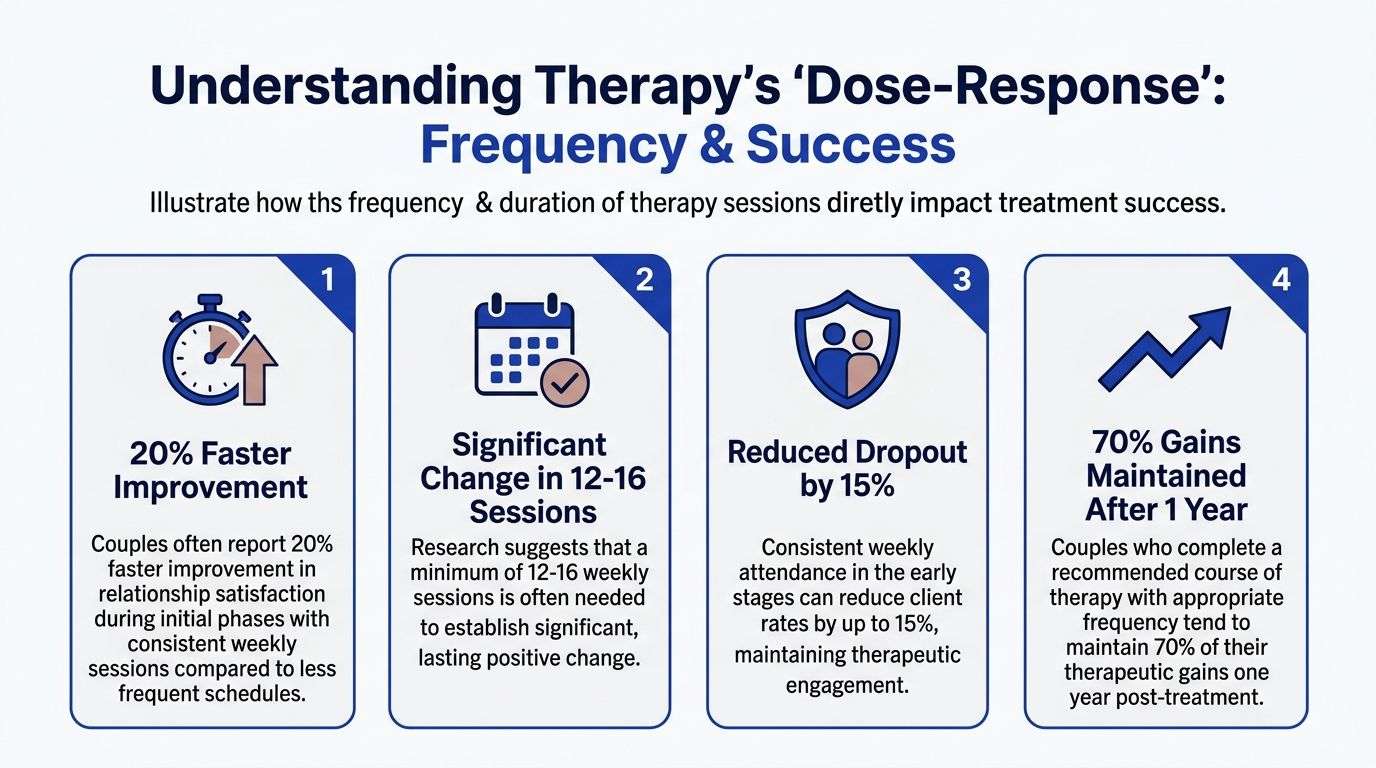
Weekly couples counselling is often the strongest place to start. Research suggests about 70% to 75% of couples report significant improvement when they participate in weekly therapy, with the biggest gains often happening in the first three months. For more information, see our couples counselling.
If you're trying to decide whether counselling should be every week, you're probably already carrying a lot. One of you may be saying, "We need help now," while the other is wondering whether weekly sessions are too much, too expensive, or too hard to fit into real life. That question makes sense. Frequency affects momentum, stress, hope, and whether therapy feels doable.
"While there's no universal rule, research and clinical consensus strongly suggest that starting with weekly sessions offers the best chance for building momentum and achieving significant, lasting change."
Many couples come in looking for the "right" answer, as if there's one schedule that works for everyone. There isn't. There is, however, a clear pattern in both research and practice. Weekly sessions are usually the best starting rhythm, especially when a relationship feels strained, repetitive arguments are happening often, or trust has been shaken. From there, the schedule can be adjusted to fit your goals, progress, and practical limits.
If you're sorting through this decision now, it can help to start with grounded guidance for relationship challenges and then talk with a therapist about what rhythm is realistic for your relationship, not just ideal on paper.
Introduction Finding Your Rhythm in Therapy
Choosing a therapy schedule can feel oddly loaded. Weekly might sound committed and hopeful to one partner, but overwhelming to the other. Biweekly may feel more manageable, yet also too slow if things at home are tense and fragile.
That tension is important. Couples usually aren't just choosing time slots. They're also choosing how much support they need, how quickly they want change, and how much emotional energy they can realistically give to the work.
Why this question matters so much
Session frequency shapes how therapy unfolds. A closer rhythm can help you remember what happened in the last conversation, stay connected to the work, and come back before resentment rebuilds. A wider rhythm can create more breathing room, but it can also make it easier to lose traction.
Weekly therapy isn't about "doing more therapy." It's about reducing the distance between insight and practice.
For many couples, the first few sessions are less about solving everything and more about slowing down the cycle that keeps hurting both people. If those early meetings are too far apart, the same painful pattern can repeat several times before anyone has support making sense of it.
A practical question, not a moral one
Some readers worry that if they can't attend weekly, therapy won't work. That's not the message. The better question is this: What frequency gives your relationship enough structure to change, while still being sustainable?
That answer depends on more than research alone. It depends on how distressed you are, what you're working through, whether both partners are engaged, and what your week looks like. The goal isn't to follow a rigid rule. The goal is to find a cadence that helps you stay in the process long enough for real change to take hold.
The Weekly Standard Why Most Therapy Starts This Way
When therapists recommend weekly sessions at the beginning, they're not being inflexible. They're trying to create the conditions that help therapy work.
Research consistently indicates that approximately 70% to 75% of couples report significant improvement in relationship satisfaction after participating in weekly couples therapy, with the most substantial gains typically occurring within the first three months of treatment.
Momentum matters early
A useful analogy is physical therapy or fitness. If you're trying to strengthen a weak area, long gaps between efforts usually make it harder to build consistency. Relationship work often functions the same way.
In the early phase of couples counselling, you're learning to notice patterns in real time. Maybe one of you pursues, the other shuts down. Maybe practical conversations turn into criticism within minutes. Weekly sessions help you return while those moments are still fresh. That gives the therapist a clearer view of what happened and gives both partners a better chance of trying something different next time.
The alliance needs repetition
Another reason weekly tends to be the default is the therapeutic alliance, which means the working relationship between you, your partner, and the therapist. Trust doesn't appear because everyone wants it to. It usually grows through repetition, predictability, and feeling understood over time.
When sessions are close together, couples often find it easier to:
- Remember details accurately: The therapist can help untangle conflict while the emotions and sequence are still clear.
- Practise one skill at a time: You might work on slowing interruptions, naming softer feelings, or repairing after conflict.
- Stay emotionally connected to the process: You don't have to "start over" every time you walk back into the room.
- Contain distress more effectively: If things are escalated at home, support arrives before another long stretch of disconnection.
Practical rule: If your relationship feels unstable, frequent sessions often function like scaffolding. They don't replace the work. They help hold it up while new habits are forming.
Weekly isn't forever
Many couples get confused about this point. A weekly start doesn't mean an indefinite commitment to weekly therapy. It usually means front-loading support while the relationship is most reactive and while new skills are still unfamiliar.
That early structure gives therapy a better chance to "catch." Once communication becomes steadier and sessions are reinforcing change rather than merely stopping damage, many couples can shift to a less frequent rhythm without losing progress.
What Research Says About Session Frequency and Success
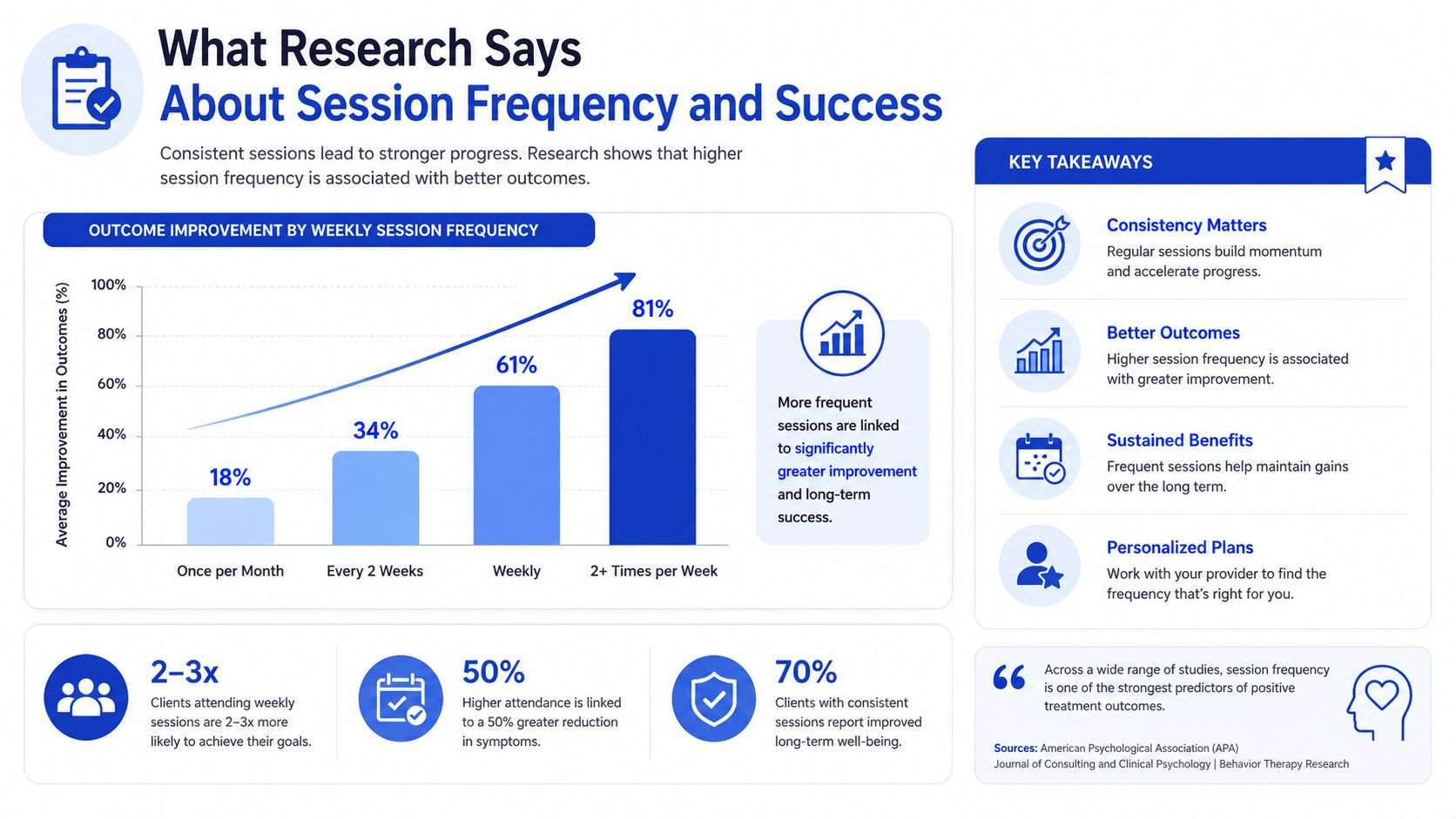
The simplest way to understand the research is to think in terms of a dose-response pattern. In plain language, the amount and timing of therapy often affect the outcome. Not because more is always better, but because enough consistency is needed for the work to become usable in daily life.
Research indicates that approximately 70% to 75% of couples report significant improvements in relationship satisfaction after completing couples therapy, with Emotionally Focused Therapy (EFT) specifically showing a 75% success rate in moving couples from distress to recovery.
Why frequency changes what happens between sessions
Couples therapy doesn't only work in the room. It works in the week between appointments, when you try to pause an old argument, hear each other differently, or repair after a rupture. Weekly meetings create shorter loops between learning and application.
That matters because relationship distress is usually repetitive. If a couple fights three times before the next session, they may arrive feeling defeated or too flooded to reflect. If they come back sooner, the therapist can help them process one or two real examples before those examples harden into a familiar story about failure.
A lot of readers understand this principle from other areas of care. If you're curious about how treatment effectiveness often depends on regular engagement, this article on understanding addiction treatment therapy offers a useful parallel about why consistency matters in behaviour change.
EFT is a good example of why weekly is often built into the model
Emotionally Focused Therapy is one of the best-known approaches for couples. It pays close attention to the emotional cycle between partners, especially the fears and needs underneath conflict. That kind of work usually depends on continuity.
For example, if one partner's anger is covering hurt and fear of rejection, and the other partner's silence is covering shame or overwhelm, those deeper layers often emerge gradually. Weekly contact helps the therapist track that unfolding process. It also helps partners return to vulnerable conversations before defensiveness takes over again.
Research gives direction, not a script
It's tempting to turn these findings into a rule like, "Weekly works, therefore everyone must go weekly." Real life is more nuanced than that. Research identifies what tends to be most effective under strong treatment conditions. Couples still have to decide what they can sustain.
"The best schedule is the one that is clinically sound and realistic enough that you can keep showing up."
That's the bridge between research and real life. Weekly often offers the best conditions for change. But a perfect plan that collapses after two sessions is less helpful than a thoughtful plan you can maintain.
Beyond Weekly When Less Frequent Sessions Make Sense
There are times when less frequent therapy isn't a compromise. It's the right fit.
In the Canadian context, licensed therapists commonly recommend weekly sessions for the first month, followed by a shift to biweekly or monthly intervals as progress is made, reflecting a benchmark protocol where 65% of couples complete therapy within 20 sessions, typically over 3–6 months.

When stepping down is a healthy sign
For many couples, the most useful rhythm changes over time. Weekly work may help stabilise things early on, but later sessions may serve more as maintenance, reflection, and course correction.
A reduced schedule often makes sense when:
- Conflict has cooled: Arguments are less explosive, and both partners can recover more quickly after tension.
- Skills are being used at home: You aren't just understanding the tools. You're applying them without as much therapist support.
- Trust is rebuilding steadily: The relationship no longer feels in immediate danger every week.
- The work needs more integration time: Some couples need longer stretches to practise new routines around parenting, boundaries, or communication.
Some couples don't start in crisis
Not every couple seeking counselling is on the brink of separation. Some come in because they want to strengthen communication, prepare for marriage, manage a life transition, or improve co-parenting. If distress is lower and both partners are already fairly reflective, a biweekly start may be clinically reasonable.
That doesn't mean slower is always better. It means the pace should match the level of urgency. A couple with frequent shutdowns, contempt, or fresh betrayal usually needs more support than a couple looking to refine an already decent connection.
Monthly sessions usually work best later
Monthly counselling can be valuable, but it's often more effective after the relationship has already gained stability. At that stage, the therapist may be helping you maintain gains, troubleshoot setbacks, and keep patterns from creeping back in.
Monthly spacing is usually less helpful when you're still trying to interrupt an active negative cycle. That's a lot of time for old habits to reassert themselves.
Clinical Factors That Influence Your Counselling Schedule
Research gives a starting point. Clinical decision-making makes it personal.
The average duration for effective couples counselling typically involves 10 to 15 sessions spread over two to four months, with clinical guidelines recommending that couples aim to meet at least every two weeks, but ideally once a week, particularly during the initial phase, according to this overview of meeting frequency in couples therapy.
A therapist isn't only asking, "How often can you come?" They're also asking what kind of support your relationship needs right now.
Factors therapists listen for
Some details strongly point toward a weekly start. Others suggest that biweekly may still be workable.
| Factor | Suggests Weekly Start | May Allow for Bi-Weekly Start |
|---|---|---|
| Level of distress | Frequent conflict, shutdown, tension at home, fear the relationship is unravelling | Distress is present but manageable, with fewer escalations |
| Therapy goals | Repair after betrayal, major trust rupture, recurring explosive arguments | Communication tune-ups, premarital work, general enrichment |
| Pattern strength | Negative cycle is fast, automatic, and hard to interrupt without support | Partners can already pause and reflect between conflicts |
| Emotional safety | One or both partners become flooded quickly or avoid difficult talks | Both can tolerate discomfort and return to hard conversations |
| Homework follow-through | Skills are new and need close support to become habits | Partners reliably practise between sessions |
| Complexity | Multiple overlapping stressors are active in the relationship | Concerns are more focused and contained |
Questions worth discussing together
If you're trying to figure out the right cadence, bring concrete examples instead of only preferences. A therapist can make a better recommendation when they know what daily life feels like.
Useful questions include:
- How intense are conflicts right now? Are you having circular arguments every few days, or mostly struggling with distance and miscommunication?
- What are you hoping to change first? Rebuilding trust, co-parenting better, reducing defensiveness, or feeling close again can each call for a different pace.
- How well do you use support between sessions? Some couples leave a session energised and practise right away. Others lose the thread by day two.
- Are there individual mental health concerns affecting the relationship? Anxiety, depression, trauma, grief, or substance use can change how much structure is needed.
- What model is the therapist using? Some approaches are more structured and benefit from tighter early sequencing.
Bring your constraints into the conversation early. Your therapist isn't only assessing your relationship. They're also helping design a schedule you can realistically sustain.
What to notice after the first few sessions
The best schedule often becomes clearer once therapy starts. If you leave sessions with insight but can't hold onto it, you may need closer support. If you're applying the work consistently and arriving with meaningful progress, a wider gap may be enough.
A good recommendation is usually based on both clinical need and actual follow-through. That's why frequency often changes as therapy unfolds.
Navigating Real-World Challenges and Teletherapy
For many couples, weekly counselling sounds wise in theory and nearly impossible in practice. Work schedules collide. Childcare falls through. Commutes eat up time. One partner travels. The other is already emotionally tired before the week even starts.
Those barriers are real, especially in Canada, where many therapy services aren't covered by public healthcare. Research also indicates that couples who used more accessible formats, such as biweekly schedules or virtual therapy, were often able to complete their course of care, suggesting that flexible arrangements can improve access and completion.
Flexibility can support follow-through
Virtual counselling has made it easier for many couples to stay engaged. Removing travel time, making it easier to join from different locations, and fitting sessions around work or parenting can be the difference between starting therapy and postponing it indefinitely.
If weekly isn't realistic, that doesn't have to end the conversation. It may mean discussing options such as:
- Starting biweekly with strong between-session practice
- Using virtual sessions to reduce scheduling strain
- Beginning weekly for a short stretch, then reassessing
- Adding light structure between sessions through journalling, shared check-ins, or therapist-assigned exercises
Some couples also find it helpful to use simple supports between appointments, such as shared calendars, reflection prompts, or helpful relationship management apps that encourage check-ins and communication practice.
Sustainable therapy is not the same as ideal therapy on paper. A plan you can keep is often more useful than a plan you resent or abandon.
The key is honesty. Tell the therapist what's workable. A thoughtful clinician would rather help you build a realistic cadence than watch you agree to a schedule that collapses under pressure.
Frequently Asked Questions About Counselling Frequency
How do we know when it's time to switch from weekly to biweekly sessions
You usually see a few signs. Conflict is less intense. Repairs happen faster. Both partners can use at least some of the skills without needing immediate coaching. Sessions start to feel less like crisis containment and more like reflection and refinement.
If you're unsure, ask your therapist directly what they would want to see before widening the gap.
What if my partner and I disagree about how often we should go
Bring that disagreement into therapy. It isn't a side issue. It's useful information about readiness, fear, motivation, and what each person believes the relationship needs.
One partner may hear "weekly" as commitment. The other may hear it as pressure. Working through that difference can become part of the therapy itself.
Can couples ever do more than one session a week
Sometimes, yes. In periods of acute crisis, some therapists may recommend a more concentrated format for a short time. That depends on the therapist's model, availability, and whether more frequent contact would be stabilising and productive.
If things feel urgent, ask about what options exist rather than assuming weekly is the maximum.
What if weekly sessions feel too intense emotionally
That's important to say out loud. Intensity doesn't always mean therapy is wrong, but it may mean the pacing needs adjustment. Some couples need more grounding, more structure, or more time to digest vulnerable conversations.
A good therapy rhythm should challenge you without overwhelming you so much that you shut down or stop coming.
If we can only afford or manage biweekly therapy, is it still worth starting
For many couples, yes. Starting with a realistic plan is often better than waiting for a perfect time that never arrives. If biweekly is what you can sustain, be upfront about that and ask how to make those sessions count.
The most important thing is not pretending your limits don't exist. It's building a plan around them thoughtfully.
If you're considering couples therapy and want a clearer sense of what schedule might fit your relationship, you can learn more about Interactive Counselling. Sometimes the next helpful step is having an informed, low-pressure conversation about what support could look like for you.
Clinically Reviewed By
Amy Mosset, MCP, RCC-S
Amy Mosset is a Master Practitioner in Clinical Counselling, Clinical Supervisor, and the owner of Interactive Counselling. She provides trauma-informed, evidence-based care and clinical supervision to registered therapists, with a focus on ethical practice, client safety, and high-quality therapeutic outcomes.