Chronic pain and mental health are closely connected, and this connection is common, not unusual. In Canada, about 20% to 22% of people live with chronic pain, and that ongoing pain is significantly linked to greater mental distress and suicide-related outcomes. For more information, see our ICBC counselling.
Some people are reading this after another cancelled plan. Some are here because sleep has become light and broken, mornings feel heavy, and even simple tasks now come with mental math: Do I have enough energy for a shower, groceries, work, or one conversation? Others are trying to make sense of a new pain condition after a motor vehicle accident, while also noticing they're more irritable, anxious, tearful, or shut down than they used to be.
"Therapy can address the connection between chronic pain and mental health by teaching skills to manage how the mind interprets pain signals and responds to the resulting emotional distress."
If that sentence brings up relief, scepticism, or both, that makes sense. Many people worry that if therapy helps with pain, someone will use that to say the pain isn't real. But that isn't what good therapy says. Good therapy starts from the opposite place: your pain is real, your distress is understandable, and your nervous system may need support on more than one level.
Living with an Invisible Weight
There's a particular kind of exhaustion that comes with pain other people can't see. You might look “fine” while carrying a body that feels tight, burning, aching, or unreliable. You may have heard yourself say, “I'm just tired,” because explaining the full truth takes more energy than you have.
For many people, the hardest part isn't only the pain itself. It's the ripple effect. Work becomes harder to focus on. Relationships start to strain under missed plans or misunderstandings. You may find yourself grieving the version of life you expected to have, even while trying to stay grateful and get through the day.
When pain changes more than your body
Chronic pain can reshape how you move through the world:
- Daily routines shrink: errands, cooking, exercise, and social plans may start to feel unpredictable.
- Your mind stays on alert: flare-ups can train you to scan for danger, overthink activity, or brace for the next bad day.
- Your identity gets shaken: many people start asking painful questions such as “What's wrong with me?” or “Will I always be like this?”
That reaction isn't weakness. It's what happens when a person lives inside a body that no longer feels safe or steady.
A large Canadian picture helps explain why so many people recognise themselves here. Chronic pain affects approximately 20% to 22% of the Canadian population, and it is significantly linked to increased suicide-related outcomes, which is one reason this issue matters far beyond pain clinics or therapy offices. It sits right at the intersection of physical suffering and emotional distress, as outlined in this Canadian research on chronic pain prevalence and suicide-related outcomes.
Pain doesn't just hurt. It can narrow your world, reduce your sense of safety, and make hope feel harder to access.
Why people often feel misunderstood
Friends or family may focus on the visible parts of your life. They might see that you got dressed, went to work, or smiled at dinner. They don't see the recovery time afterwards, the internal effort, or the cost.
That gap often creates shame. You may start questioning your own experience, pushing too hard to “prove” you're okay, then crashing later. Many people end up trapped between two painful positions: doing less than they want, or doing more than their body can currently support.
The Unseen Connection Between Body and Mind
Chronic pain makes more sense when you stop thinking about the body and mind as separate systems. A better model is an alarm system. Pain is meant to alert you to danger. But with chronic pain, that alarm can become overprotective. It starts ringing loudly, often, and sometimes long after the original injury or trigger has changed.
That doesn't mean the alarm is fake. It means the system has become more sensitive.
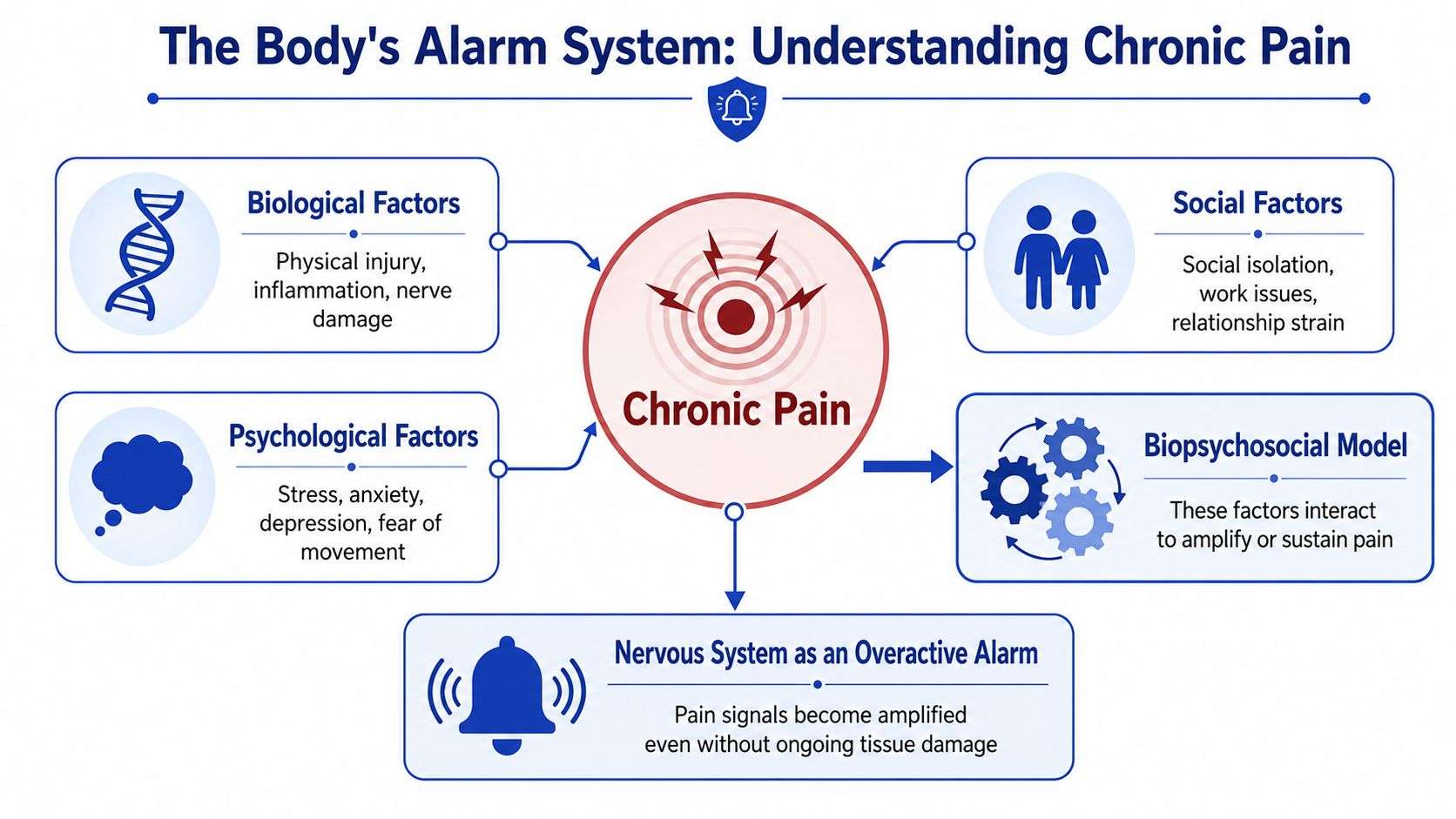
The body's alarm system can get stuck on
Pain is influenced by biological, psychological, and social factors all at once. That's what people mean by the biopsychosocial model.
A simple way to picture it:
| Part of the experience | What it can include | How it affects pain |
|---|---|---|
| Biological | injury history, inflammation, nerve sensitivity, sleep disruption | can increase physical pain signals |
| Psychological | fear, worry, low mood, frustration, hopelessness | can make the brain interpret signals as more threatening |
| Social | isolation, family stress, work pressure, feeling disbelieved | can keep the nervous system tense and reactive |
Why mood can change pain, and pain can change mood
This link isn't “just stress.” Functional imaging studies show that chronic pain and mental health disorders share overlapping biological mechanisms. That helps explain why 35% to 45% of chronic pain patients also experience depression, and why they have a nearly fourfold increased likelihood of developing anxiety, according to the American Psychiatric Association discussion of chronic pain and mental health.
If you've ever noticed that pain flares when you're overwhelmed, or that low mood makes the pain feel heavier, that fits what clinicians see every day. The brain areas involved in pain processing and emotional distress overlap. So when one system is strained, the other often reacts too.
An overactive nervous system can make a small signal feel large, and emotional distress can turn up the volume even more.
Common points of confusion
People often get stuck on one of these worries:
“If anxiety affects pain, does that mean the pain isn't physical?”
No. It means the nervous system processes physical and emotional threat together.“If my scans are unclear, am I imagining this?”
No. Pain is a real lived experience, even when tests don't fully capture it.“If I calm down, will the pain disappear?”
Not always. But reducing threat in the nervous system can change how intense, consuming, or disruptive pain feels.
How Therapy Helps Rewire the Pain-Stress Cycle
When pain and emotional distress feed each other, treatment works best when it addresses both at the same time. Individuals with chronic pain are four times more likely to experience depression or anxiety, and research shows that integrated care that treats both physical pain and mental health simultaneously is the most effective approach, as noted by Mental Health America's overview of chronic pain and mental health.
Therapy doesn't usually aim to argue with your pain or talk you out of it. It helps you change your relationship with pain, lower fear, reduce nervous system overload, and rebuild parts of life that pain has taken over.
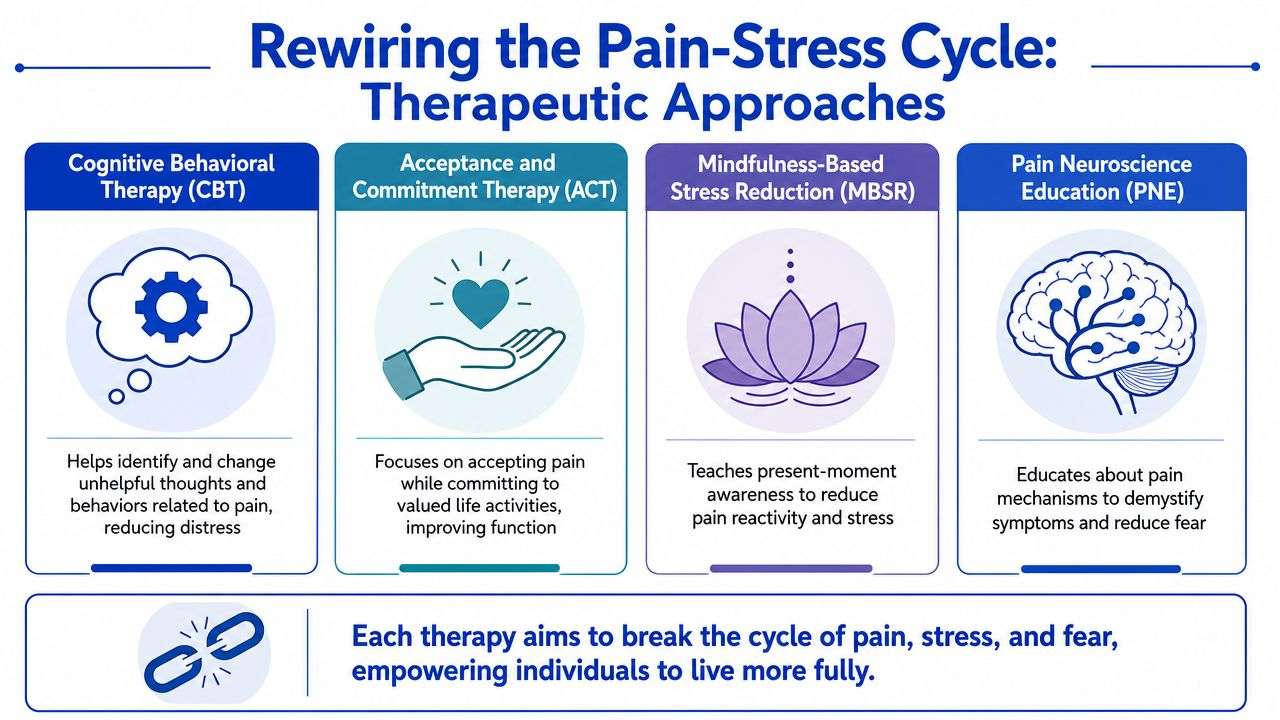
CBT helps with the thoughts that intensify suffering
Cognitive Behavioural Therapy (CBT) is often misunderstood as “thinking positive.” It's more practical than that.
Think of it this way. Pain sends the first wave. Then the mind can add a second wave:
- “This flare means I'm getting worse.”
- “I'll never manage my life.”
- “If I rest now, I'm failing.”
- “If I move, I'll make everything worse.”
CBT helps you notice those patterns and test them. Not because thoughts cause all pain, but because some thoughts increase fear, tension, avoidance, and despair.
A therapist might help you:
- Spot catastrophising: notice when your mind jumps from “I'm hurting today” to “nothing will ever improve.”
- Shift all-or-nothing patterns: move away from the boom-and-bust cycle of overdoing it on good days and crashing after.
- Build steadier coping statements: use language that is believable and calming, such as “This is hard, and I have tools.”
ACT helps you have a life even when pain is present
Acceptance and Commitment Therapy (ACT) takes a different route. It doesn't ask you to like the pain or give up on treatment. It helps you stop organising your entire life around waiting for pain to fully disappear before you live.
That can sound like:
- spending ten minutes outside because nature matters to you
- staying connected to a friend even if you need to shorten the visit
- parenting in a gentler, more paced way instead of chasing an impossible standard
Practical rule: ACT asks, “What still matters to you, even here?”
This approach is often a relief for people who feel exhausted from fighting their body every hour of the day.
Trauma-informed care helps create safety
Some people with chronic pain also carry unresolved trauma, medical trauma, or the shock of a collision, surgery, or frightening health event. In those cases, the body may stay braced. Sleep becomes light. Startle responses increase. Pain can feel tangled with fear, helplessness, or loss of trust in one's own body.
A trauma-informed therapist pays attention to safety, choice, pacing, and consent. They won't force emotional intensity or push you into coping strategies that feel overwhelming. That matters because healing usually happens when the nervous system feels less threatened, not more controlled.
Other helpful approaches
Different people benefit from different tools. Therapy may also include:
- Mindfulness-based strategies: learning to notice sensations without immediately spiralling into fear
- Pain neuroscience education: understanding how pain works so symptoms feel less mysterious and frightening
- Behavioural pacing: creating steadier patterns of activity and rest
Good therapy is collaborative. You're not there to be corrected. You're there to build a toolkit.
Specialized Support for Pain and Relationships
Chronic pain rarely stays contained within one person. It enters schedules, intimacy, parenting, finances, and how household tasks get divided. Couples often start having the same argument in different forms: one person feels unseen, the other feels helpless, and both feel lonely.

When pain changes the relationship dynamic
A partner may want to help but not know how. Sometimes support slowly turns into over-monitoring, tension, or a caregiver role neither person wanted. The person in pain may feel guilty, defensive, or ashamed. The supporting partner may feel shut out or scared to say the wrong thing.
Common pressure points include:
- Household imbalance: chores and routines may no longer feel fair or predictable.
- Emotional distance: pain can leave little room for playfulness, patience, or connection.
- Intimacy concerns: touch may become complicated by discomfort, fear, or fatigue.
- Parenting strain: children notice changes, even when adults try to hide them.
What specialized support can look like
Some people work with therapists who focus specifically on pain-related approaches, including newer pain-focused psychotherapy models. Others benefit most from couple or family counselling where the goal isn't to “fix” one person, but to create a more supportive system around the pain.
A therapist may help a couple:
- talk about limits without blame
- separate the pain problem from the relationship problem
- rebuild intimacy in ways that feel safe and realistic
- discuss what kind of help feels supportive rather than controlling
“Pain can isolate people inside the same home. Shared language often helps before solutions do.”
Family work can also help children understand what's happening in age-appropriate language. Simple explanations reduce confusion. They also help children see that a parent's pain is not their fault.
Practical Strategies to Reclaim Your Well-Being
Therapy matters, but daily life also matters. Small experiments can make the nervous system feel less cornered. The goal isn't perfection. The goal is to create a little more steadiness, choice, and self-trust.

Gentle tools that often help
Try these as experiments, not rules:
- Pace before you crash: stop activities a little earlier than you think you “should.” This can reduce the boom-and-bust cycle.
- Use brief body scans: spend one or two minutes noticing tension in the jaw, shoulders, stomach, or hands, then soften what you can.
- Choose safe movement: many people do better with small, consistent movement than with occasional big efforts.
- Track patterns kindly: a notebook can help you notice links between sleep, stress, activity, and flare-ups without turning into self-surveillance.
If sleep is one of your biggest struggles, comfort and support at night can become part of the picture. A practical consumer guide such as Golden Dreams Mattress may give you ideas about how people think through sleep setups when living with chronic pain.
The hidden harm of being disbelieved
One part of pain that doesn't get enough attention is stigma. Many people with chronic pain have been questioned, minimised, or treated like they are exaggerating. That experience can be severely harmful.
The mental health impact of pain stigma is significant. A 2023 study found that when individuals felt their pain was invalidated by others, they faced a much higher risk of depression, with shame acting as the key link.
That means feeling disbelieved isn't a minor social problem. It can become part of the suffering itself.
Simple advocacy phrases
When you're tired, it helps to have a few prepared sentences:
- With family: “I know you want me to push through, but what helps most is when you believe me and ask what I need.”
- With a clinician: “I'm looking for support with both the pain and the stress it creates.”
- With yourself: “I don't have to earn care by appearing worse.”
Shame often grows in silence. Clear language can interrupt it.
Finding the Right Support in British Columbia
You finally decide to ask for help, then run into a new kind of exhaustion. You have to compare providers, explain your pain history again, sort through funding questions, and figure out what you can realistically manage on a low-energy week. For many people in British Columbia, the search itself can feel like one more burden on an already overloaded system.
Good support should feel clarifying, not confusing. A helpful counsellor understands that chronic pain affects more than the body. It can change sleep, mood, concentration, work, relationships, and your sense of trust in your own body. In that way, pain care works a bit like tending to a house after a storm. You do not only look at the broken window. You also check the wiring, the water damage, and what has stopped feeling safe.
What useful support often includes
Counselling for chronic pain is often more useful when it includes a few core features:
- Whole-person care: support that addresses pain alongside stress, grief, trauma, identity changes, relationships, sleep, and daily functioning.
- Evidence-informed approaches: methods such as CBT, ACT, mindfulness-based strategies, and trauma-informed therapy can help reduce distress and improve coping.
- Flexibility: sessions may need to fit around flare-ups, fatigue, transportation limits, work schedules, or medical appointments.
- Validation: feeling believed matters. For people who have been dismissed or questioned, the therapeutic relationship itself can begin to reduce some of the fear and shame wrapped around pain.
In British Columbia, that practical side matters. Access is not only about finding a therapist who understands chronic pain. It is also about finding support that fits your circumstances, your energy, and your finances.
A note about ICBC-funded counselling
If your pain began after a motor vehicle accident, or became harder to manage after one, ICBC-funded counselling may be available depending on your claim and situation. This can make a real difference. After an accident, people are often coping with pain while also dealing with driving anxiety, disrupted routines, paperwork, medical visits, and a nervous system that stays on high alert.
That combination can be hard to explain to others. It can also make people feel isolated, especially if they hear messages that they should be "over it by now." Counselling can help address the emotional effects of accident-related pain while you continue with physical recovery and other care.
If you want to explore what kinds of help are available, you can learn more about our counselling services below. The main point is simple. Support for pain-related emotional distress exists in British Columbia, and for many people, it becomes a practical part of recovery rather than one more thing to carry alone.
Frequently Asked Questions About Pain and Therapy
Does therapy mean my pain is all in my head
No. Therapy for chronic pain starts from the understanding that your pain is real. It focuses on how the nervous system, emotions, stress, beliefs, relationships, and coping patterns influence the pain experience. That isn't dismissal. It's a more complete model of care.
What if I'm too exhausted to start therapy
That's common. Many people come to therapy already depleted. A good therapist can work at a slower pace, help you prioritise one or two manageable goals, and adapt sessions to your energy. You don't need to arrive organised, optimistic, or ready to do everything at once.
Can therapy help if my pain started after a car accident
Yes, it can. After an accident, pain often becomes tied to fear, hypervigilance, disrupted sleep, and loss of confidence in the body. Therapy can help with the emotional and nervous system effects of that experience while you continue addressing the physical side of recovery.
Why is it so hard for people with chronic pain to get mental health support
Because this is often a system problem, not a personal failing. Research describes a “cascade-of-care” failure in which people with chronic pain have high need for mental health treatment but low actual use, often because of barriers such as long wait times and lack of coverage for psychological therapies, as explained in this analysis of the mental health treatment use gap in chronic pain.
If you've struggled to access care, that struggle makes sense. It doesn't mean you didn't try hard enough.
What if I've been dismissed before and don't trust therapy
That reaction is understandable. Many people with chronic pain have experienced invalidation in medical and personal settings. You're allowed to be cautious. Therapy should feel collaborative, respectful, and grounded in your lived experience. If it doesn't, the fit may be wrong.
If you're living with the overlap of chronic pain and emotional strain, Interactive Counselling offers a place to learn more about support that can be customized to individuals, couples, families, and those recovering from motor vehicle accidents. Reaching for information can be a gentle first step, especially when you've been carrying a lot for a long time.
Clinically Reviewed By
Amy Mosset, MCP, RCC-S
Amy Mosset is a Master Practitioner in Clinical Counselling, Clinical Supervisor, and the owner of Interactive Counselling. She provides trauma-informed, evidence-based care and clinical supervision to registered therapists, with a focus on ethical practice, client safety, and high-quality therapeutic outcomes.