Many couples in Grande Prairie can access counselling with daytime, evening, and weekend appointments, and research suggests the process can make a real difference: 71% of people in one 2026 survey said couples therapy improved their relationship, while a broader review found around 70% of couples improve and many finish within 20 sessions or about six months or less. If you're feeling distant, stuck in the same argument, or unsure how to talk without things going sideways, that doesn't mean your relationship is broken beyond repair. It often means you need a steadier place to slow down, understand what's happening, and learn a different way to reach each other. For more information, see our Grande Prairie couples counselling.
Couples counselling is a supportive, collaborative process where partners work with a therapist to improve communication, resolve conflicts, and strengthen their emotional bond. For more information, see our counselling in Grande Prairie.
You might be here because the small things have started turning into big fights. Or because there aren't many fights at all anymore, just tension, silence, and the ache of feeling alone beside someone you still care about. That experience is more common than many couples realise, especially when work stress, parenting, finances, shift schedules, and everyday exhaustion pile up. For more information, see our couples counselling.
Couples counselling in Grande Prairie: strengthening your relationship often begins with one simple shift. Instead of asking, “Who's the problem?” you begin asking, “What keeps happening between us, and how do we change it together?” That question opens the door to hope.
Your Guide to Reconnecting and Rebuilding
A lot of couples wait longer than they need to. Not because they don't care, but because they're tired, unsure, and a bit scared of what counselling might bring up.
One partner may think, “If we need therapy, something must be seriously wrong.” The other may worry, “What if the therapist blames me?” In real life, many couples arrive much less dramatically than people imagine. They come in after months of bickering about chores, after feeling disconnected since a baby arrived, or after a stretch of shift work left them living like roommates.
When disconnection creeps in quietly
In Grande Prairie, practical life often puts pressure on relationships. Long workdays, rotating schedules, parenting demands, and general stress can make even loving couples feel out of sync. A missed text becomes a bigger argument. A tired tone gets mistaken for rejection. After a while, both people stop feeling understood.
That doesn't mean love is gone.
It usually means the relationship needs care, structure, and a safer way to talk about what's been hurting. Sometimes couples also try rebuilding connection at home in small ways before or alongside therapy, such as planning intentional time together with tips for romantic dates at home. Those moments can help, but if the same painful pattern keeps returning, a guided conversation often becomes the next helpful step.
Many couples don't need a verdict on their relationship. They need help getting out of the same painful loop.
Why counselling can feel hopeful, not alarming
Counselling isn't only for couples in crisis. It can also help couples who still care about each other but don't know how to stop the drift. Seen this way, therapy becomes less like an emergency measure and more like relationship maintenance with depth and honesty.
A gentle, structured process can help you:
- Slow arguments down so they don't escalate so quickly
- Say what you mean more clearly without blame or shutdown
- Understand the pattern underneath the conflict rather than debating only the surface issue
- Reconnect emotionally after distance, resentment, or hurt
- Make room for repair when trust or closeness has been shaken
What Is Couples Counselling Really
A lot of couples in Grande Prairie arrive with the same private worry. One person is bracing for blame. The other is wondering whether the therapist will tell them the relationship is beyond repair. If that is where you are starting, you are in very normal territory.
Couples counselling is a guided conversation with structure, care, and a clear purpose. The purpose is to help both of you understand the pattern that keeps pulling you apart, then practice a different way of responding to each other. A therapist works like someone holding a map on a snowy back road. They are not driving the truck for you, and they are not choosing your destination. They help you see where you are getting stuck, where the road gets slippery, and what will help you get traction again.

The therapist isn't a referee
One of the first questions many couples ask is, “Will you take sides?”
A skilled couples therapist pays attention to each partner and to the relationship between them. That means the session is not built around proving who is right. It is built around noticing what happens between you. Maybe one of you pushes for answers when feeling scared, and the other shuts down when feeling overwhelmed. Maybe small disappointments turn into sharp criticism, then silence, then distance for days.
The pattern becomes the focus, because the pattern is usually what keeps the pain alive.
A key turning point is often this. Couples begin to see the problem as something happening between them, not as proof that one person is the problem. That shift can lower defensiveness and make room for honesty.
| What couples often worry about | What counselling often helps with |
|---|---|
| Being judged | Creating enough safety to speak honestly |
| Getting blamed for every conflict | Seeing the cycle more clearly |
| Repeating the same old fight | Understanding what the fight is really about |
| Feeling pressured to stay together no matter what | Looking at what repair, trust, and change would actually involve |
It is practical as well as emotional
Many people hear the word counselling and picture endless talking with no direction. Good couples work is usually much more grounded than that.
Sessions often help couples build skills in areas such as:
- Communication during conflict so conversations do not spin out as quickly
- Emotional awareness so reactions make more sense to both partners
- Repair after disconnection including what helps after a harsh argument or shutdown
- Trust rebuilding after secrecy, betrayal, or repeated letdowns
- Connection habits that support warmth, teamwork, and follow-through
This emotional piece can feel confusing at first, especially when the fights seem to be about chores, money, sex, parenting, or time. But practical disagreements often carry emotional weight. “You are late again” can carry loneliness. “Why do I have to ask?” can carry exhaustion. “You never want to talk” can carry fear.
In other words, the surface topic matters, and the meaning underneath it matters too.
Practical insight: The loudest argument in a relationship is often not about the deepest issue.
Counselling helps you work as a team again
At its best, couples counselling gives you a room where hard truths can be said with less damage. That does not mean every session feels easy. Some are tender. Some are awkward. Some bring relief because, for the first time in a while, both of you can hear the pain underneath the anger.
For many couples in Grande Prairie, that alone can feel unfamiliar. Life here can be busy, demanding, and stretched by shift work, parenting, seasonal stress, or long-standing routines that leave little room for real connection. Counselling slows the moment down enough for both partners to stop reacting on autopilot.
You do not need to arrive with perfect words. You do not need to be in total crisis either. You only need some willingness to look squarely at what is happening and to try a different process together.
Evidence-Informed Approaches That Help Couples Heal
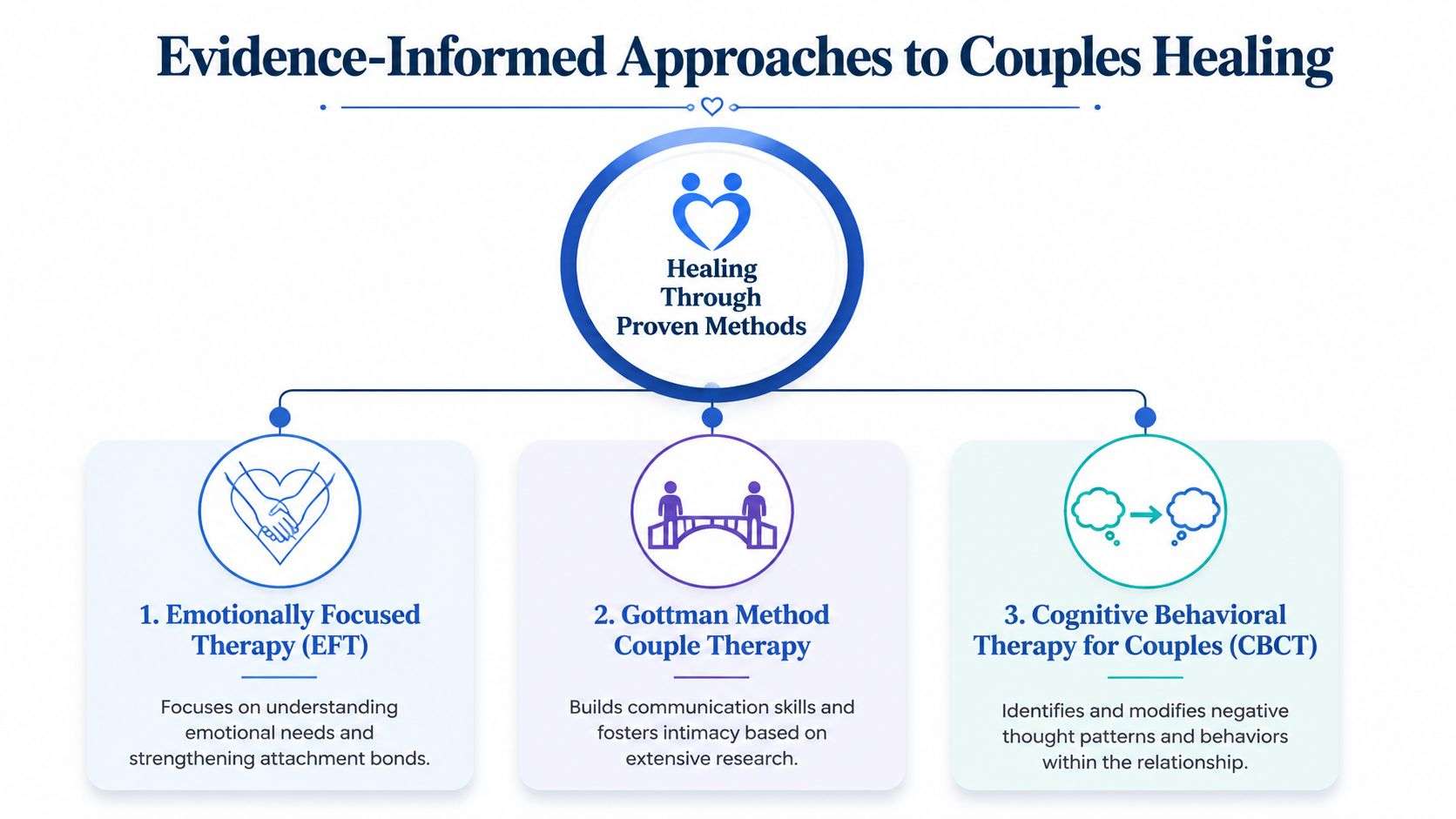
Not all couples therapy looks the same. Different therapists use different models, and that matters. When a counsellor uses a clear, evidence-informed approach, sessions tend to feel more grounded, less random, and more focused on lasting change.
Emotionally Focused Therapy
Emotionally Focused Therapy (EFT) is one of the best-known approaches for couples. It looks closely at the emotional bond between partners and the negative cycle that takes over when that bond feels threatened.
For example, one partner may pursue with criticism or urgency because they feel abandoned. The other may shut down because they feel overwhelmed or like they can never get it right. On the surface, it looks like one person is angry and one doesn't care. Underneath, both may be scared of disconnection.
EFT helps couples:
- Notice the cycle instead of attacking each other
- Name the softer emotion underneath the anger or withdrawal
- Respond to each other with more safety
- Build a more secure bond over time
Research summaries about couple therapy in Canada report that about 70% to 75% of distressed couples move into recovery, roughly 90% show measurable improvement by the end of treatment, and gains can last for two years or longer when couples complete treatment (SENTI overview of marriage therapy success rates).
Gottman Method and skills-based work
The Gottman Method is another widely used framework. It pays close attention to the small daily habits that either strengthen or weaken a relationship. In plain language, it asks questions like: Do you turn toward each other? Do you know how to repair after conflict? Is there still friendship under the stress?
This style of work often helps couples who want practical tools as well as deeper understanding. A therapist may help you:
- track how arguments start
- spot contempt, defensiveness, or shutdown
- practise repair attempts
- rebuild friendship and shared meaning
Cognitive and behavioural approaches
Some couples also benefit from Cognitive Behavioural Therapy for Couples (CBCT) or other structured approaches that focus on how thoughts, assumptions, and repeated behaviours shape the relationship. This can be useful when both people get stuck in automatic interpretations such as “You did that because you don't respect me” or “Nothing I do will ever be enough.”
Different approaches can be blended thoughtfully. What matters most is that the therapy is relationship-specific, grounded in training, and shaped around the couple in front of the therapist.
The model matters, but the real turning point is often this. Both partners start seeing the cycle as the problem, not each other.
Common Relationship Challenges We Can Address Together
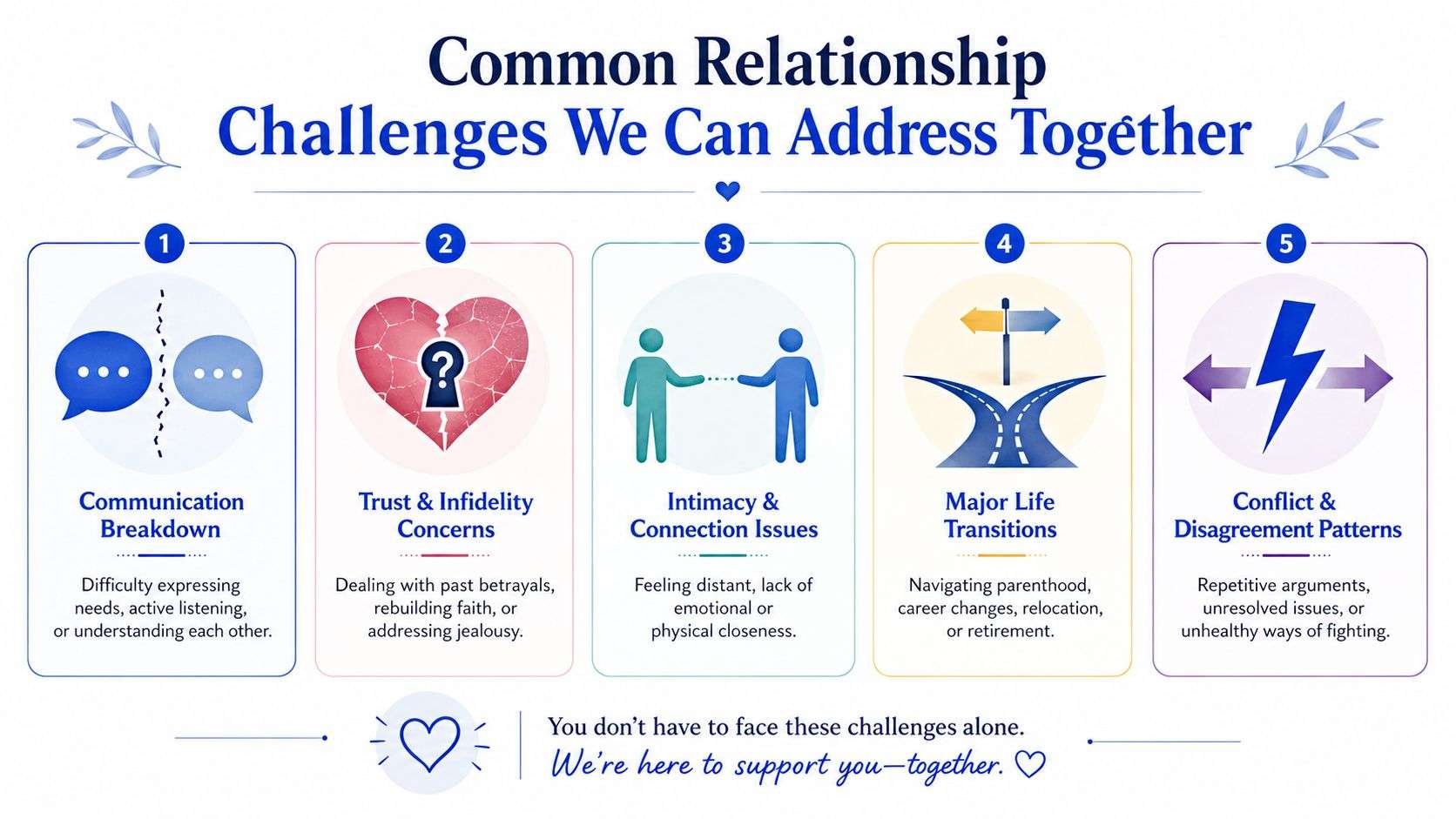
Most couples don't come to counselling because they've failed. They come because the same painful issue keeps returning, and their usual ways of handling it aren't working anymore.
The issues are common, even when they feel deeply personal
You may recognize your relationship in one or more of these:
Communication that keeps missing the mark
You talk, but one of you feels dismissed and the other feels attacked. The conversation becomes about tone, timing, or wording instead of the need underneath.Recurring arguments that never fully resolve
Some couples fight about the same thing in different clothing. It might be chores, in-laws, time together, or priorities. The topic changes a bit, but the emotional wound stays the same.Trust that has been shaken
This can follow infidelity, secrecy, broken promises, emotional withdrawal, or repeated dishonesty. Rebuilding trust takes more than saying “move on.” It usually requires safety, accountability, and careful repair.Loss of intimacy or emotional closeness
Many couples become efficient co-managers of life while losing warmth, affection, or desire. That drift can feel painful and confusing, especially when no single dramatic event caused it.Life transitions that strain the bond
New parenthood, job changes, relocation, grief, health stress, or blended family dynamics can expose weak spots in even caring relationships.
Some “practical” conflicts are really emotional ones
Money is a good example. A disagreement about spending, saving, or debt may sound financial, but it often carries meanings about security, control, partnership, fairness, or trust. Couples who are trying to sort through that topic sometimes find it helpful to read practical resources such as Coveredly on combining finances while also addressing the deeper emotional layer in therapy.
Here are signs the issue may be less about the topic and more about the pattern:
| Surface issue | Deeper pain that may be underneath |
|---|---|
| Chores | “I feel unsupported” |
| Parenting decisions | “I feel alone in responsibility” |
| Sex and affection | “I don't feel wanted or safe” |
| Spending | “I don't feel secure with you” |
| Time together | “I don't feel chosen” |
Struggling in one of these areas doesn't make your relationship unusual. It makes your relationship human.
What to Expect in Your Counselling Sessions
You pull into a parking lot in Grande Prairie, or log in from home after a long day, and both of you are wondering the same thing. Will this turn into a blame session. Will we be asked to say everything perfectly. What if one of us shuts down.
Those worries are common. The first part of couples counselling is often about lowering the temperature enough for both people to feel heard, especially if home has started to feel tense, quiet, or unpredictable.
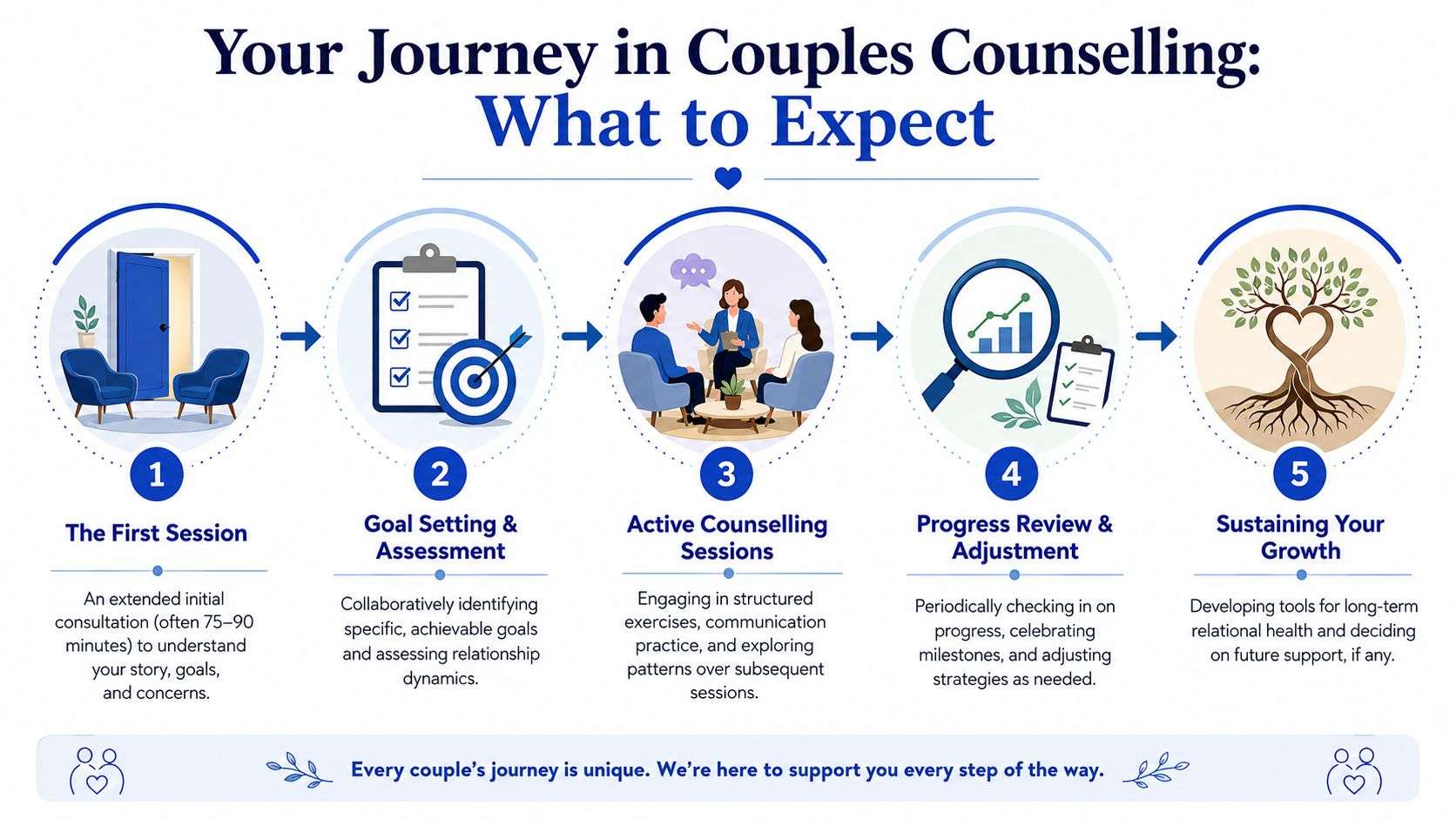
The first session usually slows things down
Early sessions are less like a debate and more like creating a map. Your counsellor is listening for what happens between you, what each of you longs for, and where conversations tend to go off course.
In many Grande Prairie practices, the opening appointment is set up with enough time for both partners to speak without rushing. That matters in a regional community where couples are often fitting counselling around shift work, parenting, winter roads, or long workdays. A steadier pace can help each person feel there is room for their side of the story.
A therapist will often ask about:
- Why you decided to come in now
- What happens when conflict starts
- What has felt painful, distant, or stuck
- What each of you hopes will improve
- Whether there are immediate concerns about safety, trust, or severe stress
You do not need polished answers. “We keep missing each other.” “Every talk turns into a fight.” “I stop talking when I feel overwhelmed.” That is more than enough to begin.
The process becomes clearer as sessions continue
After the first meeting, counselling usually becomes more focused and practical. The goal is not to replay every argument in detail. The goal is to notice the pattern underneath them.
A useful comparison is a dance. One person pursues, the other pulls back. One gets louder, the other goes quiet. After a while, both people are reacting to the pattern almost automatically. Therapy helps you pause that dance, understand what drives it, and practise different steps.
Sessions often include:
- Identifying the cycle you get pulled into
- Learning how to speak from hurt or fear instead of anger or criticism
- Listening for meaning, not only for facts
- Repairing injuries when trust has been strained
- Trying small changes between sessions so progress happens in daily life, not only in the office
Some sessions feel relieving. Some feel tender. Some may leave you thinking hard afterward. That does not mean therapy is going badly. It often means you are finally talking about the parts that have been driving the disconnection.
Progress usually looks gradual, not dramatic
Many couples come in hoping for one breakthrough conversation. More often, change happens in smaller moments. A fight ends sooner. Someone stays present instead of walking away. An apology sounds more genuine. A hard topic becomes possible without the same explosion.
That kind of progress matters because relationships are built through repeated interactions. If those interactions become safer and clearer, trust can start to grow again.
Counselling also works best when both partners take part in the process. Your therapist can guide, reflect, and interrupt unhelpful patterns, but the core work is the new experience you create together, session by session.
A helpful expectation: You are not supposed to solve everything at once. You are building enough safety, honesty, and structure to start talking to each other in a new way.
Choosing the Right Couples Counsellor in Grande Prairie
You might be sitting at the kitchen table after another hard week, both of you tired, both unsure how to start. One of you says, "Maybe we should talk to someone," and the room gets quiet. That moment is common. Reaching out for couples counselling in Grande Prairie is not a sign that your relationship has failed. It often means you both still care enough to look for help.
Choosing a counsellor is a little like choosing a guide for rough roads. Skill matters, but so does steadiness. A couples therapist is paying attention to two people at once, and also to the pattern that keeps pulling you into the same painful place.
Look for fit, structure, and couples-specific training
The first contact can tell you a lot. Notice whether both of you feel respected. Listen for clarity. A helpful therapist can explain how they work in plain language and stay focused on the relationship dynamic instead of turning the session into a debate about who is right.
It also helps to ask direct questions early, especially if one or both of you feel nervous about wasting time or money.
Questions worth asking include:
- What experience do you have with couples counselling?
- Do you use a specific approach, such as EFT or Gottman-informed work?
- How do you respond when one partner shuts down or feels guarded?
- What does progress usually look like over time?
- How do you help couples when conflict escalates quickly?
You are not looking for a perfect personality match. You are looking for a therapist who can stay calm, organized, and fair while helping both of you feel heard.
Practical details matter in Grande Prairie
In Grande Prairie, practical fit often matters as much as emotional fit. Work in the region can involve shift changes, long days, seasonal pressure, childcare challenges, and winter travel. A good counselling plan has to fit real life, not an ideal schedule.
That means asking about appointment times, virtual options, fees, and insurance coverage before you begin. Many couples do better when sessions are easy enough to keep showing up for, especially during stressful stretches.
Practical questions can include:
- Do your appointment times work with rotating or irregular schedules?
- Are online or phone sessions available when travel is difficult?
- Can we attend consistently without adding more strain at home?
- Do our benefit plans help cover part of the cost?
These details are not small. They protect follow-through. Even a skilled therapist may not be the right choice if getting to sessions becomes a repeated source of stress.
The right fit should feel steady
A strong first session does not always feel relieving. Sometimes it feels careful, emotional, or unfamiliar because you are speaking about tender things with a new person in the room. What matters more is whether the therapist creates enough safety and structure for the conversation to stay productive.
In a smaller regional community, some couples also worry about privacy, stigma, or running into someone they know. Those concerns are understandable. A professional couples counsellor should explain confidentiality clearly and help you understand the process so it feels less mysterious and more manageable.
Steadiness matters more than charm. You want someone who can hold both perspectives, slow conflict down, and help the two of you begin again with a little more understanding and a little less fear.
Frequently Asked Questions About Couples Counselling
Will the therapist take sides or blame one of us
A skilled couples therapist doesn't act as a judge. The therapist's job is to understand both partners and help identify the pattern harming the relationship. That means making room for accountability where needed, while still staying focused on repair, safety, and change.
What if my partner is hesitant to try counselling
That's very common. Many people worry they'll be blamed, exposed, or pressured. It can help to frame counselling as support for the relationship rather than proof that something is terribly wrong. Sometimes agreeing to try one session is a more approachable first step than debating the whole future of therapy.
Is our relationship bad enough for counselling
You don't have to wait for a crisis. In fact, earlier support is often easier because resentment and hopelessness haven't hardened as much. Counselling can help with disconnection, repeated tension, life transitions, trust issues, or wanting a healthier way to communicate.
What if we get emotional in session
That is normal. Couples therapy often touches vulnerable places. A good therapist helps slow the conversation down so emotion becomes something to understand, not something that takes over the room.
Can counselling help if only one of us is ready to change
It can still be useful to begin. Real progress is easiest when both partners engage, but one person's increased clarity, emotional regulation, and communication can still shift a relationship dynamic. Sometimes one partner starting the process makes it safer for the other to join later.
If you're considering support, Interactive Counselling offers information about counselling services that may help you take the next step with more clarity. You don't need to have the perfect words before reaching out. Many couples begin with nothing more polished than, “We care about each other, but we need help finding our way back.”
Clinically Reviewed By
Amy Mosset, MCP, RCC-S
Amy Mosset is a Master Practitioner in Clinical Counselling, Clinical Supervisor, and the owner of Interactive Counselling. She provides trauma-informed, evidence-based care and clinical supervision to registered therapists, with a focus on ethical practice, client safety, and high-quality therapeutic outcomes.