ICBC provides direct-billed counselling in Vernon after a car accident, and you can start within the first 12 weeks after the collision without a doctor's referral if your claim is active. To begin covered care, you need your ICBC claim number and Personal Health Number. For more information, see our Vernon ICBC counselling.
A crash can leave you feeling rattled long after the vehicles stop moving. Some people notice fear when they get back behind the wheel. Others can't sleep, feel jumpy in traffic, or keep replaying the moment over and over. If that's where you are right now, you're not overreacting. You're responding to something frightening and disruptive. For more information, see our counselling in Vernon.
"ICBC counselling in Vernon means you may be able to access direct-billed therapy after a car accident, without a doctor's referral, during the first 12 weeks of recovery once you have an active claim." For more information, see our ICBC counselling.
Finding Your Footing After a Collision
You might be reading this while juggling a lot at once. Maybe you're waiting for calls about vehicle repairs, trying to keep up with work, and wondering why your body feels tense all the time. Maybe the physical pain gets the attention first, but the emotional side keeps showing up in quieter ways. You avoid the route where the crash happened. You flinch at sudden braking. You feel tired, irritable, or unlike yourself.
Those reactions are common after an accident. They can happen whether the collision was severe or “not that bad” on paper. Your nervous system doesn't measure events the way insurance forms do. It reacts to shock, loss of control, pain, and uncertainty.

Counselling can help you make sense of those reactions. It gives you a place to slow things down, understand what your mind and body are doing, and start rebuilding a sense of safety. That matters just as much as tending to physical injuries. If you're also dealing with pain, stiffness, or mobility issues, this article on healing faster with physical therapy can help you think about the physical side of recovery alongside emotional care.
What emotional recovery can look like
For one person, recovery means being able to drive to work without panic. For another, it means sleeping through the night again. For someone else, it means not feeling on edge every time a family member is late getting home.
You don't need to wait until things feel “serious enough” to seek support.
A lot of people delay because they think they should be coping better by now. But post-accident stress doesn't always look dramatic. Sometimes it looks like headaches, irritability, brain fog, or an urge to stay home because everything feels like too much.
Why this process feels so confusing
The hard part is that when you're already stressed, even simple systems can feel impossible to sort through. Terms like “direct billing,” “claim activation,” and “approved sessions” don't mean much when you're anxious and tired.
That's why it helps to break the process into small, manageable steps. Once you understand what ICBC counselling is, how coverage works, and what to expect from a first appointment, the whole thing usually feels much less overwhelming.
Understanding Your ICBC Counselling Benefits
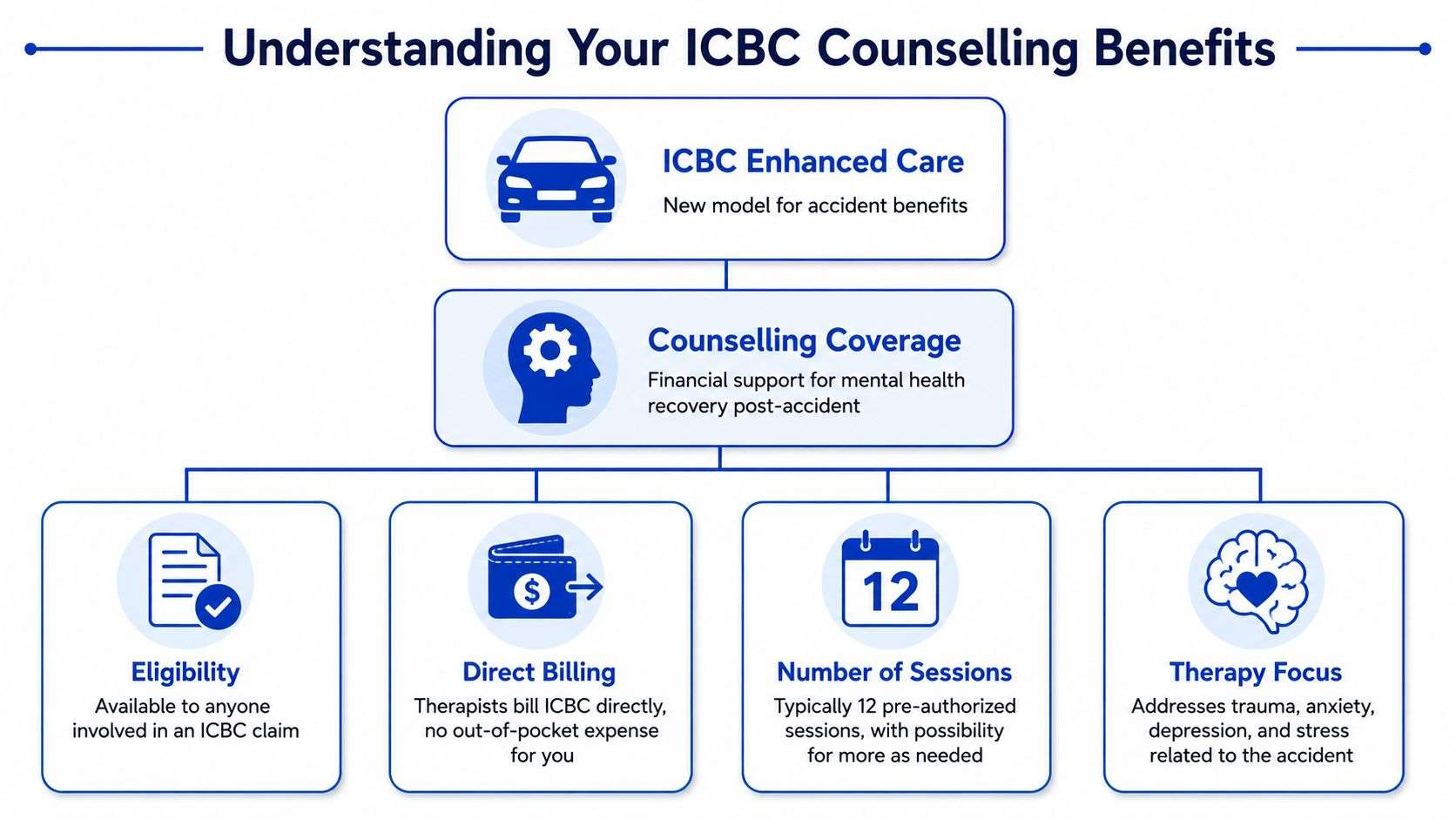
In British Columbia, ICBC's Enhanced Care model has covered crash-related treatment for the first 12 weeks after a collision since May 2021, and ICBC says you don't need a referral from a family physician or nurse practitioner to start pre-approved treatment during that period. ICBC also states that to begin covered care, you need an ICBC claim number and your Personal Health Number. You can review that directly on ICBC's page about accessing treatment during your first 12 weeks of recovery.
The basic idea
ICBC-funded counselling is meant to reduce barriers after a crash. Instead of asking you to line up a referral first and sort out reimbursement later, the system is set up so eligible people can start getting support sooner.
If you've ever tried to manage accident benefits in another context, you may have come across different systems, such as understanding PIP insurance. ICBC works differently, so it helps to focus on the B.C. rules rather than assuming all accident coverage follows the same process.
What you need to qualify for early access
Generally, the key pieces are straightforward:
- An active ICBC claim: You need to report the collision and have a claim number created.
- Your Personal Health Number: Providers typically need this along with your claim details.
- The timing to be right: Early access applies during the first 12 weeks after the collision.
- An approved provider: The counsellor or clinic needs to be able to work within ICBC's framework for covered treatment.
What this benefit does and does not mean
A common misunderstanding arises here. Counselling coverage is real, but it isn't a vague open-ended promise. It sits inside a specific claims framework.
A helpful way to think about it is this:
| What it means | In plain language |
|---|---|
| No referral required at the start | You don't have to wait for a family doctor or nurse practitioner before beginning pre-approved care in the early period. |
| Direct billing may be available | If you work with an eligible provider, the provider can bill ICBC rather than asking you to pay first. |
| The first 12 weeks matter | Timing affects access to early pre-approved treatment. |
| Your claim information matters | Without an active claim number, the process usually can't move forward. |
Practical rule: If you've been in a collision and think counselling might help, start the claim process early, even if you're still unsure whether you'll use every available session.
Why people feel relieved when they learn this
A lot of stress comes from thinking, “I can't handle one more form,” or “I don't have a family doctor, so I guess I can't start.” For many people in Vernon, learning that early counselling access doesn't require that referral changes the picture completely. It turns therapy from “another impossible task” into something you can begin.
How Direct-Billing Works in Vernon
When people hear direct billing, they often wonder if it's too good to be true or if there's a catch hidden in the paperwork. In practical terms, direct billing means an eligible provider submits the covered counselling charges to ICBC instead of asking you to pay upfront and chase reimbursement later.
That's a big deal when you're already stretched thin. After an accident, even small administrative tasks can feel heavy.
The steps from claim to appointment
ICBC says health-care providers in British Columbia can be found through its locator and must meet ICBC requirements to direct bill for pre-approved treatment sessions. That framework helps people access care faster because the main issues are usually whether the provider is eligible and whether the claim is active, not whether the client can prepay. You can see that process on ICBC's page for finding a health-care provider.
Here's what the process often looks like in real life:
You report the collision to ICBC
Once the claim is created, you receive your claim number.You look for a provider who can work within ICBC's system
In Vernon, that usually means checking whether the counsellor or clinic can direct bill under the applicable ICBC framework.You share your claim details
The provider will typically ask for your claim number and Personal Health Number so they can confirm the information needed to get started.The provider verifies eligibility and coverage details
This is one of the most important behind-the-scenes steps. It helps reduce billing surprises and prevents treatment from starting on the wrong assumptions.You book your first session
Once the claim is active and the provider can proceed, counselling can begin.
What you usually don't have to do
People often picture themselves filling out stacks of forms after every appointment. With direct billing, that usually isn't how it works on the client side.
In many cases, you're not expected to:
- Pay first and wait to be repaid
- Track each session for reimbursement
- Get a doctor's note just to begin early access care
- Figure out provider eligibility on your own without asking questions
That said, it's still worth confirming details at the time of booking. Claims systems are never fun, and asking basic questions early can save a lot of stress later.
The most common bottlenecks
Most delays come from one of two places:
- The claim isn't fully active yet
- The provider isn't set up to direct bill within ICBC's requirements
Those are practical issues, not personal failures. If you run into them, it doesn't mean you've done something wrong. It usually means one piece of the process still needs to be confirmed.
If something feels unclear, ask the clinic exactly what they need from you next. Most confusion gets resolved much faster when the next step is concrete.
What to Expect from Your Counselling Sessions
A lot of people arrive at the first appointment carrying one quiet fear. "What if I fall apart and don't know how to explain any of this?"
That fear is common after a collision. Your mind may still be trying to sort out what happened while the rest of life keeps demanding that you function, drive, sleep, work, and answer questions. Counselling gives that stress a place to slow down. The first few sessions usually focus on helping you feel steady enough to talk, not on pushing you to tell every detail before you are ready.

The first session is usually about orientation, not pressure
Early appointments often work like getting your bearings after a storm. Before you can decide what support will help, your therapist needs to understand what has changed since the accident and what feels hardest right now.
You may hear questions such as:
- What has felt different since the collision?
- Are sleep, mood, concentration, or patience harder than usual?
- Do you feel tense as a driver or passenger?
- Are certain roads, intersections, or weather conditions bringing up fear?
- Is pain or physical recovery affecting your emotions day to day?
Short answers are fine. "I'm not sleeping well," "I hate red lights now," or "I don't feel like myself" gives your therapist a real starting point.
You do not need to tell the whole story in perfect order
People often assume therapy begins with a full, detailed retelling of the crash. Sometimes that happens. Often it does not.
A skilled therapist usually listens for the impact, not just the timeline. They want to understand how your nervous system is responding now. That might show up as jumpiness in traffic, anger that surprises you, trouble focusing at work, avoiding errands, feeling numb, or crying more easily than before. The collision may have lasted seconds, but its effects can ripple through the rest of the week.
What often comes up in ICBC counselling
After a car accident, people commonly bring concerns like these into session:
| Common concern | How it may show up |
|---|---|
| Anxiety | Bracing in traffic, scanning for danger, feeling keyed up on the road |
| Sleep disruption | Trouble falling asleep, waking often, restless or tense nights |
| Fear of driving | Avoiding highways, left turns, busy intersections, or riding as a passenger |
| Stress linked to pain | Irritability, discouragement, exhaustion, or feeling worn down by slow recovery |
| Loss of confidence | Doubting your ability to manage normal routines safely and calmly |
Recovery often starts with helping your mind and body stop acting like the accident is still happening.
Counselling usually includes both support and skills
Good trauma-informed counselling is not only about talking. It often includes practical tools you can use between sessions.
Depending on your needs, that may include grounding exercises, ways to settle your body when panic rises, strategies for sleep, help with intrusive memories, or gradual support for returning to driving. If you are also dealing with pain, counselling may help you work with the emotional strain that pain adds to recovery. The goal is not to force progress. The goal is to build enough safety and confidence that progress becomes possible.
A common point of confusion: 12 weeks is not the same as 12 sessions
Many clients hear "12" and assume it means one session per week for 12 weeks. That is where confusion starts.
ICBC early access counselling is tied to a time window after the accident, not a simple promise of exactly 12 weekly appointments in every case. Session timing, frequency, and next steps can depend on your claim, your provider's recommendations, and whether more treatment is approved later. If this feels muddy, you are not missing something obvious. The wording is easy to mix up when you are already stressed.
Ask your counsellor to explain your current approval in plain language. A clear answer should tell you how many sessions are available now, what deadline applies, and what happens if you need ongoing care.
Progress can look small at first, and still be real
Some early changes are easy to miss because they do not look dramatic. You might drive to one familiar store again. You might stop replaying the collision every night. You might notice that your shoulders drop a little when you stop at an intersection.
Those moments count. Recovery after an accident is often less like flipping a switch and more like teaching your body, one repetition at a time, that the road is not automatically dangerous now.
Finding the Right Support at Interactive Counselling
A lot of people reach this stage feeling more uncertain than they expected. The claim is open. The appointments are possible. Yet one question keeps getting stuck in your mind: who am I supposed to talk to?
After a collision, counselling is not only about getting a time slot approved. It is about finding a person and a setting where your nervous system can settle enough to speak openly. If the room feels cold, rushed, or hard to relate to, many clients start holding back without meaning to. That can make therapy feel confusing or flat, even when the counsellor is qualified on paper.
Fit affects how safe the process feels
Good counselling fit is not a luxury item. It shapes whether you feel able to show up fully.
For some people, fit means working with someone who understands trauma responses after a crash, like panic at intersections or a body that stays tense long after the danger has passed. For others, fit also includes cultural awareness, LGBTQ+ inclusive care, disability-informed support, or a therapist who understands how family roles, language, and past experiences with health systems can affect recovery.
That matters because post-accident stress rarely stays in one neat box. A collision can affect sleep, work, relationships, confidence, and your sense of safety all at once. A clinic like Interactive Counselling may be helpful when you want support that can hold the full picture, not only the driving piece.
Questions worth asking before you book
You do not need to guess whether a counsellor is a good match. Asking a few clear questions early can save you stress later.
Consider asking:
- Do you work with trauma after car accidents, including fear of driving or being a passenger?
- What session formats do you offer if pain, fatigue, childcare, or transportation make attendance harder?
- How do you approach counselling when someone feels overwhelmed, emotionally numb, or unsure where to start?
- Can the clinic help match me with someone who is trauma-informed and aligned with my identity, values, or communication needs?
These questions are less about interviewing someone perfectly and more about checking whether the process feels workable. A good match often starts with simple clarity.
What a good fit usually feels like
Sometimes clients expect a dramatic sign. More often, it is quieter than that.
You may notice that the therapist explains things plainly. They do not rush to fix you. They listen without making you defend why the accident affected you so much. The pace feels manageable, like walking on stable ground instead of being pushed uphill.
Practical fit matters too. Appointment times may need to work around medical care, school pickups, shift changes, or days when your pain flares. If those details are treated seriously, counselling becomes easier to continue, and consistency often matters more than intensity at the start.
The right counsellor does not need to share your exact story. They need to understand how to make space for it with skill, respect, and care.
Preparing for Your First Appointment
The first appointment usually goes more smoothly when you gather a few essentials ahead of time. You don't need to prepare a perfect summary of the accident. A simple checklist is enough.
What to have ready
Bring or have access to:
- Your ICBC claim number
- Your Personal Health Number
- Basic accident details such as the date of the collision
- A short list of current concerns like sleep problems, fear of driving, panic, pain-related stress, or trouble concentrating
- Questions you want answered about coverage, session format, or next steps
If your mind goes blank under stress, jot a few notes in your phone before the session. That can help if you tend to forget details once you're in the room.
What to think about beforehand
You don't need to map out your whole treatment plan. It's enough to ask yourself:
- What has changed for me since the accident?
- What feels hardest right now?
- What would I like daily life to feel like again?
Those answers help your therapist understand where to begin. Maybe your goal is to drive without panic. Maybe it's to stop snapping at loved ones. Maybe it's just to sleep better and feel calmer in your own body.
What you don't need to do
You don't need to minimise your symptoms. You don't need to wait until everything falls apart. And you don't need to be “good at therapy” to benefit from it.
Showing up while stressed, uncertain, or emotionally flat is still showing up.
Frequently Asked Questions About ICBC Therapy
Do I need a doctor's referral to start ICBC counselling in Vernon
No. During the early access period, ICBC states that people do not need a referral from a family physician or nurse practitioner to begin pre-approved treatment in B.C. if coverage is in place. What you generally need to get started is an active claim and the necessary identifying information already discussed earlier in this article.
Does direct billing mean I don't pay upfront
With an approved provider working within ICBC's framework, direct billing means the provider bills ICBC for covered counselling sessions rather than asking you to pay first and seek reimbursement afterward. It's still wise to confirm the provider's billing process when booking, but the purpose of direct billing is to remove prepayment as a barrier.
What confuses people about the 12-week rule
Many people hear about pre-approved sessions and assume the main issue is using those sessions quickly enough. The bigger issue is the timeline from the accident date.
According to ICBC's 2025 Annual Report, 28% of counselling claims in the North Okanagan were rejected or delayed due to misunderstandings about this timeline. The key point is that the 12-week window is a rigid statutory deadline for starting pre-approved care, not just a general suggestion.
If you remember one thing, remember this. Count from the date of the collision, not from the date you first feel ready to book.
What if I didn't realise I needed help until later
That happens often. Some people move into survival mode after a crash and only notice the emotional impact weeks later. If you're outside the early window, don't assume support is impossible. It does mean the process may be different, and you may need updated guidance about what documentation or approval is required next.
The important thing is not to give up because the system feels confusing. Ask the provider what applies to your specific situation now.
Can I choose a counsellor who feels like the right fit for me
Yes, fit matters. Many people want someone who understands trauma, identity, family context, or cultural safety concerns. If that matters to you, ask directly before booking. It's a valid part of care, not an extra preference you're supposed to ignore.
If you'd like to learn more about accident-related therapy options, Interactive Counselling provides information about counselling support for trauma, anxiety, family stress, and ICBC-related recovery. If you're feeling overwhelmed, taking one small step to get clear on your options can make the process feel much more manageable.
Clinically Reviewed By
Amy Mosset, MCP, RCC-S
Amy Mosset is a Master Practitioner in Clinical Counselling, Clinical Supervisor, and the owner of Interactive Counselling. She provides trauma-informed, evidence-based care and clinical supervision to registered therapists, with a focus on ethical practice, client safety, and high-quality therapeutic outcomes.