After a car accident, it’s easy to feel lost and overwhelmed. The initial shock can linger, showing up as sleepless nights, anxiety when you drive, or a constant sense of being on edge. These feelings are completely normal, and more importantly, you don’t have to push through them alone. Taking the first step toward feeling better is an act of strength, and support is available to you. For more information, see our Kelowna ICBC counselling.
"To access your Part 7 Accident Benefits for ICBC counselling in Kelowna, you must first report your accident to ICBC to get a claim number, and then you can book an appointment directly with a registered clinical counsellor who will bill ICBC on your behalf for up to 12 pre-approved sessions." For more information, see our counselling in Kelowna.
Your Guide to Post-Accident Recovery in Kelowna
Getting back on your feet after a collision is about more than just healing physical injuries. Your mental and emotional health are just as critical. The good news is that in British Columbia, the system is designed to support your entire recovery, acknowledging that the mind and body heal together. For more information, see our ICBC counselling.
This guide is designed to gently walk you through the process, cutting through the confusion to show you exactly how to access funded psychological support through your ICBC claim. Let’s explore how you can connect with the help you need, so you can focus on healing.
How Your ICBC Benefits Work
Under ICBC's Enhanced Care model, every person injured in a B.C. crash gets access to a wide range of recovery benefits. This is a no-fault system, which is a crucial and reassuring point. It means your access to care is there for you, no matter who was responsible for the accident.
Counselling is recognized as an essential part of this recovery framework.
For anyone recovering in Kelowna, here's what you need to know: you are likely eligible for 12 pre-approved counselling sessions starting from the date of your accident. You don't even need a doctor's referral to get started, which makes accessing support that much easier. You can find more details in ICBC's official Your Guide to Enhanced Accident Benefits.
The first 12 weeks post-accident are a critical window for accessing a range of pre-approved treatments. ICBC has streamlined this process to ensure you can get help for both your physical and psychological injuries right away, without unnecessary delays.
Your Initial 12-Week ICBC Recovery Window
This table breaks down the pre-approved treatments available within the first 12 weeks after your accident, highlighting how counselling fits into your early recovery plan.
| Type of Support | What It Covers | Initial Access Details |
|---|---|---|
| Counselling | Sessions with a registered clinical counsellor to address trauma, anxiety, PTSD, and other psychological impacts. | 12 pre-approved sessions are available without a doctor's referral. |
| Physiotherapy | Treatment for muscle, joint, and mobility issues. | 25 pre-approved sessions are available without a doctor's referral. |
| Chiropractic | Spinal adjustments and care for musculoskeletal injuries. | 25 pre-approved sessions are available without a doctor's referral. |
| Massage Therapy | Treatment for soft tissue injuries and pain management. | 12 pre-approved sessions are available without a doctor's referral. |
| Kinesiology | Active rehabilitation and exercise therapy to restore function. | 12 pre-approved sessions are available without a doctor's referral. |
As you can see, counselling is integrated directly into your recovery plan from day one, giving it the same importance as your physical therapies.
A Whole-Person Approach to Healing
True recovery addresses both the mind and body. While you're working through the emotional impact of the crash in counselling, you might also be dealing with physical limitations.
It’s all part of the same journey back to wellness. Making that first call to a counsellor is a powerful step. It’s an acknowledgment that the invisible injuries from an accident deserve just as much care and attention as the visible ones. With the right support in place, you can start to feel more like yourself again.
Starting Your Claim to Unlock Part 7 Benefits
After a car accident, your first move is often the most critical for getting the support you need. Everything hinges on one thing: your ICBC claim number. This number is the key to accessing your Part 7 benefits, which cover crucial services like counselling for the psychological impact of the crash.
To get that claim number, you must report the accident to ICBC. It's best to do this as soon as you can. While the official window can vary, you should aim to call them within 24 to 48 hours. This initial call gets your file started. From there, you have about 30 days to provide a written statement and 90 days to submit the formal proof of claim.
Understanding the Initial Steps
We know it can feel like a lot of paperwork, but these first steps are simply about getting your claim officially on the books. Once that's done, you can start connecting with healthcare providers without worrying about the cost.
Think of it this way:
- The Phone Call: This is your first report. You'll give them the basic "who, what, where, when" of the accident, and in return, you'll get your claim number.
- The 30-Day Statement: This is where you provide a more detailed written account of what happened.
- The 90-Day CL-22 Form: This is the formal application for your accident benefits. It's the most important form for locking in your coverage.
Your ICBC claim number is what you'll give your counsellor, physiotherapist, or any other practitioner. It's how they get paid directly by ICBC, so you aren't out of pocket for your care.
This infographic breaks down the journey from the moment of the crash to starting your recovery.
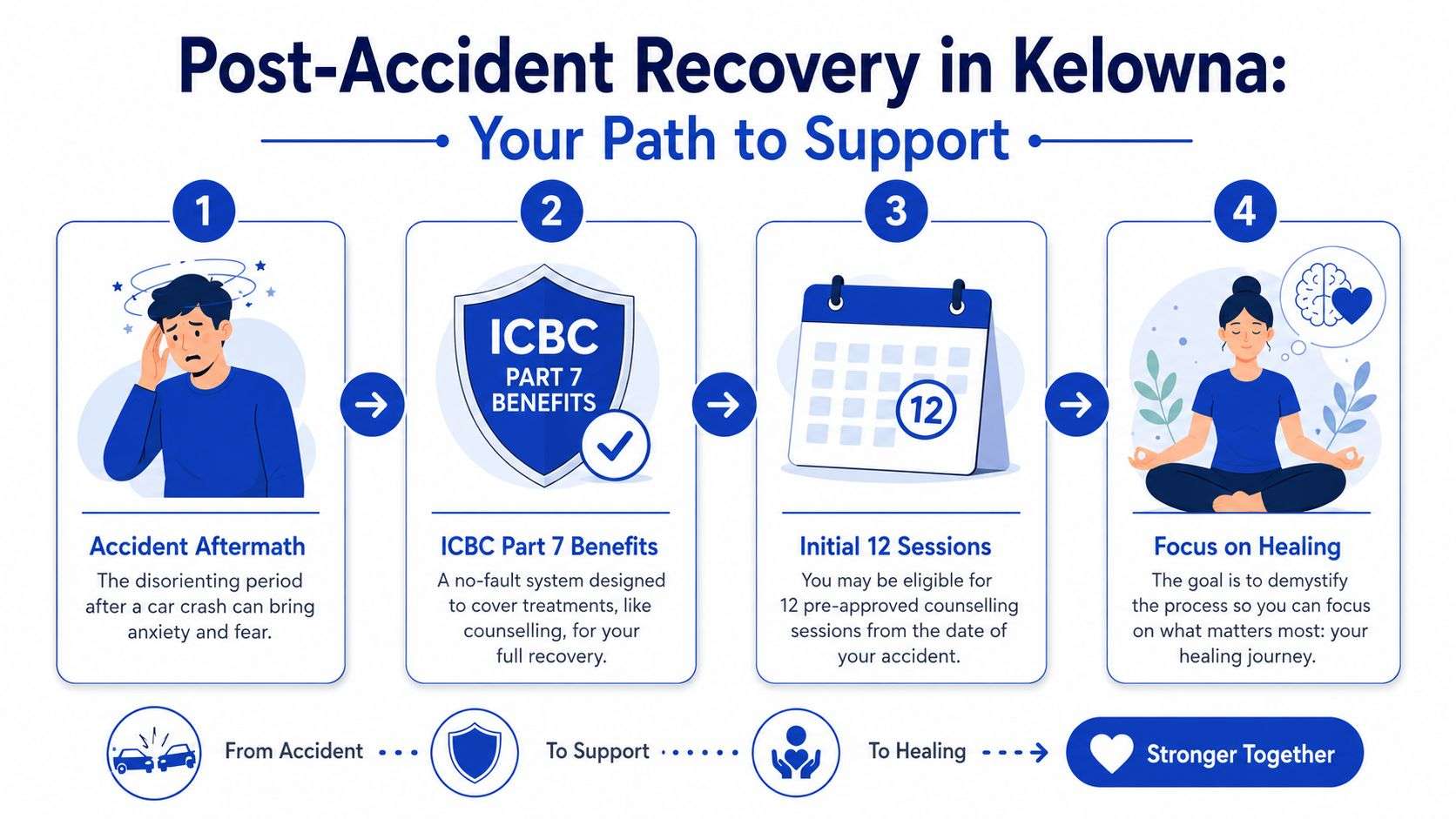
As you can see, the process is designed to get you help as soon as possible. The goal is always to clear the path so you can focus on what truly matters: your healing.
Alright, you have your ICBC claim number in hand. Now comes the most important part: finding the right person to help you navigate the emotional aftermath of the accident. This isn't just about ticking a box; connecting with the right counsellor is a huge part of your healing process.
Your search should start and end with a Registered Clinical Counsellor (RCC). This credential is very important. RCCs are not only highly qualified but also approved to bill ICBC directly, which means you won't have to deal with the hassle of paperwork or reimbursement. They understand the system and can guide you through it.
What to Look for in a Counsellor
Even though you don't need a doctor's note to begin your 12 pre-approved sessions, it's always a good idea to keep your family doctor in the loop about your treatment.
As you start looking for a counsellor in Kelowna, you'll want someone who has specific experience with what you're going through. Look for professionals who specialize in:
- Trauma and PTSD: The psychological impact of a car accident is often underestimated. Look for counsellors who are trained in trauma-informed care and use evidence-based methods like EMDR (Eye Movement Desensitization and Reprocessing) or CBT (Cognitive Behavioural Therapy).
- MVA Recovery: There's a big difference between general counselling and working with someone who truly understands the unique challenges of accident recovery. These specialists understand everything from managing chronic pain to navigating the grief you might feel for your old, pre-accident life.
- Anxiety and Phobias: It's completely normal to feel terrified of getting back in a car. A good counsellor can give you practical tools to manage panic attacks, flashbacks, and that overwhelming fear of driving.
The single most important factor is the connection you feel with your therapist. You're looking for someone who makes you feel safe, truly heard, and understood. This relationship is the foundation for rebuilding your confidence and sense of well-being.
In-Person or Virtual Sessions?
One of the helpful developments in recent years is how flexible therapy has become. You can now choose the setting that works best for your recovery.

You can meet a counsellor for traditional in-person sessions at their office here in Kelowna. Or, you can have secure virtual appointments from the comfort of your own home. Online counselling is an excellent option if your injuries make it hard to travel or if you simply feel more comfortable and safe in your own space.
Most clinics offer both, so don't be afraid to ask. The goal is to make this part of your recovery as stress-free as possible. When you feel ready to see how much counselling can help, finding that right fit is the first step toward feeling like yourself again.
How Booking and Direct Billing Actually Work
The last thing you want to deal with after a car accident is another pile of bills or confusing paperwork. Thankfully, when it comes to accessing psychological care through ICBC, the system is set up to let you focus purely on your recovery.
Once you’ve found a counsellor you feel a connection with, the logistics are surprisingly simple. In most cases, you will not see a bill. ICBC-approved counsellors and clinics use a process called direct billing, meaning they handle all the financial paperwork directly with ICBC on your behalf.
What the Clinic Needs From You
When you call or email to book your first session, the clinic’s administrative staff will just need a few key details to get everything set up. Be ready to provide:
- Your full name and date of birth
- Your ICBC claim number
- The date of your accident
That’s it. From there, the clinic’s team takes over. They confirm your Part 7 coverage, submit invoices for your sessions, and manage all the backend communication with ICBC. Your only job is to show up for your appointments and focus on your well-being.
What If You Need More Than 12 Sessions?
It's a common and important question: what happens after the initial 12 pre-approved sessions are used up? It's helpful to think of these first 12 sessions as a starting point, not a hard stop.
If you and your counsellor feel that ongoing therapy would be beneficial for your recovery, your counsellor can submit a treatment plan to ICBC to request an extension. It's a standard part of the process, and they will handle the request for you, advocating for the care you need.
What to Expect on Your Counselling Journey
Deciding to start therapy after a car accident is a huge step, and it's completely normal to feel a bit unsure about what happens next. You might be wondering what these sessions are actually like. Let's gently pull back the curtain on the counselling process.
Your first few appointments are really about getting comfortable and building a connection with your counsellor. Their main job is to create a safe, confidential space where you can talk openly without any judgment. You’ll have the chance to share your experience—the accident itself, and more importantly, how it's affecting your life now. From there, you'll work together to figure out what you want to achieve.
Common Therapeutic Approaches
So, what do you actually do in therapy? Your counsellor won't just listen; they'll use well-established, evidence-based techniques to help you process the trauma and get back on your feet.
While every therapist has their own style, many who work with MVA survivors use two particularly powerful methods:
- Cognitive Behavioural Therapy (CBT): This is a very practical, goal-oriented approach. It helps you notice and change the unhelpful thought patterns that often show up after an accident. For example, if you find yourself constantly replaying the crash or feeling a surge of panic every time you hear tires squeal, CBT gives you tools to challenge those automatic reactions and regain a sense of control.
- Eye Movement Desensitization and Reprocessing (EMDR): Specifically designed for trauma, EMDR is a unique therapy that helps your brain properly process the accident memory so it's less distressing. It is highly effective at "un-sticking" the traumatic memory so it no longer triggers such an intense physical and emotional response in your daily life.
The goal of therapy isn't to make you forget the accident ever happened. It's about reducing the emotional power of the memory. It helps you put the event in the past where it belongs, so you can feel safe and confident again in your day-to-day life.

Ultimately, ICBC counselling in Kelowna offers you a dedicated time and place to work through difficult emotions. It’s where you can learn real-world coping skills and start the journey back to feeling like yourself, supported every step of the way.
Frequently Asked Questions About ICBC-Funded Counselling
Starting counselling can feel like a big step, especially when you're also navigating the stress of a car accident. It’s natural to have questions about how it all works. We've gathered some common questions to provide clear, reassuring answers about accessing ICBC counselling in Kelowna.
What if the accident was my fault? Can I still get counselling?
Yes, you absolutely can. This is one of the most common worries we hear, and the answer is a huge relief for many people. Under ICBC's Enhanced Care model, your benefits are not tied to who was at fault in the collision. If you're a B.C. resident and were hurt in a crash, you are entitled to counselling and other recovery benefits. The system is specifically designed to get everyone the support they need to heal, so please don't let worry about fault stop you from reaching out.
Do I have to get a doctor's referral first?
No, you don't. You can immediately access your first 12 pre-approved counselling sessions without any referral from a doctor. This is a wonderful feature of the program because it removes a barrier to getting help quickly. You have the freedom to find a registered clinical counsellor who accepts ICBC clients and book an appointment directly. While it's not required, we always recommend keeping your family doctor informed. They are a key part of your overall recovery team, and good communication helps ensure all your care is coordinated.
What happens if I need more than 12 sessions?
The initial 12 sessions are there to provide immediate support, but recovery isn't always on a fixed timeline. For many people, healing is a longer journey, and the system accounts for that. If you and your counsellor feel that more sessions would be beneficial, your counsellor will handle the next steps. They will prepare and submit a new treatment plan to ICBC to request an extension on your behalf. The process is designed to be flexible and support your unique needs for as long as therapy is helping your recovery.
How is my privacy protected with ICBC?
Your privacy and confidentiality are legally protected and are a cornerstone of therapy. Your counsellor will only share the most basic, necessary information with ICBC for billing and session approval purposes, such as confirming your attendance and outlining high-level treatment goals. The personal details of what you discuss in your sessions are strictly confidential between you and your therapist. This is a non-negotiable ethical standard that creates a safe, trusted space where you can do the real work of healing.
Your Path Forward Starts Here
Deciding to seek support after a car accident takes real courage. It’s important to remember that what you’re feeling—whether it’s stress, anxiety, or just not feeling like yourself—is a completely normal response to an incredibly stressful event. Please be gentle with yourself during this time.
The most important thing to remember is that recovery isn't a race. There’s no timeline you have to meet. The entire purpose of ICBC-funded counselling is to give you a dedicated space and professional, evidence-based tools to help you heal on your own terms and at your own pace. The fact that you're reading this shows you're already taking a proactive step toward your own well-being.
Think of therapy as a partnership. A compassionate counsellor meets you exactly where you are right now and works with you to navigate the path back to feeling safe, calm, and in control. You don't have to do this alone. When you feel ready to learn more, professional support is here for you.
Clinically Reviewed By
Amy Mosset, MCP, RCC-S
Amy Mosset is a Master Practitioner in Clinical Counselling, Clinical Supervisor, and the owner of Interactive Counselling. She provides trauma-informed, evidence-based care and clinical supervision to registered therapists, with a focus on ethical practice, client safety, and high-quality therapeutic outcomes.