Kelowna offers several mental health support paths in 2026, including publicly funded care through Interior Health's 36 mental health and substance use centres, local crisis support, community non-profits, and private counselling for individuals, couples, youth, and families. If you're trying to figure out where to start, the most practical first step is to match your situation to the right doorway: urgent crisis support, public intake, youth and family services, community programs, or private therapy. For more information, see our Kelowna youth counselling.
If you're reading this while feeling stressed, stuck, or tired of searching, that makes sense. A lot of people start looking for help late at night, between work tasks, after a hard conversation, or when they finally realise things haven't been okay for a while. For more information, see our counselling in Kelowna.
"Kelowna mental health resources in 2026 include public care through Interior Health, crisis lines, youth and family access points, community-based supports, and private counselling options that each serve different needs." For more information, see our youth counselling.
You Are Not Alone in Seeking Support in Kelowna
It is 10:30 on a Tuesday night. You are sitting in your kitchen, searching for help on your phone after a hard day, and every option seems to lead to three more. One page mentions Interior Health. Another lists private counsellors. A third talks about crisis support. By the time you have a few tabs open, it can feel harder to start than it did five minutes ago.
That feeling is common, and it is not a sign that you are doing this wrong.
Across Canada, many people who need mental health support still do not receive it, according to the Mental Health Commission of Canada's key facts on mental health. This fact helps explain why so many people in Kelowna run into the same barriers. Long waits, uncertainty about where to begin, worries about cost, and the strain of trying to judge what is urgent all show up at once.
In Kelowna, the search can feel even more confusing because help does not come through one single door. It works more like a set of neighbourhood routes. If you live near Rutland, Downtown, Glenmore, Mission, or West Kelowna and are searching from home, the practical question is often not “Is there support in Kelowna?” It is “Which path fits my situation, and what happens after I make that first call?”
That is usually where people get stuck.
Some are trying to sort out whether they need immediate help or a regular counselling appointment. Some are choosing between publicly funded care through Interior Health and private therapy they arrange themselves. Some are looking for a child, a teen, a partner, or an aging parent, which changes the starting point. And some are exhausted and need the shortest path to a real person.
A useful way to understand the system is to picture two main roads. One road is public care, where assessment, referrals, and some ongoing support may be available, often with lower direct cost but less control over timing and provider choice. The other road is private care, where you usually book directly, often get in faster, and pay out of pocket or through extended health benefits. Both roads can lead to good support. They just work differently, and knowing that early can save a lot of frustration.
Why people often feel overwhelmed
The questions below are practical, and they are the right ones to ask:
- Where do I start? Should I contact a crisis line, a public intake service, a family doctor, or a private counsellor?
- How soon do I need help? Do I need support today, or am I looking for an appointment in the next few days or weeks?
- What will this cost? Am I hoping for publicly funded services, lower-cost community support, or private sessions?
- Who is the support for? An adult, a teen, a child, a couple, or a whole family?
Those questions can make the system feel bigger than it is. In practice, you do not need to understand every service in Kelowna before reaching out. You only need one reasonable first step.
What this guide will help clarify
This guide is built to function like a local map you can read when you are tired. It explains how Kelowna's mental health options fit together in everyday terms, including the difference between public and private pathways, where crisis help fits, how support for children and youth is usually accessed, and what kinds of community services may help while you are waiting.
A reassuring rule of thumb: if you are unsure which option is the best fit, start with the one you can contact today and explain what is happening. The first conversation often points you to the next one.
Some people need safety support right away. Some need an assessment and referral. Some need weekly therapy with a counsellor they choose themselves. Some need help close to home and want to understand what is available in their part of Kelowna without spending hours comparing websites.
You do not have to solve the whole system tonight. You just need a clear place to begin.
Understanding Your Main Pathways Public vs Private Care
A lot of confusion starts with one simple phrase: “I need therapy.” In Kelowna, that can point to two different routes. One route goes through the public system, usually Interior Health. The other goes through private counsellors or therapy practices that you contact yourself.
They serve different purposes.
Public care often works like a central hub. It is usually the better starting point if you need an assessment, help sorting out what kind of support fits your situation, access to mental health and substance use services, or care that connects with other public programs. Private care is usually more direct. You choose a therapist, ask about availability, and book if the fit and cost work for you.
For many people, the hardest part is not deciding whether they need help. It is figuring out which door to try first.
The public system in Kelowna
If you live in Kelowna, public mental health support is generally organized through Interior Health. That pathway can make sense if money is tight, if your needs are more complex than weekly counselling, or if you are not sure what kind of support you need yet.
A simple way to understand public care is this: it is designed to assess needs first, then connect people to the right level of service based on urgency, eligibility, and program availability.
That means the public route may help with:
- Assessment and referral
- Community mental health support
- Substance use services
- Follow-up connected to broader public care
- Help figuring out which service fits your situation
If you are in Rutland, Glenmore, Downtown, Mission, or West Kelowna and trying to compare options, the practical question is less about neighbourhood boundaries and more about access style. Public care is usually the route for coordinated services across the region. It is not usually the route people choose because they want a specific therapist or evening appointments every week.
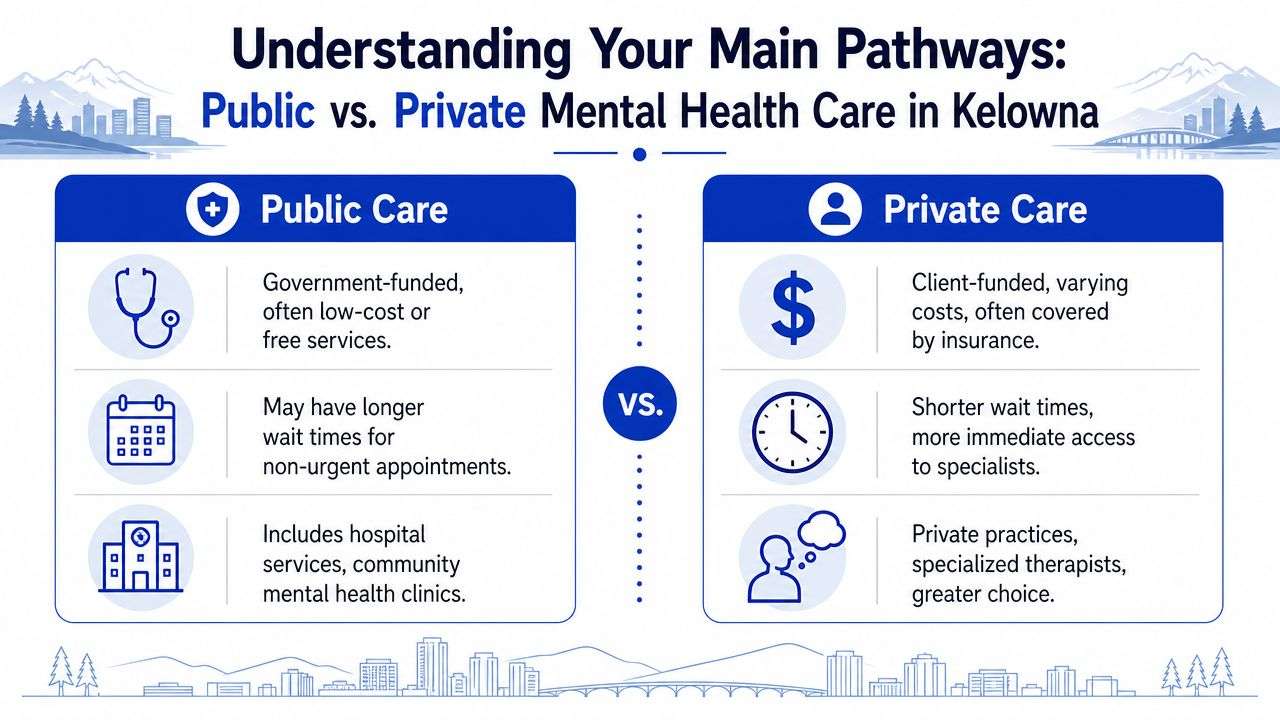
Here is the required comparison visual:
The private pathway
Private counselling usually means you contact a practice directly, read therapist profiles, ask about fees and availability, and book with the person who seems like the best fit. This route gives you more say in who you see and what kind of therapy style you want.
That added choice usually comes with added cost.
In general terms, private sessions are paid by the client, although some people use extended health benefits, workplace coverage, or other reimbursement options. Wait times are often shorter than in the public system, but that depends on the therapist, the day and time you need, and the type of support you are looking for. A therapist with evening space in Lower Mission may fill quickly. A practice near Downtown or Glenmore may have earlier daytime openings.
| Feature | Public System (e.g., Interior Health) | Private Practice Counselling |
|---|---|---|
| Access point | Central intake and referral | Direct booking with a practice |
| Cost to client | Often publicly funded | Client-funded, sometimes supported by benefits or other coverage |
| Wait expectations | May involve waiting for non-urgent care | Often more immediate, depending on therapist availability |
| Choice of provider | More limited by program structure | More choice in therapist style and specialty |
| Best for | Assessment, referrals, coordinated public services | Ongoing talk therapy, relationship work, family support, focused counselling goals |
How to choose between them
You do not need to treat this like a lifelong decision. People often use both routes at different times.
Start with public care if you want help sorting out the system, need access to services beyond counselling alone, or cannot reasonably pay private fees right now. Start with private care if your main goal is ongoing therapy, you want to choose your therapist yourself, or you need a schedule and style of care that feels more suited to your day-to-day life.
A useful local rule of thumb is this: public care is usually the better front door for coordinated support. Private care is usually the clearer path for direct counselling.
If you still feel stuck, ask yourself one question: do I need a system that can assess and refer me, or do I need a therapist I can start with directly? That answer is often enough to choose your first call.
Immediate Help When You Are in Crisis
It is 11:40 p.m. in Kelowna. Someone you love is panicking, talking about hopelessness, or acting in a way that feels unsafe. In that moment, the system can feel confusing fast. The first job is not to figure out the whole mental health system. The first job is to choose the safest next step.
If you or someone else is in immediate danger, call 911 or go to the nearest hospital emergency department. If there is a weapon, a serious injury, loss of consciousness, or an immediate risk that someone may act on suicidal thoughts, use emergency services right away.
If the situation is urgent but you are unsure whether it is a 911 emergency, call a crisis line. In Kelowna, that can be the fastest way to speak to a real person who can help you calm the moment, assess risk, and decide whether home support, emergency care, or another public service is the right next step. As noted earlier, Interior Health connects this region to crisis support and hospital-based pathways after hours, which matters because private therapists usually are not set up to provide immediate crisis response.

When to use which option
- Call 911 if there is immediate risk to life, a suicide attempt in progress, violent behaviour, or you cannot keep yourself or another person safe.
- Go to emergency if urgent in-person medical or psychiatric care is needed, especially if someone is intoxicated, severely disoriented, hearing or seeing things that are putting them at risk, or unable to care for basic safety.
- Call a crisis line if someone needs immediate emotional support, help getting grounded, a safety plan for the next few hours, or clear advice about whether to stay home, go to hospital, or involve emergency services.
A simple way to sort this out is to ask, "Does this person need immediate physical protection or immediate medical care?" If yes, use 911 or emergency. If you need guidance first, use the crisis line.
If you're helping someone else
Keep your voice calm and your sentences short. Stay with the person if it is safe to do so. Ask direct questions such as, "Are you thinking about hurting yourself?" Clear questions do not put the idea in someone's head. They help you understand the level of risk.
Try not to take on the role of counsellor, investigator, and decision-maker all at once. You are there to help with the next safe step.
Stay focused on the next safe action, not the perfect action.
If a child or teen may be at risk because of abuse or neglect, use the provincial reporting pathway listed in the youth services section below.
Finding Support for Children Youth and Families
Family mental health searches often start with uncertainty. A parent notices their child isn't sleeping, a teacher raises concerns, or a teen starts withdrawing and says they're “fine” when they clearly aren't. In those moments, many caregivers worry they're either overreacting or missing something serious.
In Kelowna and West Kelowna, youth support is more structured than it first appears. There are dedicated intake pathways, which means families usually don't need to guess their way into care.

A local example of how intake works
For children, teens, and families in the Kelowna West catchment, BC's provincial directory lists a dedicated youth mental health access point at 15–2484 Main Street, West Kelowna, offering referral and intake, assessments, and therapy/intervention by phone at 1-250-707-2732, as shown in the BC service directory for Kelowna West children, teens, and families.
That's useful because it gives families a concrete first contact. Instead of trying to decide which clinician or program name sounds right, you can start with intake and let the system help sort out the next step.
What families can usually expect
A youth or family pathway often begins with a few basic questions:
- What is happening right now: mood changes, anxiety, school refusal, behaviour changes, grief, trauma, conflict at home
- How urgent it feels: recent escalation, safety concerns, self-harm worries, substance use, or major functioning changes
- Who is involved: child, teen, parent, guardian, school, physician, or another support person
From there, families may be directed toward assessment, therapy, intervention, or another support route.
When the issue involves family stress
Sometimes the concern isn't only about one child. The whole household may be strained. Separation, co-parenting conflict, blended family changes, grief, or repeated communication breakdowns can all show up in a child's behaviour.
In those cases, support that includes parents or caregivers can be especially helpful. Family counselling doesn't mean someone is to blame. It means the family is treated as a system where patterns can change.
Children often communicate distress through behaviour before they can explain it clearly in words.
If you're worried about abuse or neglect, the same BC directory directs people to the child welfare reporting line at 1-800-663-9122. That pathway is separate from local mental health intake because it serves a different purpose. It's there to protect safety first.
Specialized and Low-Cost Community Resources
A lot of people in Kelowna reach a middle stage in the search for help. The problem is real, but the next step is not obvious. You may not need a full private therapy practice right away. You may also not want to wait for every answer before getting some support in place.
That is where community resources help fill the gap.
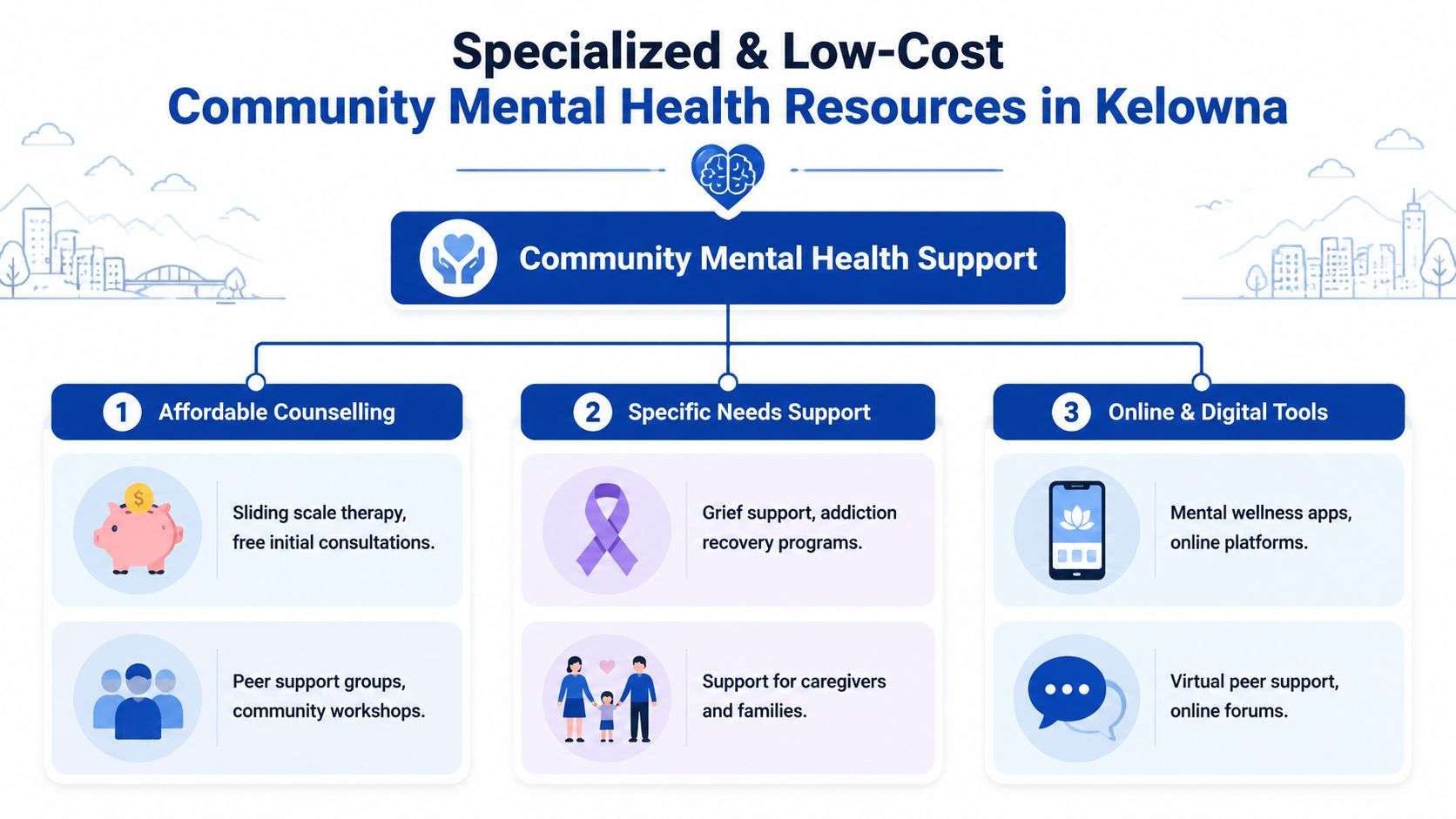
Community-based support that can bridge gaps
If the public system feels slow and private therapy feels expensive, community programs often sit in the middle. They can offer earlier support, lower-cost options, group connection, and practical coping tools while you decide what level of care fits best.
In Kelowna, CMHA Kelowna is one of the places people often look for that kind of support. Programs may include peer support, wellness groups, education, and early-intervention services. These are often useful for people who need structure and human contact, not only formal treatment.
Neighbourhood access matters here. A service that is affordable but hard to reach across town may still feel out of reach. When comparing options, check three simple things first: where it is, whether it is virtual or in person, and how often you can attend.
Community supports can be a good fit for:
- People waiting for public services through Interior Health
- Residents who want a lower-cost starting point before booking private therapy
- People feeling isolated who would benefit from peer connection
- Families trying to add routine and coping strategies at home
Support for specific situations
Some concerns are tied to a specific life event rather than a broad, long-term pattern. A motor vehicle accident is a good example. After an accident, a person might deal with pain-related stress, trouble sleeping, fear of driving, irritability, or a nervous system that stays on high alert.
In that situation, event-specific counselling can make more sense than a general search for therapy. Kelowna residents may also come across Interactive Counselling as one local provider that includes ICBC-funded support for motor vehicle accident recovery. That can be helpful to know if cost is one of the main barriers.
Practical supports at home can matter too. For some children, and for some neurodivergent teens and adults, reducing sensory overload can make daily life more manageable between appointments. Families looking at calming home setups may find sensory tents for autism useful as one example of a lower-stimulation support tool.
What low-cost support can and cannot do
It helps to picture these services as a ramp, not the whole building. They can reduce isolation, add routine, teach coping skills, and make the first step feel less heavy.
They also have limits. Community programs may not provide formal diagnosis, trauma-focused treatment, or the level of ongoing one-to-one care some people need. Public services through Interior Health may involve intake and wait times. Private care may be faster, but usually comes with out-of-pocket cost unless you have coverage or a funding route such as ICBC.
A calmer question is often more useful than asking whether a service will solve everything. Ask, “Does this help me get support now, in a way I can realistically afford and access from my part of Kelowna?”
How to Choose the Right Therapist for You
Once you decide to look for a therapist, the next challenge is usually fit. Not just credentials on paper, but whether you feel understood, respected, and safe enough to do real work.
That matters more than many people expect.
Start with your actual reason for reaching out
You do not need a polished explanation. A simple starting point is enough:
- “I'm anxious all the time and can't switch off.”
- “My relationship feels stuck.”
- “My teen is struggling and we're all walking on eggshells.”
- “I think trauma is affecting me more than I've admitted.”
- “I'm grieving, and it's not getting easier to carry.”
Those plain-language descriptions help narrow the kind of therapist or service you need.
Questions worth asking in a consultation
You're allowed to ask direct questions. In fact, it's wise to.
Some helpful ones include:
- What kinds of concerns do you usually support people with
- How do you approach anxiety, trauma, family conflict, or grief
- What does a first session usually look like
- Do you offer in-person, phone, or virtual sessions
- How collaborative is your style
- How will we know whether therapy is helping
You don't need to ask them all. Pick the ones that matter most.
The right therapist doesn't need to feel perfect. They need to feel workable, respectful, and safe enough for honesty.
Pay attention to fit, not just availability
A therapist can be qualified and still not be the right match for you. That isn't failure. It's information.
Look for signs such as:
| Green flag | What it may feel like |
|---|---|
| You feel heard | The therapist doesn't rush past what matters to you |
| The pace feels manageable | You're not pushed faster than you can handle |
| Their explanations make sense | You leave with more clarity, not more confusion |
| You can imagine coming back | Even if the session was emotional, it felt worthwhile |
If you're unsure after the first session
That's normal. A first appointment is often about orientation and trust-building, not instant relief.
Ask yourself:
- Did I feel respected
- Did they understand why I came
- Did the conversation feel grounded
- Would I be willing to try one or two more sessions
If the answer is no, you're allowed to keep looking. Therapy works best when the relationship feels steady enough to support honest work.
Your Next Steps to Taking Action
When you're overwhelmed, the best next step is usually a small one. Not a ten-step plan. Not a total life overhaul. Just one action that reduces uncertainty.
If you need a practical way forward, use this simple guide.
Choose the path that matches your situation
- If it's a crisis: call 911, go to emergency, or use a crisis line for immediate support.
- If you want public mental health access: contact the local Interior Health entry point and begin with assessment or referral.
- If you're seeking help for a child or teen: use the youth intake route for your catchment area.
- If cost is a major concern: look at community-based supports while you explore other options.
- If you want ongoing counselling with more choice: contact a private counsellor or practice directly.
Keep your first step simple
Write down three things before you call or email:
- What's been hardest lately
- How urgent it feels
- Whether you're looking for support for yourself, your child, your relationship, or your family
That's enough to begin.
You do not need to be “in crisis enough” or “struggling enough” to deserve support. You also don't need to wait until things get worse. Reaching out early is often kinder to yourself and to the people around you.
If this guide has helped you sort out your options, hold onto that clarity. One small action today can turn a vague, overwhelming problem into a real starting point.
Frequently Asked Questions About Kelowna Mental Health Services
Do I need a family doctor to get mental health support in Kelowna
Not always. Some services have their own intake process, and private counselling can usually be booked directly. If you don't have a family doctor, start with the most relevant access point for your situation rather than waiting for the “ideal” referral path.
What is the difference between a public mental health service and a private counsellor
Public services are generally part of a larger health system and may focus on assessment, referral, coordinated care, crisis response, or community mental health support. Private counsellors are usually contacted directly and are often used for ongoing talk therapy, relationship support, trauma work, grief counselling, or family counselling.
What if I'm not sure whether my situation is serious enough
If something is affecting your sleep, work, relationships, parenting, mood, or sense of safety, it's serious enough to talk about. You do not need to prove that you're struggling “enough” before seeking help.
Can virtual counselling still be helpful
For many people, yes. Virtual sessions can make support more accessible when travel, childcare, mobility, work schedules, or anxiety about attending in person make it harder to start. The key question is whether you can speak privately and feel comfortable enough to engage.
How do I know if a therapist is a good fit
Fit usually shows up in the basics. You feel heard. Their approach makes sense to you. The pace feels manageable. You can picture telling the truth in the room, even if that feels hard. If something feels off, you're allowed to keep looking.
If you'd like a calmer next step after reading this guide, Interactive Counselling offers more information about counselling for individuals, couples, children, youth, and families, including in-person, phone, and virtual options. You can explore the site at your own pace and decide what feels right for you.
Clinically Reviewed By
Amy Mosset, MCP, RCC-S
Amy Mosset is a Master Practitioner in Clinical Counselling, Clinical Supervisor, and the owner of Interactive Counselling. She provides trauma-informed, evidence-based care and clinical supervision to registered therapists, with a focus on ethical practice, client safety, and high-quality therapeutic outcomes.