Couples counselling in Vernon can help you break the same painful fight pattern, rebuild trust, and talk about what's really happening underneath the argument. In evidence-based couples therapy, about 70% to 75% of distressed couples move from distress to recovery, roughly 90% show measurable improvement, and meaningful change often starts in the first 8 to 10 sessions. For more information, see our Vernon couples counselling.
Maybe the argument started over dishes, money, parenting, texting back, or who sounded irritated in the car. Then it turned into the same old ending. One of you shut down. The other pushed harder. Both of you walked away feeling alone, misunderstood, and a little less hopeful than before. For more information, see our counselling in Vernon.
In Vernon, couples counselling helps manage conflict by giving partners a confidential place to slow down, understand the negative cycle they keep getting caught in, and practise new ways of responding that protect connection instead of damaging it. For more information, see our couples counselling.
That matters everywhere, but it matters in a smaller city in a particular way. When people think about getting help in Vernon, they're often weighing two problems at once. The relationship strain itself, and the worry about privacy. If you live in a place where your worlds overlap through school, work, sports, church, or community life, asking for support can feel exposed before you've even booked the first session.
Still, being stuck has a cost too. If your conflict has started to affect sleep, parenting, intimacy, or your sense of safety with each other, it's worth taking seriously. Couples counselling isn't only for the brink of separation. It can also be a practical way to understand patterns early, before resentment hardens.
When Every Disagreement Feels Like the Same Old Fight
Most couples don't come in because of one argument. They come in because the argument keeps changing clothes.
One night it looks like a fight about spending. Another night it's about who forgot to text. By the weekend it's about in-laws, sex, parenting, or whose turn it is to carry the mental load. But underneath, the same sequence keeps happening. One partner feels criticised and gets defensive. The other feels ignored and gets louder. Then one of you shuts down, the other feels abandoned, and both leave the conversation convinced the other person just doesn't get it.
That's the part many couples miss. The problem usually isn't just the topic. It's the cycle.
What the cycle often looks like
Here are a few common versions:
Pursue and withdraw
One partner raises concerns quickly and intensely. The other goes quiet, delays, or leaves the room. Both think they're protecting themselves.Criticism and counterattack
One person says, “You never help.” The other hears failure and responds with their own complaint.Numbness and resentment
The fights become less explosive but more distant. You stop talking because every conversation seems to go badly.
“If you can predict how a fight will end before it starts, you're probably dealing with a pattern, not a one-off issue.”
In high-conflict relationships, it can also help to understand how repeated escalation affects decision-making, co-parenting, and separation conversations.
What works, and what usually doesn't
What usually doesn't work is trying to win the argument, prove intent, or force a resolution while both people are flooded and defensive.
What tends to help is:
- Slowing the conversation down enough to notice what triggered the spiral
- Naming the pattern instead of blaming the person
- Getting underneath the reaction to the fear, hurt, loneliness, or disconnection below it
- Practising new responses when the familiar sequence starts
That's why good couples counselling isn't a debate stage or a referee's chair. It's a place to see the pattern clearly and learn how to interrupt it while there's still enough connection left to repair.
The Small City Dilemma of Seeking Support
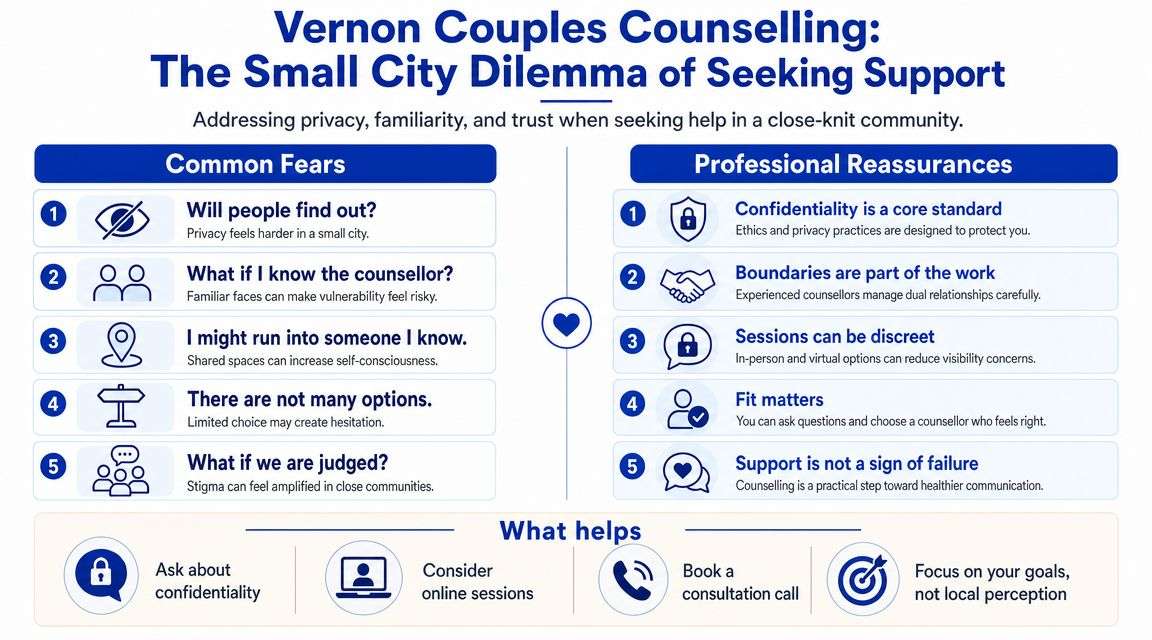
In a smaller community, many couples hesitate for a reason that larger-city articles barely mention. They're not only asking, “Can this relationship improve?” They're also asking, “What if we know the therapist, or the therapist knows someone we know?”
That concern is real. One of the most overlooked realities of vernon couples counselling: navigating conflict in a smaller city is that privacy can feel like part of the problem. In smaller BC communities, anonymity is harder, and couples often want clear answers about how to find a therapist outside their immediate social network and how confidentiality is handled in a smaller place. That concern is reflected in the discussion on small-city privacy concerns in couples counselling.
The privacy worry usually sounds like this
It may not sound dramatic out loud, but it carries weight:
- “What if we run into our therapist at the grocery store?”
- “What if they know our kids' teacher?”
- “What if one of us works with someone in their circle?”
- “What if we don't want anyone knowing we're having trouble?”
Those are not overreactions. They're practical questions.
What ethical counselling looks like in a smaller community
A good therapist won't dismiss these concerns. They'll address them openly.
That often includes talking through:
Boundaries in public
Many therapists won't initiate contact if they see you out in the community, which helps protect your privacy.Confidential intake and record handling
You should be told how your information is collected, stored, and protected.Fit beyond familiarity
If a therapist feels too socially close for comfort, that matters. You don't have to ignore your instincts.Alternate formats
Some couples prefer phone or secure virtual sessions because it reduces exposure and gives them more control over privacy.
Practical rule: If privacy is one of your biggest barriers, raise it in the first contact. You're allowed to ask direct questions about confidentiality, boundaries, and whether the fit feels too close to home.
A smaller city changes the choice, not the value of care
Smaller communities often have an established provider base, but fewer options than a dense urban area. That means fit matters more, and practical things like commute, availability, and comfort with the therapist may shape whether couples start and continue care.
The privacy question shouldn't be brushed aside. It should be part of choosing wisely. For some couples, the right answer is still local in-person therapy. For others, the best answer is working with someone outside their immediate social orbit through phone or secure virtual care.
Communication Tools to Use Before Your First Session
By the time many Vernon couples book a first session, they are already tired of one argument wearing different clothes. A comment about dishes turns into a fight about respect. A late reply turns into a fight about trust. You do not have to fix the whole relationship before counselling starts, but you can make home feel less volatile while you wait.
The goal here is modest and important. Lower the temperature. Protect the conversation from turning into another injury.
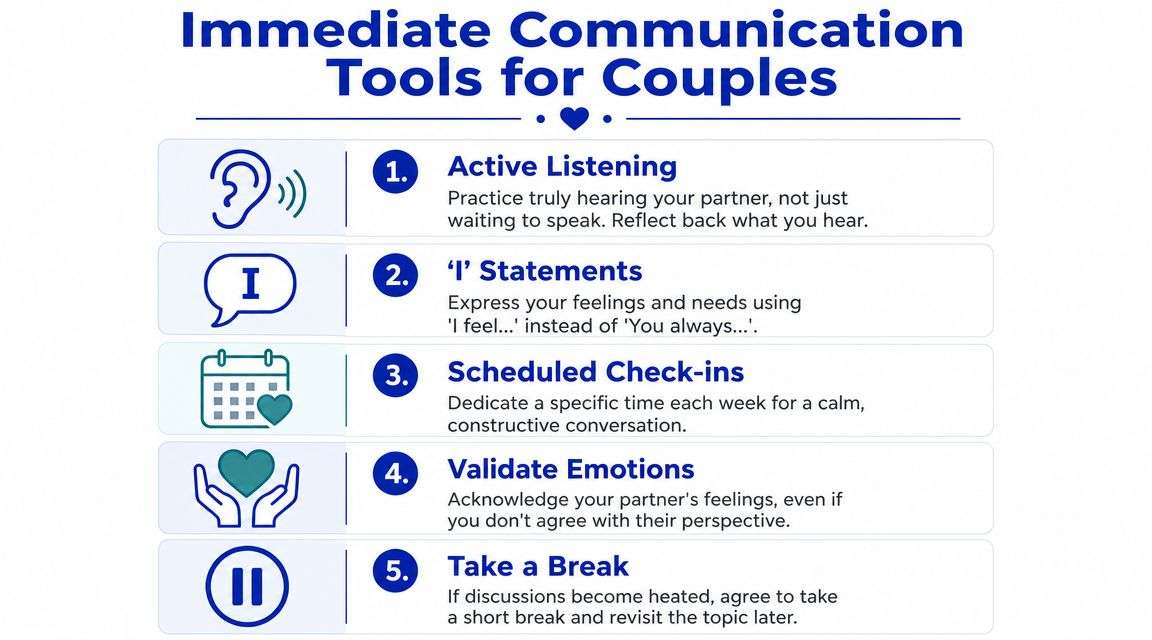
Use a structured time-out
In practice, this is one of the most useful tools couples can start right away. It works best when both people agree that a pause is meant to protect the conversation, not escape it.
A good time-out has three parts. Name the problem early, set a return time, and come back when you said you would.
How to do it
Name what is happening
Say, “I'm too worked up to do this well.”Make your intention clear
Say, “I do want to finish this conversation.”Choose a specific time to return
Pick a time later that day if you can.Use the break to settle your body
Walk, shower, sit outside, stretch, or drink water.Return to the topic
Following through matters. Without that, a break starts to feel like avoidance.
Useful wording often sounds like this:
“I want to keep talking about this, and I need 30 minutes to calm down first. Can we come back at 7:30?”
A few things reliably make it worse:
- Walking out without saying anything
- Slamming doors
- Sending sharp texts from another room
- Using silence to punish
- Agreeing to return, then refusing
Try a speaker-listener structure
This can feel stiff at first. That is fine. Couples who interrupt, defend, or assume meaning usually need more structure, not less.
One person speaks for a minute or two. The other person reflects back what they heard before adding their own view. The listener is not agreeing. The listener is showing they understood.
A simple example:
- Speaker: “When you looked at your phone while I was talking, I felt unimportant.”
- Listener: “You felt brushed off when I looked at my phone.”
- Speaker: “Yes. Then I got sharp because I was hurt.”
- Listener: “So the sharp tone came after you felt hurt.”
Then switch roles.
In a smaller city, this matters for another reason. If privacy concerns have kept you both from talking openly with friends or family, the two of you may be carrying the full weight of the relationship alone. A structured conversation at home can reduce some of that pressure before your first appointment.
Keep the topic narrow
Couples rarely get anywhere when five old fights show up inside one new one. Stay with one moment. One behaviour. One request.
That usually means:
- Describe what happened, not your partner's character
- Lead with your feeling, not your accusation
- Ask for one change, not a personality overhaul
Here is the difference:
| Less helpful | More helpful |
|---|---|
| “You never care about me.” | “When I was talking and you walked away, I felt alone.” |
| “You always do this.” | “This morning's conversation is still bothering me.” |
| “You're impossible to talk to.” | “I want to say this in a way you can actually hear.” |
Specific language gives you something to work with. Global criticism usually starts another round.
Use a weekly check-in
Short, predictable check-ins help couples who keep having hard conversations at the worst possible moment, in the kitchen, in the car, or late at night when both people are done.
Set 20 minutes once a week. Same day. Same time. Phones away.
Use these three questions:
- What felt good between us this week?
- What felt hard?
- What would help me feel more connected this week?
If you live in a place like Vernon, where there is a decent chance you know your neighbours, your kids' teachers, and half the people at the grocery store, privacy worries can make couples delay getting support. This check-in is not a replacement for therapy. It is a practical way to stop every issue from spilling out in public, at family events, or in front of people you both know.
A calmer conversation at home will not solve everything. It does make the first session more useful, because you arrive with clearer examples, less recent damage, and a better sense of where the pattern breaks down.
Choosing Your Path to Support in Vernon
In Vernon, the question often isn't whether counselling could help. It's which format will make it easiest for you to start, keep going, and stay honest.
That matters because couples therapy only helps if you can attend it consistently enough to do the work. A Canadian review of couple counselling found meaningful short- and long-term effects, while also noting attrition as a real challenge. It anticipated about 20% attrition by 3 months and an additional 30% by 12 months in follow-up, and it highlights flexible delivery, including in-person, phone, or secure virtual, as a practical way to reduce dropout linked to travel, scheduling, or privacy concerns in smaller cities, as described in the Canadian review of couple counselling and attrition.
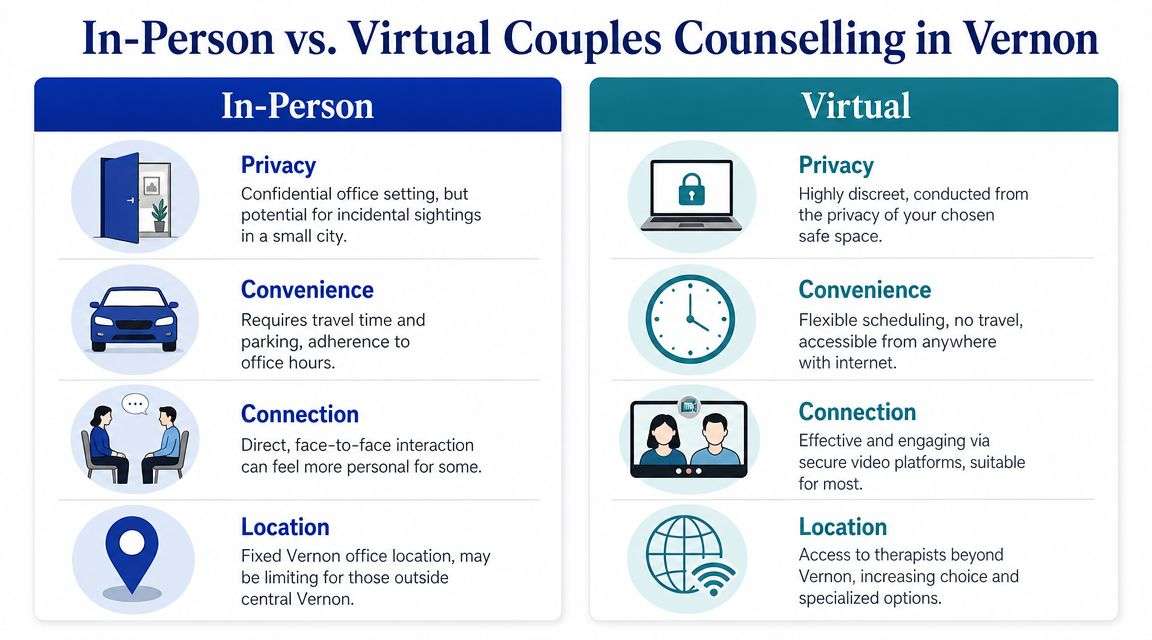
In-person and virtual both have strengths
Here's the practical comparison many couples need.
| Format | Often helpful when | Main trade-off |
|---|---|---|
| In-person | You both focus better in a shared room, want separation from home distractions, or value face-to-face presence | Travel, timing, and potential visibility in a smaller community |
| Secure virtual | Privacy is a top concern, schedules are tight, or you want access beyond your immediate area | Home distractions, screen fatigue, or less comfort with online conversation |
Questions worth asking before you book
Not every good therapist is a good fit for every couple. Ask enough to get a feel for the work.
Consider questions like:
- How do you approach recurring conflict?
- How do you handle it when one partner shuts down and the other escalates?
- Do you offer in-person, phone, or secure virtual sessions?
- How do you manage confidentiality in a smaller community?
- What happens if we're unsure whether we want repair or separation?
What to look for in the answer
You're listening for clarity, steadiness, and structure.
A useful answer usually sounds like someone who can:
- describe an approach plainly
- explain how they keep both partners emotionally safe
- stay neutral without becoming passive
- talk openly about boundaries and confidentiality
- help you sort out whether you need repair work, discernment, or a separation-focused process
Sometimes the right therapist is local and in person. Sometimes the right therapist is not in your immediate community at all. In a smaller city, having options can make the difference between thinking about help and receiving it.
What to Expect from Couples Counselling
The first few sessions usually feel less mysterious once you know what they're for. Good couples counselling is structured, collaborative, and much less about blaming than many people expect.
The therapist is not there to declare a winner. They're there to understand the pattern, the injuries, and the moments where both of you lose your footing.
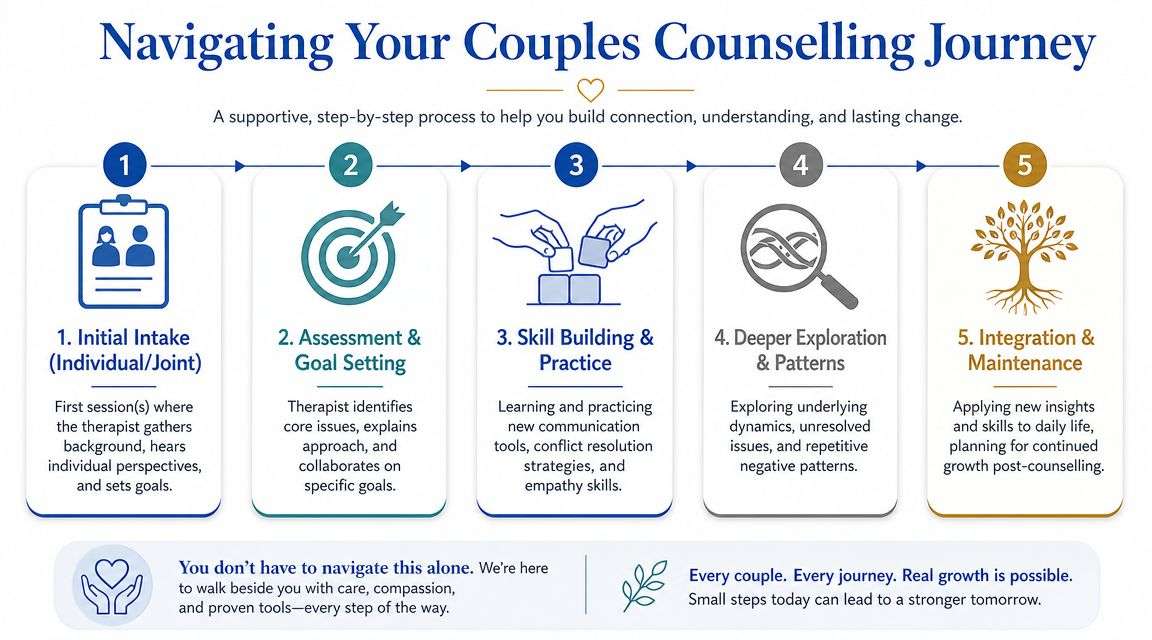
The early sessions are usually about mapping the problem
At the beginning, most therapists will want to know:
- how the relationship has been feeling lately
- what topics trigger the worst conflict
- how each of you reacts under stress
- what repair attempts work, and what falls apart
- what each of you hopes will change
That assessment stage matters because many couples come in describing content when the core work is about process. The therapist listens for the repeated loop. Who pursues. Who withdraws. Where fear, anger, shame, or hurt show up. What each partner reaches for when they feel disconnected.
A strong model looks below the argument
One evidence-based benchmark often discussed in couples work is Emotionally Focused Couples Therapy. A summary of the model reports that about 70% to 75% of distressed couples move from distress to recovery, roughly 90% show measurable improvement, and meaningful change often emerges within the first 8 to 10 sessions in the discussion of Emotionally Focused Therapy outcomes.
That doesn't mean every couple gets the same result. It does mean there is a grounded reason for hope.
What therapy often changes first is not agreement. It's safety. Once partners feel less attacked and less alone, the actual issue becomes easier to address.
What sessions often involve
A typical process may include:
Telling the story
Each partner gets space to explain how things have been feeling.Identifying the negative cycle
This is the repeating dance that traps both of you.Understanding what's underneath
Anger often sits on top of fear, grief, loneliness, shame, or longing.Practising new responses
Slower conversations. Clearer repair. More direct emotional language.Applying it outside the room
The goal is not insight alone. It's a different experience at home.
Frequently Asked Questions About Couples Therapy
What if my partner doesn't want to come?
This comes up often.
A hesitant partner usually hears blame before they hear support. The invitation matters. “We keep having the same fight and I want help changing it” usually lands better than “you need therapy” or “someone has to tell you what you're doing wrong.”
If they still say no, one person can still start. Individual counselling can help you get clearer about your part in the cycle, speak more directly, and decide what you will and will not keep tolerating. In some cases, one partner beginning the work lowers the temperature enough that the other becomes more open later.
How do we know if our problem is serious enough?
If an issue keeps repeating and starts shaping daily life, it deserves attention. That may look like poor sleep, dread before coming home, tension around the kids, emotional distance, or feeling like every practical conversation turns into a fight.
You do not need to wait for a breaking point.
Couples often get more out of therapy when they come in before resentment hardens into contempt. Early help is usually simpler help.
Can therapy help if the fights are really about money, parenting, addiction, or infidelity?
Often, yes. The catch is that these concerns do not all need the same format.
Some couples need repair work. Some need a careful process to decide whether they want to stay together. Others need support around disclosure, boundaries, sobriety, co-parenting, or a respectful separation. This overview of different paths for complex relationship conflict gives a useful starting point, but the right fit depends on the facts of your relationship.
That difference matters in Vernon. In a smaller city, couples sometimes delay getting help because they worry about being seen, judged, or discussed through overlapping social circles. Waiting usually makes the issue heavier. A better approach is to ask direct questions before booking. Do you offer virtual sessions? How do you handle accidental public encounters? What does communication outside session look like? Those questions are practical, not awkward.
Is couples counselling confidential in a small city?
Yes. Confidentiality is a basic part of ethical practice.
In a place like Vernon, privacy concerns are often more specific than they would be in a larger centre. You may know your therapist's neighbour, your child's teacher may know your partner's family, or you may worry about running into someone in a waiting room. Those are real concerns, and a good therapist should be able to explain their privacy practices clearly.
Ask about virtual care, billing labels, email contact, voicemail messages, and what happens if you see each other in public. Many couples feel more settled once they know exactly how those situations are handled.
What if we're not even sure we want to stay together?
Uncertainty is a valid reason to come in. You do not need to arrive fully committed to repair.
Sometimes the first goal is establishing clarity. Can trust be rebuilt? Is there enough goodwill left to work with? Are both people willing to make changes, or is one person already halfway out the door? Getting honest answers to those questions can prevent months of repeating the same painful conversation at home.
If you have been carrying this alone, support can still help you sort out the next step. Interactive Counselling offers couples and individual support for people who are trying to make careful decisions about their relationship.
Clinically Reviewed By
Amy Mosset, MCP, RCC-S
Amy Mosset is a Master Practitioner in Clinical Counselling, Clinical Supervisor, and the owner of Interactive Counselling. She provides trauma-informed, evidence-based care and clinical supervision to registered therapists, with a focus on ethical practice, client safety, and high-quality therapeutic outcomes.