The right type of counselling in Kelowna usually depends on three things: how severe your symptoms feel, whether you want individual, couples, family, or more structured care, and what format fits your life right now. Local access is also flexible, with 61% of Kelowna therapists offering both in-person and online care, and 39% offering online-only care. For more information, see our Kelowna couples counselling.
Maybe you're sitting with several browser tabs open, trying to make sense of terms like CBT, DBT, EFT, trauma therapy, couples counselling, family counselling, virtual sessions, and phone appointments. Maybe your concern seems simple at first, then quickly stops feeling simple. Anxiety mixed with grief. Parenting stress mixed with relationship tension. Trauma mixed with daily functioning. For more information, see our counselling in Kelowna.
"The right counselling for you is the option that matches your concern, your preferred setting, and the level of support you need right now." For more information, see our couples counselling.
That's where many people get stuck. Most guides explain therapy labels, but they don't help much when your life doesn't fit into one clean category. In real life, people often need support that can address overlapping concerns and make room for care over time, especially when choosing the perfect specialty right away feels impossible.
Finding Your Way Through Kelowna's Therapy Options
To determine kelowna therapy: which type of counselling is right for you?, the most useful place to start isn't with jargon. It's with your actual day-to-day experience.
Are you mainly looking for help with panic, low mood, or grief? Are you arguing with your partner and feeling distant at the same time? Are parenting conflicts affecting the whole household? These questions matter more than picking the most impressive-sounding method.
A common problem in Kelowna therapy content is that it lists approaches but doesn't help people decide based on complexity and continuity of care. Many people delay care because they aren't sure where to begin, and the better starting point is often the type of support that can coordinate across issues rather than forcing everything into one narrow label.
A helpful rule: the best therapy isn't always the most specialized therapy first. It's often the therapy that helps you stabilise, build skills, and then decide what deeper work is needed.
That can be a relief to hear.
You don't need to solve your whole treatment plan before booking one session. You only need a sensible first step.
Here's a simple early guide:
| Situation | Often a good starting point | Why |
|---|---|---|
| You feel overwhelmed, anxious, or low on your own | Individual counselling | Gives space to focus on your symptoms and coping |
| The distress shows up mostly in your relationship | Couples counselling | Targets patterns between both people |
| Tension involves parents, children, or the wider household | Family counselling | Looks at the system, not just one person |
| Your needs overlap across several areas | A therapist who can sequence care | Helps you work in stages instead of choosing one label too early |
Many clients feel pressure to "pick the right therapy" as if one choice will define everything. It won't. Therapy works best when it responds to what's happening in your life now, while leaving room to adjust as things become clearer.
Understanding the Main Categories of Therapy
Before comparing therapy methods, it helps to separate two different decisions. One is who should be in the room. The other is how care is delivered.
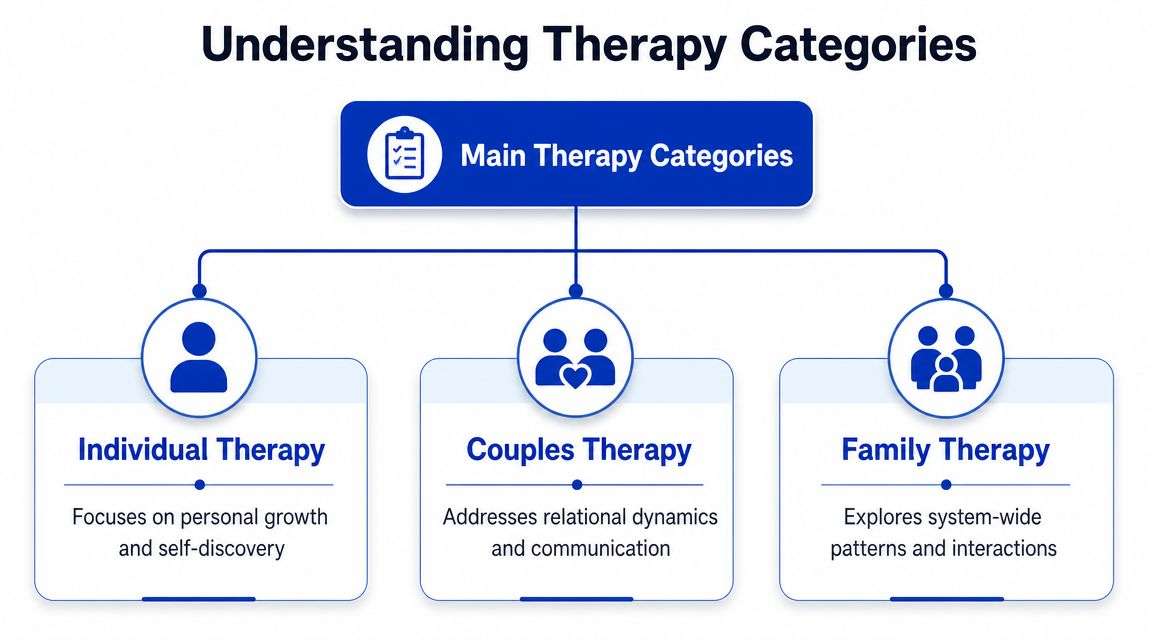
Who is the therapy for
Individual counselling is one person working with one therapist. This is often the clearest fit when your main concern is internal, such as anxiety, depression, grief, self-esteem, or trauma symptoms.
Couples counselling focuses on the relationship itself. Even if one partner feels more distressed, the work looks at patterns between you, such as criticism, shutdown, mistrust, recurring arguments, or feeling emotionally far apart.
Family counselling is useful when the problem lives in the wider system. That may include parenting struggles, conflict between a parent and child, separation-related tension, blended family stress, or a home environment that feels stuck in the same painful cycles.
How care is delivered
In British Columbia, common formats include individual counselling, couples and family counselling, group counselling, intensive outpatient programs, and inpatient programs. Homewood Health notes that the decision depends mainly on severity of symptoms, comfort with communal care, and time available for treatment in its guide on choosing the right counselling format.
That practical lens matters. The right therapy has to fit your life, not just your diagnosis.
For many people in Kelowna, the question sounds more like this:
- Symptom level: Are you dealing with milder but persistent stress, anxiety, or low mood, or do you need more structured support?
- Setting preference: Do you feel safest meeting in person, or do you open up more easily from home by video or phone?
- Time reality: Can you attend during the day, or do you need evening or weekend options to make therapy sustainable?
Some people choose poorly not because they misunderstand therapy, but because they ignore access. A therapy type that fits your schedule is often the therapy you can actually continue.
Intensity matters too
For milder concerns such as stress, anxiety, or depression, individual or couples/family counselling is often appropriate. For more severe symptoms, more structured care can be more beneficial, especially if functioning and safety are significantly affected.
That doesn't mean you need to diagnose yourself. It means you can ask a simpler question: Do I need a private space to work things through, or do I need a more intensive level of support right now?
This is also why delivery format matters. In BC, therapy seekers often compare options like in-person, phone, and secure virtual sessions because convenience changes follow-through. If a format reduces barriers, it can make starting therapy far less daunting.
Comparing Common Counselling Approaches
You might sit with two therapists in Kelowna, describe the same problem, and hear two different recommendations. That can feel confusing at first. In practice, it usually means the therapists are looking at different layers of the same struggle.
One may focus on symptom relief. Another may focus on the relationship patterns, past injuries, or emotional habits feeding those symptoms. Therapy approaches are less like competing brands and more like different maps. The useful question is not, "Which model is best?" It is, "What kind of help do I need right now?"
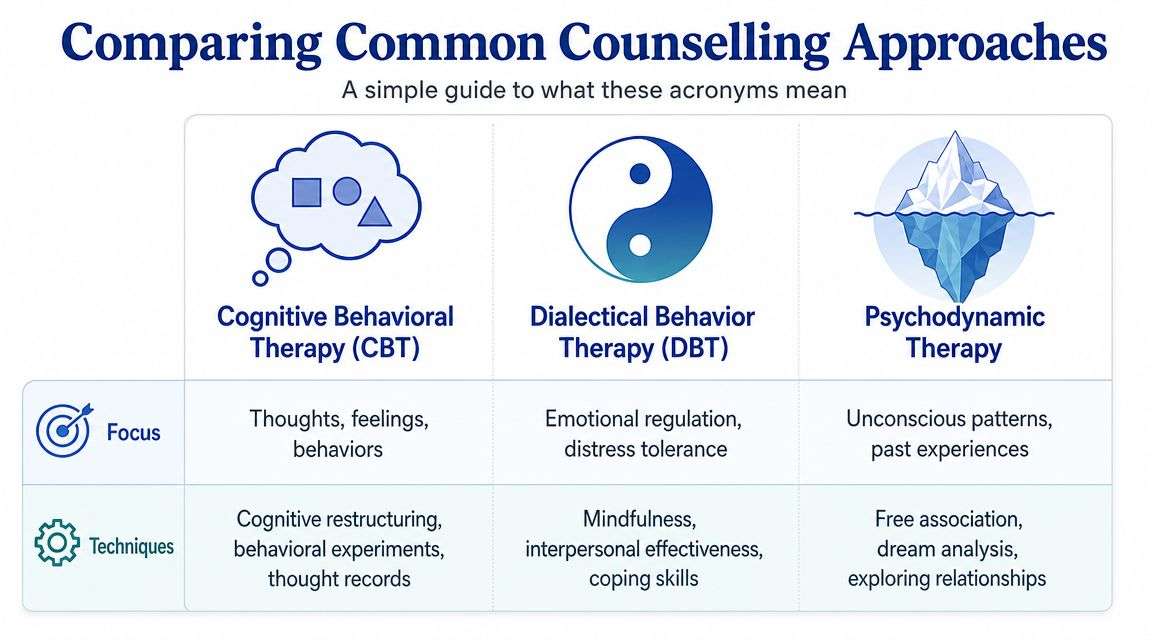
A side by side comparison
| Approach | Main focus | What sessions often feel like | Often suited for |
|---|---|---|---|
| CBT | Current thoughts, feelings, and behaviours | Structured, practical, skills-oriented | Anxiety, depression, stress, phobias, compulsive patterns |
| DBT | Emotion regulation and coping under stress | Skills practice, noticing triggers, tolerating distress | Intense emotions, reactivity, relationship strain linked to dysregulation |
| Psychodynamic therapy | Unconscious patterns and past relationships | Reflective, exploratory, insight-oriented | Longstanding patterns, identity concerns, deeper relational themes |
| EFT for couples | Attachment needs and emotional injuries | Slowing down conflict to reach vulnerable feelings | Emotional disconnection, attachment pain, recurring hurt |
| Couples CBT | Interaction loops and behaviour patterns | Communication-focused, concrete, pattern-changing | Repetitive conflict, criticism, defensiveness |
| Gottman Method | Relationship skills and conflict management | Practical tools and exercises | High-conflict couples, rebuilding daily relational habits |
CBT and psychodynamic therapy
A simple way to compare CBT and psychodynamic therapy is to ask where the work begins.
CBT usually starts with what is happening in your life now. You and the therapist look at patterns you can observe, such as anxious predictions, avoidance, harsh self-talk, shutdown, or routines that keep depression going. Sessions often include specific strategies you can try between appointments.
Psychodynamic therapy usually starts with patterns that have a longer history. You might look at recurring themes in relationships, reactions that feel bigger than the present moment, or old roles you learned to survive earlier experiences. The goal is often insight first, then change that grows out of that understanding.
A home-repair comparison can help. CBT often helps when you need to stop the leak and fix what is actively causing damage. Psychodynamic therapy often helps when you also want to know why this part of the house keeps cracking in the same place.
Neither approach is necessarily more advanced or more serious. They answer different questions.
If you have one main issue and want a focused, practical starting point, CBT may feel reassuring. If several concerns overlap, such as trauma history, self-worth, and repeated relationship pain, a more exploratory approach can make room for that complexity.
EFT, couples CBT, and Gottman
Couples therapy has the same issue with labels. Three therapists may all say they help with conflict, but the work in the room can feel very different.
EFT usually focuses on the emotional bond underneath the argument. A couple may look angry on the surface, while the deeper pattern is fear of rejection, loneliness, or feeling unimportant. The therapist helps slow the conflict enough for those vulnerable feelings to become speakable.
Couples CBT often focuses more directly on the cycle itself. Who criticizes, who withdraws, what assumptions flare up, and what each partner does next. This approach can be especially helpful if the relationship gets stuck in predictable arguments and both people want clearer tools.
Gottman Method work often emphasizes observable relationship habits, such as how partners repair after conflict, express appreciation, discuss ongoing differences, and build trust in daily life. It is practical and skill-based, but still attentive to emotion.
Here is the part that helps many couples choose. If the deepest hurt is, "I don't feel close to you anymore," EFT may be a strong fit. If the daily problem is, "We keep having the same fight and it gets ugly fast," couples CBT or Gottman-based work may feel easier to apply right away. If both are true, a therapist may combine approaches.
That is common in good therapy. Real lives rarely fit into one neat category.
Where does DBT fit
DBT is often misunderstood as a therapy for only one narrow group of people. In everyday counselling, many therapists use DBT-informed skills more broadly.
It is often helpful when emotions rise fast, feel overwhelming, or lead to reactions you regret later. The skills usually focus on four areas: noticing what you feel, getting through distress without making things worse, regulating emotion over time, and handling relationships more effectively.
DBT works a bit like learning steadier footing before climbing a steep trail. If your inner state shifts quickly, insight alone may not be enough at first. You may need concrete ways to slow things down so other therapy work can stick.
That is why modality labels can only tell you so much. One person may need a clear method for a single issue. Another may need support that addresses trauma, mood, communication, and family stress together. The best fit often depends less on the acronym and more on how simple or layered your situation feels.
Matching the Right Therapy to Your Concern
You book a first appointment because of anxiety. Ten minutes in, you realize the anxiety spikes after arguments with your partner, your sleep has been poor since a loss, and old trauma gets stirred up whenever conflict starts. That is a common therapy starting point. The concern that gets you through the door is not always the whole picture.
A useful way to choose therapy is to ask two questions. Is this mainly one clear problem, or several connected problems? And where does the strain show up most, inside you, in a relationship, or across a family?
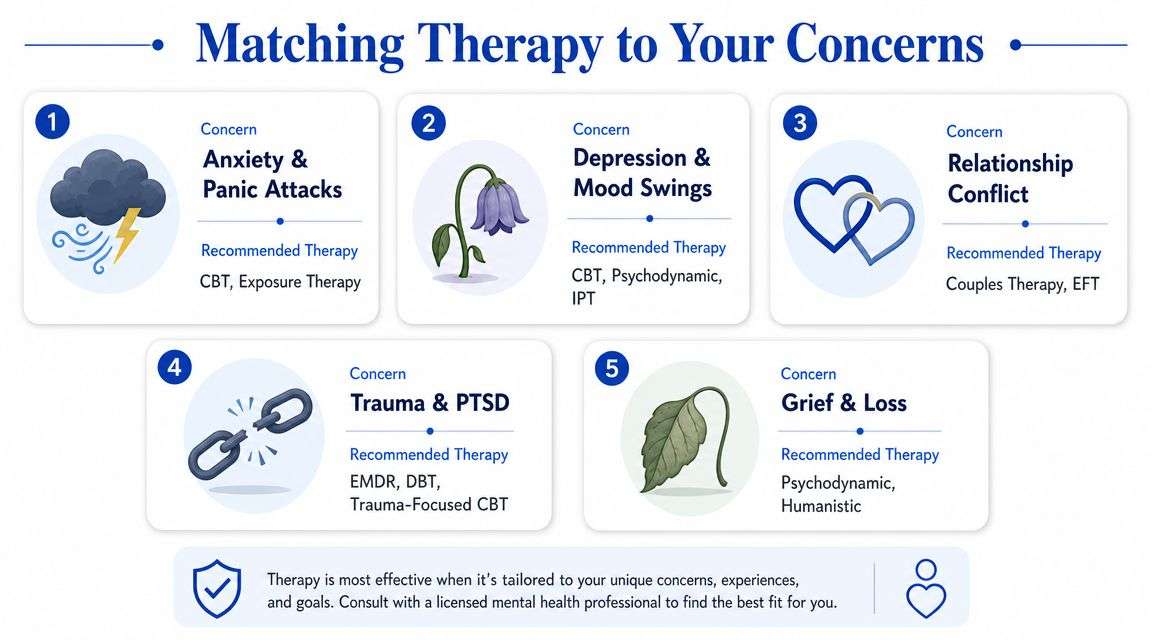
Anxiety and panic
If anxiety is the clearest problem, a structured approach often helps. CBT is commonly used for racing thoughts, avoidance, panic, and the cycle where fear keeps teaching your body that everyday situations are dangerous.
Some anxiety needs more than standard CBT tools. Panic can involve body sensations that feel alarming. Phobias and compulsions often improve when therapy includes gradual exposure. If anxiety is tied to a traumatic event, treatment usually needs a trauma-informed pace so you are not pushed too fast.
A simple way to picture it is this. Anxiety treatment often works like helping an overactive alarm system become more accurate again.
Depression, burnout, and prolonged stress
Low mood is not always one thing. For one person it looks like heaviness and hopelessness. For another it looks like irritability, exhaustion, and feeling checked out from life.
That difference matters.
Some people do well with practical tools that help restore routine, challenge harsh thinking, and rebuild momentum. Others need a therapist who can make room for grief, identity changes, loneliness, or a season of life that has worn them down. If stress has been piling up for months, the goal may be less about fixing a single symptom and more about understanding why your system has stayed overloaded for so long.
Trauma and PTSD
Trauma care usually works best in stages. Early sessions often focus on sleep, grounding, emotional regulation, and creating enough safety that deeper work will not leave you flooded afterward.
Then, if it fits, therapy may shift into more direct trauma processing.
Trauma rarely stays in one corner of life. It can shape trust, parenting, work stress, and how your body reacts to ordinary conflict. If your concern includes trauma plus relationship strain or family tension, the right fit is often a therapist who can sequence the work carefully instead of treating each issue as separate.
Relationship conflict
Couples often ask for help with communication, but communication is only the visible part of the problem. Underneath, one partner may feel dismissed, the other may feel criticized, and both can get stuck protecting themselves instead of reaching each other.
If the pattern is frequent arguments, defensiveness, and repeated gridlock, skills-based work such as couples CBT or Gottman-informed counselling can be helpful. If the pain is more about distance, disconnection, or feeling alone together, EFT may fit better because it focuses on the emotional bond underneath the conflict.
Some couples also like a few structured tools between sessions, such as relationship improvement worksheets, as long as worksheets support the therapy rather than replace it.
Parenting and co-parenting challenges
Parenting problems are often layered. A child may be acting out, but the strain may also involve parental burnout, unresolved conflict between co-parents, or a home that has become tense for everyone.
In that situation, the best match depends on where the pressure sits most heavily:
- Individual therapy if your own anxiety, exhaustion, grief, or trauma history is shaping how you respond
- Couples counselling if parenting disagreements are damaging the partnership or making consistency hard
- Family counselling if conflict is bouncing around the household and everyone is reacting to everyone else
Therapy works best when it addresses the level where the problem lives.
Grief and overlapping concerns
Grief often arrives with companions. Sleep problems, anxiety, numbness, relationship tension, and questions about identity are all common. The same is true for many other concerns. What looks like one issue on paper can be several threads woven together in real life.
If that sounds familiar, you do not need to choose the perfect label before you start. You are looking for a therapist who can recognize what is primary, what is secondary, and what needs attention first. That kind of fit is often more helpful than choosing a therapist based on an acronym alone.
Deciding Between Individual Couples or Family Counselling
Many people assume they should start with the person who feels the worst. Sometimes that's right. Sometimes it misses the underlying source of distress.

Ask where the problem lives
Try these questions slowly:
Mostly inside you
Do you feel anxious, numb, depressed, triggered, or stuck even when you're alone? If yes, individual counselling may be the clearest starting point.Mostly between you and a partner
Does the pain show up in recurring arguments, trust injuries, shutdowns, or parenting disagreements? Couples work may be more effective than trying to fix the relationship one person at a time.Across the household
Is everyone reacting to everyone else? Are there parent-child blowups, blended family strain, or separation-related tension affecting multiple people? Family counselling may address the system more directly.
A few real-life examples
One parent may say, "I need help with my child." But after a few questions, it becomes clear the bigger issue is exhaustion, guilt, and conflict with a co-parent. That situation may call for both individual support and relationship work, but one of those will usually make the better first step.
Another person may book individual counselling for anxiety, then realise most panic episodes happen after conflict at home. In that case, individual therapy can still help, but couples or family work may address a major trigger that individual coping skills alone can't resolve.
The first therapy format you choose doesn't lock you in. It simply gives you the right starting room.
When mixed needs are present
If your concerns overlap, use this decision guide:
| If this feels most true | Start here |
|---|---|
| "I need help functioning better myself" | Individual counselling |
| "We keep getting stuck together" | Couples counselling |
| "Our home feels tense and everyone is affected" | Family counselling |
| "I'm not sure because all of these are true" | Start with the area causing the most daily disruption |
People often worry this means they have to choose only one forever. You don't. Good therapy can shift as the picture becomes clearer.
Your Practical Next Steps for Starting Therapy in Kelowna
You finally sit down to book a therapist, open three browser tabs, and feel more unsure than when you started. One profile mentions CBT. Another says trauma-informed. A third offers couples, family, and individual counselling. At that point, many people do not need more terminology. They need a simple way to choose a good first step.
Start with the problem that is creating the most strain in daily life. Therapy works a bit like seeing the right door first. You do not need to map the whole building before you enter. If one issue is clear and contained, such as panic attacks after driving, focused therapy may fit well. If your stress is tied to several layers at once, such as trauma, burnout, and relationship conflict, choose a therapist who can help sort the pieces with you rather than expecting yourself to arrive with the perfect label.
What to expect in a first session
A first session is usually a structured conversation, not an interrogation and not an emotional performance.
Your therapist will often ask what brought you in, how long it has been affecting you, what feels hardest right now, and what you hope will feel different with support. They may also ask about sleep, relationships, work, health, coping habits, and safety. Those questions are not a test. They help the therapist understand whether your concern is a single thread, a knot of overlapping issues, or something that would benefit from involving a partner or family member later on.
You do not need a polished summary. “I'm overwhelmed and I can't tell what the main problem is” is a very useful place to begin.
If you already know you want a practical, skills-based approach for anxiety, compulsions, trauma symptoms, or fear-based avoidance, it is reasonable to ask whether the therapist works in a structured way and how they would approach those concerns.
Questions to ask yourself before booking
A few honest questions can narrow the options:
What is affecting me most day to day
Focus on impact, not diagnosis. Trouble sleeping, constant arguments, shutdown, grief, irritability, or feeling stuck all give useful clues.Is this mainly about me, about us, or about the household
This question often points you toward individual, couples, or family work more clearly than therapy jargon does.Do I want skill-building, deeper reflection, or a mix of both
Some therapists are very structured. Others work more through insight, patterns, and emotion. Many combine both.What can I realistically attend consistently
The best therapy format is one you can keep showing up for. In-person, virtual, and phone sessions each help different people.
Some people also like a small starting point between booking and the first appointment. If relationship strain is part of the picture, gentle homework such as relationship improvement worksheets can help you organise your thoughts before or alongside counselling.
A note about ICBC-funded counselling
After a motor vehicle accident, people are often dealing with more than one issue at once. There may be anxiety about driving, pain, poor sleep, irritability, or tension at home because everyone is under stress. In that situation, it helps to ask two practical questions early. Is counselling related to the accident covered through ICBC, and does the therapist have experience supporting accident-related concerns?
A therapist or clinic can usually explain their process, what documentation may be needed, and whether your starting point makes sense as individual support or as part of a broader recovery plan.
If you are comparing options for individual, couples, family, child, or youth counselling, Interactive Counselling offers those service categories in Kelowna, which can be useful if you are trying to match the type of support to the complexity of what is going on.
Compassionate Answers to Your Therapy Questions
What if I don't click with my therapist
That happens, and it doesn't mean therapy isn't for you.
Sometimes the therapist is skilled, kind, and ethical, but the fit still isn't right. You may need someone more direct, more gentle, more structured, more relational, or someone whose communication style feels easier to trust. It's okay to notice that.
A good therapist won't expect instant closeness. They will usually welcome honest feedback about pace, style, or what isn't landing.
How long does therapy usually take
It depends on what you're working on and what kind of change you want.
Some people come for focused support around one issue and feel clearer after a shorter stretch of therapy. Others are working through layered concerns, such as trauma plus relationship patterns or grief plus depression, and need longer-term support. Therapy doesn't have to be all or nothing. It can be brief, seasonal, or ongoing.
Is what I'm going through serious enough for counselling
If it's affecting your wellbeing, your relationships, your sleep, your work, or your sense of self, it matters.
You don't need to wait until things become unbearable. Many people benefit most when they come in before a problem reaches crisis level. Counselling isn't reserved for the worst-case scenario. It's also for confusing seasons, painful transitions, and the quiet kind of suffering that others may not see.
If you keep thinking, "Maybe I should talk to someone," that thought is often worth listening to.
Will I have to talk about things I'm not ready to share
No. Therapy should move at a pace that respects your readiness.
You may be invited to talk about difficult things, but you shouldn't be forced or cornered. Especially in trauma-informed work, pacing matters. Safety matters. Trust matters. Sometimes the first meaningful work is helping your nervous system settle enough that talking becomes possible later.
What if I cry, shut down, or don't know what to say
That's more common than you may think.
Some people cry in the first five minutes. Some talk nonstop because silence feels scary. Some go blank. None of that means you're doing therapy wrong. The therapist's job is to meet you there and help create enough steadiness that the session can still be useful.
If you're weighing your options and want a clearer sense of what kind of support fits your situation, Interactive Counselling offers information about counselling for individuals, couples, families, children, and youth, along with virtual, phone, and in-person options. Sometimes the most helpful next step is to learn what type of care matches your life right now.
Clinically Reviewed By
Amy Mosset, MCP, RCC-S
Amy Mosset is a Master Practitioner in Clinical Counselling, Clinical Supervisor, and the owner of Interactive Counselling. She provides trauma-informed, evidence-based care and clinical supervision to registered therapists, with a focus on ethical practice, client safety, and high-quality therapeutic outcomes.