If you work in trades or the oilfield around Grande Prairie and ADHD is making it harder to stay organised, manage fatigue, or keep up with safety-critical tasks, counselling can help in practical ways that fit the job. In Alberta's extraction industries, 160,000+ workers are employed, and with an estimated 5 to 7% ADHD prevalence, roughly 8,000 to 11,000 people could be managing ADHD symptoms while working around complex machinery and safety protocols. For more information, see our Grande Prairie counselling.
Grande Prairie ADHD counselling for adults in trades and oilfield work is specialised support that helps manage symptoms to improve safety, job performance, and well-being in demanding work environments.
"Grande Prairie ADHD counselling for adults in trades and oilfield work helps people manage focus, planning, impulsivity, and stress in ways that support safer work, steadier performance, and better day-to-day functioning."
You might be reading this after another long shift, wondering why simple things seem harder for you than they should. Maybe you can troubleshoot equipment under pressure, but paperwork piles up. Maybe you work hard, care about safety, and still miss steps when the day gets chaotic. Maybe your brain is either flat-out or fully locked in, with very little in between.
That experience can feel isolating. It can also make people blame themselves when the problem is not laziness, immaturity, or a lack of work ethic. For many adults, ADHD shows up most clearly in high-pressure settings where timing, sequencing, memory, and self-control matter every hour.
The Unseen Challenge of ADHD in Trades and Oilfield Work
It is 6:10 a.m. You are already thinking three steps ahead. The crew is waiting, the weather is turning, and a small delay can throw off the whole day. You can solve a mechanical problem fast, read a site in minutes, and keep going when other people are fading. Then a handoff detail slips, a form gets missed, or your temper spikes over something that seems minor. That gap between what you are capable of and what keeps going wrong is often where adult ADHD hides.
In trades and oilfield work, ADHD does not always look loud or obvious. It often shows up in the parts of the job that happen between the big tasks. Tracking steps in order. Holding instructions in mind while interruptions pile up. Estimating time accurately. Switching gears without losing something important. A person can be skilled, committed, and safety-minded, and still struggle with those mental gears.
Grande Prairie adds another layer. Work in this region often involves long shifts, changing job sites, nights, early starts, camp rotations, noise, fatigue, and very little room for error. Those conditions do not create ADHD, but they can expose it the same way rough ground exposes a loose wheel alignment. A problem that seems manageable at home can become much harder to ignore around heavy equipment, live hazards, and strict procedures.
Why this often gets missed
Many adults in the trades have spent years being described in ways that sound personal, not clinical:
- You need to try harder
- You're smart, but inconsistent
- You do great work when you want to
- You just need to get organised
Those messages stick. After enough years, people start to treat a brain-based difficulty like a character flaw.
ADHD often affects executive functioning. That is the set of mental skills used to start tasks, plan steps, manage time, remember details, control reactions, and finish what you started. If attention is the headlamp, executive function is the tool belt. You may have the ability and the knowledge, but it is harder to grab the right mental tool at the right moment.
ADHD in adults often looks less like low attention and more like inconsistent control over attention, timing, memory, and impulse.
That difference matters on a rig, in a shop, or at a job site. In lower-risk settings, a missed detail might mean inconvenience. In high-risk work, the same kind of lapse can affect lockout steps, communication, documentation, driving, or hazard awareness.
Why specialised support matters here
Generic advice often falls flat for people in these jobs. "Use a planner" does not solve much if your schedule changes every week, your workday starts before sunrise, and your brain is trying to keep pace with radios, noise, crew changes, and safety demands. Support has to fit the real conditions of the work.
That means looking at ADHD through an occupational lens. Which symptoms show up during pre-job planning? What happens during shift transitions, equipment checks, permit tasks, or long drives after poor sleep? Where does frustration create risk? Where does hyperfocus help, and where does it backfire?
This is why adult ADHD counselling for trades and oilfield workers needs to be practical. The goal is not to turn you into a different kind of person. The goal is to help you work with your brain in a way that protects safety, improves consistency, and reduces the constant effort it takes to stay on track.
How ADHD Shows Up on the Rig and at the Job Site
It is 6:10 a.m. You are halfway through a pre-start, the radio crackles, someone asks for an update, and your mind jumps three steps ahead. You know the procedure. You have done it many times. But one interruption is enough to break the sequence, and later you are left wondering whether you finished the check or only meant to.
That is how ADHD often shows up in trades and oilfield work. Not as a lack of skill. Not as a lack of effort. It shows up in the gap between knowing what to do and doing it the same way, every time, under pressure.
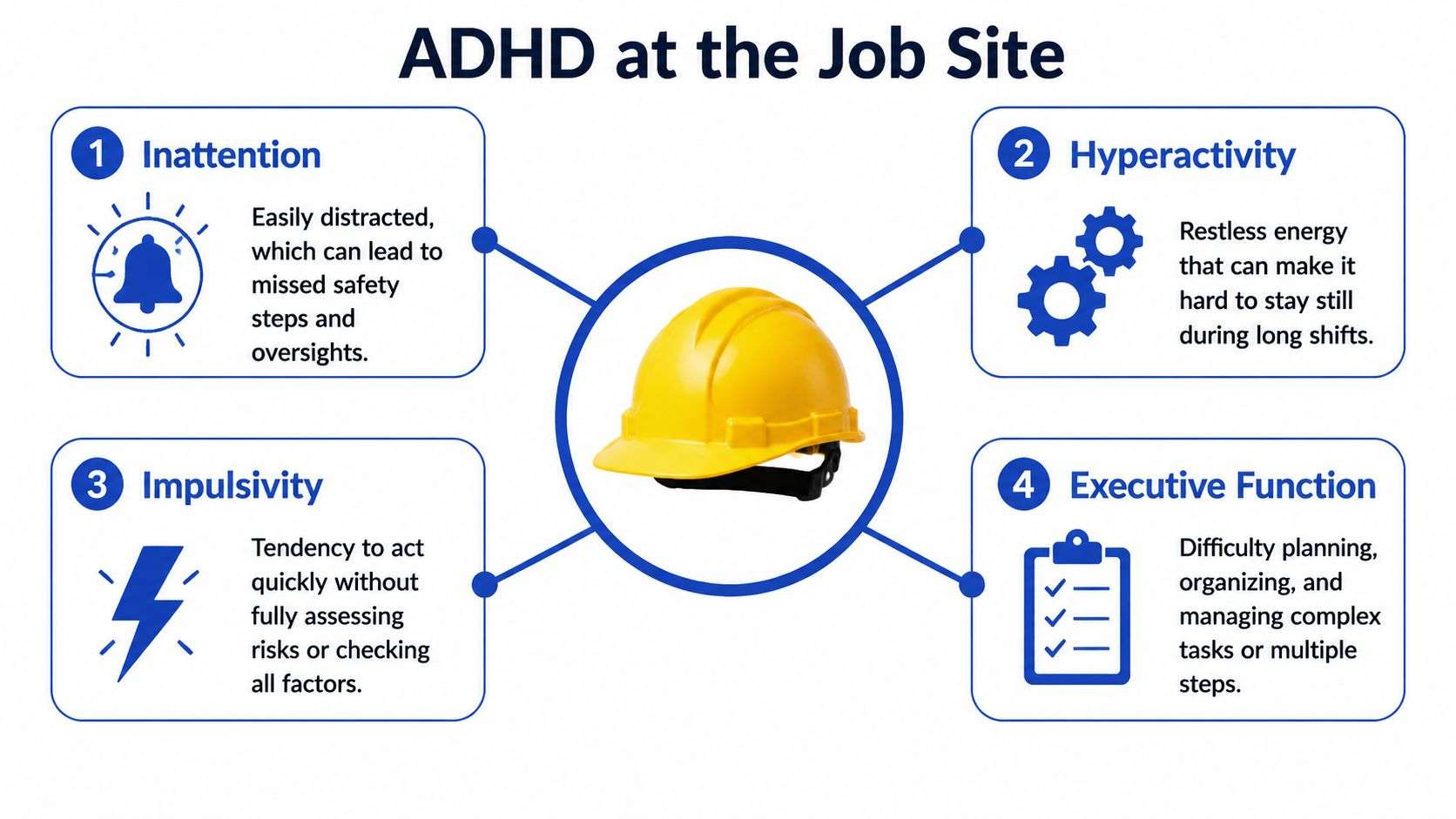
In lower-risk jobs, an attention lapse might lead to a late email or a forgotten appointment. On a rig, in a shop, or on a busy site around Grande Prairie, the same kind of lapse can affect isolation steps, equipment checks, handoffs, driving, permits, or situational awareness. That is why general ADHD advice often misses the mark here. The work setting changes the stakes.
Inattention at work
Inattention does not always look like staring out the window. For many adults, it looks more like attention that locks on hard to one thing and slips off another at the wrong moment.
On the job, that can show up as:
- Missing one step in a familiar process after a radio call, question, or sudden change
- Setting down a tool, tag, or form and having no clear memory of where
- Underestimating time and getting squeezed later in the shift
- Hearing instructions halfway and filling in the rest from habit
- Scanning a hazard assessment without fully taking it in because your brain is already on the next task
That pattern can confuse people around you, and it can confuse you too. You may be excellent in a breakdown, sharp in an emergency, and fully dialed in on difficult mechanical work. Then you miss a simple admin detail or forget a routine item. ADHD often creates uneven attention, not low ability.
Impulsivity under pressure
Impulsivity in adults is often fast action, fast speech, or fast decisions. It can look efficient right up until it creates a problem.
At a rig or job site, that may mean:
- Jumping in before the full plan is clear
- Taking the shorter route because the proper sequence feels slow
- Answering "yes" before checking the spec, measurement, or permit detail
- Cutting someone off in a safety conversation because your brain wants to solve the problem now
- Snapping when corrected after a long shift, poor sleep, or sensory overload
A useful way to understand this is to picture the brain's braking system. In calm moments, the brakes work well enough. Under fatigue, frustration, noise, or time pressure, the brakes can grab later than you want. In high-risk work, a two-second delay in self-checking can matter.
Practical clue: If your first thought after a mistake is, “I knew that. I just went too fast,” impulsivity may be part of the pattern.
Hyperactivity and internal restlessness
Many adults in trades do not see themselves in the word hyperactive. They are not bouncing off the walls. They are often hard workers who can put in long hours. What they notice is internal restlessness.
It can feel like a motor running in the background. During active, hands-on work, that energy may help. During monitoring, waiting, paperwork, meetings, or standby time, it can turn into irritability, distraction, or an urge to move on before the task is finished.
| Work situation | Possible ADHD response |
|---|---|
| Long repetitive monitoring | Attention drifts, body feels agitated |
| Waiting for parts, approvals, or instructions | Frustration climbs quickly |
| Detailed paperwork after physical work | Mental stamina drops fast |
| Quiet meetings or toolbox talks | Focus fades unless actively engaged |
This is one reason some workers describe themselves as "great in the thick of it" and terrible with the slow parts. The issue is not character. The issue is that low-stimulation tasks can feel harder to hold onto, especially after twelve-hour shifts, weather exposure, noise, and poor sleep.
Executive function problems often drive the pattern
Executive function works like the site foreman in the brain. It helps with sequencing, prioritising, shifting tasks, holding details in mind, and finishing what was started.
When that system is under strain, the workday can become harder than it looks from the outside. A capable journeyman, operator, or labourer may still have trouble with:
- Keeping multi-step procedures in order
- Switching tasks without dropping a detail
- Remembering the next step unless it is visible
- Estimating what can realistically fit in a shift
- Closing out paperwork, follow-up, or final checks
- Sorting urgent from important when several demands hit at once
That last point matters on busy sites. ADHD can make everything feel equally urgent in the moment. If a radio call, a crew question, a machine issue, and a half-finished checklist hit at once, the brain may bounce instead of sort. From the outside, it can look scattered. From the inside, it often feels like being flooded with tabs open.
For adults in trades and oilfield work, this is often the missing explanation. They know the job. They care about doing it right. Yet the parts of the day that require consistent sequencing, working memory, and self-interruption control keep breaking down. Naming that pattern clearly is the first step toward making the work safer and more manageable.
Counselling That Works for Hands-On Adults
You finish a long shift, finally sit down, and someone says counselling might help. If you work with tools, equipment, or heavy machinery, that can sound too vague to trust. You are used to solving problems you can see.
Useful ADHD counselling is practical. It helps you spot the points where your day breaks down, understand why they break down, and build systems that hold up when you are tired, rushed, or under pressure.

CBT for adult ADHD
Cognitive Behavioural Therapy, or CBT, focuses on the chain between thoughts, stress, and actions. For adults in trades and oilfield work, that chain often speeds up under fatigue, noise, production pressure, or a mistake that feels bigger than it is.
A common pattern sounds like this:
- “I already messed this up, so the whole shift is shot.”
- “If I cannot do it right, I will put it off.”
- “I always pull it together at the last minute.”
- “If I ask again, they'll think I wasn't listening.”
Those thoughts are not character flaws. They are fast mental habits, and they can push someone toward procrastination, cutting corners, or shutting down after an error. On a high-risk site, that matters because the cost is not only stress. It can affect handoffs, checks, timing, and safety decisions.
CBT helps slow the chain down enough to make a different choice. For a journeyman, operator, driver, or labourer, that might mean learning how to:
- break a job into steps you can see
- reset after a mistake instead of losing the next hour to self-criticism
- catch perfectionism before it turns into delay
- plan around shift work and uneven energy, not around an ideal week
Executive function coaching inside counselling
Counselling for ADHD also works like skills training. If CBT helps with the mental loop, executive function work helps with the workday itself.
That can include:
- Time blocking: giving a task a clear start, finish, and cue to begin
- Visual breakdowns: using a checklist, whiteboard, or phone note instead of keeping steps in your head
- Transition routines: using the same short process for handoffs, interruptions, and end-of-shift wrap-up
- Priority sorting: deciding what is safety-critical, what is time-sensitive, and what can wait
Some adults hear this and think, “I know how to use a checklist.” The issue usually is not knowing. The issue is using the system consistently when the radio is going, the schedule changes, and your brain is already overloaded.
Simple systems often work best for that reason. A complicated method can look smart on paper and fail by Wednesday.
The best ADHD strategies are often boring on purpose. If a system is too clever, you probably will not use it on your tired day.
Therapy that fits the job
Counselling has to respect the reality of Grande Prairie work. Camp schedules, early call times, weather shifts, long drives, rotating crews, and sudden changes all put pressure on attention and follow-through. A generic plan built for a quiet office worker often misses the point.
A counsellor who understands ADHD in trades and oilfield settings will usually focus on questions that matter on site. Where do errors happen most often. During startup. After interruptions. At paperwork time. Near the end of a long shift. Around handoffs. The goal is to find the pattern, then build responses that reduce risk and make performance steadier.
That kind of work can include practicing how to pause before a rushed decision, how to ask for clarification without shame, or how to recover your place after an interruption from a radio call or supervisor. It can also include planning for home life, because poor sleep, conflict, and burnout often make work symptoms worse the next day.
Good counselling does not ask you to become a different kind of person. It helps you use your strengths, such as fast problem-solving, persistence, and hands-on thinking, while putting guardrails around the parts of ADHD that can create safety problems under pressure.
Practical Strategies for Managing ADHD in High-Risk Environments
You don't have to wait until everything is sorted out to make work safer and steadier. Small changes can reduce mistakes, lower stress, and make the day more manageable.

Use external systems, not memory
If you have ADHD, memory often feels reliable until it suddenly isn't. That's why external supports matter.
Try:
- One capture tool only: use one notebook, one notes app, or one small clipboard. Not five places.
- Photo reminders: take a quick photo of whiteboards, staged materials, or setup order when allowed and appropriate.
- End-of-task reset: before leaving an area, do the same short check every time. Tools, paperwork, next-step note.
- Visible sequencing: list steps where you can see them, not just where you think you'll remember them.
A common mistake is building a perfect system on a good day. Build the system for your tired day.
Protect task transitions
Many errors happen during the switch between one thing and the next. That's true for handoffs, interruptions, and multitasking.
A useful reset can be as simple as this:
- Stop moving
- Name the task
- Check the next step
- Confirm the risk point
- Then restart
That takes seconds. It can prevent a lot.
Reduce fatigue-related mistakes
Long shifts and changing schedules can amplify ADHD symptoms. You may notice more irritability, slower processing, and more missed details when sleep is off.
Helpful habits include:
- Pre-shift prep: lay out what you need the night before, including food, gear, keys, and any paperwork
- Same-order mornings: keep wake-up tasks in one fixed sequence
- Micro-breaks when possible: even a brief pause to breathe and reset attention can help
- Low-friction sleep setup: blackout curtains, phone out of reach, and a consistent wind-down routine when possible
This won't make shift work easy. It can make it less chaotic.
Make communication more direct
ADHD can create misunderstandings when your brain assumes, rushes, or forgets part of the message. Clear communication reduces that risk.
You can use short scripts like:
- “Can you give me that in order?”
- “I want to make sure I've got this right.”
- “My next step is X, then Y. Correct?”
- “I need a quick reset. I'll come back to that in a minute.”
These aren't signs of weakness. They're safety tools.
If you work in a fast environment, asking for clarity is often more professional than pretending you caught everything.
Organise for speed, not for looks
A lot of advice about organisation is too tidy to be useful. What matters is whether the system helps you move reliably.
Consider:
| Problem | Better approach |
|---|---|
| Constantly losing essentials | Keep keys, badge, wallet, and phone in one fixed spot |
| Forgetting next actions | Leave yourself a written “restart note” before breaks |
| Tool clutter | Group by task, not by category alone |
| Admin avoidance | Pair paperwork with a fixed cue, such as right after coffee or right after gear drop |
The goal isn't to become a different personality. The goal is to reduce preventable friction.
What to Expect from ADHD Counselling and How to Find the Right Fit
Starting counselling can feel awkward if you've never done it, or if past help didn't fit. Many adults worry they'll be judged, over-analysed, or told obvious things they've already tried.
A better experience usually feels collaborative. You bring the actual life problems. The counsellor helps you sort patterns, build tools, and test changes.

What a first session often includes
The first few conversations usually focus on things like:
- what's happening at work
- where symptoms hit hardest
- how sleep, stress, and mood affect functioning
- whether there are patterns around anger, shame, avoidance, or burnout
- what “better” would look like for you
You don't need to show up with the right words. “I keep dropping balls and I'm tired of it” is enough to start.
Questions worth asking a counsellor
Not every counsellor works the same way. Fit matters.
You can ask:
- Have you worked with adults who have ADHD?
- Do you understand shift work or high-risk job environments?
- How do you help with workplace issues like focus, organisation, and overwhelm?
- Do you use practical tools, not just discussion?
- Can you support someone who's also dealing with stress, anger, anxiety, or burnout?
These are fair questions. You're not being difficult. You're checking fit the same way you would with any skilled service.
When work injuries and mental health overlap
Some adults seek support after a safety incident, prolonged stress, or a workplace mental health issue. In those cases, it can help to understand how documentation and claims may work more broadly. This overview of mental health claims after psychiatric injuries can give useful general context.
That doesn't replace legal or clinical advice for your own situation. It helps you understand that work-related psychological strain is real, and worth taking seriously.
You don't need to wait until things fall apart to get support. Counselling is often most useful when you're still functioning, but paying too high a price to keep functioning.
Accessing ADHD Support in Grande Prairie
A lot of adults in Grande Prairie reach the same point. They can handle a breakdown in the field, a schedule change, or a long stretch of high pressure work, but booking help for their own brain feels harder than troubleshooting a machine in the dark.
Part of that is access. Part of it is timing. Trades and oilfield schedules do not leave much room for weekly appointments at the same hour every Tuesday, and ADHD often makes the admin side of getting help feel heavier than it should.
In a regional community, support can also look different than it does in a larger city. You may need to choose between local in-person care, virtual sessions, or a mix of both. For rural Albertans, that kind of flexibility can make mental health care easier to continue over time, especially when travel, rotation work, or distance get in the way, as discussed in this overview from the Alberta College of Social Workers on rural and remote practice.
For adults in trades and oilfield work, the best option is often the one you can sustain during real life. A good counselling setup should fit around camp rotations, shutdowns, early starts, parenting, and the recovery time that follows long, high-risk shifts.
What helps people stay engaged
Useful support usually includes a few practical features:
- Appointment times that work with changing shifts
- Phone or secure virtual sessions when getting into town is hard
- A direct, respectful counselling style
- Help with overlapping issues like anxiety, anger, burnout, trauma, or chronic stress
- An understanding of how ADHD can affect safety, paperwork, communication, and follow-through on the job
That last point matters in this region. ADHD support for a desk job and ADHD support for a worker around heavy equipment, driving, confined spaces, or live safety procedures are not the same conversation. The risks are different, so the coping strategies need to be different too.
If you are still unsure
You do not need certainty before you reach out.
A lot of adults start because they are missing steps, feeling overloaded, forgetting simple things when tired, getting reactive under pressure, or bringing work stress home every night. Those patterns deserve attention whether or not you already have a diagnosis.
A more useful question is simple. Are these patterns affecting your safety, your work, your relationships, or your energy enough that support would make life more manageable? If the answer is yes, that is a strong enough reason to look for help.
Frequently Asked Questions About ADHD and Work
Can I have ADHD if I'm good at my job sometimes?
Yes. ADHD is often inconsistent. Many adults perform very well in urgent, hands-on, or high-interest situations and then struggle with planning, paperwork, follow-through, or repetitive tasks. That inconsistency is part of why ADHD gets missed.
Do I need a formal diagnosis before starting counselling?
No. Counselling can still help if you're dealing with attention problems, disorganisation, emotional reactivity, or workplace stress. If assessment would be useful, a counsellor can often help you think through that next step.
Is it normal for ADHD to affect my temper at work?
It can. ADHD doesn't just affect focus. It can also affect frustration tolerance, impulse control, and recovery after stress. That might show up as snapping, shutting down, or feeling flooded faster than other people seem to.
What if I'm worried counselling won't be practical enough?
That concern makes sense. Ask directly about approach. A good fit for grande prairie adhd counselling for adults in trades and oilfield work should include real strategies for routines, task breakdown, communication, and managing high-pressure environments.
Can virtual counselling still work if I'm on rotation or at a remote site?
For many people, yes. Flexible phone or secure virtual sessions can make it much easier to keep momentum when your schedule changes or travel is difficult. Consistency matters more than a perfect setup.
If this article felt familiar, you don't have to keep carrying it alone. Interactive Counselling offers evidence-informed, practical support for adults who want help making work, stress, and everyday life feel more manageable.
Clinically Reviewed By
Amy Mosset, MCP, RCC-S
Amy Mosset is a Master Practitioner in Clinical Counselling, Clinical Supervisor, and the owner of Interactive Counselling. She provides trauma-informed, evidence-based care and clinical supervision to registered therapists, with a focus on ethical practice, client safety, and high-quality therapeutic outcomes.