
ADHD time blindness is a real neurological difficulty with sensing, estimating, and managing time, not a character flaw. In one Canadian finding, 68% of adults with ADHD showed time blindness in time estimation tasks, compared with 12% of controls, and a Statistics Canada analysis found 42% of adults with ADHD reported chronic difficulties with time management, linked with 2.5 times higher rates of unemployment or underemployment.
You meant to leave on time. You started getting ready early. You even felt anxious about being late. And somehow, you still looked up, realised the clock had moved faster than your brain expected, and the whole morning fell apart.
For many people with ADHD, this pattern is painfully familiar. It can look like procrastination from the outside. It can feel like failure on the inside. Partners may think, “If this mattered, you'd be on time.” Parents may say, “You just need to try harder.” The person with ADHD often ends up carrying the heaviest message of all: “Maybe I'm just lazy.”
ADHD time blindness is not laziness. It is a brain-based difficulty with perceiving, estimating, and organising time.
That Feeling of Always Being Behind
A lot of people first notice time blindness through ordinary moments that become loaded with shame.
You say you'll leave in ten minutes, then get pulled into answering one email. You believe a shower, breakfast, and packing a bag will take half an hour. You sit down to pay one bill and somehow lose a whole evening. None of this happens because you don't care. It happens while caring a lot.

That is part of what makes ADHD and time blindness so confusing. The effort is real. The intention is real. These challenges result in significant and tangible outcomes.
Why this hurts so much
When someone repeatedly misses deadlines, arrives late, or underestimates how long things will take, other people often read it as disrespect, avoidance, or immaturity. Over time, those reactions can damage self-trust.
Many adults with ADHD start to expect that they'll disappoint people. They may over-apologise, overpromise, or stop trying to explain themselves because they're tired of sounding like they're making excuses.
“I was trying” and “I got it wrong” can both be true at the same time.
This isn't a rare issue. A Statistics Canada analysis discussed in this review of ADHD time blindness found that 42% of adults with ADHD reported chronic difficulties with time management, and those difficulties were linked with 2.5 times higher rates of unemployment or underemployment.
What families often miss
From the outside, time can look obvious. You can see the clock. You can count backward from the appointment. You can estimate how long lunch takes.
But for a person with time blindness, time often doesn't feel steady or visible in that way. It can feel abstract until the deadline is right in front of them. There may be a vague sense that “there's still time,” right up until there suddenly isn't.
If this is your experience, you're not broken. If you love someone with ADHD, they probably aren't ignoring what matters. They may be struggling with a core trait that deserves understanding, structure, and support.
Understanding ADHD Time Blindness
Time blindness means having trouble sensing the passage of time, estimating how long things will take, planning around future time, and shifting between tasks before time runs out.
Some people describe it as living with only two time zones: now and not now. If something isn't immediate, it may not feel emotionally real yet. That's why a deadline next week can feel strangely distant, even when you logically know it matters.
What it can look like in daily life
Time blindness can show up in ways that seem inconsistent:
- Underestimating tasks: You think folding laundry will take five minutes, then it takes much longer.
- Losing track during absorbing tasks: You check one message, start researching something interesting, and miss bedtime.
- Difficulty starting early: A future event matters, but your brain doesn't generate urgency until the last minute.
- Trouble with transitions: Stopping one task and starting another can feel abrupt and disorganising.
- Waiting mode: You have an appointment later, so you feel unable to begin anything else first.
A University of British Columbia finding summarised here reported that 68% of adults with ADHD exhibited time blindness, defined as more than 30% deviation in time estimation tasks, compared with 12% in the control group. That matters because it tells us this isn't just a bad habit. It's a measurable difference.
Time Blindness vs. Laziness A Clear Distinction
| Aspect | Time Blindness (Neurological) | Laziness (Behavioural) |
|---|---|---|
| Motivation | Often wants to do the task and may feel distressed about not doing it | Usually involves low willingness to exert effort |
| Internal experience | Confusion, urgency spikes, poor sense of elapsed time, frustration | Relative indifference or deliberate avoidance |
| Planning | Struggles to estimate time and sequence steps accurately | May understand the timeline but choose not to act |
| Emotional impact | Shame, panic, guilt, self-blame | Not necessarily associated with distress about timing |
| Pattern | Inconsistent and affected by interest, transitions, deadlines, and structure | More stable choice pattern across situations |
| Best response | External supports, coaching, therapy, routines, accommodations | Accountability and behaviour change strategies |
Why the confusion happens
The outside view and inside experience don't match.
A partner sees lateness. The person with ADHD remembers rushing, trying, and believing there was enough time. A parent sees a child stalling on homework. The child may be overwhelmed by not knowing how long it will take or where to begin.
That mismatch often creates conflict. One person sees behaviour. The other person is living a processing difference.
Key distinction: Laziness is about not wanting to use effort. Time blindness is about not reliably sensing and organising time, even when effort is present.
When people finally hear that distinction, many feel relief. Not because it removes responsibility, but because it replaces blame with accuracy. Accurate understanding is what makes helpful change possible.
The Brain Science Behind Time Perception
When therapists and clinicians say time blindness is neurological, they mean the brain systems involved in planning, attention, and timing work differently in ADHD.
You don't need to memorise brain anatomy to understand this. It helps to picture three parts of the system: the prefrontal cortex, dopamine regulation, and the brain's internal timing network, which includes the cerebellum.
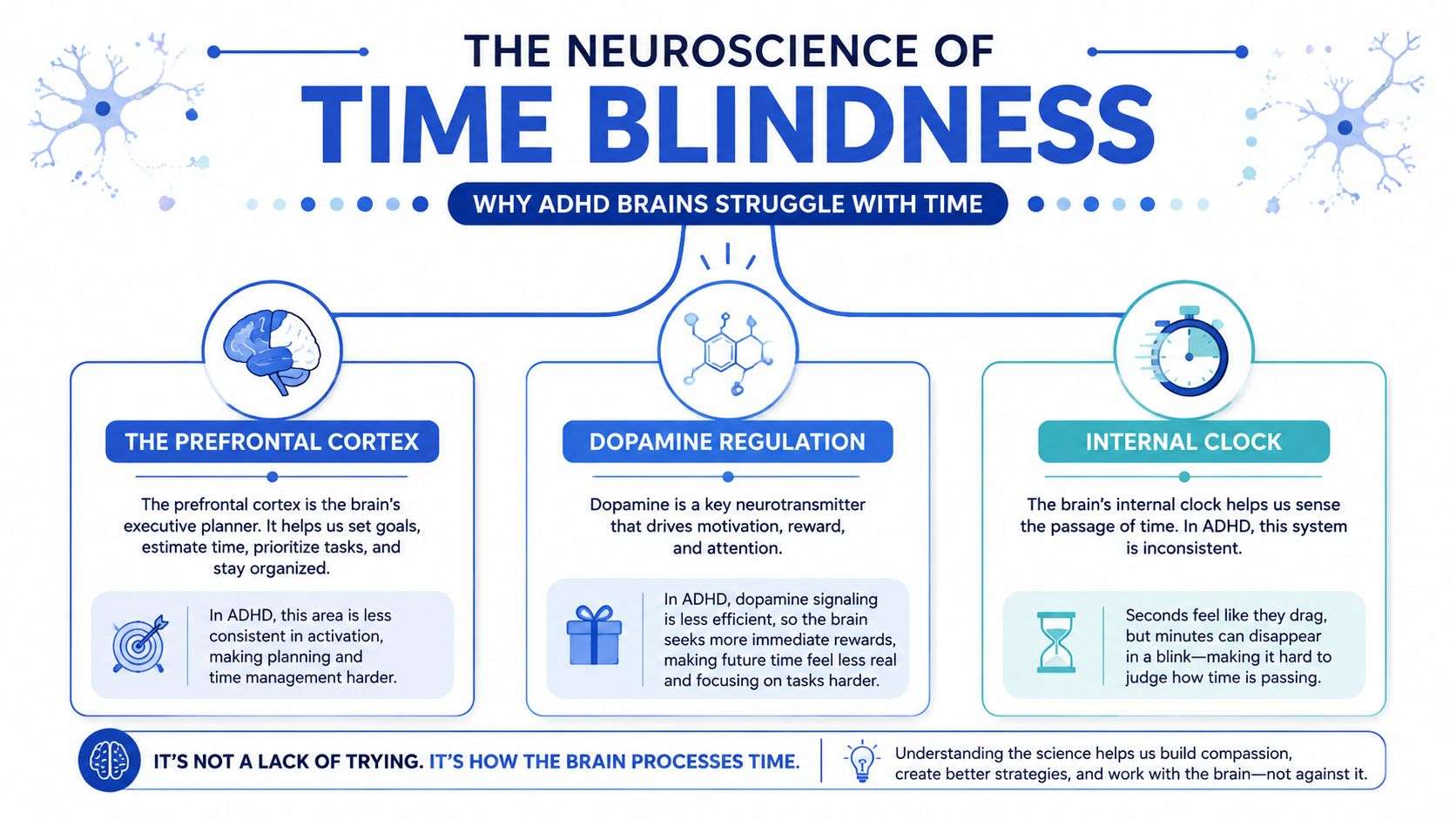
The prefrontal cortex
The prefrontal cortex helps with planning, sequencing, decision-making, and holding the future in mind. You can think of it as the brain's organiser.
If that organiser is underpowered, several things become harder at once:
- seeing how long a task will really take
- holding multiple steps in order
- noticing time passing while focused on something else
- acting early for a future deadline that doesn't feel urgent yet
A neuroimaging study published in PMC found that adults with ADHD in Vancouver showed reduced prefrontal cortex activity during time estimation tasks, which was associated with 30% to 40% poorer accuracy. After methylphenidate, prefrontal activity normalised and time perception improved to near-control levels.
Dopamine and urgency
Dopamine's description is often oversimplified. In this context, it helps the brain register what matters enough to act on now.
If dopamine signalling is inconsistent, boring or delayed-reward tasks may not create enough “go” signal. The person may care very much, but the brain doesn't generate momentum until the task becomes immediate, emotionally intense, or interesting.
That's why many people with ADHD can do hard things under pressure, yet struggle with easier things that have no urgency. It isn't because the easy thing should be easier. It's because the brain's activation system responds differently.
The internal clock
The cerebellum and related timing networks help the brain track duration and sequence. If that internal clock is off, a few minutes can feel like half an hour, or half an hour can disappear in what feels like ten minutes.
This can create real-life errors like:
- leaving too late because getting ready felt shorter than it was
- interrupting routines because the next step didn't feel due yet
- assuming there's time for one more task before an appointment
A weak inner clock can make sincere intentions unreliable unless time is made visible outside the brain.
That's why external supports help so much. A visible timer, repeated alarm, countdown clock, or shared calendar isn't a crutch. It's a bridge between intention and action.
Practical Strategies for Managing Your Time
You look up at the clock and feel a jolt. You were sure you had ten more minutes. Your partner is waiting in the car, your child is asking where their shoes are, and now everyone is stressed. Moments like this can make a person with ADHD feel careless, and make the people around them feel unimportant. A better system can change that.
Helpful strategies make time visible, audible, and easier to act on. The goal is not to force your brain to work like someone else's. The goal is to build supports around the places where time tends to disappear.

Make time visible outside your head
For many people with ADHD, time works like a radio playing in another room. You know it is there, but it is hard to track clearly unless something turns up the volume.
Useful supports include:
- Visual timers: A countdown clock shows time shrinking in real time.
- Analog clocks: Clock hands can make passing time easier to grasp than changing numbers.
- Layered alarms: Set one alarm to begin getting ready, one to switch tasks, and one for the actual leave-now moment.
- Calendar alerts: Reminders before an event help with transition time, not just the start time.
One reminder is often too easy to miss. A series of cues works better because it supports the whole process, not only the deadline.
Shrink the starting point
A task like “finish the report” asks the brain to hold too much at once. “Open the document” gives the brain somewhere concrete to begin.
Try a sequence like this:
- Open laptop.
- Find the file.
- Write the title.
- Set a timer for a short work block.
- Check what the next smallest step is.
Small steps do two jobs at once. They reduce dread, and they make time easier to estimate because short actions are easier to measure than vague projects.
If a task keeps getting postponed, the problem is often that the first step is still too big.
Use shared structure, especially at home
Many ADHD tools are described as individual habits, but family routines often work better than solo effort. A parent, partner, or roommate can help create a rhythm that reduces last-minute conflict.
Body doubling is one example. One person works while another person is nearby, either in the room or on video. The second person does not need to supervise. Their presence helps anchor attention and gives the task a clearer beginning and end.
This can look like:
- a teen starting homework at the kitchen table while a parent does email nearby
- one partner folding laundry while the other tidies the entryway
- two students joining a quiet video call and checking in every 20 minutes
Short work blocks also help. Some people focus best with a 10 or 15 minute timer. Others do better with a simple rule such as one song, one task.
Practice estimating time with curiosity
Time awareness can improve when people repeatedly compare their guess with reality. A study in PMC on cognitive training and timing suggests that practicing timing skills may help children with ADHD improve their accuracy.
You can practice this in ordinary life:
- guess how long it will take to shower and get dressed, then time it
- estimate a school assignment before starting it, then write down the actual time
- keep a note on your phone called “real times” for chores, commutes, and routines
For students and families, simple printable scheduling tools can reduce daily friction. These lesson planning resources for student organization can be adapted for homework blocks, after-school routines, or a shared weekly plan on the fridge.
Replace shame with scripts and systems
A time plan works better when the people around you know how to talk about it. Blame usually triggers defensiveness or hopelessness. Clear, respectful language makes problem-solving more likely.
A partner might say:
- “We need a leaving system that helps both of us. What reminders would support you best?”
- “I know you care about being on time. Let's set the departure alarm for 6:20, not just the event time.”
A parent might say:
- “Your brain has a hard time feeling time pass. Let's check the timer together.”
- “You are not in trouble. We do need a better routine for mornings.”
If you are the person with ADHD, you can try:
- “I want to be reliable, and I do better with two reminders instead of one.”
- “Please tell me the actual leave time, not only the appointment time.”
The goal is fewer rushed apologies and fewer resentful assumptions. Over time, these systems can protect trust as much as they protect the schedule.
How to Support Someone with Time Blindness
If you love someone with ADHD, time blindness can wear on the relationship. Repeated lateness, missed handoffs, forgotten transitions, and rushed apologies can start to feel personal.
That's especially true in couples and families. One person may feel abandoned or disrespected. The other may feel constantly criticised for something they're trying hard to manage.

A 2024 University of British Columbia Family Study discussed here reported that 40% of Canadian couples with one ADHD partner reported divorce ideation linked to time blindness-related conflicts, yet 12% accessed joint counselling. That gap matters. These struggles are common, and many families need more support than they realise.
Shift from blame to teamwork
The most helpful reframe is this: the problem is not the person. The problem is the system failing the person.
That doesn't remove accountability. It changes the type of accountability you build together.
Instead of saying:
- “You never care enough to be on time.”
Try:
- “We keep getting hurt by this pattern. Let's build a system that helps both of us.”
Instead of:
- “Why can't you just remember?”
Try:
- “What reminder would reach you at the right moment?”
Communication scripts that reduce defensiveness
These scripts help because they describe impact without assigning motive.
For partners
- “When we're late, I feel stressed and unimportant. I know you're not doing that on purpose. Can we set a leaving-time alarm together?”
- “I need reliability around school pickup. What backup system can we create so I'm not carrying that worry alone?”
For parents
- “I'm not upset that this feels hard. I want to help you make time easier to see.”
- “Let's check how long this takes, instead of guessing and fighting about it.”
For the person with ADHD
- “I know my lateness affects you. I'm not asking for a pass. I'm asking to solve it with tools, not shame.”
- “If you remind me, please be specific. ‘Start shoes now' helps me more than ‘Hurry up.’”
The sentence that often changes the room is, “I believe you're trying. We still need a better system.”
Build family systems that do the remembering
Support works best when it is concrete.
Consider tools like:
- Shared digital calendars: Add school events, pickups, medical appointments, and travel time.
- Visible launch stations: Put keys, bags, forms, and chargers in one place near the door.
- Transition cues: Use the same music playlist, kitchen timer, or voice assistant routine before leaving.
- Reverse planning: Start with the must-leave time, then count backward to getting dressed, packing, and breakfast.
Some adults also benefit from workplace boundary planning, especially when overcommitment and time drift increase stress. This guide on reclaiming time for high-performing professionals can offer useful ideas for setting clearer limits around work demands.
What support does not look like
It doesn't help to moralise, lecture, or use sarcasm. Comments like “If you cared, you'd do it” usually increase shame, not follow-through.
Shame can produce urgency for a moment. It rarely builds durable systems. Calm structure works better.
Professional Support and Therapeutic Options
Sometimes tools at home aren't enough, especially if time blindness is affecting work, parenting, school, or the relationship itself.
Professional support can help in a few different ways.
Individual therapy
A therapist can help you untangle the emotional fallout of years of feeling unreliable. That may include shame, anxiety, perfectionism, or hopelessness.
Approaches like CBT can be useful when a person has developed harsh beliefs such as “I'm lazy,” “I always ruin things,” or “There's no point trying because I'll fail again.” Those thoughts don't improve time management. They usually make starting even harder.
ADHD-focused practical support
ADHD coaching or skills-based counselling can help with:
- building realistic routines
- testing reminder systems
- improving task initiation
- creating buffers for transitions
- reviewing what repeatedly breaks down and why
This kind of support is practical. You're not just talking about the problem. You're designing ways around it.
Couples and family counselling
When time blindness has become a recurring source of conflict, relational support can make a big difference. A counsellor can help families move from accusation to collaboration.
That may include:
- repair after repeated lateness or missed responsibilities
- co-parenting systems
- division of labour conversations
- clearer expectations and backup plans
- language that communicates impact without blame
If you seek help, look for someone who understands neurodiversity and executive functioning. The right fit should feel respectful, structured, and non-judgmental.
Frequently Asked Questions About Time Blindness
| Question | Answer |
|---|---|
| Can you have time blindness without ADHD? | Yes. Time perception difficulties can show up for other reasons too. But if time blindness comes with patterns like distractibility, poor task initiation, impulsivity, or chronic overwhelm, an ADHD assessment may be worth discussing with a qualified professional. |
| Can medication help with time blindness? | For some people, yes. The brain imaging evidence described earlier suggests medication can improve the brain activity involved in time estimation. Medication decisions should always be made with a physician who knows your health history. |
| How do I explain this without sounding like I'm making excuses? | Try saying, “I'm not avoiding responsibility. I'm explaining the pattern accurately so I can manage it better.” Pair the explanation with a plan, such as using multiple alarms or a shared calendar. People usually respond better when they hear both understanding and accountability. |
| Why do I care so much and still get it wrong? | Because caring and time perception are different functions. You can be highly motivated and still struggle to estimate duration, shift attention, or feel future urgency. That mismatch is one reason ADHD can feel so discouraging. |
| Should parents push harder or help more? | Usually both structure and compassion are needed. Children and teens benefit from clear routines, visual time supports, and repeated practice. Pressure without tools often increases conflict. Support without expectations can leave them stuck. The balance is collaborative structure. |
If the phrase adhd and time blindness: why it is not laziness speaks directly to your life, the most healing next step is often simple: replace self-criticism with accurate language, then build supports around what's hard.
You don't need to prove that you're trying hard enough. You need systems, understanding, and sometimes help.
If this article felt familiar, Interactive Counselling offers support for individuals, couples, parents, and families who are working through ADHD-related stress, relationship strain, life transitions, and the emotional weight of feeling chronically behind. Reaching out for support can be a steady, compassionate next step.
Looking for ADHD Support?
If time blindness is making daily life harder than it needs to be, working with a counsellor who understands ADHD can help you build practical structure and reduce the shame that often comes with it. Interactive Counselling offers ADHD-informed therapy at our Kelowna, Vernon, Penticton, and Grande Prairie locations, as well as online across BC and Alberta. Reach out to book a session with one of our counsellors and take a steady next step.
Clinically Reviewed By
Amy Mosset, MCP, RCC-S
Amy Mosset is a Master Practitioner in Clinical Counselling, Clinical Supervisor, and the owner of Interactive Counselling. She provides trauma-informed, evidence-based care and clinical supervision to registered therapists, with a focus on ethical practice, client safety, and high-quality therapeutic outcomes.